
从线程池说起
本文知识结构图:
线程池常用配置 & 源码理解
摘要:线程池常用配置以及相关使用方式。并基于源码理解其工作原理。在源码的基础上,延伸出来的相关知识点。
动态设定线程池关键参数
参考文章:
- https://www.cnblogs.com/thisiswhy/p/12690630.html
- https://tech.meituan.com/2020/04/02/java-pooling-pratice-in-meituan.html
关键信息:
- 线程池可以动态调整其核心数参数。
setCorePoolSize方法 - spring
ThreadPoolTaskExecutor类包装了 juc 的ThreadPoolExecutor类,提供了更安全的调整线程池参数的方式
setCorePoolSize 源码及文档
/**
* Sets the core number of threads.  This overrides any value set
* in the constructor.  If the new value is smaller than the
* current value, excess existing threads will be terminated when
* they next become idle.  If larger, new threads will, if needed,
* be started to execute any queued tasks.
*
* @param corePoolSize the new core size
* @throws IllegalArgumentException if {@code corePoolSize < 0}
* @see #getCorePoolSize
*/
public void setCorePoolSize(int corePoolSize) {
    if (corePoolSize < 0)
        throw new IllegalArgumentException();
    int delta = corePoolSize - this.corePoolSize;
    this.corePoolSize = corePoolSize;
    // 如果设置的 poolSize 小于当前工作的线程数,则将当前等待的任务取消(调用线程的 interrupt 方法)
    // 否则给当前队列中等待的任务创建新的线程(Worker),知道等待队列中没有任务在等待
    if (workerCountOf(ctl.get()) > corePoolSize)
        interruptIdleWorkers();
    else if (delta > 0) {
        // We don't really know how many new threads are "needed".
        // As a heuristic, prestart enough new workers (up to new
        // core size) to handle the current number of tasks in
        // queue, but stop if queue becomes empty while doing so.
        int k = Math.min(delta, workQueue.size());
        while (k-- > 0 && addWorker(null, true)) {
            if (workQueue.isEmpty())
                break;
        }
    }
}
线程池的几个参数
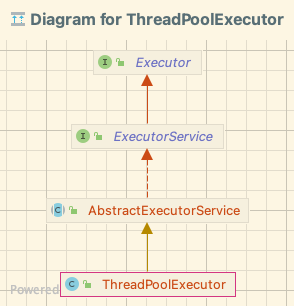
使用 ThreadPoolExecutor 创建线程池。ThreadPoolExecutor 类是创建线程池的基本类,其他类似 Executors 的各种创建方法,实际都是都过 new ThreadPoolExecutor 对象来创建线程池的。
继承关系:
参数说明:
ThreadPoolExecutor threadPoolExecutor = new ThreadPoolExecutor(
        10,                             // *corePoolSize: 保证存活的最少的线程数,最小是 0
        20,                             // *maximumPoolSize: 线程池最大的线程数(最大值实际上取决于 CAPCITY: 2^29 - 1。具体解释如下 )
        0L,                             // keepAliveTime: 空闲线程的保留时间(毫秒)。当当前线程数量大于 corePoolSize 时,多出来的空余线程保留多久再 kill。在开启 allowCoreThreadTimeOut 时生效。否则一直保留空闲的线程
        TimeUnit.SECONDS,               // unit: 表示 keepAliveTime 的时间单位
        new ArrayBlockingQueue<>(10)    // workQuque: 存放等待的任务的队列
);
其中和线程池性能相关的参数有:
- corePoolSize
- maximumPoolSize
- workQuque(长度)
常用案例
定义一个简单的 Runnable 任务
Runnable PrintTask = () -> System.out.println(Thread.currentThread().getName());
向线程池提交一个任务(Runnable,Thread)
threadPoolExecutor.execute(PrintTask);
向线程池提交一个有结果的任务(Callable)
Future<String> submit = threadPoolExecutor.submit(() -> {
    System.out.println("after");
    try {
        TimeUnit.SECONDS.sleep(3);
    } catch (InterruptedException e) {
        e.printStackTrace();
    }
    return "Haha";
});
System.out.println("before");
Object ret = submit.get();
System.out.println(ret);
关闭线程池
// 不再接收新的任务提交,等现有任务(在运行的以及在队列中的)运行结束,关闭线程池
threadPoolExecutor.shutdown();
源码理解
线程池状态
线程池状态如下:
| 状态 | 描述 |
|---|---|
| RUNNGING | 能接受新提交的任务,并且也能处理阻塞队列中的任务 |
| SHUTDONW | 关闭状态,不再接受新提交的任务,继续处理阻塞队列中的任务 |
| STOP | 不接受新的任务,也不处理队列中的任务,并中断正在处理任务的进程 |
| TIDYING | 所有任务都终止了,workerCount 为 0 |
| TERMINATED | 在 terminated 方法执行完后进入该状态 |
线程池的状态维护,是内部通过两个值来维护的:workerCount, runState。具体实现,是将这两个值维护在一个变量里
private final AtomicInteger ctl = new AtomicInteger(ctlOf(RUNNING, 0));
ctl 使用 32 位整型的高三位保存 runState, 低 29 位保存 workerCount(最大就是 2^29 - 1 个)
private static final int COUNT_BITS = Integer.SIZE - 3;   // 32 - 3 = 29
private static final int CAPACITY   = (1 << COUNT_BITS) - 1;

// 运行状态保存在高位(一个符号位,两个数值位)
// runState is stored in the high-order bits
private static final int RUNNING    = -1 << COUNT_BITS;
private static final int SHUTDOWN   =  0 << COUNT_BITS;
private static final int STOP       =  1 << COUNT_BITS;
private static final int TIDYING    =  2 << COUNT_BITS;
private static final int TERMINATED =  3 << COUNT_BITS;
execute 解析
addWorker
shutdown 步骤
/**
* Initiates an orderly shutdown in which previously submitted
* tasks are executed, but no new tasks will be accepted.
* Invocation has no additional effect if already shut down.
*
* <p>This method does not wait for previously submitted tasks to
* complete execution.  Use {@link #awaitTermination awaitTermination}
* to do that.
*
* @throws SecurityException {@inheritDoc}
*/
public void shutdown() {
    // 1. 获取全局可重入锁
    final ReentrantLock mainLock = this.mainLock;
    mainLock.lock();
    try {
        // 2. 权限检测,使用 SecurityManager 检测每个 worker 是否有 shutdown 权限。
        checkShutdownAccess();
        // 3. 调整线程池状态为 shutdown
        advanceRunState(SHUTDOWN);
        // 4. 将空闲的 worker 终止
        interruptIdleWorkers();
        // 5. 如果是调度的线程池,则可注册 shutdown 事件
        onShutdown(); // hook for ScheduledThreadPoolExecutor
    } finally {
        mainLock.unlock();
    }
    tryTerminate();
}
1. 权限检测
/**
* If there is a security manager, makes sure caller has
* permission to shut down threads in general (see shutdownPerm).
* If this passes, additionally makes sure the caller is allowed
* to interrupt each worker thread. This might not be true even if
* first check passed, if the SecurityManager treats some threads
* specially.
*/
private void checkShutdownAccess() {
    SecurityManager security = System.getSecurityManager();
    if (security != null) {
        security.checkPermission(shutdownPerm);
        final ReentrantLock mainLock = this.mainLock;
        mainLock.lock();
        try {
            // 依次检查当前调用者是否拥有每个 worker 所属线程的 shutdown 权限
            for (Worker w : workers)
                security.checkAccess(w.thread);
        } finally {
            mainLock.unlock();
        }
    }
}
checkAccess 方法中的知识点。
通过查看 checkAccess 方法源码,可以知道,只有当传入的线程属于 rootGroup 时才进行 check。
public void checkAccess(Thread t) {
    if (t == null) {
        throw new NullPointerException("thread can't be null");
    }
    if (t.getThreadGroup() == rootGroup) {
        checkPermission(SecurityConstants.MODIFY_THREAD_PERMISSION);
    } else {
        // just return
    }
}
那么什么是 rootGroup 呢?
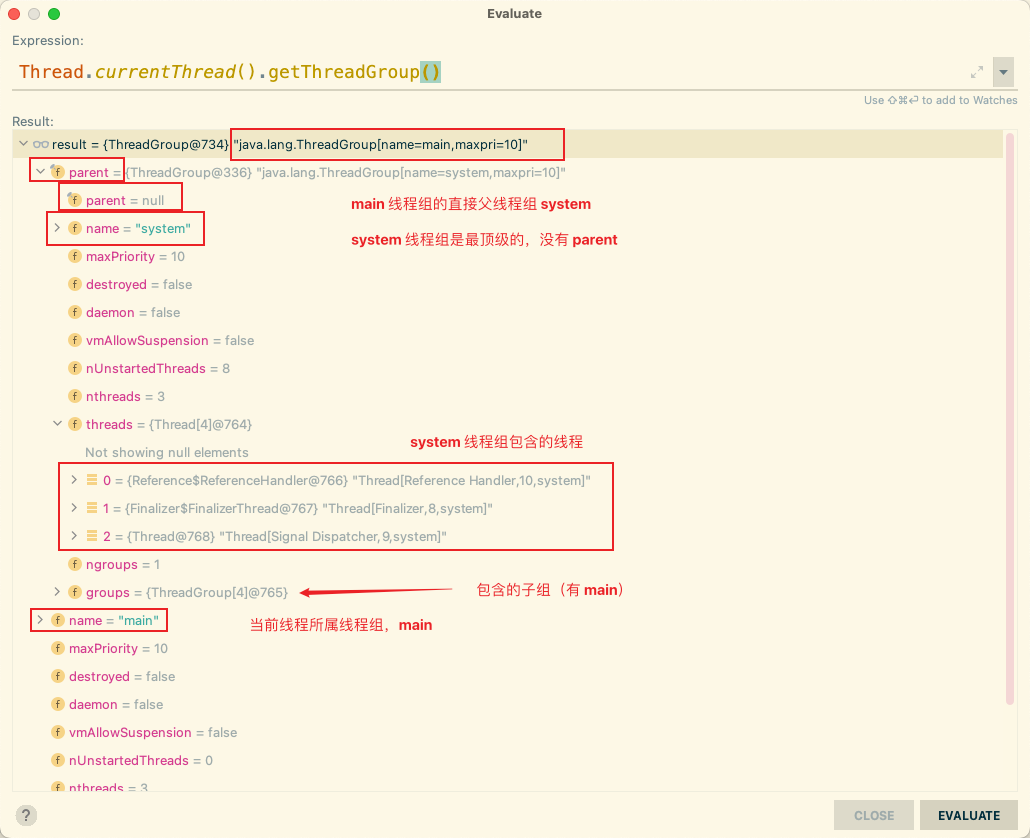
在该方法的注释中有这么一句: if the tread argument is a system thread then this method calls checkPermission. If the thread argument is not a system thread, this method just returns sliently。这句注释配合源码可以知道,rootGroup 就是系统线程。通过再次查看 rootGroup 的创建方式可以知道,所有线程组最终的 parent 是 system 这个线程组。
如果从 main 方法打断点,获取当前线程的 threadGroup,可以看到这样的一个线程组层级关系:
private static ThreadGroup rootGroup = getRootGroup();

private static ThreadGroup getRootGroup() {
    ThreadGroup root =  Thread.currentThread().getThreadGroup();
    while (root.getParent() != null) {
        root = root.getParent();
    }
    return root;
}
2. 升级线程池的状态
使用 CAS 无锁方式升级。
/**
* Transitions runState to given target, or leaves it alone if
* already at least the given target.
*
* @param targetState the desired state, either SHUTDOWN or STOP
*        (but not TIDYING or TERMINATED -- use tryTerminate for that)
*/
private void advanceRunState(int targetState) {
    for (;;) {
        int c = ctl.get();
        if (runStateAtLeast(c, targetState) ||
            ctl.compareAndSet(c, ctlOf(targetState, workerCountOf(c))))
            break;
    }
}
那么什么是 CAS?
这里用到的是 AtomicInteger 的 compareAndSet 方法,该方法底层则是使用 Unsafe 类提供的 CAS 方法。
/**
* Atomically sets the value to the given updated value
* if the current value {@code ==} the expected value.
*
* @param expect the expected value
* @param update the new value
* @return {@code true} if successful. False return indicates that
* the actual value was not equal to the expected value.
*/
public final boolean compareAndSet(int expect, int update) {
    return unsafe.compareAndSwapInt(this, valueOffset, expect, update);
}
CAS 是 Compare And Swap 的简称,用来原子性得修改变量值。原理是:修改值之前,判断变量当前值是否和期望的值一致,一致则说明该值没有被其他线程修改过,则进行修改;否则说明该值被其他线程修改过,本次修改失败。
因为 Unsafe 类的方法是 native 方法,实际使用的是 cpu 的原子指令 cmpxchg。
CAS 参考文章:美团:Java 魔法类——Unsafe 应用解析
CAS 的典型应用场景:
- Java 的 atomic 相关类。
AtomicInterge…… - Java juc 包下的 AQS
- CurrentHashMap
3. 中断空闲的 worker
实际执行的方法为:
/**
* Interrupts threads that might be waiting for tasks (as indicated by not being locked) so they can check for termination or configuration changes.
* Ignores SecurityExceptions (in which case some threads may remain uninterrupted).
*/
private void interruptIdleWorkers(boolean onlyOne) {
  final ReentrantLock mainLock = this.mainLock;
  mainLock.lock();
  try {
    for (Worker w : workers) {
      Thread t = w.thread;
      // 如果线程不是已终止状态,并且能够获取到 worker 的锁(表示该 worker 空闲,未被加锁)
      if (!t.isInterrupted() && w.tryLock()) {
        try {
          t.interrupt();
        } catch (SecurityException ignore) {
        } finally {
          w.unlock();
        }
      }
      if (onlyOne)
        break;
    }
  } finally {
    mainLock.unlock();
  }
}
实际上,最终调用的还是线程的 interrupt 方法。
这里用尝试获取 worker 的锁来表示 worker 是否空闲。
那么,worker 的工作原理是什么呢
这里的 Worker 指的是 ThreadPoolExecutor 类中的 Worker 类。
- 功能:主要用来维护任务线程的中断控制状态。以及其他的记录工作
- 实现:继承了 AQS(
AbstractQueuedSynchronizer) 来简化任务运行前后锁的获取与释放工作。
Worker 也实现了 Runnable 接口,也是一个可以运行的线程,其 run 方法中调用 ThreadPoolExecutor.runWorker 方法,该方法内部在获取到一个 task 之前,都会获取 Worker 的不可重入锁,表示当前 Worker 正在运行。(获取线程池状态时也会以此作为依据)
翻看 runWorker 的代码,可以发现以下几点值得注意的地方:
- Worker 被创建,如果一直可以获得任务,就会一直运行下去。使用 while 循环判断是否能获得任务,如果
getTask返回 null, 则结束循环,销毁 worker。 - Worker 运行 task 的方式就是直接调用 task 的 run 方法。有点超出一般的认知。一般在用户代码中,不会直接调用 run 方法。普遍得认为,手动调用 run 方法会使这个线程失去被调度执行的机会,而 run 方法也将变成一个在当前线程执行的普通方法。但是在此处,Worker 本身就是被调度的,task 这个线程在此处的作用就是提供一个统一的 run 方法。
再来说说 getTask 方法。
getTask
- 功能:阻塞或者等待一段时间得获取 task
- 返回值情况:
- 正常情况下返回需要执行的 task
- 否则返回 null, 表示这个 worker 需要被结束。
- 当前 Worker 数超出
maximumPoolSize - 线程池已经关闭(stopped)
- 线程池 shutdown 并且等待队列为空
- 当前 Worker 空闲的时间足够长(情况较复杂)
- 当前 Worker 数超出
private Runnable getTask() {
  boolean timedOut = false; // Did the last poll() time out?

  for (;;) {
    int c = ctl.get();
    int rs = runStateOf(c);

    // Check if queue empty only if necessary.
    if (rs >= SHUTDOWN && (rs >= STOP || workQueue.isEmpty())) {
      decrementWorkerCount();
      return null;
    }

    int wc = workerCountOf(c);

    // 是否通过时间来判断 Worker 是否该被销毁
    boolean timed = allowCoreThreadTimeOut || wc > corePoolSize;

    if ((wc > maximumPoolSize || (timed && timedOut))
        && (wc > 1 || workQueue.isEmpty())) {
      if (compareAndDecrementWorkerCount(c))
        return null;
      continue;
    }

    try {
      Runnable r = timed ?
        workQueue.poll(keepAliveTime, TimeUnit.NANOSECONDS) :
        workQueue.take();
      if (r != null)
        return r;
      timedOut = true;
    } catch (InterruptedException retry) {
      timedOut = false;
    }
  }
}

 浙公网安备 33010602011771号