
Spark内核源码解析十:task原理解析和源码解析
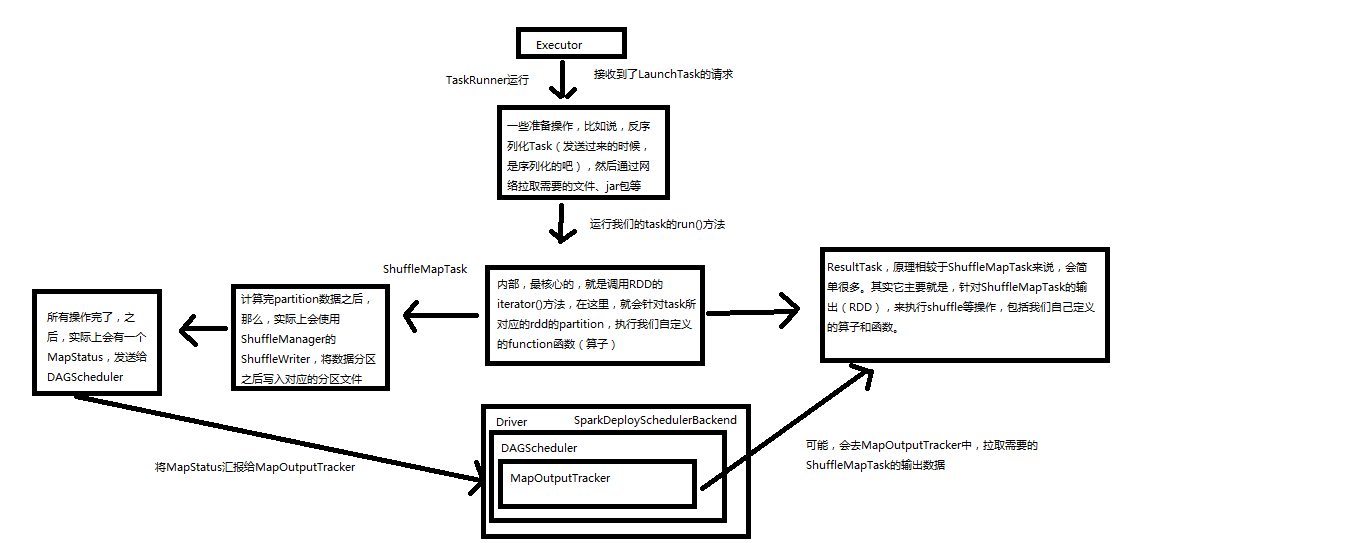
入口函数如下,Executor
 // 对于每一个task都会创建一个taskRunner,继承了java的Runnable接口可以作为一个线程任务进行调用,后面会放入线程池中进行执行
  def launchTask(
      context: ExecutorBackend,
      taskId: Long,
      attemptNumber: Int,
      taskName: String,
      serializedTask: ByteBuffer) {
    val tr = new TaskRunner(context, taskId = taskId, attemptNumber = attemptNumber, taskName,
      serializedTask)
    // 放入内存缓存
    runningTasks.put(taskId, tr)
    threadPool.execute(tr)
  }
override def run() {
      val deserializeStartTime = System.currentTimeMillis()
      // 设置了当前类的加载器,
      Thread.currentThread.setContextClassLoader(replClassLoader)
      val ser = env.closureSerializer.newInstance()
      logInfo(s"Running $taskName (TID $taskId)")
      execBackend.statusUpdate(taskId, TaskState.RUNNING, EMPTY_BYTE_BUFFER)
      var taskStart: Long = 0
      startGCTime = gcTime

      try {

        // 对task采用反序列化,
        val (taskFiles, taskJars, taskBytes) = Task.deserializeWithDependencies(serializedTask)
        // 将需要的jar包和依赖拷贝过来
        updateDependencies(taskFiles, taskJars)
        // 将数据反序列化成为task,因为java的类加载可以利用反射动态加载一个类,然后创建这个类的对象,
        // 可以指定相关资源进行加载
        task = ser.deserialize[Task[Any]](taskBytes, Thread.currentThread.getContextClassLoader)

        // If this task has been killed before we deserialized it, let's quit now. Otherwise,
        // continue executing the task.
        if (killed) {
          // Throw an exception rather than returning, because returning within a try{} block
          // causes a NonLocalReturnControl exception to be thrown. The NonLocalReturnControl
          // exception will be caught by the catch block, leading to an incorrect ExceptionFailure
          // for the task.
          throw new TaskKilledException
        }

        attemptedTask = Some(task)
        logDebug("Task " + taskId + "'s epoch is " + task.epoch)
        env.mapOutputTracker.updateEpoch(task.epoch)

        // Run the actual task and measure its runtime.
        taskStart = System.currentTimeMillis()
        // 计算task执行时间,执行task。就是mapstatus,封装了ShuffleMapTask计算数据,输出位置,
        // 如果后面有一个shuffleMapTask,就会去联系MapOutPutTracker,来获取上一个ShuffleMapTask位置,通过网络获取数据
        // ResultTask也是一样处理
        val value = task.run(taskAttemptId = taskId, attemptNumber = attemptNumber)
        val taskFinish = System.currentTimeMillis()

        // If the task has been killed, let's fail it.
        if (task.killed) {
          throw new TaskKilledException
        }

        val resultSer = env.serializer.newInstance()
        val beforeSerialization = System.currentTimeMillis()
        val valueBytes = resultSer.serialize(value)
        val afterSerialization = System.currentTimeMillis()

        // 计算跟task的一些相关统计信息,序列化,gc时间,反序列化时间
        for (m <- task.metrics) {
          m.setExecutorDeserializeTime(taskStart - deserializeStartTime)
          m.setExecutorRunTime(taskFinish - taskStart)
          m.setJvmGCTime(gcTime - startGCTime)
          m.setResultSerializationTime(afterSerialization - beforeSerialization)
        }

        val accumUpdates = Accumulators.values

        val directResult = new DirectTaskResult(valueBytes, accumUpdates, task.metrics.orNull)
        val serializedDirectResult = ser.serialize(directResult)
        val resultSize = serializedDirectResult.limit

        // directSend = sending directly back to the driver
        val serializedResult = {
          if (maxResultSize > 0 && resultSize > maxResultSize) {
            logWarning(s"Finished $taskName (TID $taskId). Result is larger than maxResultSize " +
              s"(${Utils.bytesToString(resultSize)} > ${Utils.bytesToString(maxResultSize)}), " +
              s"dropping it.")
            ser.serialize(new IndirectTaskResult[Any](TaskResultBlockId(taskId), resultSize))
          } else if (resultSize >= akkaFrameSize - AkkaUtils.reservedSizeBytes) {
            val blockId = TaskResultBlockId(taskId)
            env.blockManager.putBytes(
              blockId, serializedDirectResult, StorageLevel.MEMORY_AND_DISK_SER)
            logInfo(
              s"Finished $taskName (TID $taskId). $resultSize bytes result sent via BlockManager)")
            ser.serialize(new IndirectTaskResult[Any](blockId, resultSize))
          } else {
            logInfo(s"Finished $taskName (TID $taskId). $resultSize bytes result sent to driver")
            serializedDirectResult
          }
        }

        // 调用CoarseGrainedExecutor的statusUpdate方法,发送任务的执行结束的消息,向driver发送
        execBackend.statusUpdate(taskId, TaskState.FINISHED, serializedResult)

      } catch {
        case ffe: FetchFailedException => {
          val reason = ffe.toTaskEndReason
          execBackend.statusUpdate(taskId, TaskState.FAILED, ser.serialize(reason))
        }

        case _: TaskKilledException | _: InterruptedException if task.killed => {
          logInfo(s"Executor killed $taskName (TID $taskId)")
          execBackend.statusUpdate(taskId, TaskState.KILLED, ser.serialize(TaskKilled))
        }

        case cDE: CommitDeniedException => {
          val reason = cDE.toTaskEndReason
          execBackend.statusUpdate(taskId, TaskState.FAILED, ser.serialize(reason))
        }

        case t: Throwable => {
          // Attempt to exit cleanly by informing the driver of our failure.
          // If anything goes wrong (or this was a fatal exception), we will delegate to
          // the default uncaught exception handler, which will terminate the Executor.
          logError(s"Exception in $taskName (TID $taskId)", t)

          val serviceTime = System.currentTimeMillis() - taskStart
          val metrics = attemptedTask.flatMap(t => t.metrics)
          for (m <- metrics) {
            m.setExecutorRunTime(serviceTime)
            m.setJvmGCTime(gcTime - startGCTime)
          }
          val reason = new ExceptionFailure(t, metrics)
          execBackend.statusUpdate(taskId, TaskState.FAILED, ser.serialize(reason))

          // Don't forcibly exit unless the exception was inherently fatal, to avoid
          // stopping other tasks unnecessarily.
          if (Utils.isFatalError(t)) {
            SparkUncaughtExceptionHandler.uncaughtException(t)
          }
        }
      } finally {
        // Release memory used by this thread for shuffles
        env.shuffleMemoryManager.releaseMemoryForThisThread()
        // Release memory used by this thread for unrolling blocks
        env.blockManager.memoryStore.releaseUnrollMemoryForThisThread()
        // Release memory used by this thread for accumulators
        Accumulators.clear()
        runningTasks.remove(taskId)
      }
    }
  }
final def run(taskAttemptId: Long, attemptNumber: Int): T = {
    // 创建task执行上线问,记录全局性的东西,例如重试了几次,处于那个stage,要处理那个partition的rdd
    context = new TaskContextImpl(stageId = stageId, partitionId = partitionId,
      taskAttemptId = taskAttemptId, attemptNumber = attemptNumber, runningLocally = false)
    TaskContextHelper.setTaskContext(context)
    context.taskMetrics.setHostname(Utils.localHostName())
    taskThread = Thread.currentThread()
    if (_killed) {
      kill(interruptThread = false)
    }
    try {
      // 只封装了子类的通用操作,task子类有ShuffleMapTask,ResultTask
      runTask(context)
    } finally {
      context.markTaskCompleted()
      TaskContextHelper.unset()
    }
  }
shuffleMapTask
// 有mapstatus返回值,
  override def runTask(context: TaskContext): MapStatus = {
    // Deserialize the RDD using the broadcast variable.
    // 对要处理的rdd相关数据,做一些反序列化的,这个rdd是怎么拿到的,多个task运行在executor里面,并行运行或者并发运行
    // 可能不在一个地方,但是一个stage的task,要处理的rdd都是一样的,通过broadcast variable拿到
    val ser = SparkEnv.get.closureSerializer.newInstance()
    val (rdd, dep) = ser.deserialize[(RDD[_], ShuffleDependency[_, _, _])](
      ByteBuffer.wrap(taskBinary.value), Thread.currentThread.getContextClassLoader)

    metrics = Some(context.taskMetrics)
    var writer: ShuffleWriter[Any, Any] = null
    try {
      // 获取shuffleManager
      val manager = SparkEnv.get.shuffleManager
      writer = manager.getWriter[Any, Any](dep.shuffleHandle, partitionId, context)
      // 调用rdd的iterator方法,并且传入当前task要处理哪个partition,核心逻辑就在rdd的iterator
      // 方法中在这里实现了针对某个partition执行算子和函数,针对rdd的partition进行处理,有返回数据通过shuffleWriter经过
      // HashPartition写入自己的分区,mapstatus封装了shufflemaptask计算后的数据,存储在那里,就是blockmanager信息
      // blockmanager就是spark底层内存、数据、磁盘管理组件
      writer.write(rdd.iterator(partition, context).asInstanceOf[Iterator[_ <: Product2[Any, Any]]])
      return writer.stop(success = true).get
    } catch {
      case e: Exception =>
        try {
          if (writer != null) {
            writer.stop(success = false)
          }
        } catch {
          case e: Exception =>
            log.debug("Could not stop writer", e)
        }
        throw e
    }
  }
CoarseGrainedSchedulerBackend,调用taskscheduler更新任务的状态
case StatusUpdate(executorId, taskId, state, data) =>
        scheduler.statusUpdate(taskId, state, data.value)
        if (TaskState.isFinished(state)) {
          executorDataMap.get(executorId) match {
            case Some(executorInfo) =>
              executorInfo.freeCores += scheduler.CPUS_PER_TASK
              makeOffers(executorId)
            case None =>
              // Ignoring the update since we don't know about the executor.
              logWarning(s"Ignored task status update ($taskId state $state) " +
                "from unknown executor $sender with ID $executorId")
          }
        }

 浙公网安备 33010602011771号