tensorflow多层感知器实例笔记
import tensorflow as tf
import pandas as pd
import numpy as py
import matplotlib.pyplot as plt
%matplotlib inline
data = pd.read_csv("C:\\Users\\94823\\Desktop\\tensorflow学习需要的数据集\\advertise.csv")
data
| TV | radio | newspaper | sales | |
|---|---|---|---|---|
| 1 | 230.1 | 37.8 | 69.2 | 22.1 |
| 2 | 44.5 | 39.3 | 45.1 | 10.4 |
| 3 | 17.2 | 45.9 | 69.3 | 9.3 |
| 4 | 151.5 | 41.3 | 58.5 | 18.5 |
| 5 | 180.8 | 10.8 | 58.4 | 12.9 |
| ... | ... | ... | ... | ... |
| 196 | 38.2 | 3.7 | 13.8 | 7.6 |
| 197 | 94.2 | 4.9 | 8.1 | 9.7 |
| 198 | 177.0 | 9.3 | 6.4 | 12.8 |
| 199 | 283.6 | 42.0 | 66.2 | 25.5 |
| 200 | 232.1 | 8.6 | 8.7 | 13.4 |
200 rows × 4 columns
data.head()
| TV | radio | newspaper | sales | |
|---|---|---|---|---|
| 1 | 230.1 | 37.8 | 69.2 | 22.1 |
| 2 | 44.5 | 39.3 | 45.1 | 10.4 |
| 3 | 17.2 | 45.9 | 69.3 | 9.3 |
| 4 | 151.5 | 41.3 | 58.5 | 18.5 |
| 5 | 180.8 | 10.8 | 58.4 | 12.9 |
plt.scatter(data.TV,data.sales)
<matplotlib.collections.PathCollection at 0x2a67f0e33d0>
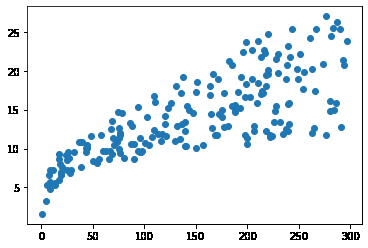
plt.scatter(data.radio,data.sales)
<matplotlib.collections.PathCollection at 0x2a67f1e6520>
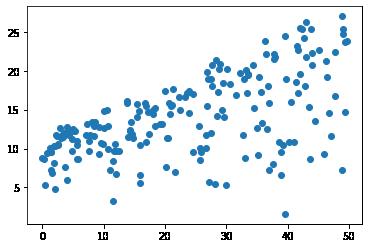
plt.scatter(data.newspaper,data.sales)
<matplotlib.collections.PathCollection at 0x2a67f337ca0>
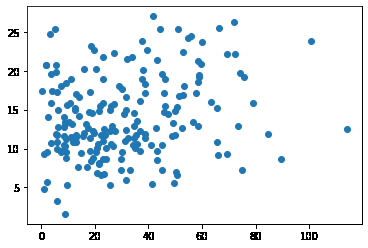
x = data.iloc[:, 0:-1] # 取所有行,以及除去最后一列的数据
x
| TV | radio | newspaper | |
|---|---|---|---|
| 1 | 230.1 | 37.8 | 69.2 |
| 2 | 44.5 | 39.3 | 45.1 |
| 3 | 17.2 | 45.9 | 69.3 |
| 4 | 151.5 | 41.3 | 58.5 |
| 5 | 180.8 | 10.8 | 58.4 |
| ... | ... | ... | ... |
| 196 | 38.2 | 3.7 | 13.8 |
| 197 | 94.2 | 4.9 | 8.1 |
| 198 | 177.0 | 9.3 | 6.4 |
| 199 | 283.6 | 42.0 | 66.2 |
| 200 | 232.1 | 8.6 | 8.7 |
200 rows × 3 columns
y = data.iloc[:,-1]  # 取所有行以及最后一列的数据
y
1 22.1
2 10.4
3 9.3
4 18.5
5 12.9
...
196 7.6
197 9.7
198 12.8
199 25.5
200 13.4
Name: sales, Length: 200, dtype: float64
model = tf.keras.Sequential(
    # 列表形式[],几个列表元素就是有多少个感知器
    # 10表示输出的单元的个数,3表示输入的三个维度,activation就是中间层的激活,
    # 1表示第二层输出的单元个数,因为第二层就是最后的输出层,所以就是输出的结果是一个
    [tf.keras.layers.Dense(10,input_shape=(3,),activation='relu'),
    tf.keras.layers.Dense(1)
    ]
)
model.summary()
Model: "sequential"
_________________________________________________________________
Layer (type) Output Shape Param #
=================================================================
dense (Dense) (None, 10) 40
_________________________________________________________________
dense_1 (Dense) (None, 1) 11
=================================================================
Total params: 51
Trainable params: 51
Non-trainable params: 0
_________________________________________________________________
- 第一行的param中为40是因为有三个输入再加一个偏置b也就是\(w_i1x_1+w_i2x_2+w_i3x_3+bi=y_i\)
- 第二行有11个参数是因为十个输入再加上一个偏置!
# 训练模型
model.compile(
    optimizer='adam',# adam是常用的优化方法
    loss='mse'
)
model.fit(x,y,epochs=100)
Epoch 91/100
7/7 [==============================] - 0s 833us/step - loss: 3.6655
Epoch 92/100
7/7 [==============================] - 0s 834us/step - loss: 3.6252
Epoch 93/100
7/7 [==============================] - 0s 1000us/step - loss: 3.5899
Epoch 94/100
7/7 [==============================] - 0s 833us/step - loss: 3.5679
Epoch 95/100
7/7 [==============================] - 0s 1ms/step - loss: 3.5273
Epoch 96/100
7/7 [==============================] - 0s 833us/step - loss: 3.5049
Epoch 97/100
7/7 [==============================] - 0s 834us/step - loss: 3.4880
Epoch 98/100
7/7 [==============================] - 0s 1000us/step - loss: 3.4627
Epoch 99/100
7/7 [==============================] - 0s 667us/step - loss: 3.4396
Epoch 100/100
7/7 [==============================] - 0s 1ms/step - loss: 3.4226
<keras.callbacks.History at 0x2a67fc77ee0>
test = data.iloc[:10,0:-1] # 对前十个数据进行预测
model.predict(test)
array([[22.26979 ],
[14.242942 ],
[ 8.892993 ],
[18.704414 ],
[13.689433 ],
[ 6.2554317],
[11.340095 ],
[10.898435 ],
[ 1.2222604],
[11.607856 ]], dtype=float32)
data.iloc[:10,-1]
1 22.1
2 10.4
3 9.3
4 18.5
5 12.9
6 7.2
7 11.8
8 13.2
9 4.8
10 10.6
Name: sales, dtype: float64

 浙公网安备 33010602011771号