
Linux shell command lsof All In One
Linux shell command lsof All In One
lsof -
list open files
Linux 系统中一切皆文件 ✅
demos
# /Users/xgqfrms-mm/Documents/github/Raspberry-Pi/Pi-3B/man-docs/
# save to  man-docs
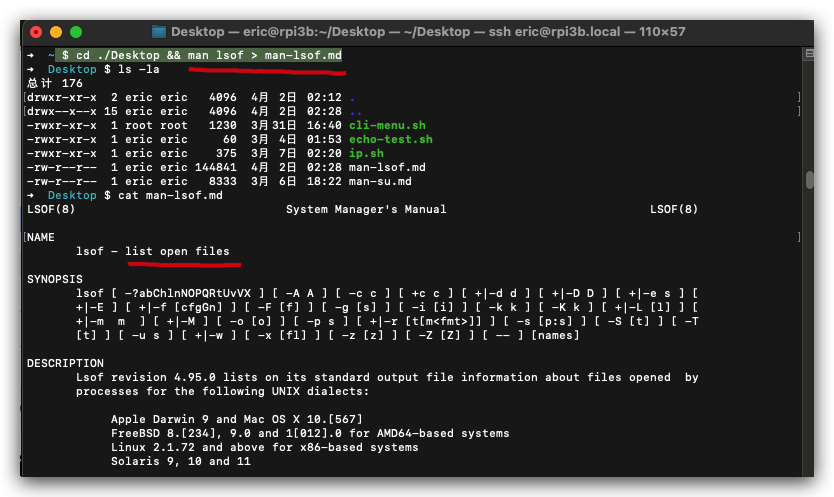
$ cd ./Desktop && man lsof > man-lsof.md

$ cat man-lsof.md
$ lsof -i
# lsof & grep
$ lsof -Pi | grep LISTEN
(🐞 反爬虫测试!打击盗版⚠️)如果你看到这个信息, 说明这是一篇剽窃的文章,请访问 https://www.cnblogs.com/xgqfrms/ 查看原创文章!
man lsof
# docs
$ man lsof
# docs
$ man lsof
LSOF(8) System Manager's Manual LSOF(8)
NAME
lsof - list open files
SYNOPSIS
lsof [ -?abChlnNOPQRtUvVX ] [ -A A ] [ -c c ] [ +c c ] [ +|-d d ] [ +|-D D ] [ +|-e s ] [
+|-E ] [ +|-f [cfgGn] ] [ -F [f] ] [ -g [s] ] [ -i [i] ] [ -k k ] [ -K k ] [ +|-L [l] ] [
+|-m m ] [ +|-M ] [ -o [o] ] [ -p s ] [ +|-r [t[m<fmt>]] ] [ -s [p:s] ] [ -S [t] ] [ -T
[t] ] [ -u s ] [ +|-w ] [ -x [fl] ] [ -z [z] ] [ -Z [Z] ] [ -- ] [names]
DESCRIPTION
Lsof revision 4.95.0 lists on its standard output file information about files opened by
processes for the following UNIX dialects:
Apple Darwin 9 and Mac OS X 10.[567]
FreeBSD 8.[234], 9.0 and 1[012].0 for AMD64-based systems
Linux 2.1.72 and above for x86-based systems
Solaris 9, 10 and 11
(See the DISTRIBUTION section of this manual page for information on how to obtain the
latest lsof revision.)
An open file may be a regular file, a directory, a block special file, a character spe‐
cial file, an executing text reference, a library, a stream or a network file (Internet
socket, NFS file or UNIX domain socket.) A specific file or all the files in a file sys‐
tem may be selected by path.
Instead of a formatted display, lsof will produce output that can be parsed by other pro‐
grams. See the -F, option description, and the OUTPUT FOR OTHER PROGRAMS section for
more information.
In addition to producing a single output list, lsof will run in repeat mode. In repeat
mode it will produce output, delay, then repeat the output operation until stopped with
an interrupt or quit signal. See the +|-r [t[m<fmt>]] option description for more infor‐
mation.
OPTIONS
In the absence of any options, lsof lists all open files belonging to all active pro‐
cesses.
If any list request option is specified, other list requests must be specifically re‐
quested - e.g., if -U is specified for the listing of UNIX socket files, NFS files won't
be listed unless -N is also specified; or if a user list is specified with the -u option,
UNIX domain socket files, belonging to users not in the list, won't be listed unless the
-U option is also specified.
Normally, list options that are specifically stated are ORed - i.e., specifying the -i
option without an address and the -ufoo option produces a listing of all network files OR
files belonging to processes owned by user ``foo''. The exceptions are:
1) the `^' (negated) login name or user ID (UID), specified with the -u option;
2) the `^' (negated) process ID (PID), specified with the -p option;
3) the `^' (negated) process group ID (PGID), specified with the -g option;
4) the `^' (negated) command, specified with the -c option;
5) the (`^') negated TCP or UDP protocol state names, specified with the -s [p:s] option.
Since they represent exclusions, they are applied without ORing or ANDing and take effect
before any other selection criteria are applied.
The -a option may be used to AND the selections. For example, specifying -a, -U, and
-ufoo produces a listing of only UNIX socket files that belong to processes owned by user
``foo''.
Caution: the -a option causes all list selection options to be ANDed; it can't be used to
cause ANDing of selected pairs of selection options by placing it between them, even
though its placement there is acceptable. Wherever -a is placed, it causes the ANDing of
all selection options.
Items of the same selection set - command names, file descriptors, network addresses,
process identifiers, user identifiers, zone names, security contexts - are joined in a
single ORed set and applied before the result participates in ANDing. Thus, for example,
specifying -i@aaa.bbb, -i@ccc.ddd, -a, and -ufff,ggg will select the listing of files
that belong to either login ``fff'' OR ``ggg'' AND have network connections to either
host aaa.bbb OR ccc.ddd.
Options may be grouped together following a single prefix -- e.g., the option set ``-a -b
-C'' may be stated as -abC. However, since values are optional following +|-f, -F, -g,
-i, +|-L, -o, +|-r, -s, -S, -T, -x and -z. when you have no values for them be careful
that the following character isn't ambiguous. For example, -Fn might represent the -F
and -n options, or it might represent the n field identifier character following the -F
option. When ambiguity is possible, start a new option with a `-' character - e.g., ``-F
-n''. If the next option is a file name, follow the possibly ambiguous option with
``--'' - e.g., ``-F -- name''.
Either the `+' or the `-' prefix may be applied to a group of options. Options that
don't take on separate meanings for each prefix - e.g., -i - may be grouped under either
prefix. Thus, for example, ``+M -i'' may be stated as ``+Mi'' and the group means the
same as the separate options. Be careful of prefix grouping when one or more options in
the group does take on separate meanings under different prefixes - e.g., +|-M; ``-iM''
is not the same request as ``-i +M''. When in doubt, use separate options with appropri‐
ate prefixes.
-? -h These two equivalent options select a usage (help) output list. Lsof displays a
shortened form of this output when it detects an error in the options supplied
to it, after it has displayed messages explaining each error. (Escape the `?'
character as your shell requires.)
-a causes list selection options to be ANDed, as described above.
-A A is available on systems configured for AFS whose AFS kernel code is implemented
via dynamic modules. It allows the lsof user to specify A as an alternate name
list file where the kernel addresses of the dynamic modules might be found. See
the lsof FAQ (The FAQ section gives its location.) for more information about
dynamic modules, their symbols, and how they affect lsof.
-b causes lsof to avoid kernel functions that might block - lstat(2), readlink(2),
and stat(2).
See the BLOCKS AND TIMEOUTS and AVOIDING KERNEL BLOCKS sections for information
on using this option.
-c c selects the listing of files for processes executing the command that begins
with the characters of c. Multiple commands may be specified, using multiple -c
options. They are joined in a single ORed set before participating in AND op‐
tion selection.
If c begins with a `^', then the following characters specify a command name
whose processes are to be ignored (excluded.)
If c begins and ends with a slash ('/'), the characters between the slashes are
interpreted as a regular expression. Shell meta-characters in the regular ex‐
pression must be quoted to prevent their interpretation by the shell. The clos‐
ing slash may be followed by these modifiers:
b the regular expression is a basic one.
i ignore the case of letters.
x the regular expression is an extended one
(default).
See the lsof FAQ (The FAQ section gives its location.) for more information on
basic and extended regular expressions.
The simple command specification is tested first. If that test fails, the com‐
mand regular expression is applied. If the simple command test succeeds, the
command regular expression test isn't made. This may result in ``no command
found for regex:'' messages when lsof's -V option is specified.
+c w defines the maximum number of initial characters of the name, supplied by the
UNIX dialect, of the UNIX command associated with a process to be printed in the
COMMAND column. (The lsof default is nine.)
Note that many UNIX dialects do not supply all command name characters to lsof
in the files and structures from which lsof obtains command name. Often di‐
alects limit the number of characters supplied in those sources. For example,
Linux 2.4.27 and Solaris 9 both limit command name length to 16 characters.
If w is zero ('0'), all command characters supplied to lsof by the UNIX dialect
will be printed.
If w is less than the length of the column title, ``COMMAND'', it will be raised
to that length.
-C disables the reporting of any path name components from the kernel's name cache.
See the KERNEL NAME CACHE section for more information.
+d s causes lsof to search for all open instances of directory s and the files and
directories it contains at its top level. +d does NOT descend the directory
tree, rooted at s. The +D D option may be used to request a full-descent direc‐
tory tree search, rooted at directory D.
Processing of the +d option does not follow symbolic links within s unless the
-x or -x l option is also specified. Nor does it search for open files on file
system mount points on subdirectories of s unless the -x or -x f option is also
specified.
Note: the authority of the user of this option limits it to searching for files
that the user has permission to examine with the system stat(2) function.
-d s specifies a list of file descriptors (FDs) to exclude from or include in the
output listing. The file descriptors are specified in the comma-separated set s
- e.g., ``cwd,1,3'', ``^6,^2''. (There should be no spaces in the set.)
The list is an exclusion list if all entries of the set begin with `^'. It is
an inclusion list if no entry begins with `^'. Mixed lists are not permitted.
A file descriptor number range may be in the set as long as neither member is
empty, both members are numbers, and the ending member is larger than the start‐
ing one - e.g., ``0-7'' or ``3-10''. Ranges may be specified for exclusion if
they have the `^' prefix - e.g., ``^0-7'' excludes all file descriptors 0
through 7.
Multiple file descriptor numbers are joined in a single ORed set before partici‐
pating in AND option selection.
When there are exclusion and inclusion members in the set, lsof reports them as
errors and exits with a non-zero return code.
See the description of File Descriptor (FD) output values in the OUTPUT section
for more information on file descriptor names.
fd is a pseudo file descriptor name for specifying the whole range of possible
file descriptor numbers. fd does not appear in FD column of output.
+D D causes lsof to search for all open instances of directory D and all the files
and directories it contains to its complete depth.
Processing of the +D option does not follow symbolic links within D unless the
-x or -x l option is also specified. Nor does it search for open files on file
system mount points on subdirectories of D unless the -x or -x f option is also
specified.
Note: the authority of the user of this option limits it to searching for files
that the user has permission to examine with the system stat(2) function.
Further note: lsof may process this option slowly and require a large amount of
dynamic memory to do it. This is because it must descend the entire directory
tree, rooted at D, calling stat(2) for each file and directory, building a list
of all the files it finds, and searching that list for a match with every open
file. When directory D is large, these steps can take a long time, so use this
option prudently.
-D D directs lsof's use of the device cache file. The use of this option is some‐
times restricted. See the DEVICE CACHE FILE section and the sections that fol‐
low it for more information on this option.
-D must be followed by a function letter; the function letter may optionally be
followed by a path name. Lsof recognizes these function letters:
? - report device cache file paths
b - build the device cache file
i - ignore the device cache file
r - read the device cache file
u - read and update the device cache file
The b, r, and u functions, accompanied by a path name, are sometimes restricted.
When these functions are restricted, they will not appear in the description of
the -D option that accompanies -h or -? option output. See the DEVICE CACHE
FILE section and the sections that follow it for more information on these func‐
tions and when they're restricted.
The ? function reports the read-only and write paths that lsof can use for the
device cache file, the names of any environment variables whose values lsof will
examine when forming the device cache file path, and the format for the personal
device cache file path. (Escape the `?' character as your shell requires.)
When available, the b, r, and u functions may be followed by the device cache
file's path. The standard default is .lsof_hostname in the home directory of
the real user ID that executes lsof, but this could have been changed when lsof
was configured and compiled. (The output of the -h and -? options show the
current default prefix - e.g., ``.lsof''.) The suffix, hostname, is the first
component of the host's name returned by gethostname(2).
When available, the b function directs lsof to build a new device cache file at
the default or specified path.
The i function directs lsof to ignore the default device cache file and obtain
its information about devices via direct calls to the kernel.
The r function directs lsof to read the device cache at the default or specified
path, but prevents it from creating a new device cache file when none exists or
the existing one is improperly structured. The r function, when specified with‐
out a path name, prevents lsof from updating an incorrect or outdated device
cache file, or creating a new one in its place. The r function is always avail‐
able when it is specified without a path name argument; it may be restricted by
the permissions of the lsof process.
When available, the u function directs lsof to read the device cache file at the
default or specified path, if possible, and to rebuild it, if necessary. This
is the default device cache file function when no -D option has been specified.
+|-e s exempts the file system whose path name is s from being subjected to kernel
function calls that might block. The +e option exempts stat(2), lstat(2) and
most readlink(2) kernel function calls. The -e option exempts only stat(2) and
lstat(2) kernel function calls. Multiple file systems may be specified with
separate +|-e specifications and each may have readlink(2) calls exempted or
not.
This option is currently implemented only for Linux.
CAUTION: this option can easily be mis-applied to other than the file system of
interest, because it uses path name rather than the more reliable device and in‐
ode numbers. (Device and inode numbers are acquired via the potentially block‐
ing stat(2) kernel call and are thus not available, but see the +|-m m option as
a possible alternative way to supply device numbers.) Use this option with
great care and fully specify the path name of the file system to be exempted.
When open files on exempted file systems are reported, it may not be possible to
obtain all their information. Therefore, some information columns will be
blank, the characters ``UNKN'' preface the values in the TYPE column, and the
applicable exemption option is added in parentheses to the end of the NAME col‐
umn. (Some device number information might be made available via the +|-m m op‐
tion.)
+|-E +E specifies that Linux pipe, Linux UNIX socket, Linux INET(6) socket closed in
a local host, Linux pseudoterminal files, POSIX Message Queueue implementation
in Linux, and Linux eventfd should be displayed with endpoint information and
the files of the endpoints should also be displayed.
Note 1: UNIX socket file endpoint information is only available when the compile
flags line of -v output contains HASUXSOCKEPT, and psudoterminal endpoint infor‐
mation is only available when the compile flags line contains HASPTYEPT.
Note 2: POSIX Message Queue file endpoint information is only available when
mqueue file system is mounted.
Pipe endpoint information is displayed in the NAME column in the form
``PID,cmd,FDmode'', where PID is the endpoint process ID; cmd is the endpoint
process command; FD is the endpoint file's descriptor; and mode is the endpoint
file's access mode.
Pseudoterminal endpoint information is displayed in the NAME column as
``->/dev/ptsmin PID,cmd,FDmode'' or ``PID,cmd,FDmode''. The first form is for a
master device; the second, for a slave device. min is a slave device's minor
device number; and PID, cmd, FD and mode are the same as with pipe endpoint in‐
formation. Note: psudoterminal endpoint information is only available when the
compile flags line of -V output contains HASPTYEPT. In addition, this feature
works on Linux kernels above 4.13.0.
UNIX socket file endpoint information is displayed in the NAME column in the
form
``type=TYPE ->INO=INODE PID,cmd,FDmode'', where TYPE is the socket type; INODE
is the i-node number of the connected socket; and PID, cmd, FD and mode are the
same as with pipe endpoint information. Note: UNIX socket file endpoint infor‐
mation is available only when the compile flags line of -v output contains HA‐
SUXSOCKEPT.
INET socket file endpoint information is inserted to the value at the NAME col‐
umn in th form
PID, cmd, FD and mode are the same as with pipe endpoint information. The end‐
point information is available only if the socket is used for local IPC; both
endpoints bind to the same local IPv4 or IPv6 address.
POSIX Message Queue file endpoint information is displayed in the NAME column in
the same form as that of pipe.
eventfd endpoint information is displayed in the NAME column in the same form as
that of pipe. This feature works on Linux kernels above 5.2.0.
Multiple occurrences of this information can appear in a file's NAME column.
-E specifies that endpoint supported files should be displayed with endpoint in‐
formation, but not the files of the endpoints.
+|-f [cfgGn]
f by itself clarifies how path name arguments are to be interpreted. When fol‐
lowed by c, f, g, G, or n in any combination it specifies that the listing of
kernel file structure information is to be enabled (`+') or inhibited (`-').
Normally a path name argument is taken to be a file system name if it matches a
mounted-on directory name reported by mount(8), or if it represents a block de‐
vice, named in the mount output and associated with a mounted directory name.
When +f is specified, all path name arguments will be taken to be file system
names, and lsof will complain if any are not. This can be useful, for example,
when the file system name (mounted-on device) isn't a block device. This hap‐
pens for some CD-ROM file systems.
When -f is specified by itself, all path name arguments will be taken to be sim‐
ple files. Thus, for example, the ``-f -- /'' arguments direct lsof to search
for open files with a `/' path name, not all open files in the `/' (root) file
system.
Be careful to make sure +f and -f are properly terminated and aren't followed by
a character (e.g., of the file or file system name) that might be taken as a pa‐
rameter. For example, use ``--'' after +f and -f as in these examples.
$ lsof +f -- /file/system/name
$ lsof -f -- /file/name
The listing of information from kernel file structures, requested with the +f
[cfgGn] option form, is normally inhibited, and is not available in whole or
part for some dialects - e.g., /proc-based Linux kernels below 2.6.22. When the
prefix to f is a plus sign (`+'), these characters request file structure infor‐
mation:
c file structure use count (not Linux)
f file structure address (not Linux)
g file flag abbreviations (Linux 2.6.22 and up)
Abbrev. Flag in C code (see open(2))
W O_WRONLY
RW O_RDWR
CR O_CREAT
EXCL O_EXCL
NTTY O_NOCTTY
TR O_TRUNC
AP O_APPEND
ND O_NDELAY
SYN O_SYNC
ASYN O_ASYNC
DIR O_DIRECT
DTY O_DIRECTORY
NFLK O_NOFOLLOW
NATM O_NOATIME
DSYN O_DSYNC
RSYN O_RSYNC
LG O_LARGEFILE
CX O_CLOEXEC
TMPF O_TMPFILE
G file flags in hexadecimal (Linux 2.6.22 and up)
n file structure node address (not Linux)
When the prefix is minus (`-') the same characters disable the listing of the
indicated values.
File structure addresses, use counts, flags, and node addresses may be used to
detect more readily identical files inherited by child processes and identical
files in use by different processes. Lsof column output can be sorted by output
columns holding the values and listed to identify identical file use, or lsof
field output can be parsed by an AWK or Perl post-filter script, or by a C pro‐
gram.
-F f specifies a character list, f, that selects the fields to be output for process‐
ing by another program, and the character that terminates each output field.
Each field to be output is specified with a single character in f. The field
terminator defaults to NL, but may be changed to NUL (000). See the OUTPUT FOR
OTHER PROGRAMS section for a description of the field identification characters
and the field output process.
When the field selection character list is empty, all standard fields are se‐
lected (except the raw device field, security context and zone field for compat‐
ibility reasons) and the NL field terminator is used.
When the field selection character list contains only a zero (`0'), all fields
are selected (except the raw device field for compatibility reasons) and the NUL
terminator character is used.
Other combinations of fields and their associated field terminator character
must be set with explicit entries in f, as described in the OUTPUT FOR OTHER
PROGRAMS section.
When a field selection character identifies an item lsof does not normally list
- e.g., PPID, selected with -R - specification of the field character - e.g.,
``-FR'' - also selects the listing of the item.
When the field selection character list contains the single character `?', lsof
will display a help list of the field identification characters. (Escape the
`?' character as your shell requires.)
-g [s] excludes or selects the listing of files for the processes whose optional
process group IDentification (PGID) numbers are in the comma-separated set s -
e.g., ``123'' or ``123,^456''. (There should be no spaces in the set.)
PGID numbers that begin with `^' (negation) represent exclusions.
Multiple PGID numbers are joined in a single ORed set before participating in
AND option selection. However, PGID exclusions are applied without ORing or
ANDing and take effect before other selection criteria are applied.
The -g option also enables the output display of PGID numbers. When specified
without a PGID set that's all it does.
-i [i] selects the listing of files any of whose Internet address matches the address
specified in i. If no address is specified, this option selects the listing of
all Internet and x.25 (HP-UX) network files.
If -i4 or -i6 is specified with no following address, only files of the indi‐
cated IP version, IPv4 or IPv6, are displayed. (An IPv6 specification may be
used only if the dialects supports IPv6, as indicated by ``[46]'' and
``IPv[46]'' in lsof's -h or -? output.) Sequentially specifying -i4, followed
by -i6 is the same as specifying -i, and vice-versa. Specifying -i4, or -i6 af‐
ter -i is the same as specifying -i4 or -i6 by itself.
Multiple addresses (up to a limit of 100) may be specified with multiple -i op‐
tions. (A port number or service name range is counted as one address.) They
are joined in a single ORed set before participating in AND option selection.
An Internet address is specified in the form (Items in square brackets are op‐
tional.):
[46][protocol][@hostname|hostaddr][:service|port]
where:
46 specifies the IP version, IPv4 or IPv6
that applies to the following address.
'6' may be be specified only if the UNIX
dialect supports IPv6. If neither '4' nor
'6' is specified, the following address
applies to all IP versions.
protocol is a protocol name - TCP, UDP
hostname is an Internet host name. Unless a
specific IP version is specified, open
network files associated with host names
of all versions will be selected.
hostaddr is a numeric Internet IPv4 address in
dot form; or an IPv6 numeric address in
colon form, enclosed in brackets, if the
UNIX dialect supports IPv6. When an IP
version is selected, only its numeric
addresses may be specified.
service is an /etc/services name - e.g., smtp -
or a list of them.
port is a port number, or a list of them.
IPv6 options may be used only if the UNIX dialect supports IPv6. To see if the
dialect supports IPv6, run lsof and specify the -h or -? (help) option. If the
displayed description of the -i option contains ``[46]'' and ``IPv[46]'', IPv6
is supported.
IPv4 host names and addresses may not be specified if network file selection is
limited to IPv6 with -i 6. IPv6 host names and addresses may not be specified
if network file selection is limited to IPv4 with -i 4. When an open IPv4 net‐
work file's address is mapped in an IPv6 address, the open file's type will be
IPv6, not IPv4, and its display will be selected by '6', not '4'.
At least one address component - 4, 6, protocol, hostname, hostaddr, or service
- must be supplied. The `@' character, leading the host specification, is al‐
ways required; as is the `:', leading the port specification. Specify either
hostname or hostaddr. Specify either service name list or port number list. If
a service name list is specified, the protocol may also need to be specified if
the TCP, UDP and UDPLITE port numbers for the service name are different. Use
any case - lower or upper - for protocol.
Service names and port numbers may be combined in a list whose entries are sepa‐
rated by commas and whose numeric range entries are separated by minus signs.
There may be no embedded spaces, and all service names must belong to the speci‐
fied protocol. Since service names may contain embedded minus signs, the start‐
ing entry of a range can't be a service name; it can be a port number, however.
Here are some sample addresses:
-i6 - IPv6 only
TCP:25 - TCP and port 25
@1.2.3.4 - Internet IPv4 host address 1.2.3.4
@[3ffe:1ebc::1]:1234 - Internet IPv6 host address
3ffe:1ebc::1, port 1234
UDP:who - UDP who service port
TCP@lsof.itap:513 - TCP, port 513 and host name lsof.itap
tcp@foo:1-10,smtp,99 - TCP, ports 1 through 10,
service name smtp, port 99, host name foo
tcp@bar:1-smtp - TCP, ports 1 through smtp, host bar
:time - either TCP, UDP or UDPLITE time service port
-K k selects the listing of tasks (threads) of processes, on dialects where task
(thread) reporting is supported. (If help output - i.e., the output of the -h
or -? options - shows this option, then task (thread) reporting is supported by
the dialect.)
If -K is followed by a value, k, it must be ``i''. That causes lsof to ignore
tasks, particularly in the default, list-everything case when no other options
are specified.
When -K and -a are both specified on Linux, and the tasks of a main process are
selected by other options, the main process will also be listed as though it
were a task, but without a task ID. (See the description of the TID column in
the OUTPUT section.)
Where the FreeBSD version supports threads, all threads will be listed with
their IDs.
In general threads and tasks inherit the files of the caller, but may close some
and open others, so lsof always reports all the open files of threads and tasks.
-k k specifies a kernel name list file, k, in place of /vmunix, /mach, etc. -k is
not available under AIX on the IBM RISC/System 6000.
-l inhibits the conversion of user ID numbers to login names. It is also useful
when login name lookup is working improperly or slowly.
+|-L [l] enables (`+') or disables (`-') the listing of file link counts, where they are
available - e.g., they aren't available for sockets, or most FIFOs and pipes.
When +L is specified without a following number, all link counts will be listed.
When -L is specified (the default), no link counts will be listed.
When +L is followed by a number, only files having a link count less than that
number will be listed. (No number may follow -L.) A specification of the form
``+L1'' will select open files that have been unlinked. A specification of the
form ``+aL1 <file_system>'' will select unlinked open files on the specified
file system.
For other link count comparisons, use field output (-F) and a post-processing
script or program.
+|-m m specifies an alternate kernel memory file or activates mount table supplement
processing.
The option form -m m specifies a kernel memory file, m, in place of /dev/kmem or
/dev/mem - e.g., a crash dump file.
The option form +m requests that a mount supplement file be written to the stan‐
dard output file. All other options are silently ignored.
There will be a line in the mount supplement file for each mounted file system,
containing the mounted file system directory, followed by a single space, fol‐
lowed by the device number in hexadecimal "0x" format - e.g.,
/ 0x801
Lsof can use the mount supplement file to get device numbers for file systems
when it can't get them via stat(2) or lstat(2).
The option form +m m identifies m as a mount supplement file.
Note: the +m and +m m options are not available for all supported dialects.
Check the output of lsof's -h or -? options to see if the +m and +m m options
are available.
+|-M Enables (+) or disables (-) the reporting of portmapper registrations for local
TCP, UDP and UDPLITE ports, where port mapping is supported. (See the last
paragraph of this option description for information about where portmapper reg‐
istration reporting is supported.)
The default reporting mode is set by the lsof builder with the HASPMAPENABLED
#define in the dialect's machine.h header file; lsof is distributed with the
HASPMAPENABLED #define deactivated, so portmapper reporting is disabled by de‐
fault and must be requested with +M. Specifying lsof's -h or -? option will
report the default mode. Disabling portmapper registration when it is already
disabled or enabling it when already enabled is acceptable. When portmapper
registration reporting is enabled, lsof displays the portmapper registration (if
any) for local TCP, UDP or UDPLITE ports in square brackets immediately follow‐
ing the port numbers or service names - e.g., ``:1234[name]'' or
``:name[100083]''. The registration information may be a name or number, de‐
pending on what the registering program supplied to the portmapper when it reg‐
istered the port.
When portmapper registration reporting is enabled, lsof may run a little more
slowly or even become blocked when access to the portmapper becomes congested or
stopped. Reverse the reporting mode to determine if portmapper registration re‐
porting is slowing or blocking lsof.
For purposes of portmapper registration reporting lsof considers a TCP, UDP or
UDPLITE port local if: it is found in the local part of its containing kernel
structure; or if it is located in the foreign part of its containing kernel
structure and the local and foreign Internet addresses are the same; or if it is
located in the foreign part of its containing kernel structure and the foreign
Internet address is INADDR_LOOPBACK (127.0.0.1). This rule may make lsof ignore
some foreign ports on machines with multiple interfaces when the foreign Inter‐
net address is on a different interface from the local one.
See the lsof FAQ (The FAQ section gives its location.) for further discussion
of portmapper registration reporting issues.
Portmapper registration reporting is supported only on dialects that have RPC
header files. (Some Linux distributions with GlibC 2.14 do not have them.)
When portmapper registration reporting is supported, the -h or -? help output
will show the +|-M option.
-n inhibits the conversion of network numbers to host names for network files. In‐
hibiting conversion may make lsof run faster. It is also useful when host name
lookup is not working properly.
-N selects the listing of NFS files.
-o directs lsof to display file offset at all times. It causes the SIZE/OFF output
column title to be changed to OFFSET. Note: on some UNIX dialects lsof can't
obtain accurate or consistent file offset information from its kernel data
sources, sometimes just for particular kinds of files (e.g., socket files.)
Consult the lsof FAQ (The FAQ section gives its location.) for more informa‐
tion.
The -o and -s options are mutually exclusive; they can't both be specified.
When neither is specified, lsof displays whatever value - size or offset - is
appropriate and available for the type of the file.
-o o defines the number of decimal digits (o) to be printed after the ``0t'' for a
file offset before the form is switched to ``0x...''. An o value of zero (un‐
limited) directs lsof to use the ``0t'' form for all offset output.
This option does NOT direct lsof to display offset at all times; specify -o
(without a trailing number) to do that. -o o only specifies the number of dig‐
its after ``0t'' in either mixed size and offset or offset-only output. Thus,
for example, to direct lsof to display offset at all times with a decimal digit
count of 10, use:
-o -o 10
or
-oo10
The default number of digits allowed after ``0t'' is normally 8, but may have
been changed by the lsof builder. Consult the description of the -o o option in
the output of the -h or -? option to determine the default that is in effect.
-O directs lsof to bypass the strategy it uses to avoid being blocked by some ker‐
nel operations - i.e., doing them in forked child processes. See the BLOCKS AND
TIMEOUTS and AVOIDING KERNEL BLOCKS sections for more information on kernel op‐
erations that may block lsof.
While use of this option will reduce lsof startup overhead, it may also cause
lsof to hang when the kernel doesn't respond to a function. Use this option
cautiously.
-p s excludes or selects the listing of files for the processes whose optional
process IDentification (PID) numbers are in the comma-separated set s - e.g.,
``123'' or ``123,^456''. (There should be no spaces in the set.)
PID numbers that begin with `^' (negation) represent exclusions.
Multiple process ID numbers are joined in a single ORed set before participating
in AND option selection. However, PID exclusions are applied without ORing or
ANDing and take effect before other selection criteria are applied.
-P inhibits the conversion of port numbers to port names for network files. In‐
hibiting the conversion may make lsof run a little faster. It is also useful
when port name lookup is not working properly.
-Q ignore failed search terms. When lsof is told to search for users of a file, or
for users of a device, or for a specific PID, or for certain protocols in use by
that PID, and so on, lsof will return an error if any of the search results are
empty. The -Q option will change this behavior so that lsof will instead return
a successful exit code (0) even if any of the search results are empty. In addi‐
tion, missing search terms will not be reported to stderr.
+|-r [t[c<N>][m<fmt>]]
puts lsof in repeat mode. There lsof lists open files as selected by other op‐
tions, delays t seconds (default fifteen), then repeats the listing, delaying
and listing repetitively until stopped by a condition defined by the prefix to
the option.
If the prefix is a `-', repeat mode is endless. Lsof must be terminated with an
interrupt or quit signal. `c<N>' is for specifying the limits of repeating; if
the number of iterations reaches at `<N>', Lsof stops itself.
If the prefix is `+', repeat mode will end the first cycle no open files are
listed - and of course when lsof is stopped with an interrupt or quit signal.
When repeat mode ends because no files are listed, the process exit code will be
zero if any open files were ever listed; one, if none were ever listed.
Lsof marks the end of each listing: if field output is in progress (the -F, op‐
tion has been specified), the default marker is `m'; otherwise the default
marker is ``========''. The marker is followed by a NL character.
The optional "m<fmt>" argument specifies a format for the marker line. The
<fmt> characters following `m' are interpreted as a format specification to the
strftime(3) function, when both it and the localtime(3) function are available
in the dialect's C library. Consult the strftime(3) documentation for what may
appear in its format specification. Note that when field output is requested
with the -F option, <fmt> cannot contain the NL format, ``%n''. Note also that
when <fmt> contains spaces or other characters that affect the shell's interpre‐
tation of arguments, <fmt> must be quoted appropriately.
Repeat mode reduces lsof startup overhead, so it is more efficient to use this
mode than to call lsof repetitively from a shell script, for example.
To use repeat mode most efficiently, accompany +|-r with specification of other
lsof selection options, so the amount of kernel memory access lsof does will be
kept to a minimum. Options that filter at the process level - e.g., -c, -g, -p,
-u - are the most efficient selectors.
Repeat mode is useful when coupled with field output (see the -F, option de‐
scription) and a supervising awk or Perl script, or a C program.
-R directs lsof to list the Parent Process IDentification number in the PPID col‐
umn.
-s [p:s] s alone directs lsof to display file size at all times. It causes the SIZE/OFF
output column title to be changed to SIZE. If the file does not have a size,
nothing is displayed.
The optional -s p:s form is available only for selected dialects, and only when
the -h or -? help output lists it.
When the optional form is available, the s may be followed by a protocol name
(p), either TCP or UDP, a colon (`:') and a comma-separated protocol state name
list, the option causes open TCP and UDP files to be excluded if their state
name(s) are in the list (s) preceded by a `^'; or included if their name(s) are
not preceded by a `^'.
Dialects that support this option may support only one protocol. When an unsup‐
ported protocol is specified, a message will be displayed indicating state names
for the protocol are unavailable.
When an inclusion list is defined, only network files with state names in the
list will be present in the lsof output. Thus, specifying one state name means
that only network files with that lone state name will be listed.
Case is unimportant in the protocol or state names, but there may be no spaces
and the colon (`:') separating the protocol name (p) and the state name list (s)
is required.
If only TCP and UDP files are to be listed, as controlled by the specified ex‐
clusions and inclusions, the -i option must be specified, too. If only a single
protocol's files are to be listed, add its name as an argument to the -i option.
For example, to list only network files with TCP state LISTEN, use:
-iTCP -sTCP:LISTEN
Or, for example, to list network files with all UDP states except Idle, use:
-iUDP -sUDP:^Idle
State names vary with UNIX dialects, so it's not possible to provide a complete
list. Some common TCP state names are: CLOSED, IDLE, BOUND, LISTEN, ESTAB‐
LISHED, SYN_SENT, SYN_RCDV, ESTABLISHED, CLOSE_WAIT, FIN_WAIT1, CLOSING,
LAST_ACK, FIN_WAIT_2, and TIME_WAIT. Two common UDP state names are Unbound and
Idle.
See the lsof FAQ (The FAQ section gives its location.) for more information on
how to use protocol state exclusion and inclusion, including examples.
The -o (without a following decimal digit count) and -s option (without a fol‐
lowing protocol and state name list) are mutually exclusive; they can't both be
specified. When neither is specified, lsof displays whatever value - size or
offset - is appropriate and available for the type of file.
Since some types of files don't have true sizes - sockets, FIFOs, pipes, etc. -
lsof displays for their sizes the content amounts in their associated kernel
buffers, if possible.
-S [t] specifies an optional time-out seconds value for kernel functions - lstat(2),
readlink(2), and stat(2) - that might otherwise deadlock. The minimum for t is
two; the default, fifteen; when no value is specified, the default is used.
See the BLOCKS AND TIMEOUTS section for more information.
-T [t] controls the reporting of some TCP/TPI information, also reported by netstat(1),
following the network addresses. In normal output the information appears in
parentheses, each item except TCP or TPI state name identified by a keyword,
followed by `=', separated from others by a single space:
<TCP or TPI state name>
QR=<read queue length>
QS=<send queue length>
SO=<socket options and values>
SS=<socket states>
TF=<TCP flags and values>
WR=<window read length>
WW=<window write length>
Not all values are reported for all UNIX dialects. Items values (when avail‐
able) are reported after the item name and '='.
When the field output mode is in effect (See OUTPUT FOR OTHER PROGRAMS.) each
item appears as a field with a `T' leading character.
-T with no following key characters disables TCP/TPI information reporting.
-T with following characters selects the reporting of specific TCP/TPI informa‐
tion:
f selects reporting of socket options,
states and values, and TCP flags and
values.
q selects queue length reporting.
s selects connection state reporting.
w selects window size reporting.
Not all selections are enabled for some UNIX dialects. State may be selected
for all dialects and is reported by default. The -h or -? help output for the
-T option will show what selections may be used with the UNIX dialect.
When -T is used to select information - i.e., it is followed by one or more se‐
lection characters - the displaying of state is disabled by default, and it must
be explicitly selected again in the characters following -T. (In effect, then,
the default is equivalent to -Ts.) For example, if queue lengths and state are
desired, use -Tqs.
Socket options, socket states, some socket values, TCP flags and one TCP value
may be reported (when available in the UNIX dialect) in the form of the names
that commonly appear after SO_, so_, SS_, TCP_ and TF_ in the dialect's header
files - most often <sys/socket.h>, <sys/socketvar.h> and <netinet/tcp_var.h>.
Consult those header files for the meaning of the flags, options, states and
values.
``SO='' precedes socket options and values; ``SS='', socket states; and ``TF='',
TCP flags and values.
If a flag or option has a value, the value will follow an '=' and the name --
e.g., ``SO=LINGER=5'', ``SO=QLIM=5'', ``TF=MSS=512''. The following seven val‐
ues may be reported:
Name
Reported Description (Common Symbol)
KEEPALIVE keep alive time (SO_KEEPALIVE)
LINGER linger time (SO_LINGER)
MSS maximum segment size (TCP_MAXSEG)
PQLEN partial listen queue connections
QLEN established listen queue connections
QLIM established listen queue limit
RCVBUF receive buffer length (SO_RCVBUF)
SNDBUF send buffer length (SO_SNDBUF)
Details on what socket options and values, socket states, and TCP flags and val‐
ues may be displayed for particular UNIX dialects may be found in the answer to
the ``Why doesn't lsof report socket options, socket states, and TCP flags and
values for my dialect?'' and ``Why doesn't lsof report the partial listen queue
connection count for my dialect?'' questions in the lsof FAQ (The FAQ section
gives its location.) On Linux this option also prints the state of UNIX domain
sockets.
-t produce terse output comprising only process identifiers (without a header), so
that it is easy to use programmatically. e.g.
# reload anything using old SSL
lsof -t /lib/*/libssl.so.* | xargs -r kill -HUP
# get list of processes and then iterate over them (Bash only)
mapfile -t pids < <(
lsof -wt /var/log/your.log
)
for pid in "${pids[@]}" ; do
your_command -p "$pid"
done
The -t option implies the -w option.
-u s selects the listing of files for the user whose login names or user ID numbers
are in the comma-separated set s - e.g., ``abe'', or ``548,root''. (There
should be no spaces in the set.)
Multiple login names or user ID numbers are joined in a single ORed set before
participating in AND option selection.
If a login name or user ID is preceded by a `^', it becomes a negation - i.e.,
files of processes owned by the login name or user ID will never be listed. A
negated login name or user ID selection is neither ANDed nor ORed with other se‐
lections; it is applied before all other selections and absolutely excludes the
listing of the files of the process. For example, to direct lsof to exclude the
listing of files belonging to root processes, specify ``-u^root'' or ``-u^0''.
-U selects the listing of UNIX domain socket files.
-v selects the listing of lsof version information, including: revision number;
when the lsof binary was constructed; who constructed the binary and where; the
name of the compiler used to construct the lsof binary; the version number of
the compiler when readily available; the compiler and loader flags used to con‐
struct the lsof binary; and system information, typically the output of uname's
-a option.
-V directs lsof to indicate the items it was asked to list and failed to find -
command names, file names, Internet addresses or files, login names, NFS files,
PIDs, PGIDs, and UIDs.
When other options are ANDed to search options, or compile-time options restrict
the listing of some files, lsof may not report that it failed to find a search
item when an ANDed option or compile-time option prevents the listing of the
open file containing the located search item.
For example, ``lsof -V -iTCP@foobar -a -d 999'' may not report a failure to lo‐
cate open files at ``TCP@foobar'' and may not list any, if none have a file de‐
scriptor number of 999. A similar situation arises when HASSECURITY and HAS‐
NOSOCKSECURITY are defined at compile time and they prevent the listing of open
files.
+|-w Enables (+) or disables (-) the suppression of warning messages.
The lsof builder may choose to have warning messages disabled or enabled by de‐
fault. The default warning message state is indicated in the output of the -h
or -? option. Disabling warning messages when they are already disabled or en‐
abling them when already enabled is acceptable.
The -t option implies the -w option.
-x [fl] may accompany the +d and +D options to direct their processing to cross over
symbolic links and|or file system mount points encountered when scanning the di‐
rectory (+d) or directory tree (+D).
If -x is specified by itself without a following parameter, cross-over process‐
ing of both symbolic links and file system mount points is enabled. Note that
when -x is specified without a parameter, the next argument must begin with '-'
or '+'.
The optional 'f' parameter enables file system mount point cross-over process‐
ing; 'l', symbolic link cross-over processing.
The -x option may not be supplied without also supplying a +d or +D option.
-X This is a dialect-specific option.
AIX:
This IBM AIX RISC/System 6000 option requests the reporting of executed text
file and shared library references.
WARNING: because this option uses the kernel readx() function, its use on a busy
AIX system might cause an application process to hang so completely that it can
neither be killed nor stopped. I have never seen this happen or had a report of
its happening, but I think there is a remote possibility it could happen.
By default use of readx() is disabled. On AIX 5L and above lsof may need se‐
tuid-root permission to perform the actions this option requests.
The lsof builder may specify that the -X option be restricted to processes whose
real UID is root. If that has been done, the -X option will not appear in the
-h or -? help output unless the real UID of the lsof process is root. The de‐
fault lsof distribution allows any UID to specify -X, so by default it will ap‐
pear in the help output.
When AIX readx() use is disabled, lsof may not be able to report information for
all text and loader file references, but it may also avoid exacerbating an AIX
kernel directory search kernel error, known as the Stale Segment ID bug.
The readx() function, used by lsof or any other program to access some sections
of kernel virtual memory, can trigger the Stale Segment ID bug. It can cause
the kernel's dir_search() function to believe erroneously that part of an
in-memory copy of a file system directory has been zeroed. Another application
process, distinct from lsof, asking the kernel to search the directory - e.g.,
by using open(2) - can cause dir_search() to loop forever, thus hanging the ap‐
plication process.
Consult the lsof FAQ (The FAQ section gives its location.) and the 00README
file of the lsof distribution for a more complete description of the Stale Seg‐
ment ID bug, its APAR, and methods for defining readx() use when compiling lsof.
Linux:
This Linux option requests that lsof skip the reporting of information on all
open TCP, UDP and UDPLITE IPv4 and IPv6 files.
This Linux option is most useful when the system has an extremely large number
of open TCP, UDP and UDPLITE files, the processing of whose information in the
/proc/net/tcp* and /proc/net/udp* files would take lsof a long time, and whose
reporting is not of interest.
Use this option with care and only when you are sure that the information you
want lsof to display isn't associated with open TCP, UDP or UDPLITE socket
files.
Solaris 10 and above:
This Solaris 10 and above option requests the reporting of cached paths for
files that have been deleted - i.e., removed with rm(1) or unlink(2).
The cached path is followed by the string `` (deleted)'' to indicate that the
path by which the file was opened has been deleted.
Because intervening changes made to the path - i.e., renames with mv(1) or re‐
name(2) - are not recorded in the cached path, what lsof reports is only the
path by which the file was opened, not its possibly different final path.
-z [z] specifies how Solaris 10 and higher zone information is to be handled.
Without a following argument - e.g., NO z - the option specifies that zone names
are to be listed in the ZONE output column.
The -z option may be followed by a zone name, z. That causes lsof to list only
open files for processes in that zone. Multiple -z z option and argument pairs
may be specified to form a list of named zones. Any open file of any process in
any of the zones will be listed, subject to other conditions specified by other
options and arguments.
-Z [Z] specifies how SELinux security contexts are to be handled. It and 'Z' field
output character support are inhibited when SELinux is disabled in the running
Linux kernel. See OUTPUT FOR OTHER PROGRAMS for more information on the 'Z'
field output character.
Without a following argument - e.g., NO Z - the option specifies that security
contexts are to be listed in the SECURITY-CONTEXT output column.
The -Z option may be followed by a wildcard security context name, Z. That
causes lsof to list only open files for processes in that security context.
Multiple -Z Z option and argument pairs may be specified to form a list of secu‐
rity contexts. Any open file of any process in any of the security contexts
will be listed, subject to other conditions specified by other options and argu‐
ments. Note that Z can be A:B:C or *:B:C or A:B:* or *:*:C to match against the
A:B:C context.
-- The double minus sign option is a marker that signals the end of the keyed op‐
tions. It may be used, for example, when the first file name begins with a mi‐
nus sign. It may also be used when the absence of a value for the last keyed
option must be signified by the presence of a minus sign in the following option
and before the start of the file names.
names These are path names of specific files to list. Symbolic links are resolved be‐
fore use. The first name may be separated from the preceding options with the
``--'' option.
If a name is the mounted-on directory of a file system or the device of the file
system, lsof will list all the files open on the file system. To be considered
a file system, the name must match a mounted-on directory name in mount(8) out‐
put, or match the name of a block device associated with a mounted-on directory
name. The +|-f option may be used to force lsof to consider a name a file sys‐
tem identifier (+f) or a simple file (-f).
If name is a path to a directory that is not the mounted-on directory name of a
file system, it is treated just as a regular file is treated - i.e., its listing
is restricted to processes that have it open as a file or as a process-specific
directory, such as the root or current working directory. To request that lsof
look for open files inside a directory name, use the +d s and +D D options.
If a name is the base name of a family of multiplexed files - e.g, AIX's
/dev/pt[cs] - lsof will list all the associated multiplexed files on the device
that are open - e.g., /dev/pt[cs]/1, /dev/pt[cs]/2, etc.
If a name is a UNIX domain socket name, lsof will usually search for it by the
characters of the name alone - exactly as it is specified and is recorded in the
kernel socket structure. (See the next paragraph for an exception to that rule
for Linux.) Specifying a relative path - e.g., ./file - in place of the file's
absolute path - e.g., /tmp/file - won't work because lsof must match the charac‐
ters you specify with what it finds in the kernel UNIX domain socket structures.
If a name is a Linux UNIX domain socket name, in one case lsof is able to search
for it by its device and inode number, allowing name to be a relative path. The
case requires that the absolute path -- i.e., one beginning with a slash ('/')
be used by the process that created the socket, and hence be stored in the
/proc/net/unix file; and it requires that lsof be able to obtain the device and
node numbers of both the absolute path in /proc/net/unix and name via successful
stat(2) system calls. When those conditions are met, lsof will be able to
search for the UNIX domain socket when some path to it is is specified in name.
Thus, for example, if the path is /dev/log, and an lsof search is initiated when
the working directory is /dev, then name could be ./log.
If a name is none of the above, lsof will list any open files whose device and
inode match that of the specified path name.
If you have also specified the -b option, the only names you may safely specify
are file systems for which your mount table supplies alternate device numbers.
See the AVOIDING KERNEL BLOCKS and ALTERNATE DEVICE NUMBERS sections for more
information.
Multiple file names are joined in a single ORed set before participating in AND
option selection.
AFS
Lsof supports the recognition of AFS files for these dialects (and AFS versions):
AIX 4.1.4 (AFS 3.4a)
HP-UX 9.0.5 (AFS 3.4a)
Linux 1.2.13 (AFS 3.3)
Solaris 2.[56] (AFS 3.4a)
It may recognize AFS files on other versions of these dialects, but has not been tested
there. Depending on how AFS is implemented, lsof may recognize AFS files in other di‐
alects, or may have difficulties recognizing AFS files in the supported dialects.
Lsof may have trouble identifying all aspects of AFS files in supported dialects when AFS
kernel support is implemented via dynamic modules whose addresses do not appear in the
kernel's variable name list. In that case, lsof may have to guess at the identity of AFS
files, and might not be able to obtain volume information from the kernel that is needed
for calculating AFS volume node numbers. When lsof can't compute volume node numbers, it
reports blank in the NODE column.
The -A A option is available in some dialect implementations of lsof for specifying the
name list file where dynamic module kernel addresses may be found. When this option is
available, it will be listed in the lsof help output, presented in response to the -h or
-?
See the lsof FAQ (The FAQ section gives its location.) for more information about dy‐
namic modules, their symbols, and how they affect lsof options.
Because AFS path lookups don't seem to participate in the kernel's name cache operations,
lsof can't identify path name components for AFS files.
SECURITY
Lsof has three features that may cause security concerns. First, its default compilation
mode allows anyone to list all open files with it. Second, by default it creates a
user-readable and user-writable device cache file in the home directory of the real user
ID that executes lsof. (The list-all-open-files and device cache features may be dis‐
abled when lsof is compiled.) Third, its -k and -m options name alternate kernel name
list or memory files.
Restricting the listing of all open files is controlled by the compile-time HASSECURITY
and HASNOSOCKSECURITY options. When HASSECURITY is defined, lsof will allow only the
root user to list all open files. The non-root user may list only open files of pro‐
cesses with the same user IDentification number as the real user ID number of the lsof
process (the one that its user logged on with).
However, if HASSECURITY and HASNOSOCKSECURITY are both defined, anyone may list open
socket files, provided they are selected with the -i option.
When HASSECURITY is not defined, anyone may list all open files.
Help output, presented in response to the -h or -? option, gives the status of the HAS‐
SECURITY and HASNOSOCKSECURITY definitions.
See the Security section of the 00README file of the lsof distribution for information on
building lsof with the HASSECURITY and HASNOSOCKSECURITY options enabled.
Creation and use of a user-readable and user-writable device cache file is controlled by
the compile-time HASDCACHE option. See the DEVICE CACHE FILE section and the sections
that follow it for details on how its path is formed. For security considerations it is
important to note that in the default lsof distribution, if the real user ID under which
lsof is executed is root, the device cache file will be written in root's home directory
- e.g., / or /root. When HASDCACHE is not defined, lsof does not write or attempt to
read a device cache file.
When HASDCACHE is defined, the lsof help output, presented in response to the -h, -D?, or
-? options, will provide device cache file handling information. When HASDCACHE is not
defined, the -h or -? output will have no -D option description.
Before you decide to disable the device cache file feature - enabling it improves the
performance of lsof by reducing the startup overhead of examining all the nodes in /dev
(or /devices) - read the discussion of it in the 00DCACHE file of the lsof distribution
and the lsof FAQ (The FAQ section gives its location.)
WHEN IN DOUBT, YOU CAN TEMPORARILY DISABLE THE USE OF THE DEVICE CACHE FILE WITH THE -Di
OPTION.
When lsof user declares alternate kernel name list or memory files with the -k and -m op‐
tions, lsof checks the user's authority to read them with access(2). This is intended to
prevent whatever special power lsof's modes might confer on it from letting it read files
not normally accessible via the authority of the real user ID.
OUTPUT
This section describes the information lsof lists for each open file. See the OUTPUT FOR
OTHER PROGRAMS section for additional information on output that can be processed by an‐
other program.
Lsof only outputs printable (declared so by isprint(3)) 8 bit characters. Non-printable
characters are printed in one of three forms: the C ``\[bfrnt]'' form; the control char‐
acter `^' form (e.g., ``^@''); or hexadecimal leading ``\x'' form (e.g., ``\xab'').
Space is non-printable in the COMMAND column (``\x20'') and printable elsewhere.
For some dialects - if HASSETLOCALE is defined in the dialect's machine.h header file -
lsof will print the extended 8 bit characters of a language locale. The lsof process
must be supplied a language locale environment variable (e.g., LANG) whose value repre‐
sents a known language locale in which the extended characters are considered printable
by isprint(3). Otherwise lsof considers the extended characters non-printable and prints
them according to its rules for non-printable characters, stated above. Consult your di‐
alect's setlocale(3) man page for the names of other environment variables that may be
used in place of LANG - e.g., LC_ALL, LC_CTYPE, etc.
Lsof's language locale support for a dialect also covers wide characters - e.g., UTF-8 -
when HASSETLOCALE and HASWIDECHAR are defined in the dialect's machine.h header file, and
when a suitable language locale has been defined in the appropriate environment variable
for the lsof process. Wide characters are printable under those conditions if isw‐
print(3) reports them to be. If HASSETLOCALE, HASWIDECHAR and a suitable language locale
aren't defined, or if iswprint(3) reports wide characters that aren't printable, lsof
considers the wide characters non-printable and prints each of their 8 bits according to
its rules for non-printable characters, stated above.
Consult the answers to the "Language locale support" questions in the lsof FAQ (The FAQ
section gives its location.) for more information.
Lsof dynamically sizes the output columns each time it runs, guaranteeing that each col‐
umn is a minimum size. It also guarantees that each column is separated from its prede‐
cessor by at least one space.
COMMAND contains the first nine characters of the name of the UNIX command associated
with the process. If a non-zero w value is specified to the +c w option, the
column contains the first w characters of the name of the UNIX command associ‐
ated with the process up to the limit of characters supplied to lsof by the
UNIX dialect. (See the description of the +c w command or the lsof FAQ for
more information. The FAQ section gives its location.)
If w is less than the length of the column title, ``COMMAND'', it will be
raised to that length.
If a zero w value is specified to the +c w option, the column contains all the
characters of the name of the UNIX command associated with the process.
All command name characters maintained by the kernel in its structures are
displayed in field output when the command name descriptor (`c') is specified.
See the OUTPUT FOR OTHER COMMANDS section for information on selecting field
output and the associated command name descriptor.
PID is the Process IDentification number of the process.
TID is the task (thread) IDentification number, if task (thread) reporting is sup‐
ported by the dialect and a task (thread) is being listed. (If help output -
i.e., the output of the -h or -? options - shows this option, then task
(thread) reporting is supported by the dialect.)
A blank TID column in Linux indicates a process - i.e., a non-task.
TASKCMD is the task command name. Generally this will be the same as the process
named in the COMMAND column, but some task implementations (e.g., Linux) per‐
mit a task to change its command name.
The TASKCMD column width is subject to the same size limitation as the COMMAND
column.
ZONE is the Solaris 10 and higher zone name. This column must be selected with the
-z option.
SECURITY-CONTEXT
is the SELinux security context. This column must be selected with the -Z op‐
tion. Note that the -Z option is inhibited when SELinux is disabled in the
running Linux kernel.
PPID is the Parent Process IDentification number of the process. It is only dis‐
played when the -R option has been specified.
PGID is the process group IDentification number associated with the process. It is
only displayed when the -g option has been specified.
USER is the user ID number or login name of the user to whom the process belongs,
usually the same as reported by ps(1). However, on Linux USER is the user ID
number or login that owns the directory in /proc where lsof finds information
about the process. Usually that is the same value reported by ps(1), but may
differ when the process has changed its effective user ID. (See the -l option
description for information on when a user ID number or login name is dis‐
played.)
FD is the File Descriptor number of the file or:
cwd current working directory;
Lnn library references (AIX);
err FD information error (see NAME column);
jld jail directory (FreeBSD);
ltx shared library text (code and data);
Mxx hex memory-mapped type number xx.
m86 DOS Merge mapped file;
mem memory-mapped file;
mmap memory-mapped device;
pd parent directory;
rtd root directory;
tr kernel trace file (OpenBSD);
txt program text (code and data);
v86 VP/ix mapped file;
FD is followed by one of these characters, describing the mode under which the
file is open:
r for read access;
w for write access;
u for read and write access;
space if mode unknown and no lock
character follows;
`-' if mode unknown and lock
character follows.
The mode character is followed by one of these lock characters, describing the
type of lock applied to the file:
N for a Solaris NFS lock of unknown type;
r for read lock on part of the file;
R for a read lock on the entire file;
w for a write lock on part of the file;
W for a write lock on the entire file;
u for a read and write lock of any length;
U for a lock of unknown type;
x for an SCO OpenServer Xenix lock on part of the file;
X for an SCO OpenServer Xenix lock on the entire file;
space if there is no lock.
See the LOCKS section for more information on the lock information character.
The FD column contents constitutes a single field for parsing in post-process‐
ing scripts.
TYPE is the type of the node associated with the file - e.g., GDIR, GREG, VDIR,
VREG, etc.
or ``IPv4'' for an IPv4 socket;
or ``IPv6'' for an open IPv6 network file - even if its address is IPv4,
mapped in an IPv6 address;
or ``ax25'' for a Linux AX.25 socket;
or ``inet'' for an Internet domain socket;
or ``lla'' for a HP-UX link level access file;
or ``rte'' for an AF_ROUTE socket;
or ``sock'' for a socket of unknown domain;
or ``unix'' for a UNIX domain socket;
or ``x.25'' for an HP-UX x.25 socket;
or ``BLK'' for a block special file;
or ``CHR'' for a character special file;
or ``DEL'' for a Linux map file that has been deleted;
or ``DIR'' for a directory;
or ``DOOR'' for a VDOOR file;
or ``FIFO'' for a FIFO special file;
or ``KQUEUE'' for a BSD style kernel event queue file;
or ``LINK'' for a symbolic link file;
or ``MPB'' for a multiplexed block file;
or ``MPC'' for a multiplexed character file;
or ``NOFD'' for a Linux /proc/<PID>/fd directory that can't be opened -- the
directory path appears in the NAME column, followed by an error message;
or ``PAS'' for a /proc/as file;
or ``PAXV'' for a /proc/auxv file;
or ``PCRE'' for a /proc/cred file;
or ``PCTL'' for a /proc control file;
or ``PCUR'' for the current /proc process;
or ``PCWD'' for a /proc current working directory;
or ``PDIR'' for a /proc directory;
or ``PETY'' for a /proc executable type (etype);
or ``PFD'' for a /proc file descriptor;
or ``PFDR'' for a /proc file descriptor directory;
or ``PFIL'' for an executable /proc file;
or ``PFPR'' for a /proc FP register set;
or ``PGD'' for a /proc/pagedata file;
or ``PGID'' for a /proc group notifier file;
or ``PIPE'' for pipes;
or ``PLC'' for a /proc/lwpctl file;
or ``PLDR'' for a /proc/lpw directory;
or ``PLDT'' for a /proc/ldt file;
or ``PLPI'' for a /proc/lpsinfo file;
or ``PLST'' for a /proc/lstatus file;
or ``PLU'' for a /proc/lusage file;
or ``PLWG'' for a /proc/gwindows file;
or ``PLWI'' for a /proc/lwpsinfo file;
or ``PLWS'' for a /proc/lwpstatus file;
or ``PLWU'' for a /proc/lwpusage file;
or ``PLWX'' for a /proc/xregs file;
or ``PMAP'' for a /proc map file (map);
or ``PMEM'' for a /proc memory image file;
or ``PNTF'' for a /proc process notifier file;
or ``POBJ'' for a /proc/object file;
or ``PODR'' for a /proc/object directory;
or ``POLP'' for an old format /proc light weight process file;
or ``POPF'' for an old format /proc PID file;
or ``POPG'' for an old format /proc page data file;
or ``PORT'' for a SYSV named pipe;
or ``PREG'' for a /proc register file;
or ``PRMP'' for a /proc/rmap file;
or ``PRTD'' for a /proc root directory;
or ``PSGA'' for a /proc/sigact file;
or ``PSIN'' for a /proc/psinfo file;
or ``PSTA'' for a /proc status file;
or ``PSXMQ'' for a POSIX message queue file;
or ``PSXSEM'' for a POSIX semaphore file;
or ``PSXSHM'' for a POSIX shared memory file;
or ``PTS'' for a /dev/pts file;
or ``PUSG'' for a /proc/usage file;
or ``PW'' for a /proc/watch file;
or ``PXMP'' for a /proc/xmap file;
or ``REG'' for a regular file;
or ``SMT'' for a shared memory transport file;
or ``STSO'' for a stream socket;
or ``UNNM'' for an unnamed type file;
or ``XNAM'' for an OpenServer Xenix special file of unknown type;
or ``XSEM'' for an OpenServer Xenix semaphore file;
or ``XSD'' for an OpenServer Xenix shared data file;
or the four type number octets if the corresponding name isn't known.
FILE-ADDR contains the kernel file structure address when f has been specified to +f;
FCT contains the file reference count from the kernel file structure when c has
been specified to +f;
FILE-FLAG when g or G has been specified to +f, this field contains the contents of the
f_flag[s] member of the kernel file structure and the kernel's per-process
open file flags (if available); `G' causes them to be displayed in hexadeci‐
mal; `g', as short-hand names; two lists may be displayed with entries sepa‐
rated by commas, the lists separated by a semicolon (`;'); the first list may
contain short-hand names for f_flag[s] values from the following table:
AIO asynchronous I/O (e.g., FAIO)
AP append
ASYN asynchronous I/O (e.g., FASYNC)
BAS block, test, and set in use
BKIU block if in use
BL use block offsets
BSK block seek
CA copy avoid
CIO concurrent I/O
CLON clone
CLRD CL read
CR create
DF defer
DFI defer IND
DFLU data flush
DIR direct
DLY delay
DOCL do clone
DSYN data-only integrity
DTY must be a directory
EVO event only
EX open for exec
EXCL exclusive open
FSYN synchronous writes
GCDF defer during unp_gc() (AIX)
GCMK mark during unp_gc() (AIX)
GTTY accessed via /dev/tty
HUP HUP in progress
KERN kernel
KIOC kernel-issued ioctl
LCK has lock
LG large file
MBLK stream message block
MK mark
MNT mount
MSYN multiplex synchronization
NATM don't update atime
NB non-blocking I/O
NBDR no BDRM check
NBIO SYSV non-blocking I/O
NBF n-buffering in effect
NC no cache
ND no delay
NDSY no data synchronization
NET network
NFLK don't follow links
NMFS NM file system
NOTO disable background stop
NSH no share
NTTY no controlling TTY
OLRM OLR mirror
PAIO POSIX asynchronous I/O
PATH path
PP POSIX pipe
R read
RC file and record locking cache
REV revoked
RSH shared read
RSYN read synchronization
RW read and write access
SL shared lock
SNAP cooked snapshot
SOCK socket
SQSH Sequent shared set on open
SQSV Sequent SVM set on open
SQR Sequent set repair on open
SQS1 Sequent full shared open
SQS2 Sequent partial shared open
STPI stop I/O
SWR synchronous read
SYN file integrity while writing
TCPM avoid TCP collision
TMPF temporary file
TR truncate
W write
WKUP parallel I/O synchronization
WTG parallel I/O synchronization
VH vhangup pending
VTXT virtual text
XL exclusive lock
this list of names was derived from F* #define's in dialect header files <fc‐
ntl.h>, <linux</fs.h>, <sys/fcntl.c>, <sys/fcntlcom.h>, and <sys/file.h>; see
the lsof.h header file for a list showing the correspondence between the above
short-hand names and the header file definitions;
the second list (after the semicolon) may contain short-hand names for kernel
per-process open file flags from this table:
ALLC allocated
BR the file has been read
BHUP activity stopped by SIGHUP
BW the file has been written
CLSG closing
CX close-on-exec (see fcntl(F_SETFD))
LCK lock was applied
MP memory-mapped
OPIP open pending - in progress
RSVW reserved wait
SHMT UF_FSHMAT set (AIX)
USE in use (multi-threaded)
NODE-ID (or INODE-ADDR for some dialects) contains a unique identifier for the file
node (usually the kernel vnode or inode address, but also occasionally a con‐
catenation of device and node number) when n has been specified to +f;
DEVICE contains the device numbers, separated by commas, for a character special,
block special, regular, directory or NFS file;
or ``memory'' for a memory file system node under Tru64 UNIX;
or the address of the private data area of a Solaris socket stream;
or a kernel reference address that identifies the file (The kernel reference
address may be used for FIFO's, for example.);
or the base address or device name of a Linux AX.25 socket device.
Usually only the lower thirty two bits of Tru64 UNIX kernel addresses are dis‐
played.
SIZE, SIZE/OFF, or OFFSET
is the size of the file or the file offset in bytes. A value is displayed in
this column only if it is available. Lsof displays whatever value - size or
offset - is appropriate for the type of the file and the version of lsof.
On some UNIX dialects lsof can't obtain accurate or consistent file offset in‐
formation from its kernel data sources, sometimes just for particular kinds of
files (e.g., socket files.) In other cases, files don't have true sizes -
e.g., sockets, FIFOs, pipes - so lsof displays for their sizes the content
amounts it finds in their kernel buffer descriptors (e.g., socket buffer size
counts or TCP/IP window sizes.) Consult the lsof FAQ (The FAQ section gives
its location.) for more information.
The file size is displayed in decimal; the offset is normally displayed in
decimal with a leading ``0t'' if it contains 8 digits or less; in hexadecimal
with a leading ``0x'' if it is longer than 8 digits. (Consult the -o o option
description for information on when 8 might default to some other value.)
Thus the leading ``0t'' and ``0x'' identify an offset when the column may con‐
tain both a size and an offset (i.e., its title is SIZE/OFF).
If the -o option is specified, lsof always displays the file offset (or noth‐
ing if no offset is available) and labels the column OFFSET. The offset al‐
ways begins with ``0t'' or ``0x'' as described above.
The lsof user can control the switch from ``0t'' to ``0x'' with the -o o op‐
tion. Consult its description for more information.
If the -s option is specified, lsof always displays the file size (or nothing
if no size is available) and labels the column SIZE. The -o and -s options
are mutually exclusive; they can't both be specified.
For files that don't have a fixed size - e.g., don't reside on a disk device -
lsof will display appropriate information about the current size or position
of the file if it is available in the kernel structures that define the file.
NLINK contains the file link count when +L has been specified;
NODE is the node number of a local file;
or the inode number of an NFS file in the server host;
or the Internet protocol type - e.g, ``TCP'';
or ``STR'' for a stream;
or ``CCITT'' for an HP-UX x.25 socket;
or the IRQ or inode number of a Linux AX.25 socket device.
NAME is the name of the mount point and file system on which the file resides;
or the name of a file specified in the names option (after any symbolic links
have been resolved);
or the name of a character special or block special device;
or the local and remote Internet addresses of a network file; the local host
name or IP number is followed by a colon (':'), the port, ``->'', and the
two-part remote address; IP addresses may be reported as numbers or names, de‐
pending on the +|-M, -n, and -P options; colon-separated IPv6 numbers are en‐
closed in square brackets; IPv4 INADDR_ANY and IPv6 IN6_IS_ADDR_UNSPECIFIED
addresses, and zero port numbers are represented by an asterisk ('*'); a UDP
destination address may be followed by the amount of time elapsed since the
last packet was sent to the destination; TCP, UDP and UDPLITE remote addresses
may be followed by TCP/TPI information in parentheses - state (e.g., ``(ESTAB‐
LISHED)'', ``(Unbound)''), queue sizes, and window sizes (not all dialects) -
in a fashion similar to what netstat(1) reports; see the -T option description
or the description of the TCP/TPI field in OUTPUT FOR OTHER PROGRAMS for more
information on state, queue size, and window size;
or the address or name of a UNIX domain socket, possibly including a stream
clone device name, a file system object's path name, local and foreign kernel
addresses, socket pair information, and a bound vnode address;
or the local and remote mount point names of an NFS file;
or ``STR'', followed by the stream name;
or a stream character device name, followed by ``->'' and the stream name or a
list of stream module names, separated by ``->'';
or ``STR:'' followed by the SCO OpenServer stream device and module names,
separated by ``->'';
or system directory name, `` -- '', and as many components of the path name as
lsof can find in the kernel's name cache for selected dialects (See the KERNEL
NAME CACHE section for more information.);
or ``PIPE->'', followed by a Solaris kernel pipe destination address;
or ``COMMON:'', followed by the vnode device information structure's device
name, for a Solaris common vnode;
or the address family, followed by a slash (`/'), followed by fourteen
comma-separated bytes of a non-Internet raw socket address;
or the HP-UX x.25 local address, followed by the virtual connection number (if
any), followed by the remote address (if any);
or ``(dead)'' for disassociated Tru64 UNIX files - typically terminal files
that have been flagged with the TIOCNOTTY ioctl and closed by daemons;
or ``rd=<offset>'' and ``wr=<offset>'' for the values of the read and write
offsets of a FIFO;
or ``clone n:/dev/event'' for SCO OpenServer file clones of the /dev/event de‐
vice, where n is the minor device number of the file;
or ``(socketpair: n)'' for a Solaris 2.6, 8, 9 or 10 UNIX domain socket, cre‐
ated by the socketpair(3N) network function;
or ``no PCB'' for socket files that do not have a protocol block associated
with them, optionally followed by ``, CANTSENDMORE'' if sending on the socket
has been disabled, or ``, CANTRCVMORE'' if receiving on the socket has been
disabled (e.g., by the shutdown(2) function);
or the local and remote addresses of a Linux IPX socket file in the form
<net>:[<node>:]<port>, followed in parentheses by the transmit and receive
queue sizes, and the connection state;
or ``dgram'' or ``stream'' for the type UnixWare 7.1.1 and above in-kernel
UNIX domain sockets, followed by a colon (':') and the local path name when
available, followed by ``->'' and the remote path name or kernel socket ad‐
dress in hexadecimal when available;
or the association value, association index, endpoint value, local address,
local port, remote address and remote port for Linux SCTP sockets;
or ``protocol: '' followed by the Linux socket's protocol attribute.
For dialects that support a ``namefs'' file system, allowing one file to be attached to
another with fattach(3C), lsof will add ``(FA:<address1><direction><address2>)'' to the
NAME column. <address1> and <address2> are hexadecimal vnode addresses. <direction>
will be ``<-'' if <address2> has been fattach'ed to this vnode whose address is <ad‐
dress1>; and ``->'' if <address1>, the vnode address of this vnode, has been fattach'ed
to <address2>. <address1> may be omitted if it already appears in the DEVICE column.
Lsof may add two parenthetical notes to the NAME column for open Solaris 10 files:
``(?)'' if lsof considers the path name of questionable accuracy; and ``(deleted)'' if
the -X option has been specified and lsof detects the open file's path name has been
deleted. Consult the lsof FAQ (The FAQ section gives its location.) for more informa‐
tion on these NAME column additions.
LOCKS
Lsof can't adequately report the wide variety of UNIX dialect file locks in a single
character. What it reports in a single character is a compromise between the information
it finds in the kernel and the limitations of the reporting format.
Moreover, when a process holds several byte level locks on a file, lsof only reports the
status of the first lock it encounters. If it is a byte level lock, then the lock char‐
acter will be reported in lower case - i.e., `r', `w', or `x' - rather than the upper
case equivalent reported for a full file lock.
Generally lsof can only report on locks held by local processes on local files. When a
local process sets a lock on a remotely mounted (e.g., NFS) file, the remote server host
usually records the lock state. One exception is Solaris - at some patch levels of 2.3,
and in all versions above 2.4, the Solaris kernel records information on remote locks in
local structures.
Lsof has trouble reporting locks for some UNIX dialects. Consult the BUGS section of
this manual page or the lsof FAQ (The FAQ section gives its location.) for more informa‐
tion.
OUTPUT FOR OTHER PROGRAMS
When the -F option is specified, lsof produces output that is suitable for processing by
another program - e.g, an awk or Perl script, or a C program.
Each unit of information is output in a field that is identified with a leading character
and terminated by a NL (012) (or a NUL (000) if the 0 (zero) field identifier character
is specified.) The data of the field follows immediately after the field identification
character and extends to the field terminator.
It is possible to think of field output as process and file sets. A process set begins
with a field whose identifier is `p' (for process IDentifier (PID)). It extends to the
beginning of the next PID field or the beginning of the first file set of the process,
whichever comes first. Included in the process set are fields that identify the command,
the process group IDentification (PGID) number, the task (thread) ID (TID), and the user
ID (UID) number or login name.
A file set begins with a field whose identifier is `f' (for file descriptor). It is fol‐
lowed by lines that describe the file's access mode, lock state, type, device, size, off‐
set, inode, protocol, name and stream module names. It extends to the beginning of the
next file or process set, whichever comes first.
When the NUL (000) field terminator has been selected with the 0 (zero) field identifier
character, lsof ends each process and file set with a NL (012) character.
Lsof always produces one field, the PID (`p') field. In repeat mode, the marker (`m') is
also produced. All other fields may be declared optionally in the field identifier char‐
acter list that follows the -F option. When a field selection character identifies an
item lsof does not normally list - e.g., PPID, selected with -R - specification of the
field character - e.g., ``-FR'' - also selects the listing of the item.
Lsof version from 4.88 to 4.93.2 always produced one more field, the file descriptor
(`f') field. However, lsof in this version doesn't produce it. This change is for sup‐
porting the use case that a user needs only the PID field, and doesn't need the file de‐
scriptor field. Specify `f' explicitly if you need the field.
It is entirely possible to select a set of fields that cannot easily be parsed - e.g., if
the field descriptor field is not selected, it may be difficult to identify file sets.
To help you avoid this difficulty, lsof supports the -F option; it selects the output of
all fields with NL terminators (the -F0 option pair selects the output of all fields with
NUL terminators). For compatibility reasons neither -F nor -F0 select the raw device
field.
These are the fields that lsof will produce. The single character listed first is the
field identifier.
a file access mode
c process command name (all characters from proc or
user structure)
C file structure share count
d file's device character code
D file's major/minor device number (0x<hexadecimal>)
f file descriptor
F file structure address (0x<hexadecimal>)
G file flaGs (0x<hexadecimal>; names if +fg follows)
g process group ID
i file's inode number
K tasK ID
k link count
l file's lock status
L process login name
m marker between repeated output (always selected in repeat mode)
M the task comMand name
n file name, comment, Internet address
N node identifier (ox<hexadecimal>
o file's offset (0t<decimal> or 0x<hexadecimal>, see -o o)
p process ID (always selected)
P protocol name
r raw device number (0x<hexadecimal>)
R parent process ID
s file's size (decimal)
S file's stream identification
t file's type
T TCP/TPI information, identified by prefixes (the
`=' is part of the prefix):
QR=<read queue size>
QS=<send queue size>
SO=<socket options and values> (not all dialects)
SS=<socket states> (not all dialects)
ST=<connection state>
TF=<TCP flags and values> (not all dialects)
WR=<window read size> (not all dialects)
WW=<window write size> (not all dialects)
(TCP/TPI information isn't reported for all supported
UNIX dialects. The -h or -? help output for the
-T option will show what TCP/TPI reporting can be
requested.)
u process user ID
z Solaris 10 and higher zone name
Z SELinux security context (inhibited when SELinux is disabled)
0 use NUL field terminator character in place of NL
1-9 dialect-specific field identifiers (The output
of -F? identifies the information to be found
in dialect-specific fields.)
You can get on-line help information on these characters and their descriptions by speci‐
fying the -F? option pair. (Escape the `?' character as your shell requires.) Addi‐
tional information on field content can be found in the OUTPUT section.
As an example, ``-F pcfn'' will select the process ID (`p'), command name (`c'), file de‐
scriptor (`f') and file name (`n') fields with an NL field terminator character; ``-F
pcfn0'' selects the same output with a NUL (000) field terminator character.
Lsof doesn't produce all fields for every process or file set, only those that are avail‐
able. Some fields are mutually exclusive: file device characters and file major/minor
device numbers; file inode number and protocol name; file name and stream identification;
file size and offset. One or the other member of these mutually exclusive sets will ap‐
pear in field output, but not both.
Normally lsof ends each field with a NL (012) character. The 0 (zero) field identifier
character may be specified to change the field terminator character to a NUL (000). A
NUL terminator may be easier to process with xargs (1), for example, or with programs
whose quoting mechanisms may not easily cope with the range of characters in the field
output. When the NUL field terminator is in use, lsof ends each process and file set
with a NL (012).
Three aids to producing programs that can process lsof field output are included in the
lsof distribution. The first is a C header file, lsof_fields.h, that contains symbols
for the field identification characters, indexes for storing them in a table, and expla‐
nation strings that may be compiled into programs. Lsof uses this header file.
The second aid is a set of sample scripts that process field output, written in awk, Perl
4, and Perl 5. They're located in the scripts subdirectory of the lsof distribution.
The third aid is the C library used for the lsof test suite. The test suite is written
in C and uses field output to validate the correct operation of lsof. The library can be
found in the tests/LTlib.c file of the lsof distribution. The library uses the first
aid, the lsof_fields.h header file.
BLOCKS AND TIMEOUTS
Lsof can be blocked by some kernel functions that it uses - lstat(2), readlink(2), and
stat(2). These functions are stalled in the kernel, for example, when the hosts where
mounted NFS file systems reside become inaccessible.
Lsof attempts to break these blocks with timers and child processes, but the techniques
are not wholly reliable. When lsof does manage to break a block, it will report the
break with an error message. The messages may be suppressed with the -t and -w options.
The default timeout value may be displayed with the -h or -? option, and it may be
changed with the -S [t] option. The minimum for t is two seconds, but you should avoid
small values, since slow system responsiveness can cause short timeouts to expire unex‐
pectedly and perhaps stop lsof before it can produce any output.
When lsof has to break a block during its access of mounted file system information, it
normally continues, although with less information available to display about open files.
Lsof can also be directed to avoid the protection of timers and child processes when us‐
ing the kernel functions that might block by specifying the -O option. While this will
allow lsof to start up with less overhead, it exposes lsof completely to the kernel situ‐
ations that might block it. Use this option cautiously.
AVOIDING KERNEL BLOCKS
You can use the -b option to tell lsof to avoid using kernel functions that would block.
Some cautions apply.
First, using this option usually requires that your system supply alternate device num‐
bers in place of the device numbers that lsof would normally obtain with the lstat(2) and
stat(2) kernel functions. See the ALTERNATE DEVICE NUMBERS section for more information
on alternate device numbers.
Second, you can't specify names for lsof to locate unless they're file system names.
This is because lsof needs to know the device and inode numbers of files listed with
names in the lsof options, and the -b option prevents lsof from obtaining them. More‐
over, since lsof only has device numbers for the file systems that have alternates, its
ability to locate files on file systems depends completely on the availability and accu‐
racy of the alternates. If no alternates are available, or if they're incorrect, lsof
won't be able to locate files on the named file systems.
Third, if the names of your file system directories that lsof obtains from your system's
mount table are symbolic links, lsof won't be able to resolve the links. This is because
the -b option causes lsof to avoid the kernel readlink(2) function it uses to resolve
symbolic links.
Finally, using the -b option causes lsof to issue warning messages when it needs to use
the kernel functions that the -b option directs it to avoid. You can suppress these mes‐
sages by specifying the -w option, but if you do, you won't see the alternate device num‐
bers reported in the warning messages.
ALTERNATE DEVICE NUMBERS
On some dialects, when lsof has to break a block because it can't get information about a
mounted file system via the lstat(2) and stat(2) kernel functions, or because you speci‐
fied the -b option, lsof can obtain some of the information it needs - the device number
and possibly the file system type - from the system mount table. When that is possible,
lsof will report the device number it obtained. (You can suppress the report by specify‐
ing the -w option.)
You can assist this process if your mount table is supported with an /etc/mtab or
/etc/mnttab file that contains an options field by adding a ``dev=xxxx'' field for mount
points that do not have one in their options strings. Note: you must be able to edit the
file - i.e., some mount tables like recent Solaris /etc/mnttab or Linux /proc/mounts are
read-only and can't be modified.
You may also be able to supply device numbers using the +m and +m m options, provided
they are supported by your dialect. Check the output of lsof's -h or -? options to see
if the +m and +m m options are available.
The ``xxxx'' portion of the field is the hexadecimal value of the file system's device
number. (Consult the st_dev field of the output of the lstat(2) and stat(2) functions
for the appropriate values for your file systems.) Here's an example from a Sun Solaris
2.6 /etc/mnttab for a file system remotely mounted via NFS:
nfs ignore,noquota,dev=2a40001
There's an advantage to having ``dev=xxxx'' entries in your mount table file, especially
for file systems that are mounted from remote NFS servers. When a remote server crashes
and you want to identify its users by running lsof on one of its clients, lsof probably
won't be able to get output from the lstat(2) and stat(2) functions for the file system.
If it can obtain the file system's device number from the mount table, it will be able to
display the files open on the crashed NFS server.
Some dialects that do not use an ASCII /etc/mtab or /etc/mnttab file for the mount table
may still provide an alternative device number in their internal mount tables. This in‐
cludes AIX, Apple Darwin, FreeBSD, NetBSD, OpenBSD, and Tru64 UNIX. Lsof knows how to
obtain the alternative device number for these dialects and uses it when its attempt to
lstat(2) or stat(2) the file system is blocked.
If you're not sure your dialect supplies alternate device numbers for file systems from
its mount table, use this lsof incantation to see if it reports any alternate device num‐
bers:
lsof -b
Look for standard error file warning messages that begin ``assuming "dev=xxxx" from
...''.
KERNEL NAME CACHE
Lsof is able to examine the kernel's name cache or use other kernel facilities (e.g., the
ADVFS 4.x tag_to_path() function under Tru64 UNIX) on some dialects for most file system
types, excluding AFS, and extract recently used path name components from it. (AFS file
system path lookups don't use the kernel's name cache; some Solaris VxFS file system op‐
erations apparently don't use it, either.)
Lsof reports the complete paths it finds in the NAME column. If lsof can't report all
components in a path, it reports in the NAME column the file system name, followed by a
space, two `-' characters, another space, and the name components it has located, sepa‐
rated by the `/' character.
When lsof is run in repeat mode - i.e., with the -r option specified - the extent to
which it can report path name components for the same file may vary from cycle to cycle.
That's because other running processes can cause the kernel to remove entries from its
name cache and replace them with others.
Lsof's use of the kernel name cache to identify the paths of files can lead it to report
incorrect components under some circumstances. This can happen when the kernel name
cache uses device and node number as a key (e.g., SCO OpenServer) and a key on a rapidly
changing file system is reused. If the UNIX dialect's kernel doesn't purge the name
cache entry for a file when it is unlinked, lsof may find a reference to the wrong entry
in the cache. The lsof FAQ (The FAQ section gives its location.) has more information
on this situation.
Lsof can report path name components for these dialects:
FreeBSD
HP-UX
Linux
NetBSD
NEXTSTEP
OpenBSD
OPENSTEP
SCO OpenServer
SCO|Caldera UnixWare
Solaris
Tru64 UNIX
Lsof can't report path name components for these dialects:
AIX
If you want to know why lsof can't report path name components for some dialects, see the
lsof FAQ (The FAQ section gives its location.)
DEVICE CACHE FILE
Examining all members of the /dev (or /devices) node tree with stat(2) functions can be
time consuming. What's more, the information that lsof needs - device number, inode num‐
ber, and path - rarely changes.
Consequently, lsof normally maintains an ASCII text file of cached /dev (or /devices) in‐
formation (exception: the /proc-based Linux lsof where it's not needed.) The local sys‐
tem administrator who builds lsof can control the way the device cache file path is
formed, selecting from these options:
Path from the -D option;
Path from an environment variable;
System-wide path;
Personal path (the default);
Personal path, modified by an environment variable.
Consult the output of the -h, -D? , or -? help options for the current state of device
cache support. The help output lists the default read-mode device cache file path that
is in effect for the current invocation of lsof. The -D? option output lists the
read-only and write device cache file paths, the names of any applicable environment
variables, and the personal device cache path format.
Lsof can detect that the current device cache file has been accidentally or maliciously
modified by integrity checks, including the computation and verification of a sixteen bit
Cyclic Redundancy Check (CRC) sum on the file's contents. When lsof senses something
wrong with the file, it issues a warning and attempts to remove the current cache file
and create a new copy, but only to a path that the process can legitimately write.
The path from which a lsof process may attempt to read a device cache file may not be the
same as the path to which it can legitimately write. Thus when lsof senses that it needs
to update the device cache file, it may choose a different path for writing it from the
path from which it read an incorrect or outdated version.
If available, the -Dr option will inhibit the writing of a new device cache file. (It's
always available when specified without a path name argument.)
When a new device is added to the system, the device cache file may need to be recreated.
Since lsof compares the mtime of the device cache file with the mtime and ctime of the
/dev (or /devices) directory, it usually detects that a new device has been added; in
that case lsof issues a warning message and attempts to rebuild the device cache file.
Whenever lsof writes a device cache file, it sets its ownership to the real UID of the
executing process, and its permission modes to 0600, this restricting its reading and
writing to the file's owner.
LSOF PERMISSIONS THAT AFFECT DEVICE CACHE FILE ACCESS
Two permissions of the lsof executable affect its ability to access device cache files.
The permissions are set by the local system administrator when lsof is installed.
The first and rarer permission is setuid-root. It comes into effect when lsof is exe‐
cuted; its effective UID is then root, while its real (i.e., that of the logged-on user)
UID is not. The lsof distribution recommends that versions for these dialects run se‐
tuid-root.
HP-UX 11.11 and 11.23
Linux
The second and more common permission is setgid. It comes into effect when the effective
group IDentification number (GID) of the lsof process is set to one that can access ker‐
nel memory devices - e.g., ``kmem'', ``sys'', or ``system''.
An lsof process that has setgid permission usually surrenders the permission after it has
accessed the kernel memory devices. When it does that, lsof can allow more liberal de‐
vice cache path formations. The lsof distribution recommends that versions for these di‐
alects run setgid and be allowed to surrender setgid permission.
AIX 5.[12] and 5.3-ML1
Apple Darwin 7.x Power Macintosh systems
FreeBSD 4.x, 4.1x, 5.x and [6789].x for x86-based systems
FreeBSD 5.x, [6789].x and 1[012].8for Alpha, AMD64 and Sparc64
based systems
HP-UX 11.00
NetBSD 1.[456], 2.x and 3.x for Alpha, x86, and SPARC-based
systems
NEXTSTEP 3.[13] for NEXTSTEP architectures
OpenBSD 2.[89] and 3.[0-9] for x86-based systems
OPENSTEP 4.x
SCO OpenServer Release 5.0.6 for x86-based systems
SCO|Caldera UnixWare 7.1.4 for x86-based systems
Solaris 2.6, 8, 9 and 10
Tru64 UNIX 5.1
(Note: lsof for AIX 5L and above needs setuid-root permission if its -X option is used.)
Lsof for these dialects does not support a device cache, so the permissions given to the
executable don't apply to the device cache file.
Linux
DEVICE CACHE FILE PATH FROM THE -D OPTION
The -D option provides limited means for specifying the device cache file path. Its ?
function will report the read-only and write device cache file paths that lsof will use.
When the -D b, r, and u functions are available, you can use them to request that the
cache file be built in a specific location (b[path]); read but not rebuilt (r[path]); or
read and rebuilt (u[path]). The b, r, and u functions are restricted under some condi‐
tions. They are restricted when the lsof process is setuid-root. The path specified
with the r function is always read-only, even when it is available.
The b, r, and u functions are also restricted when the lsof process runs setgid and lsof
doesn't surrender the setgid permission. (See the LSOF PERMISSIONS THAT AFFECT DEVICE
CACHE FILE ACCESS section for a list of implementations that normally don't surrender
their setgid permission.)
A further -D function, i (for ignore), is always available.
When available, the b function tells lsof to read device information from the kernel with
the stat(2) function and build a device cache file at the indicated path.
When available, the r function tells lsof to read the device cache file, but not update
it. When a path argument accompanies -Dr, it names the device cache file path. The r
function is always available when it is specified without a path name argument. If lsof
is not running setuid-root and surrenders its setgid permission, a path name argument may
accompany the r function.
When available, the u function tells lsof to attempt to read and use the device cache
file. If it can't read the file, or if it finds the contents of the file incorrect or
outdated, it will read information from the kernel, and attempt to write an updated ver‐
sion of the device cache file, but only to a path it considers legitimate for the lsof
process effective and real UIDs.
DEVICE CACHE PATH FROM AN ENVIRONMENT VARIABLE
Lsof's second choice for the device cache file is the contents of the LSOFDEVCACHE envi‐
ronment variable. It avoids this choice if the lsof process is setuid-root, or the real
UID of the process is root.
A further restriction applies to a device cache file path taken from the LSOFDEVCACHE en‐
vironment variable: lsof will not write a device cache file to the path if the lsof
process doesn't surrender its setgid permission. (See the LSOF PERMISSIONS THAT AFFECT
DEVICE CACHE FILE ACCESS section for information on implementations that don't surrender
their setgid permission.)
The local system administrator can disable the use of the LSOFDEVCACHE environment vari‐
able or change its name when building lsof. Consult the output of -D? for the environ‐
ment variable's name.
SYSTEM-WIDE DEVICE CACHE PATH
The local system administrator may choose to have a system-wide device cache file when
building lsof. That file will generally be constructed by a special system administra‐
tion procedure when the system is booted or when the contents of /dev or /devices)
changes. If defined, it is lsof's third device cache file path choice.
You can tell that a system-wide device cache file is in effect for your local installa‐
tion by examining the lsof help option output - i.e., the output from the -h or -? op‐
tion.
Lsof will never write to the system-wide device cache file path by default. It must be
explicitly named with a -D function in a root-owned procedure. Once the file has been
written, the procedure must change its permission modes to 0644 (owner-read and
owner-write, group-read, and other-read).
PERSONAL DEVICE CACHE PATH (DEFAULT)
The default device cache file path of the lsof distribution is one recorded in the home
directory of the real UID that executes lsof. Added to the home directory is a second
path component of the form .lsof_hostname.
This is lsof's fourth device cache file path choice, and is usually the default. If a
system-wide device cache file path was defined when lsof was built, this fourth choice
will be applied when lsof can't find the system-wide device cache file. This is the only
time lsof uses two paths when reading the device cache file.
The hostname part of the second component is the base name of the executing host, as re‐
turned by gethostname(2). The base name is defined to be the characters preceding the
first `.' in the gethostname(2) output, or all the gethostname(2) output if it contains
no `.'.
The device cache file belongs to the user ID and is readable and writable by the user ID
alone - i.e., its modes are 0600. Each distinct real user ID on a given host that exe‐
cutes lsof has a distinct device cache file. The hostname part of the path distinguishes
device cache files in an NFS-mounted home directory into which device cache files are
written from several different hosts.
The personal device cache file path formed by this method represents a device cache file
that lsof will attempt to read, and will attempt to write should it not exist or should
its contents be incorrect or outdated.
The -Dr option without a path name argument will inhibit the writing of a new device
cache file.
The -D? option will list the format specification for constructing the personal device
cache file. The conversions used in the format specification are described in the
00DCACHE file of the lsof distribution.
MODIFIED PERSONAL DEVICE CACHE PATH
If this option is defined by the local system administrator when lsof is built, the LSOF‐
PERSDCPATH environment variable contents may be used to add a component of the personal
device cache file path.
The LSOFPERSDCPATH variable contents are inserted in the path at the place marked by the
local system administrator with the ``%p'' conversion in the HASPERSDC format specifica‐
tion of the dialect's machine.h header file. (It's placed right after the home directory
in the default lsof distribution.)
Thus, for example, if LSOFPERSDCPATH contains ``LSOF'', the home directory is
``/Homes/abe'', the host name is ``lsof.itap.purdue.edu'', and the HASPERSDC format is
the default (``%h/%p.lsof_%L''), the modified personal device cache file path is:
/Homes/abe/LSOF/.lsof_vic
The LSOFPERSDCPATH environment variable is ignored when the lsof process is setuid-root
or when the real UID of the process is root.
Lsof will not write to a modified personal device cache file path if the lsof process
doesn't surrender setgid permission. (See the LSOF PERMISSIONS THAT AFFECT DEVICE CACHE
FILE ACCESS section for a list of implementations that normally don't surrender their
setgid permission.)
If, for example, you want to create a sub-directory of personal device cache file paths
by using the LSOFPERSDCPATH environment variable to name it, and lsof doesn't surrender
its setgid permission, you will have to allow lsof to create device cache files at the
standard personal path and move them to your subdirectory with shell commands.
The local system administrator may: disable this option when lsof is built; change the
name of the environment variable from LSOFPERSDCPATH to something else; change the
HASPERSDC format to include the personal path component in another place; or exclude the
personal path component entirely. Consult the output of the -D? option for the environ‐
ment variable's name and the HASPERSDC format specification.
DIAGNOSTICS
Errors are identified with messages on the standard error file.
Lsof returns a one (1) if any error was detected, including the failure to locate command
names, file names, Internet addresses or files, login names, NFS files, PIDs, PGIDs, or
UIDs it was asked to list. If the -V option is specified, lsof will indicate the search
items it failed to list. If the -Q option is specified, lsof will ignore any search item
failures and only return an error if something unusual and unrecoverable happened.
It returns a zero (0) if no errors were detected and if either the -Q option was speci‐
fied or it was able to list some information about all the specified search arguments.
When lsof cannot open access to /dev (or /devices) or one of its subdirectories, or get
information on a file in them with stat(2), it issues a warning message and continues.
That lsof will issue warning messages about inaccessible files in /dev (or /devices) is
indicated in its help output - requested with the -h or >B -? options - with the mes‐
sage:
Inaccessible /dev warnings are enabled.
The warning message may be suppressed with the -w option. It may also have been sup‐
pressed by the system administrator when lsof was compiled by the setting of the WARNDE‐
VACCESS definition. In this case, the output from the help options will include the mes‐
sage:
Inaccessible /dev warnings are disabled.
Inaccessible device warning messages usually disappear after lsof has created a working
device cache file.
EXAMPLES
For a more extensive set of examples, documented more fully, see the 00QUICKSTART file of
the lsof distribution.
To list all open files, use:
lsof
To list all open Internet, x.25 (HP-UX), and UNIX domain files, use:
lsof -i -U
To list all open IPv4 network files in use by the process whose PID is 1234, use:
lsof -i 4 -a -p 1234
If it's okay for PID 1234 to not exist, or for PID 1234 to not have any open IPv4 network
files, add -Q :
lsof -Q -i 4 -a -p 1234
Presuming the UNIX dialect supports IPv6, to list only open IPv6 network files, use:
lsof -i 6
To list all files using any protocol on ports 513, 514, or 515 of host wonderland.cc.pur‐
due.edu, use:
lsof -i @wonderland.cc.purdue.edu:513-515
To list all files using any protocol on any port of mace.cc.purdue.edu (cc.purdue.edu is
the default domain), use:
lsof -i @mace
To list all open files for login name ``abe'', or user ID 1234, or process 456, or
process 123, or process 789, use:
lsof -p 456,123,789 -u 1234,abe
To list all open files on device /dev/hd4, use:
lsof /dev/hd4
To find the process that has /u/abe/foo open without worrying if there are none, use:
lsof -Q /u/abe/foo
To take action only if a process has /u/abe/foo open, use:
lsof /u/abe/foo echo "still in use"
To send a SIGHUP to the processes that have /u/abe/bar open, use:
kill -HUP `lsof -t /u/abe/bar`
To find any open file, including an open UNIX domain socket file, with the name /dev/log,
use:
lsof /dev/log
To find processes with open files on the NFS file system named /nfs/mount/point whose
server is inaccessible, and presuming your mount table supplies the device number for
/nfs/mount/point, use:
lsof -b /nfs/mount/point
To do the preceding search with warning messages suppressed, use:
lsof -bw /nfs/mount/point
To ignore the device cache file, use:
lsof -Di
To obtain PID and command name field output for each process, file descriptor, file de‐
vice number, and file inode number for each file of each process, use:
lsof -FpcfDi
To list the files at descriptors 1 and 3 of every process running the lsof command for
login ID ``abe'' every 10 seconds, use:
lsof -c lsof -a -d 1 -d 3 -u abe -r10
To list the current working directory of processes running a command that is exactly four
characters long and has an 'o' or 'O' in character three, use this regular expression
form of the -c c option:
lsof -c /^..o.$/i -a -d cwd
To find an IP version 4 socket file by its associated numeric dot-form address, use:
lsof -i@128.210.15.17
To find an IP version 6 socket file (when the UNIX dialect supports IPv6) by its associ‐
ated numeric colon-form address, use:
lsof -i@[0:1:2:3:4:5:6:7]
To find an IP version 6 socket file (when the UNIX dialect supports IPv6) by an associ‐
ated numeric colon-form address that has a run of zeroes in it - e.g., the loop-back ad‐
dress - use:
lsof -i@[::1]
To obtain a repeat mode marker line that contains the current time, use:
lsof -rm====%T====
To add spaces to the previous marker line, use:
lsof -r "m==== %T ===="
BUGS
Since lsof reads kernel memory in its search for open files, rapid changes in kernel mem‐
ory may produce unpredictable results.
When a file has multiple record locks, the lock status character (following the file de‐
scriptor) is derived from a test of the first lock structure, not from any combination of
the individual record locks that might be described by multiple lock structures.
Lsof can't search for files with restrictive access permissions by name unless it is in‐
stalled with root set-UID permission. Otherwise it is limited to searching for files to
which its user or its set-GID group (if any) has access permission.
The display of the destination address of a raw socket (e.g., for ping) depends on the
UNIX operating system. Some dialects store the destination address in the raw socket's
protocol control block, some do not.
Lsof can't always represent Solaris device numbers in the same way that ls(1) does. For
example, the major and minor device numbers that the lstat(2) and stat(2) functions re‐
port for the directory on which CD-ROM files are mounted (typically /cdrom) are not the
same as the ones that it reports for the device on which CD-ROM files are mounted (typi‐
cally /dev/sr0). (Lsof reports the directory numbers.)
The support for /proc file systems is available only for BSD and Tru64 UNIX dialects,
Linux, and dialects derived from SYSV R4 - e.g., FreeBSD, NetBSD, OpenBSD, Solaris,
UnixWare.
Some /proc file items - device number, inode number, and file size - are unavailable in
some dialects. Searching for files in a /proc file system may require that the full path
name be specified.
No text (txt) file descriptors are displayed for Linux processes. All entries for files
other than the current working directory, the root directory, and numerical file descrip‐
tors are labeled mem descriptors.
Lsof can't search for Tru64 UNIX named pipes by name, because their kernel implementation
of lstat(2) returns an improper device number for a named pipe.
Lsof can't report fully or correctly on HP-UX 9.01, 10.20, and 11.00 locks because of in‐
sufficient access to kernel data or errors in the kernel data. See the lsof FAQ (The FAQ
section gives its location.) for details.
The AIX SMT file type is a fabrication. It's made up for file structures whose type (15)
isn't defined in the AIX /usr/include/sys/file.h header file. One way to create such
file structures is to run X clients with the DISPLAY variable set to ``:0.0''.
The +|-f[cfn] option is not supported under /proc-based Linux lsof, because it doesn't
read kernel structures from kernel memory.
ENVIRONMENT
Lsof may access these environment variables.
LANG defines a language locale. See setlocale(3) for the names of other
variables that can be used in place of LANG - e.g., LC_ALL, LC_TYPE,
etc.
LSOFDEVCACHE defines the path to a device cache file. See the DEVICE CACHE PATH
FROM AN ENVIRONMENT VARIABLE section for more information.
LSOFPERSDCPATH defines the middle component of a modified personal device cache file
path. See the MODIFIED PERSONAL DEVICE CACHE PATH section for more in‐
formation.
FAQ
Frequently-asked questions and their answers (an FAQ) are available in the 00FAQ file of
the lsof distribution.
That latest version of the file is found at:
https://github.com/lsof-org/lsof/blob/master/00FAQ
FILES
/dev/kmem kernel virtual memory device
/dev/mem physical memory device
/dev/swap system paging device
.lsof_hostname lsof's device cache file (The suffix, hostname, is the first component
of the host's name returned by gethostname(2).)
AUTHORS
Lsof was written by Victor A.Abell <abe@purdue.edu> of Purdue University. Since version
4.93.0, the lsof-org team at GitHub maintains lsof. Many others have contributed to
lsof. They're listed in the 00CREDITS file of the lsof distribution.
DISTRIBUTION
The latest distribution of lsof is available at
https://github.com/lsof-org/lsof/releases
SEE ALSO
Not all the following manual pages may exist in every UNIX dialect to which lsof has been
ported.
access(2), awk(1), crash(1), fattach(3C), ff(1), fstat(8), fuser(1), gethostname(2), is‐
print(3), kill(1), localtime(3), lstat(2), modload(8), mount(8), netstat(1), ofiles(8L),
open(2), perl(1), ps(1), readlink(2), setlocale(3), stat(2), strftime(3), time(2), un‐
ame(1).
Revision-4.95.0 LSOF(8)
refs
https://www.cnblogs.com/xgqfrms/p/12164461.html
https://linux.die.net/man/8/lsof
https://man7.org/linux/man-pages/man8/lsof.8.html
©xgqfrms 2012-2021
www.cnblogs.com/xgqfrms 发布文章使用:只允许注册用户才可以访问!
原创文章,版权所有©️xgqfrms, 禁止转载 🈲️,侵权必究⚠️!
本文首发于博客园,作者:xgqfrms,原文链接:https://www.cnblogs.com/xgqfrms/p/18805272
未经授权禁止转载,违者必究!

 浙公网安备 33010602011771号