
Java学习第四十二天<Set接口方法><HashSet说明><HashSet链表><HashSet链表断点><HashSet扩容机制><HashSet练习>
Set接口方法

package chapter17.Set;
import java.util.HashSet;
import java.util.Iterator;
import java.util.Set;
public class SetMethod {
public static void main(String[] args) {
Set set = new HashSet();
set.add("john");
set.add("lucy");
set.add("john");
set.add(null);
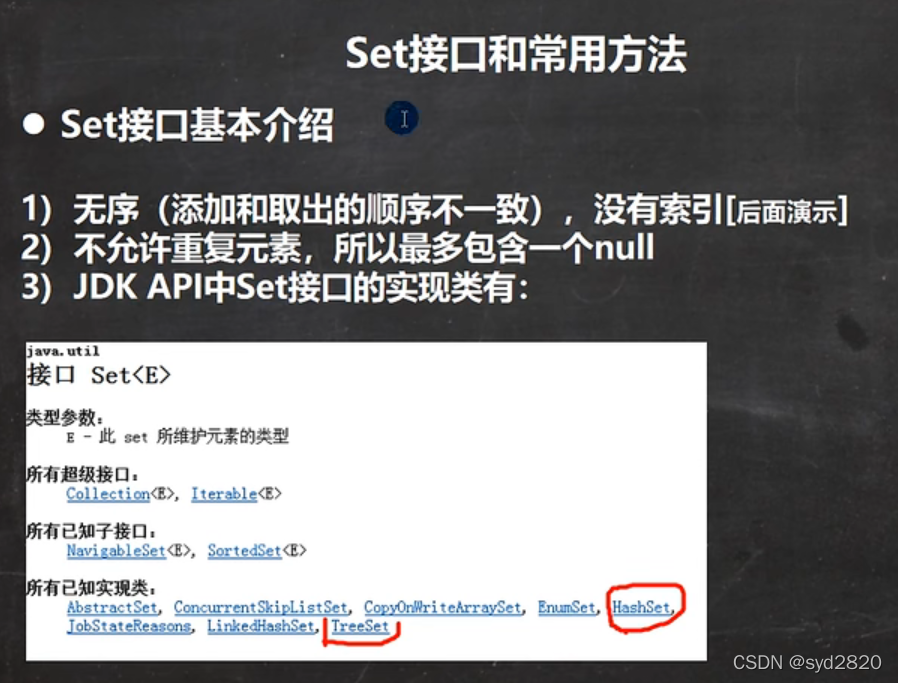
System.out.println(set);//[null, john, lucy] set接口的实现类的对象(Set接口对象),不能存放重复元素,可添加null,存放数据无序(按哈希值排序)
//遍历
Iterator iterator = set.iterator();//用迭代器
while (iterator.hasNext()) {
Object next = iterator.next();
System.out.println(next);
}
System.out.println("==================");
for (Object o:set){
System.out.println(o);//增强for
}
System.out.println("==================");
//set没有get方法,不能用普通for的索引遍历
set.remove(null);
System.out.println(set);
}
}
HashSet说明
package chapter17.Set;
import java.util.HashSet;
import java.util.Set;
public class HashSet01 {
public static void main(String[] args) {
Set hashSet = new HashSet();//底层是HashMap 看源码
hashSet.add(null);
hashSet.add(null);
System.out.println(hashSet);//HashSet 只能存一个null
//添加成功,返回true
System.out.println(hashSet.add("xx"));//T
System.out.println(hashSet.add("yy"));//T
System.out.println(hashSet.add("xx"));//F
System.out.println(hashSet.remove("xy"));//F
System.out.println(hashSet);//[null, xx, yy]
}
}
package chapter17.Set;
import java.util.HashSet;
import java.util.Set;
public class HashSet02 {
public static void main(String[] args) {
Set set = new HashSet();
System.out.println(set);
set.add("lucy");
set.add("lucy");//地址相同,加不成功
set.add(new Dog("tom"));
set.add(new Dog("tom"));//地址不同,可加成功
System.out.println(set);
set.add(new String("yy"));
set.add(new String("yy"));//不同堆,但指向一样,加不了
System.out.println(set);//[yy, Dog{name='tom'}, Dog{name='tom'}, lucy]
}
}
class Dog{
private String name;
public Dog(String name) {
this.name = name;
}
@Override
public String toString() {
return "Dog{" +
"name='" + name + '\'' +
'}';
}
}
HashSet链表
package chapter17.Set;
public class HashSetStructure {
public static void main(String[] args) {
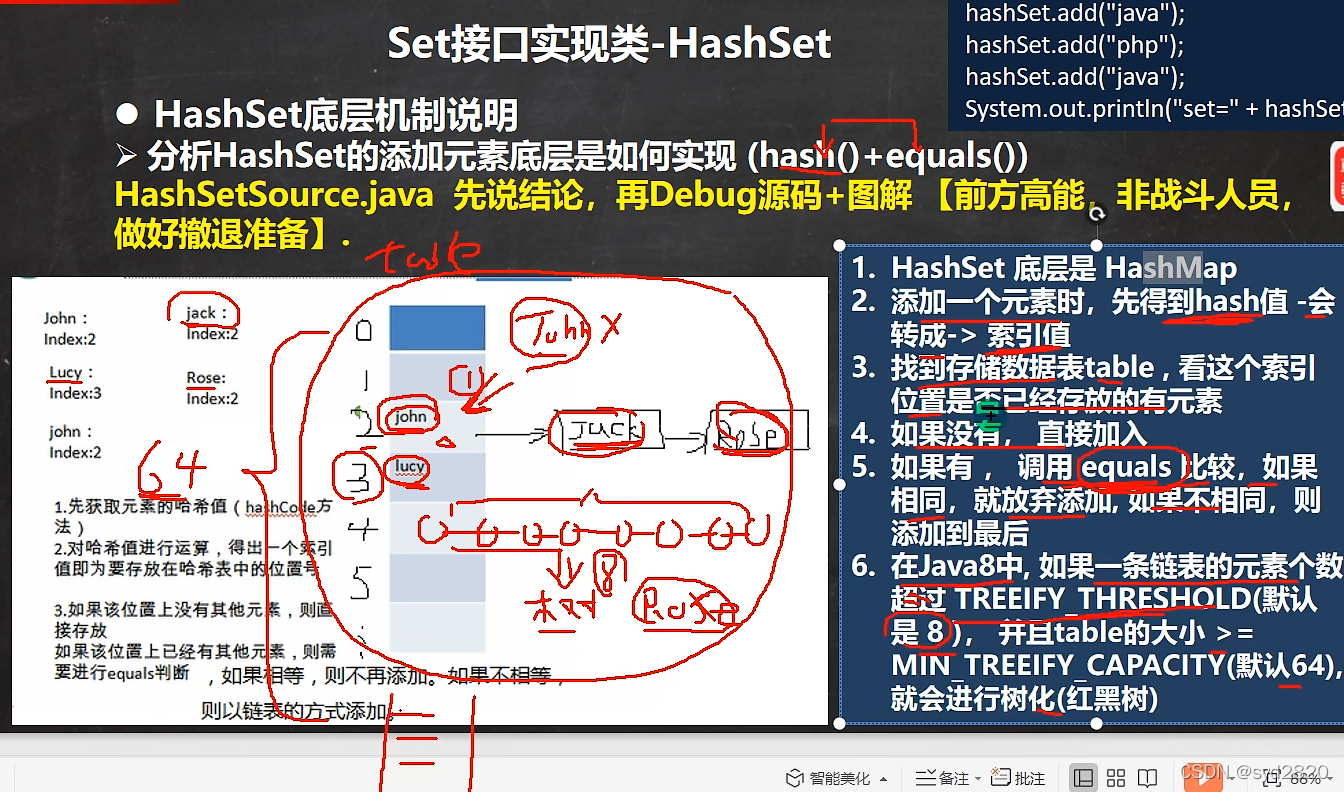
//模拟一个HashSet底层(HashMap底层结构)
//1.创建一个数组 类型 Node[] 可称为表
Node[] table = new Node[16];
Node john = new Node("john", null);
table[2]=john;
Node jack = new Node("jack", null);
john.next=jack; //将jack节点挂载到john
Node rose = new Node("Rose", null);
jack.next=rose;//将rose节点挂载到jack
System.out.println(table);
}
}
class Node{//节点,存储数据,可指向下一节点,形成链表
Object item;//存数据
Node next;//指向下一节点
public Node(Object item, Node next) {
this.item = item;
this.next = next;
}
}
HashSet链表断点
package chapter17.Set;
import java.util.HashSet;
public class HashSetSource {
public static void main(String[] args) {
HashSet hashSet = new HashSet();
hashSet.add("java");
hashSet.add("php");
hashSet.add("java");
System.out.println(hashSet);
}
}
HashSet扩容机制
package chapter17.Set;
import java.util.HashSet;
public class HashSetIncrement {
public static void main(String[] args) {
HashSet hashSet = new HashSet();
for (int i = 1; i <=100 ; i++) {
hashSet.add(i);//1-100
}
HashSet hashSet1 = new HashSet();
for (int i = 1; i <=12 ; i++) {
hashSet1.add(new A(i));
}
System.out.println(hashSet1);
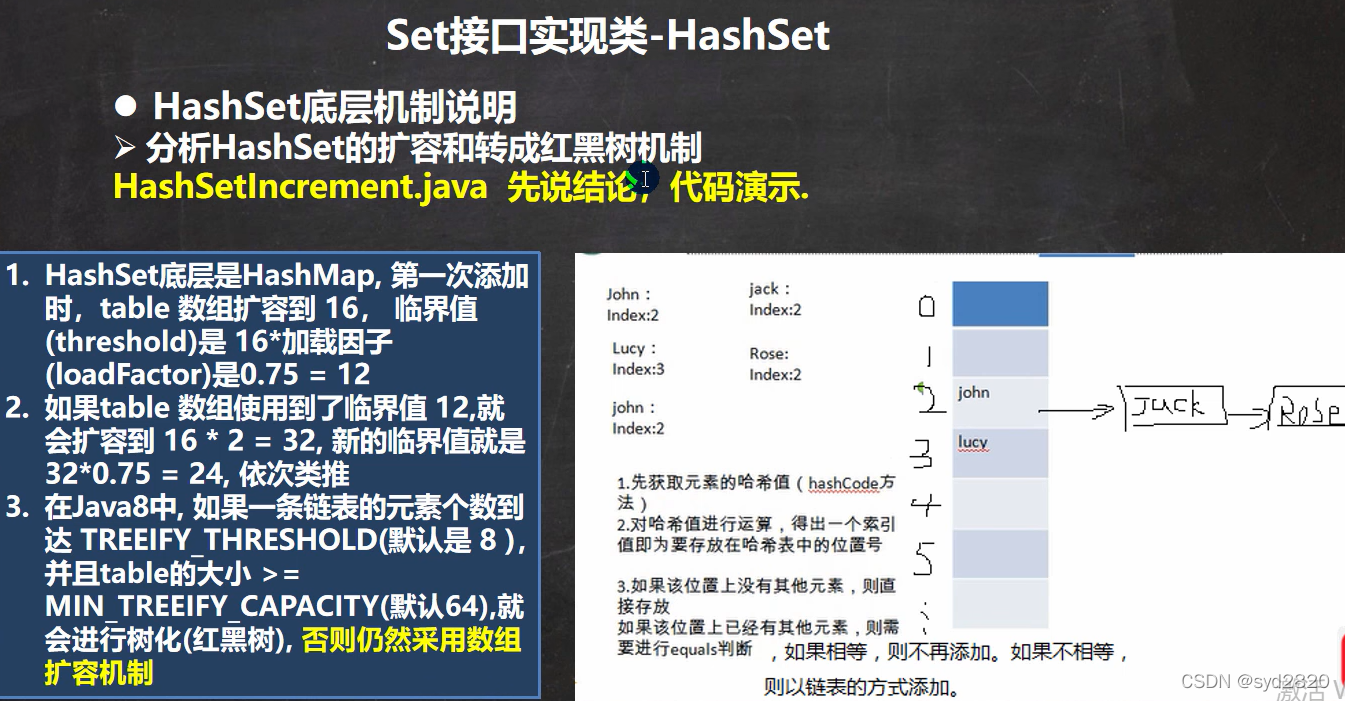
//链数变多达到条件后也会扩容(即使节点处没被占满)
}
}
class A{
private int n;
public A(int n) {
this.n = n;
}
@Override
public int hashCode() {
return 100;//哈希值一样,索引一样,能让所有元素放一个链上
}
}
HashSet练习
package chapter17.Set;
import java.util.HashSet;
import java.util.Objects;
public class HashSetExercise {
public static void main(String[] args) {
HashSet hashSet = new HashSet();
hashSet.add(new Employee("xx",6));
hashSet.add(new Employee("yy",8));
hashSet.add(new Employee("xx",6));
System.out.println(hashSet);
}
}
class Employee{
private String name;
private int age;
public Employee(String name, int age) {
this.name = name;
this.age = age;
}
//重写equals和hashCode,使得姓名和年龄一样时,返回相同hashCode值和equals,全一样就不添加
@Override
public boolean equals(Object o) {
if (this == o) return true;
if (o == null || getClass() != o.getClass()) return false;
Employee employee = (Employee) o;
return age == employee.age && Objects.equals(name, employee.name);
}
@Override
public int hashCode() {
return Objects.hash(name, age);
}
@Override
public String toString() {
return "Employee{" +
"name='" + name + '\'' +
", age=" + age +
'}';
}
}
package chapter17.Set;
import java.util.HashSet;
import java.util.Objects;
public class HashSetExercise02 {
public static void main(String[] args) {
HashSet hashSet = new HashSet();
hashSet.add(new Employee2("xx",58.8, 1993,2,25));//有
hashSet.add(new Employee2("xx",58.8, 1993,2,25));//无
hashSet.add(new Employee2("xx",60, 1993,2,25));//无
hashSet.add(new Employee2("xx",59.8, 1994,2,25));//有
hashSet.add(new Employee2("yy",5, 1993,2,25));//有
System.out.println(hashSet);
}
}
class Employee2{
private String name;
private double sal;
MyDate birthday;//在大类中可调用
public Employee2(String name, double sal,int year,int month,int day) {
this.name = name;
this.sal = sal;
birthday = new MyDate(year, month, day);
}
static class MyDate{
private int year;
private int month;
private int day;
public int getYear() {
return year;
}
public int getMonth() {
return month;
}
public int getDay() {
return day;
}
public MyDate(int year, int month, int day) {
this.year = year;
this.month = month;
this.day = day;
}
@Override//year, month, day属性相同时,则认为是同一个birthday
public boolean equals(Object o) {
if (this == o) return true;
if (o == null || getClass() != o.getClass()) return false;
MyDate myDate = (MyDate) o;
return year == myDate.year && month == myDate.month && day == myDate.day;
}
@Override
public int hashCode() {
return Objects.hash(year, month, day);
}
}
@Override//name, birthday 相同时,认为是同一员工
public boolean equals(Object o) {
if (this == o) return true;
if (o == null || getClass() != o.getClass()) return false;
Employee2 employee2 = (Employee2) o;
return Objects.equals(name, employee2.name) && Objects.equals(birthday, employee2.birthday);
}
@Override
public int hashCode() {
return Objects.hash(name, birthday);
}
@Override
public String toString() {
return "Employee2{" +
"name='" + name + '\'' +
", sal=" + sal +
'}';
}
}

 浙公网安备 33010602011771号