
数据结构期末 树
树
基本概念
1.最多一个先驱 但可能有多个后继 表示具有层次的分支关系
2.Siblings(兄弟): nodes share the same parent
Degree(树的扇出) of a tree: the maximum number of its node.
3.深度为最大层数
第i层最多2^i个结点
4.完全二叉树:满二叉树去掉最下面一层最右边若干节点
完全二叉树深度 log2(n)向下取整
第i个结点 左孩子2i+1 右孩子2i+2
父结点(i-1)/2
5.preorder(TreeNode * root){
if(root!=NULL){
cout<<root->val<<endl;
preorder(root->left);
preorder(root->right);}
inorder(TreeNode * root){
if(root!=NULL){
inorder(root->left);
cout<<root->value<<endl;
inorder(root->right);}
postorder
6.完全二叉树的数组存储
孩子与父亲节点的关系父亲i 左孩子2i+1 右孩子2i+2
7.完全二叉树插入、删除(3种情况)、查找、利用二叉查找树排序
插入
在二叉树末尾插入 只需要知道二叉树父节点的信息 即父节点的指针
当前插入节点temp=size();
判断是左节点还是右节点;将信息入栈
求出父节点的索引;
判断父节点是否为根节点,若不是重复上述操作;
查找到根节点后栈内保存从根节点到插入节点的信息,获取父节点指针;
将当前信息插入树中;
二叉搜索树
tree search
递归
TreeNode *search_for_node(TreeNode * root,int &target){
if(root==NULL||root->val==target) return root;
else if(target>root->val) return search_for_node(root->right,target);
else  return search_for_node(root->left,target);
}
非递归
TreeNode *search_for_node(TreeNode * root,int &target){
while(root!=NULL&&root->val!=target)
{
if(root->val>target) root=root->right;
else root=root->left;}
return root;}
template <class Record>
Error_code Search_tree<Record> :: tree_search(Record &target) const
{
    Error_code result = success;
    Binary_node<Record> *found = search_for_node(root, target);
    if (found == NULL)
        result = not_present;
    else
        target = found->data;
    return result;
}
二叉查找树insert
template <class Record>
Error_code Search_tree<Record> :: insert(
                                             const Record &new_data)
{//插入成功返回 success
  //插入失败返回 duplicate_error
    Error_code result=search_and_insert(root, new_data);
    if(result==success)count++;
    return result;
}
template <class Record>
Error_code Search_tree<Record> :: search_and_insert(
                       Binary_node<Record> * &sub_root ,
                       const Record &new_data)
{if(sub_root==NULL) {sub_root=new Binary_node<Record>(new_data) ;
return success;}
else if(new_data>sub_root->val) return search_and_insert(sub_root->right,new_data);
else if(new_data<sub_root->val) return search_and_insert(sub_root->left,new_data);
else return duplicate_error;}
二叉查找树中序遍历即为有序序列
适用于无序序列 对基本有序序列排序效率较低 (较不平衡
二叉查找树的删除
1)删除节点为叶子节点 左右子树均为空
2)删除节点左右子树有一个非空 子树根节点与删除节点的父亲相连
3)删除节点左右子树均非空
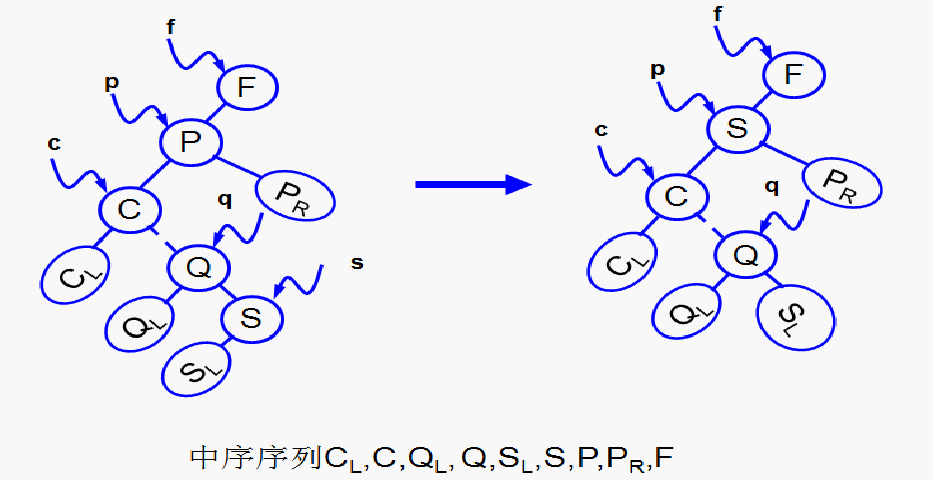
找到被删除节点中序遍历的前驱 用前驱代替被删除点
template <class Record>
Error_code Search_tree<Record> :: remove(const Record &target)
/* Post: If a Record with a key matching that of target belongs to the Search tree a code of success is returned and the corresponding node is removed from the
tree. Otherwise, a code of not present is returned.
Uses: Function search_and_destroy */
{
    Error_code result=search_and_destroy(root, target);
    if(result==success)count--;
    return result;
}
Error_code Search_tree<Record> :: search_and_destroy(
                                                           Binary_node<Record>* &sub_root,
                                                           const Record &target)
{if(sub_root==NULL||sub_root->val==target)
return remove_root(sub_root);
else if(sub_root->val>target) return search_and_destroy(root->right);
return search_and_destroy(root->left);}
template <class Record>
Error_code Search_tree<Record> :: remove_root(Binary_node<Record> * &sub_root)
{if(sub_root==NULL) return not_present;
Binary_node<Record> *to_delete=sub_root;
else if(sub_root->right!=NULL) sub_root=sub_root->right);
else if(sub_root->left!=NULL) sub_root=sub_root->left;
else{
to_delete=sub_root->left;
Binary_node<Record> * parent=sub_root;
while(to_delete->right!=NULL){
parent=to_delete;
to_delete=to_delete->right;}
if(parent==sub_root)sub_root->left=to_delete->left;
else parent->right=to_delete->left;}
delete to_delete; // Remove to_delete from tree.
return success; }
8.堆
1)完全二叉树的存储 用数组存
2)堆和完全二叉树对应
3)堆的定义 大顶堆 父亲比孩子大的完全二叉树
4)堆的调整 先决条件 左右孩子都是堆
固定操作 取max 调整堆
5)Build-Heap(A) for i from n/2 downto 1 do Heapify(A, i)
从第一个非叶子节点开始从后往前依次进行对调整
6)堆排序 空间复杂度O(1) 因为将堆顶取出 将取出的数放到数组尾部 从后往前 堆不断变小 从第一个非叶子节点从后往前一次调整成堆 通过调整操作建成堆
第一步 构造初始堆 将给定无序序列构造成大顶堆(一般降序用小顶堆 升序用大顶堆)
第二步 将堆顶元素与末尾元素交换 使数组末尾元素最大
然后调整堆 再将堆顶元素和末尾元素交换 如此反复操作
思路总结
a.将无需序列构建成一个堆,根据升序降序需求选择大顶堆或小顶堆;
b.将堆顶元素与末尾元素交换,将最大元素"沉"到数组末端;
c.重新调整结构,使其满足堆定义,然后继续交换堆顶元素与当前末尾元素,反复执行调整+交换步骤,直到整个序列有序。
时间复杂度 O(nlogn)
它的最坏,最好,平均时间复杂度均为O(nlogn)
7)结合完全二叉树存储 堆排序在数组中怎么变
8)Topk算法 //往堆上想
若要时刻输出最大的K个数 维护一个小顶堆 每次弹出堆中最小的元素 保证堆内元素是最大的K 个
时间复杂度O(klogk)
9.AVL树
如何判断是否是一颗AVL树
先判断该树中序遍历后是否有序
在判断是否平衡
10.Trie树
Tries 应用 字符串匹配的相关算法, 如前缀匹配-type ahead
11.树上基本的递归操作 节点的存储
https://juejin.im/post/5b3b55c2e51d45195d7d8c20
最大深度
int depth(TreeNode * root)
{
if(root==NULL)return 0;
return 1+max(depth(root->left),depth(root->right));}
111二叉树的最小深度
 int minDepth(TreeNode* root) {
        if(root==NULL)return 0;
        if(root->left==NULL&&root->right==NULL)return 1;
        if(root->left==NULL&&root->right!=NULL)return  minDepth(root->right)+1;
        if(root->right==NULL&&root->left!=NULL)return minDepth(root->left)+1;
        return min(minDepth(root->left),minDepth(root->right))+1;
    }
226翻转二叉树
TreeNode* invertTree(TreeNode* root) {
        if(root==NULL)return NULL;
        swap(root->left,root->right);
        invertTree(root->left);
        invertTree(root->right);
        return root;
    }
110平衡二叉树
 bool isBalanced(TreeNode * root){
if(root==NULL)return true;
if(abs(depth(root->left)-depth(root->right))>1)
return false;
return isBalanced(root->left)&&isBalanced(root->right);}
100相同的树
 bool isSameTree(TreeNode* p, TreeNode* q) {
        if(p==NULL&&q==NULL)return true;
        if(p==NULL&&q!=NULL)return false;
        if(p!=NULL&&q==NULL)return false;
        if(p->val!=q->val)return false;
        return isSameTree(p->left,q->left)&&isSameTree(p->right,q->right);
    }
101对称二叉树
 bool isSymmetric(TreeNode* root) {
        if(root==NULL)return true;
        return ismirror(root->left,root->right);
    }
    bool ismirror(TreeNode * p,TreeNode * q)
    {
        if(p==NULL&&q==NULL)return true;
        if(p!=NULL&&q==NULL)return false;
        if(p==NULL&&q!=NULL)return false;
        if(p->val!=q->val)return false;
        return ismirror(p->left,q->right)&&ismirror(p->right,q->left);
    }
222完全二叉树结点个数
  int countNodes(TreeNode* root) {
        if(root==NULL)return 0;
        return countNodes(root->left)+countNodes(root->right)+1;
    }
112路径总和
 bool hasPathSum(TreeNode* root, int sum) {
        if(root==NULL)return false;
        if(root->left==NULL&&root->right==NULL)return root->val==sum;
        return hasPathSum(root->left,sum-root->val)||hasPathSum(root->right,sum-root->val);
    }
257二叉树的所有路径
 vector<string> binaryTreePaths(TreeNode* root) {
        if(root==NULL)return res;
        binary(root,res,"");
        return res;
    }
    void binary(TreeNode * root,vector<string>&res,string path)
    {
        if(root==NULL)return;
        path+=to_string(root->val);
        if(root->left==NULL&&root->right==NULL)
        res.push_back(path);
        if(root->left!=NULL)binary(root->left,res,path+"->");
        if(root->right!=NULL)binary(root->right,res,path+"->");
    }
129求根到叶子节点数之和
int result=0;
int temp=0;
    int sumNumbers(TreeNode* root) {
     dfs(root);
     return result;
    }
    void dfs(TreeNode * root)
    {
        if(root==NULL)return ;
        temp=10*temp+root->val;
        if(root->left==NULL&&root->right==NULL)
        result+=temp;
        if(root->left)
        {dfs(root->left);
        temp/=10;
        }
        if(root->right)
         {dfs(root->right);
        temp/=10;
        }
    }
437路径总和3
int pathSum(TreeNode* root, int sum) {
        if(root==NULL)return 0;
       return path(root,sum)+pathSum(root->left,sum)+pathSum(root->right,sum);
    }
    int path(TreeNode * root,int sum)
    {
        if(root==NULL)return 0;
        return (root->val==sum)+path(root->left,sum-root->val)+path(root->right,sum-root->val);
    }
二叉树最大路径和
  int maxPathSum(TreeNode* root) {
        if(root==NULL)return 0;
        int result=-1000;
      maxPath(root,result);
return result;
    }
    int maxPath(TreeNode * root,int &val)
    {
        if(root==NULL)return 0;
        int left=max(0,maxPath(root->left,val));
        int right=max(0,maxPath(root->right,val));
        int ret=root->val+max(left,right);
        int lar=root->val+left+right;
        val=max(val,max(lar,ret));
        return ret;
    }
113路径总和2
vector<vector<int>>result;
vector<int>path;
    vector<vector<int>> pathSum(TreeNode* root, int sum) {
        if(root==NULL)return result;
       hasPath(root,sum,result,path);
       return result;
    }
    void hasPath(TreeNode * root,int sum,vector<vector<int>>&result,vector<int>&path)
    {path.push_back(root->val);
        if(root->left==NULL&&root->right==NULL&&root->val==sum)
       {result.push_back(path);
        return;}

        if(root->left!=NULL)
        {
           hasPath(root->left,sum-root->val,result,path);
           path.pop_back();
        }
         if(root->right!=NULL)
        {
           hasPath(root->right,sum-root->val,result,path);
           path.pop_back();
        }
    }

 浙公网安备 33010602011771号