
Pytorch.nn.conv2d 过程验证(单,多通道卷积过程)
来源 https://zhuanlan.zhihu.com/p/32190799
今天在看文档的时候,发现pytorch 的conv操作不是很明白,于是有了一下记录
首先提出两个问题:
1.输入图片是单通道情况下的filters是如何操作的? 即一通道卷积核卷积过程
2.输入图片是多通道情况下的filters是如何操作的? 即多通道多个卷积核卷积过程
这里首先贴出官方文档:
classtorch.nn.Conv2d(in_channels, out_channels, kernel_size, stride=1, padding=0, dilation=1, groups=1, bias=True)[source]
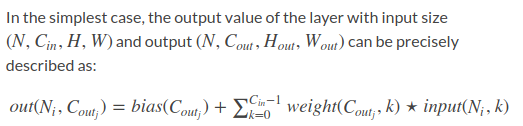
Parameters:
- in_channels (int) – Number of channels in the input image
- out_channels (int) – Number of channels produced by the convolution
- kernel_size (intortuple) – Size of the convolving kernel
- stride (intortuple,optional) – Stride of the convolution. Default: 1
- padding (intortuple,optional) – Zero-padding added to both sides of the input. Default: 0
- dilation (intortuple,optional) – Spacing between kernel elements. Default: 1
- groups (int,optional) – Number of blocked connections from input channels to output channels. Default: 1
- bias (bool,optional) – If True, adds a learnable bias to the output. Default: True
这个文档中的公式对我来说,并不能看的清楚

一通道卷积核卷积过程:
比如32个卷积核,可以学习32种特征。在有多个卷积核时,如下图所示:输出就为32个feature map
也就是, 当conv2d( in_channels = 1 , out_channels = N)
有N个filter对输入进行滤波。同时输出N个结果即feature map,每个filter滤波输出一个结果.
import torch
from torch.autograd import Variable
##单位矩阵来模拟输入
input=torch.ones(1,1,5,5)
input=Variable(input)
x=torch.nn.Conv2d(in_channels=1,out_channels=3,kernel_size=3,groups=1)
out=x(input)
print(out)
print(list(x.parameters()))
输出out的结果和conv2d 的参数如下,可以看到,conv2d是有3个filter加一个bias
# out的结果
Variable containing:
(0 ,0 ,.,.) =
 -0.3065 -0.3065 -0.3065
 -0.3065 -0.3065 -0.3065
 -0.3065 -0.3065 -0.3065

(0 ,1 ,.,.) =
 -0.3046 -0.3046 -0.3046
 -0.3046 -0.3046 -0.3046
 -0.3046 -0.3046 -0.3046

(0 ,2 ,.,.) =
  0.0710  0.0710  0.0710
  0.0710  0.0710  0.0710
  0.0710  0.0710  0.0710
[torch.FloatTensor of size 1x3x3x3]

# conv2d的参数
[Parameter containing:
(0 ,0 ,.,.) =
 -0.0789 -0.1932 -0.0990
  0.1571 -0.1784 -0.2334
  0.0311 -0.2595  0.2222

(1 ,0 ,.,.) =
 -0.0703 -0.3159 -0.3295
  0.0723  0.3019  0.2649
 -0.2217  0.0680 -0.0699

(2 ,0 ,.,.) =
 -0.0736 -0.1608  0.1905
  0.2738  0.2758 -0.2776
 -0.0246 -0.1781 -0.0279
[torch.FloatTensor of size 3x1x3x3]
, Parameter containing:
 0.3255
-0.0044
 0.0733
[torch.FloatTensor of size 3]
]
验证如下,因为是单位矩阵,所以直接对参数用sum()来模拟卷积过程:
f_p=list(x.parameters())[0]
f_p=f_p.data.numpy()
print("the result of first channel in image:", f_p[0].sum()+(0.3255))
可以看到结果是和(0 ,0 ,.,.) = -0.3065 ....一样的. 说明操作是通过卷积求和的.
the result of first channel in image: -0.306573044777
多通道卷积核卷积过程:
下图展示了在四个通道上的卷积操作,有两个卷积核,生成两个通道。其中需要注意的是,四个通道上每个通道对应一个卷积核,先将w2忽略,只看w1,那么在w1的某位置(i,j)处的值,是由四个通道上(i,j)处的卷积结果相加得到的。 所以最后得到两个feature map, 即输出层的卷积核核个数为 feature map 的个数。
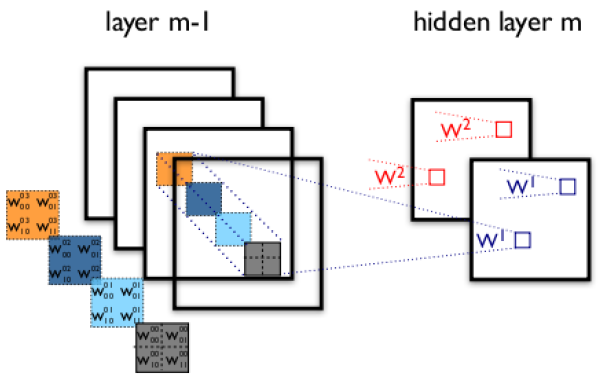
在pytorch 中的展示为
conv2d( in_channels = X(x>1) , out_channels = N)
有N乘X个filter(N组filters,每组X 个)对输入进行滤波。即每次有一组里X个filter对原X个channels分别进行滤波最后相加输出一个结果,最后输出N个结果即feature map。
验证如下:
##单位矩阵来模拟输入
input=torch.ones(1,3,5,5)
input=Variable(input)
x=torch.nn.Conv2d(in_channels=3,out_channels=4,kernel_size=3,groups=1)
out=x(input)
print(list(x.parameters()))
可以看到共有4*3=12个filter 和一个1×4的bias 作用在这个(3,5,5)的单位矩阵上
## out输出的结果
Variable containing:
(0 ,0 ,.,.) =
 -0.6390 -0.6390 -0.6390
 -0.6390 -0.6390 -0.6390
 -0.6390 -0.6390 -0.6390

(0 ,1 ,.,.) =
 -0.1467 -0.1467 -0.1467
 -0.1467 -0.1467 -0.1467
 -0.1467 -0.1467 -0.1467

(0 ,2 ,.,.) =
  0.4138  0.4138  0.4138
  0.4138  0.4138  0.4138
  0.4138  0.4138  0.4138

(0 ,3 ,.,.) =
 -0.3981 -0.3981 -0.3981
 -0.3981 -0.3981 -0.3981
 -0.3981 -0.3981 -0.3981
[torch.FloatTensor of size 1x4x3x3]

## x的参数设置
[Parameter containing:
(0 ,0 ,.,.) =
 -0.0803  0.1473 -0.0762
  0.0284 -0.0050 -0.0246
  0.1438  0.0955 -0.0500

(0 ,1 ,.,.) =
  0.0716  0.0062 -0.1472
  0.1793  0.0543 -0.1764
 -0.1548  0.1379  0.1143

(0 ,2 ,.,.) =
 -0.1741 -0.1790 -0.0053
 -0.0612 -0.1856 -0.0858
 -0.0553  0.1621 -0.1822

(1 ,0 ,.,.) =
 -0.0773 -0.1385  0.1356
  0.1794 -0.0534 -0.1110
 -0.0137 -0.1744 -0.0188

(1 ,1 ,.,.) =
 -0.0396  0.0149  0.1537
  0.0846 -0.1123 -0.0556
 -0.1047 -