RocketMQ-4.NameServer
NameServer
RouteInfoManager 所有的集群状态的维护者
RouteInfoManager基本结构:
public class RouteInfoManager {
    private static final InternalLogger log = InternalLoggerFactory.getLogger(LoggerName.NAMESRV_LOGGER_NAME);
    private final static long BROKER_CHANNEL_EXPIRED_TIME = 1000 * 60 * 2;
    private final ReadWriteLock lock = new ReentrantReadWriteLock();
    private final HashMap<String/* topic */, List<QueueData>> topicQueueTable; //topic和queue列表的映射
    private final HashMap<String/* brokerName */, BrokerData> brokerAddrTable;//brokerName和Broker信息的映射
    private final HashMap<String/* clusterName */, Set<String/* brokerName */>> clusterAddrTable;//集群名和BrokerName的映射
    private final HashMap<String/* brokerAddr */, BrokerLiveInfo> brokerLiveTable;//broker地址和broker运行状态的映射
    private final HashMap<String/* brokerAddr */, List<String>/* Filter Server */> filterServerTable;//broker地址和过滤器列表的映射

    public RouteInfoManager() {
        this.topicQueueTable = new HashMap<String, List<QueueData>>(1024);
        this.brokerAddrTable = new HashMap<String, BrokerData>(128);
        this.clusterAddrTable = new HashMap<String, Set<String>>(32);
        this.brokerLiveTable = new HashMap<String, BrokerLiveInfo>(256);
        this.filterServerTable = new HashMap<String, List<String>>(256);
    }
}
状态维护逻辑
其他角色会主动向NamerServer更新状态,其主要逻辑在DefaultRequestProcessor类中,根据不同的请求码做对应的处理:
    @Override
    public RemotingCommand processRequest(ChannelHandlerContext ctx,
        RemotingCommand request) throws RemotingCommandException {

        if (ctx != null) {
            log.debug("receive request, {} {} {}",
                request.getCode(),
                RemotingHelper.parseChannelRemoteAddr(ctx.channel()),
                request);
        }


        switch (request.getCode()) {
            case RequestCode.PUT_KV_CONFIG:
                return this.putKVConfig(ctx, request);
            case RequestCode.GET_KV_CONFIG:
                return this.getKVConfig(ctx, request);
            case RequestCode.DELETE_KV_CONFIG:
                return this.deleteKVConfig(ctx, request);
            case RequestCode.QUERY_DATA_VERSION:
                return queryBrokerTopicConfig(ctx, request);
            case RequestCode.REGISTER_BROKER:
                Version brokerVersion = MQVersion.value2Version(request.getVersion());
                if (brokerVersion.ordinal() >= MQVersion.Version.V3_0_11.ordinal()) {
                    return this.registerBrokerWithFilterServer(ctx, request);
                } else {
                    return this.registerBroker(ctx, request);
                }
            case RequestCode.UNREGISTER_BROKER:
                return this.unregisterBroker(ctx, request);
            case RequestCode.GET_ROUTEINFO_BY_TOPIC:
                return this.getRouteInfoByTopic(ctx, request);
            case RequestCode.GET_BROKER_CLUSTER_INFO:
                return this.getBrokerClusterInfo(ctx, request);
            case RequestCode.WIPE_WRITE_PERM_OF_BROKER:
                return this.wipeWritePermOfBroker(ctx, request);
            case RequestCode.GET_ALL_TOPIC_LIST_FROM_NAMESERVER:
                return getAllTopicListFromNameserver(ctx, request);
            case RequestCode.DELETE_TOPIC_IN_NAMESRV:
                return deleteTopicInNamesrv(ctx, request);
            case RequestCode.GET_KVLIST_BY_NAMESPACE:
                return this.getKVListByNamespace(ctx, request);
            case RequestCode.GET_TOPICS_BY_CLUSTER:
                return this.getTopicsByCluster(ctx, request);
            case RequestCode.GET_SYSTEM_TOPIC_LIST_FROM_NS:
                return this.getSystemTopicListFromNs(ctx, request);
            case RequestCode.GET_UNIT_TOPIC_LIST:
                return this.getUnitTopicList(ctx, request);
            case RequestCode.GET_HAS_UNIT_SUB_TOPIC_LIST:
                return this.getHasUnitSubTopicList(ctx, request);
            case RequestCode.GET_HAS_UNIT_SUB_UNUNIT_TOPIC_LIST:
                return this.getHasUnitSubUnUnitTopicList(ctx, request);
            case RequestCode.UPDATE_NAMESRV_CONFIG:
                return this.updateConfig(ctx, request);
            case RequestCode.GET_NAMESRV_CONFIG:
                return this.getConfig(ctx, request);
            default:
                break;
        }
        return null;
    }
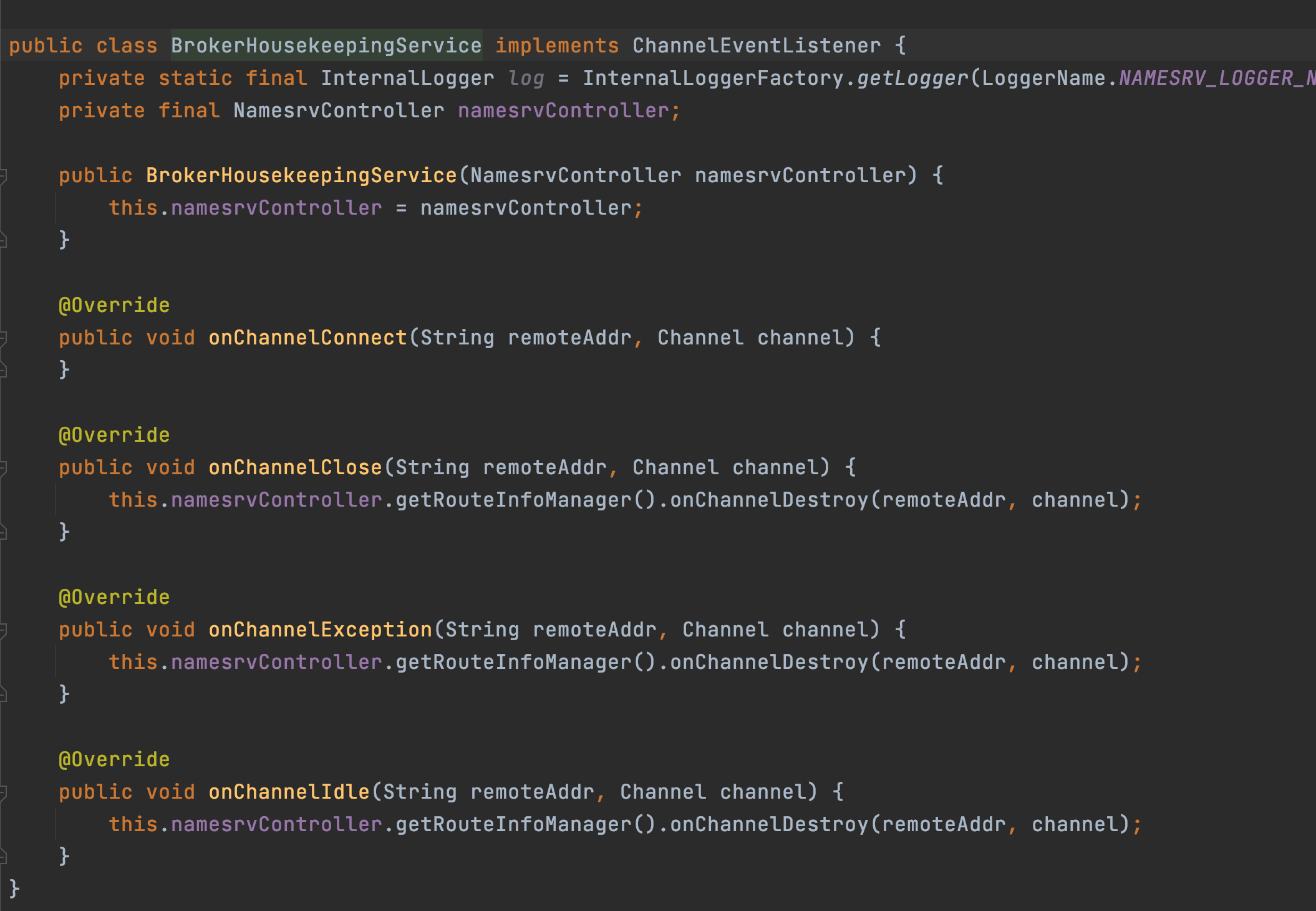
此外,断开的事件也会触发状态更新,具体逻辑在BrokerHousekeepingService类中
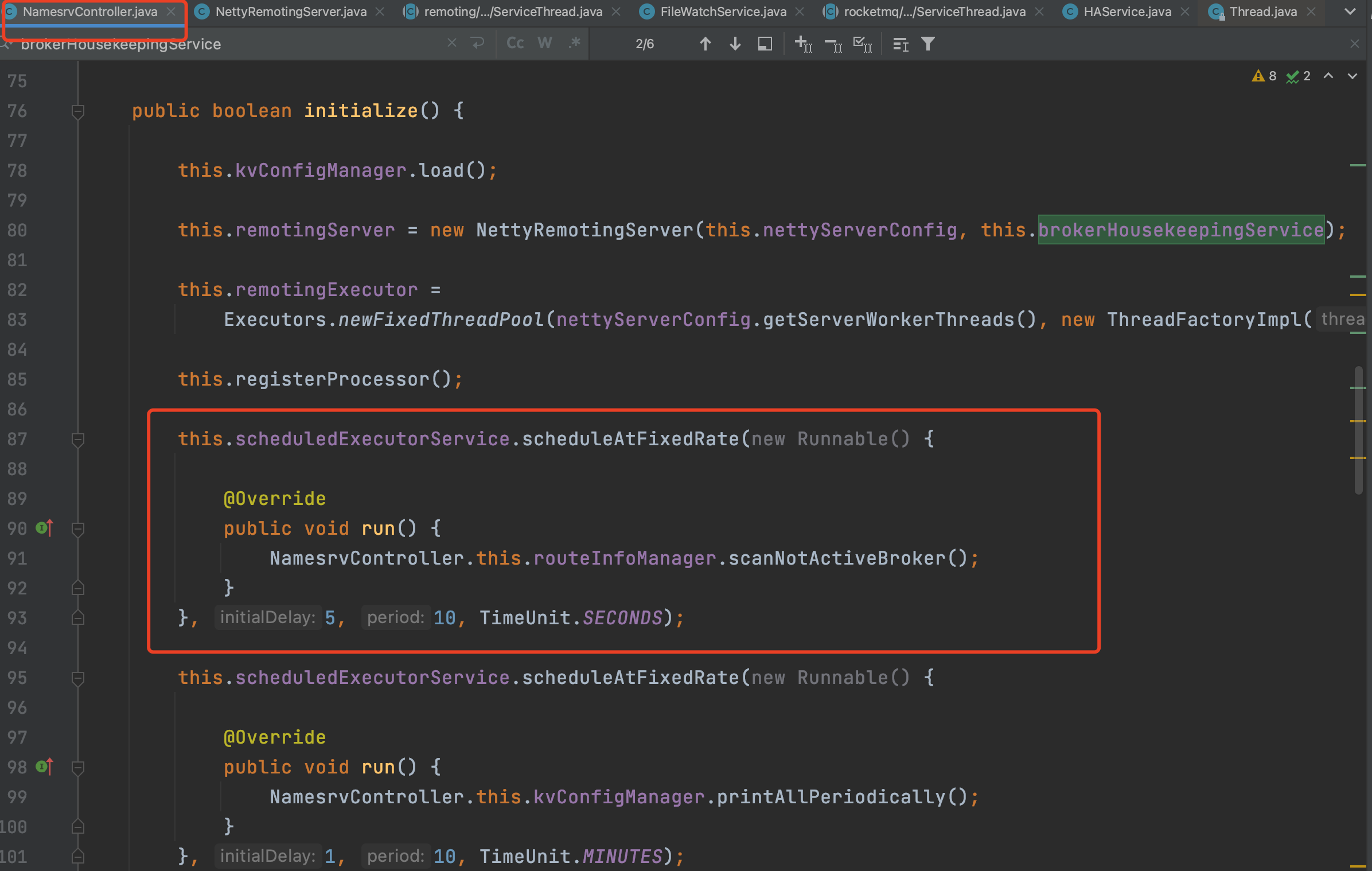
此外,NameServer还有定时检查时间戳的逻辑,Broker向NameServer发送心跳包会更新时间戳,档NameServer检查到时间戳长时间没有更新后,便会触发清理逻辑,如下:
    public void scanNotActiveBroker() {
        Iterator<Entry<String, BrokerLiveInfo>> it = this.brokerLiveTable.entrySet().iterator();
        while (it.hasNext()) {
            Entry<String, BrokerLiveInfo> next = it.next();
            long last = next.getValue().getLastUpdateTimestamp();
            if ((last + BROKER_CHANNEL_EXPIRED_TIME) < System.currentTimeMillis()) {
                RemotingUtil.closeChannel(next.getValue().getChannel());
                it.remove();
                log.warn("The broker channel expired, {} {}ms", next.getKey(), BROKER_CHANNEL_EXPIRED_TIME);
                this.onChannelDestroy(next.getKey(), next.getValue().getChannel());
            }
        }
    }
每10秒检测一次,超过2分钟,会将Broker从RouteInfoManager维护的列表中去除。
各角色间的交互流程
创建Topic的节点
仅仅以创建Topic作为一个例子:
客户端通过MQAdminStartup启动,输入的 createTopic -b xxx -x xxx 之类的命令,内部会转化成对应的SubCommand,创建Topic的command为UpdateTopicSubCommand,其实现SubCommand,主要有buildCommandLine 和execute两个方法。
先看下buildCommandLine方法的具体逻辑:
RocketMQ 命令行解析使用的是org.apache.commons.cli,会生成CommandLine,然后利用cli框架解析commandLine最终转换成RemotingCommand指令,发送给Broker去执行。
    @Override
    public Options buildCommandlineOptions(Options options) {
        OptionGroup optionGroup = new OptionGroup();//命令组

        Option opt = new Option("b", "brokerAddr", true, "create topic to which broker");
        optionGroup.addOption(opt);

        opt = new Option("c", "clusterName", true, "create topic to which cluster");
        optionGroup.addOption(opt);

        optionGroup.setRequired(true);
        options.addOptionGroup(optionGroup);

        opt = new Option("t", "topic", true, "topic name");
        opt.setRequired(true);
        options.addOption(opt);

        opt = new Option("r", "readQueueNums", true, "set read queue nums");
        opt.setRequired(false);
        options.addOption(opt);

        opt = new Option("w", "writeQueueNums", true, "set write queue nums");
        opt.setRequired(false);
        options.addOption(opt);

        opt = new Option("p", "perm", true, "set topic's permission(2|4|6), intro[2:W 4:R; 6:RW]");
        opt.setRequired(false);
        options.addOption(opt);

        opt = new Option("o", "order", true, "set topic's order(true|false)");
        opt.setRequired(false);
        options.addOption(opt);

        opt = new Option("u", "unit", true, "is unit topic (true|false)");
        opt.setRequired(false);
        options.addOption(opt);

        opt = new Option("s", "hasUnitSub", true, "has unit sub (true|false)");
        opt.setRequired(false);
        options.addOption(opt);

        return options;
    }
UpdateTopicSubCommand.execute()
--> DefaultMQAdminExt.createAndUpdateTopicConfig()
--> DefaultMQAdminExtImpl.createAndUpdateTopicConfig
--> MQClientInstance..getMQClientAPIImpl().createTopic()
--> this.remotingClient.invokeSync(CreateTopicCommand)
topic具体的创建逻辑是execute方法里面,最终的执行逻辑是在 MQClientAPIImpl 里。
部分源码如下:
    @Override
    public void execute(final CommandLine commandLine, final Options options,
        RPCHook rpcHook) throws SubCommandException {
        DefaultMQAdminExt defaultMQAdminExt = new DefaultMQAdminExt(rpcHook);
        defaultMQAdminExt.setInstanceName(Long.toString(System.currentTimeMillis()));

        try {
            TopicConfig topicConfig = new TopicConfig();
            topicConfig.setReadQueueNums(8);
            topicConfig.setWriteQueueNums(8);
            topicConfig.setTopicName(commandLine.getOptionValue('t').trim());

            // readQueueNums
            if (commandLine.hasOption('r')) {
                topicConfig.setReadQueueNums(Integer.parseInt(commandLine.getOptionValue('r').trim()));
            }

            // writeQueueNums
            if (commandLine.hasOption('w')) {
                topicConfig.setWriteQueueNums(Integer.parseInt(commandLine.getOptionValue('w').trim()));
            }

            // perm
            if (commandLine.hasOption('p')) {
                topicConfig.setPerm(Integer.parseInt(commandLine.getOptionValue('p').trim()));
            }

            boolean isUnit = false;
            if (commandLine.hasOption('u')) {
                isUnit = Boolean.parseBoolean(commandLine.getOptionValue('u').trim());
            }

            boolean isCenterSync = false;
            if (commandLine.hasOption('s')) {
                isCenterSync = Boolean.parseBoolean(commandLine.getOptionValue('s').trim());
            }

            int topicCenterSync = TopicSysFlag.buildSysFlag(isUnit, isCenterSync);
            topicConfig.setTopicSysFlag(topicCenterSync);

            boolean isOrder = false;
            if (commandLine.hasOption('o')) {
                isOrder = Boolean.parseBoolean(commandLine.getOptionValue('o').trim());
            }
            topicConfig.setOrder(isOrder);

            if (commandLine.hasOption('b')) {
                String addr = commandLine.getOptionValue('b').trim();

                defaultMQAdminExt.start();
                defaultMQAdminExt.createAndUpdateTopicConfig(addr, topicConfig);//这里发送Command给Broker

                if (isOrder) {
                    String brokerName = CommandUtil.fetchBrokerNameByAddr(defaultMQAdminExt, addr);
                    String orderConf = brokerName + ":" + topicConfig.getWriteQueueNums();
                    defaultMQAdminExt.createOrUpdateOrderConf(topicConfig.getTopicName(), orderConf, false);
                    System.out.printf("%s", String.format("set broker orderConf. isOrder=%s, orderConf=[%s]",
                        isOrder, orderConf.toString()));
                }
                System.out.printf("create topic to %s success.%n", addr);
                System.out.printf("%s", topicConfig);
                return;

            } else if (commandLine.hasOption('c')) {
                String clusterName = commandLine.getOptionValue('c').trim();

                defaultMQAdminExt.start();

                Set<String> masterSet =
                    CommandUtil.fetchMasterAddrByClusterName(defaultMQAdminExt, clusterName);
                for (String addr : masterSet) {//cluster的broker全部遍历创建
                    defaultMQAdminExt.createAndUpdateTopicConfig(addr, topicConfig);
                    System.out.printf("create topic to %s success.%n", addr);
                }

                if (isOrder) {
                    Set<String> brokerNameSet =
                        CommandUtil.fetchBrokerNameByClusterName(defaultMQAdminExt, clusterName);
                    StringBuilder orderConf = new StringBuilder();
                    String splitor = "";
                    for (String s : brokerNameSet) {
                        orderConf.append(splitor).append(s).append(":")
                            .append(topicConfig.getWriteQueueNums());
                        splitor = ";";
                    }
                    defaultMQAdminExt.createOrUpdateOrderConf(topicConfig.getTopicName(),
                        orderConf.toString(), true);
                    System.out.printf("set cluster orderConf. isOrder=%s, orderConf=[%s]", isOrder, orderConf);
                }

                System.out.printf("%s", topicConfig);
                return;
            }

            ServerUtil.printCommandLineHelp("mqadmin " + this.commandName(), options);
        } catch (Exception e) {
            throw new SubCommandException(this.getClass().getSimpleName() + " command failed", e);
        } finally {
            defaultMQAdminExt.shutdown();
        }
    }
客户端发送command
最终的执行逻辑:
    public void createTopic(final String addr, final String defaultTopic, final TopicConfig topicConfig,
        final long timeoutMillis)
        throws RemotingException, MQBrokerException, InterruptedException, MQClientException {
        CreateTopicRequestHeader requestHeader = new CreateTopicRequestHeader();
        requestHeader.setTopic(topicConfig.getTopicName());
        requestHeader.setDefaultTopic(defaultTopic);
        requestHeader.setReadQueueNums(topicConfig.getReadQueueNums());
        requestHeader.setWriteQueueNums(topicConfig.getWriteQueueNums());
        requestHeader.setPerm(topicConfig.getPerm());
        requestHeader.setTopicFilterType(topicConfig.getTopicFilterType().name());
        requestHeader.setTopicSysFlag(topicConfig.getTopicSysFlag());
        requestHeader.setOrder(topicConfig.isOrder());

        RemotingCommand request = RemotingCommand.createRequestCommand(RequestCode.UPDATE_AND_CREATE_TOPIC, requestHeader);//生成创建Topic的command,发送出去

        RemotingCommand response = this.remotingClient.invokeSync(MixAll.brokerVIPChannel(this.clientConfig.isVipChannelEnabled(), addr),
            request, timeoutMillis);
        assert response != null;
        switch (response.getCode()) {
            case ResponseCode.SUCCESS: {
                return;
            }
            default:
                break;
        }

        throw new MQClientException(response.getCode(), response.getRemark());
    }
为何不用Zookeeper
zk 作为分布式程序协调服务,作为调度中心享有盛名,其功能很强大,支持集群、master选举等功能。而RocketMQ的调度中心不需要master选举,其nameServer没有master、slave的概念,只需要一个轻量级的元数据维护中心。
其对稳定性要求高,因此自己开发容易维护。
底层通信机制
Remoting模块
通信模块代码都在Remoting模块,主要类结构如图所示:
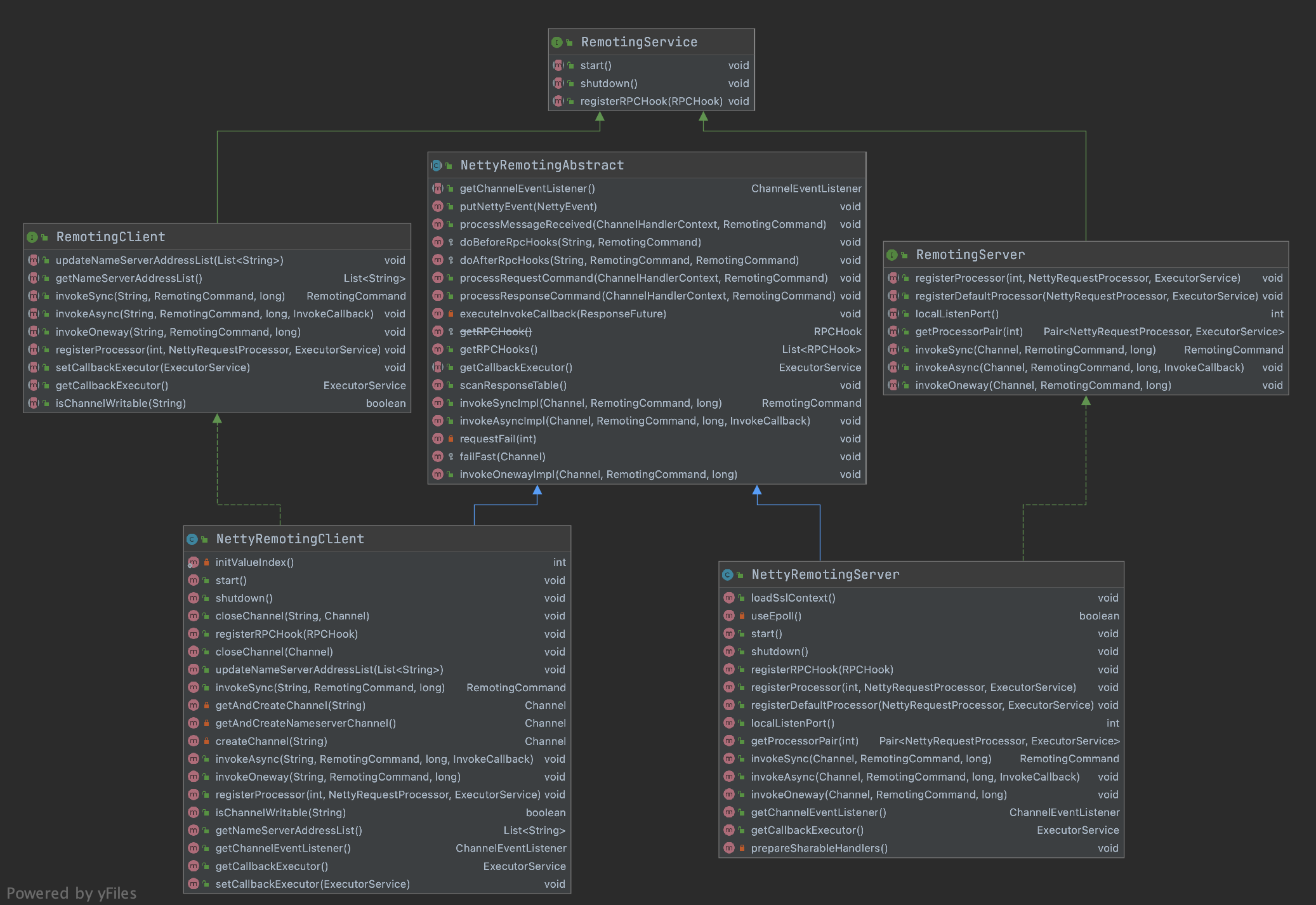
RemotingService为最上层接口,server和client分别实现且有各自特有的方法。相互之前使用RemotingCommand的进行调用,底层使用Netty进行通信。
NameServer模块通信步骤
以NameServer模块为例,启动时候会创建NamesvrController,里面就包含了NettyRemotingServer remotingServer,里面有各种Processor用于处理不同的,而NameServerController通常装载的是DefaultRequestProcessor,所有的Command的处理逻辑可以在这里面看到。
NameServer模块启动关键步骤:
org.apache.rocketmq.namesrv.NamesrvStartup#main0 // new NameSrvController
--> org.apache.rocketmq.namesrv.NamesrvController#initialize // 初始化Controller
--> org.apache.rocketmq.namesrv.NamesrvController#registerProcessor // 注册Processor
NameServerController.initialize()的逻辑:
    public boolean initialize() {

        this.kvConfigManager.load();

        this.remotingServer = new NettyRemotingServer(this.nettyServerConfig, this.brokerHousekeepingService);//实例化通信服务端

        this.remotingExecutor =
            Executors.newFixedThreadPool(nettyServerConfig.getServerWorkerThreads(), new ThreadFactoryImpl("RemotingExecutorThread_"));

        this.registerProcessor();//注册服务端下的Processors

        this.scheduledExecutorService.scheduleAtFixedRate(new Runnable() {

            @Override
            public void run() {
                NamesrvController.this.routeInfoManager.scanNotActiveBroker();
            }
        }, 5, 10, TimeUnit.SECONDS);

        this.scheduledExecutorService.scheduleAtFixedRate(new Runnable() {

            @Override
            public void run() {
                NamesrvController.this.kvConfigManager.printAllPeriodically();
            }
        }, 1, 10, TimeUnit.MINUTES);

//...

        return true;
    }
DefaultRequestProcessor的processRequest逻辑:入参就是netty的channelCtx和RocketMQ抽象的RemotingCommand
    @Override
    public RemotingCommand processRequest(ChannelHandlerContext ctx,
        RemotingCommand request) throws RemotingCommandException {

        if (ctx != null) {
            log.debug("receive request, {} {} {}",
                request.getCode(),
                RemotingHelper.parseChannelRemoteAddr(ctx.channel()),
                request);
        }


        switch (request.getCode()) {//
            case RequestCode.PUT_KV_CONFIG:
                return this.putKVConfig(ctx, request);
            case RequestCode.GET_KV_CONFIG:
                return this.getKVConfig(ctx, request);
            case RequestCode.DELETE_KV_CONFIG:
                return this.deleteKVConfig(ctx, request);
            case RequestCode.QUERY_DATA_VERSION:
                return queryBrokerTopicConfig(ctx, request);
            case RequestCode.REGISTER_BROKER:
                Version brokerVersion = MQVersion.value2Version(request.getVersion());
                if (brokerVersion.ordinal() >= MQVersion.Version.V3_0_11.ordinal()) {
                    return this.registerBrokerWithFilterServer(ctx, request);
                } else {
                    return this.registerBroker(ctx, request);
                }
            case RequestCode.UNREGISTER_BROKER:
                return this.unregisterBroker(ctx, request);
            case RequestCode.GET_ROUTEINFO_BY_TOPIC:
                return this.getRouteInfoByTopic(ctx, request);
            case RequestCode.GET_BROKER_CLUSTER_INFO:
                return this.getBrokerClusterInfo(ctx, request);
            case RequestCode.WIPE_WRITE_PERM_OF_BROKER:
                return this.wipeWritePermOfBroker(ctx, request);
            case RequestCode.GET_ALL_TOPIC_LIST_FROM_NAMESERVER:
                return getAllTopicListFromNameserver(ctx, request);
            case RequestCode.DELETE_TOPIC_IN_NAMESRV:
                return deleteTopicInNamesrv(ctx, request);
            case RequestCode.GET_KVLIST_BY_NAMESPACE:
                return this.getKVListByNamespace(ctx, request);
            case RequestCode.GET_TOPICS_BY_CLUSTER:
                return this.getTopicsByCluster(ctx, request);
            case RequestCode.GET_SYSTEM_TOPIC_LIST_FROM_NS:
                return this.getSystemTopicListFromNs(ctx, request);
            case RequestCode.GET_UNIT_TOPIC_LIST:
                return this.getUnitTopicList(ctx, request);
            case RequestCode.GET_HAS_UNIT_SUB_TOPIC_LIST:
                return this.getHasUnitSubTopicList(ctx, request);
            case RequestCode.GET_HAS_UNIT_SUB_UNUNIT_TOPIC_LIST:
                return this.getHasUnitSubUnUnitTopicList(ctx, request);
            case RequestCode.UPDATE_NAMESRV_CONFIG:
                return this.updateConfig(ctx, request);
            case RequestCode.GET_NAMESRV_CONFIG:
                return this.getConfig(ctx, request);
            default:
                break;
        }
        return null;
    }
后面的逻辑无非就是本地集群信息的一些操作了,由RoutInfoManager去完成。
Consumer模块通信步骤
Consumer的通信最终由NettyRemotingClient完成。
装载Processor到NettyRemotingClient,默认的Processor大部分情况是:ClientRemotingProcessor,里面的处理逻辑见下面代码:
MQClientManager管理MQClientInstance,里面是一个Map: private ConcurrentMap<String/* clientId */, MQClientInstance> factoryTable
MQClientInstance#mQClientAPIImpl
MQClientAPIImpl#remotingClient --> NettyRemotingClient的实例。
初始化的逻辑主要在Consumer.start方法中
ClientRemotingProcessor处理逻辑:
@Override
    public RemotingCommand processRequest(ChannelHandlerContext ctx,
        RemotingCommand request) throws RemotingCommandException {
        switch (request.getCode()) {
            case RequestCode.CHECK_TRANSACTION_STATE:
                return this.checkTransactionState(ctx, request);
            case RequestCode.NOTIFY_CONSUMER_IDS_CHANGED:
                return this.notifyConsumerIdsChanged(ctx, request);
            case RequestCode.RESET_CONSUMER_CLIENT_OFFSET:
                return this.resetOffset(ctx, request);
            case RequestCode.GET_CONSUMER_STATUS_FROM_CLIENT:
                return this.getConsumeStatus(ctx, request);

            case RequestCode.GET_CONSUMER_RUNNING_INFO:
                return this.getConsumerRunningInfo(ctx, request);

            case RequestCode.CONSUME_MESSAGE_DIRECTLY:
                return this.consumeMessageDirectly(ctx, request);

            case RequestCode.PUSH_REPLY_MESSAGE_TO_CLIENT:
                return this.receiveReplyMessage(ctx, request);
            default:
                break;
        }
        return null;
    }
协议设计和编解码
RocketMQ有自己的通信协议,通过协议在ByteBuffer和RemotingCommand之间相互转换。转换的的方法为RemotingCommand.decode 和 RemotingCommand.encode。
协议的定义如下:
|4byte  |     4byte        |                    |                 |
|length | headerlength | header data | body data |
decode逻辑如下:
    public static RemotingCommand decode(final ByteBuffer byteBuffer) {
        int length = byteBuffer.limit();//nio的byteBuffer
        int oriHeaderLen = byteBuffer.getInt();
        int headerLength = getHeaderLength(oriHeaderLen);

        byte[] headerData = new byte[headerLength];
        byteBuffer.get(headerData);

        RemotingCommand cmd = headerDecode(headerData, getProtocolType(oriHeaderLen));

        int bodyLength = length - 4 - headerLength;
        byte[] bodyData = null;
        if (bodyLength > 0) {
            bodyData = new byte[bodyLength];
            byteBuffer.get(bodyData);
        }
        cmd.body = bodyData;

        return cmd;
    }
encode逻辑如下:
public ByteBuffer encode() {
        // 1> header length size
        int length = 4;

        // 2> header data length
        byte[] headerData = this.headerEncode();
        length += headerData.length;

        // 3> body data length
        if (this.body != null) {
            length += body.length;
        }

        ByteBuffer result = ByteBuffer.allocate(4 + length);

        // length
        result.putInt(length);

        // header length
        result.put(markProtocolType(headerData.length, serializeTypeCurrentRPC));

        // header data
        result.put(headerData);

        // body data;
        if (this.body != null) {
            result.put(this.body);
        }

        result.flip();

        return result;
    }
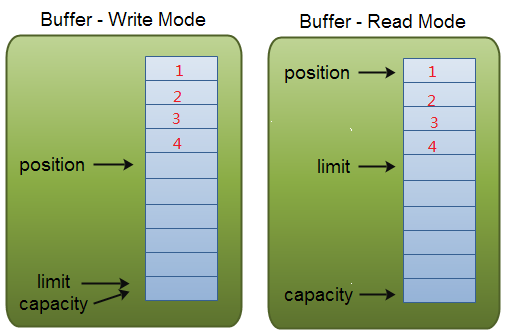
encode里面有flip操作,结合网上byteBuffer的结构图和flip的代码去理解:即读写模式的切换。
/**
翻转这个缓冲区。 将限制设置为当前位置,然后将位置设置为零。 如果定义了标记,则将其丢弃。
在一系列通道读取或放置操作之后,调用此方法以准备一系列通道写入或相关获取操作。 例如:
       buf.put(magic);    // Prepend header
       in.read(buf);      // Read data into rest of buffer
       buf.flip();        // Flip buffer
       out.write(buf);    // Write header + data to channel
当将数据从一个地方传输到另一个地方时,此方法通常与compact方法结合使用。
返回:
这个缓冲区
*/
public final Buffer flip() {
        limit = position;
        position = 0;
        mark = -1;
        return this;
    }
小结
- NameServer扮演了调度中心的角色,内部RouteInfoManager维护了所有的集群信息。Producer,Consumer通过长链接上报自己的状态,并维护更新,所有的集群信息维护在内存中。NameServer很重要,被设计的很轻量;
- RocketMQ底部借用Netty完成了通信,抽象有RemotingService接口,最终的处理逻辑全部在NettyRequestProcessor中,例如MQClientInstance(Client)的处理逻辑,大部分在ClientRemotingProcessor中org.apache.rocketmq.remoting.netty.NettyRemotingClient#start方法,设置了事件的pipeline,最后会add一个handler,即:org.apache.rocketmq.remoting.netty.NettyRemotingClient.NettyClientHandler,里面会调用Processor.
RemotingCommand processRequest(ChannelHandlerContext ctx, RemotingCommand request) throws Exception;方法;

 浙公网安备 33010602011771号