
Spark 任务划分&作业提交
1、Stage任务划分
DAG有向无环图:DAG(Directed Acyclic Graph)有向无环图是由点和线组成的拓扑图形,该图形具有方向,不会闭环。原始的RDD通过一系列的转换就形成了DAG,根据RDD之间的依赖关系的不同将DAG划分成不同的Stage,对于窄依赖,partition的转换处理在Stage中完成计算。对于宽依赖,由于有Shuffle的存在,只能在parent RDD处理完成后,才能开始接下来的计算,因此宽依赖是划分Stage的依据。例如,DAG记录了RDD的转换过程和任务的阶段。
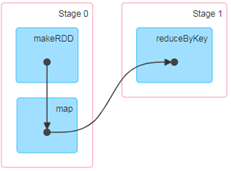
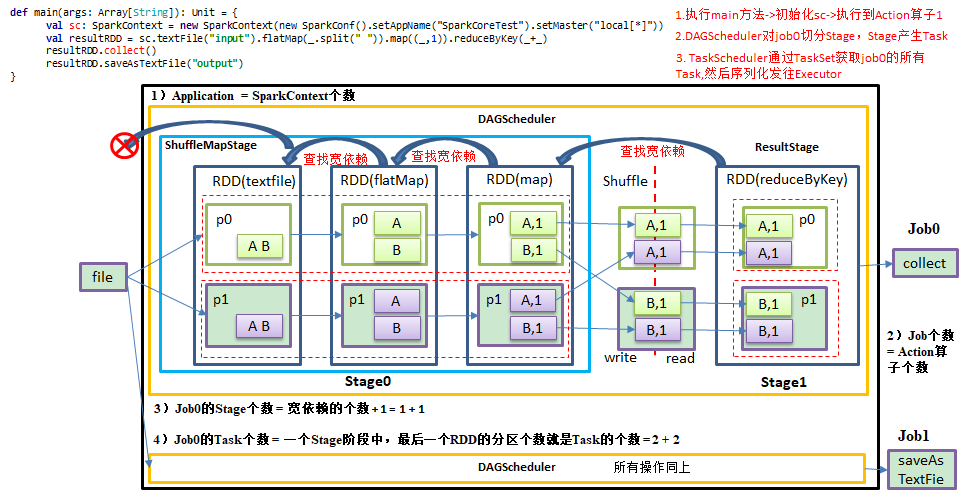
RDD任务切分中间分为:Application、Job、Stage和Task
(1)Application:初始化一个SparkContext即生成一个Application;
(2)Job:一个Action算子就会生成一个Job;
(3)Stage:Stage等于宽依赖的个数加1;
(4)Task:一个Stage阶段中,最后一个RDD的分区个数就是Task的个数。
注意:Application->Job->Stage->Task每一层都是1对n的关系。
代码实现
/**
 * Job 调度
 * 概念:
 * 集群:Yarn || Standalone
 * 应用:一个spark程序,一般创建一个SparkContex,表示创建一个应用
 * 一个集群可以创建多个应用
 * Job Spark 应用可以并发运行多个Job,每次触发行动操作都会提交一个Job,
 * 一个Spark应用可以有多个Job
 * Stage 根据job 中宽依赖的数量划分,Stage 数量 = 宽依赖数量 + 1
 * Task:每个Stage 由多个 task 组成,每个stage 的最后一个RDD的分区的数量就是当前stage的 task 数量
 */
object Spark02_Task {
  def main(args: Array[String]): Unit = {
    //创建 配置对象
    val conf: SparkConf = new SparkConf().setAppName("wordcount").setMaster("local[2]")
    //配置上下文对象
    var sc: SparkContext = new SparkContext(conf)
    val rdd: RDD[String] = sc.makeRDD(List("hello spark", "flink", "hello", "word hello"))
    //rdd 血缘关系
    println(rdd.toDebugString)
    println(rdd.dependencies)
    println("**************************************")
    val flatMap: RDD[String] = rdd.flatMap(_.split(" "))
    println(flatMap.toDebugString)
    println(flatMap.dependencies)
    println("**************************************")
    val map: RDD[(String, Int)] = flatMap.map((_, 1))
    println(map.toDebugString)
    println(map.dependencies)
    println("**************************************")
    val resRDD: RDD[(String, Int)] = map.reduceByKey(_ + _)
    /*println(resRDD.toDebugString)
    println(resRDD.dependencies)*/
    resRDD.collect().foreach(println)
    resRDD.saveAsTextFile("E:\\workspace_idea\\spark0520\\output")
    Thread.sleep(900000000 )
    //关闭
    sc.stop()
  }
}
job 数量
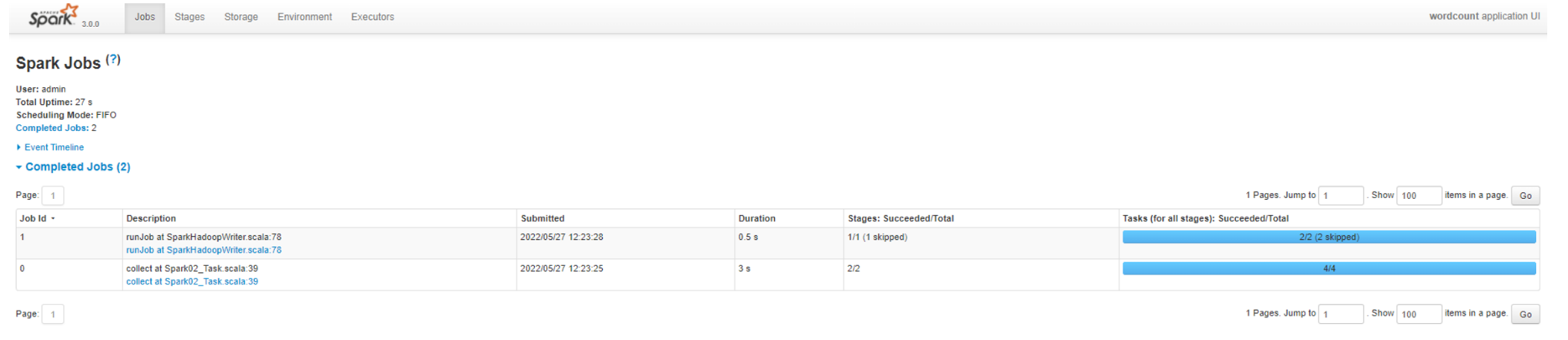
Stage 数量
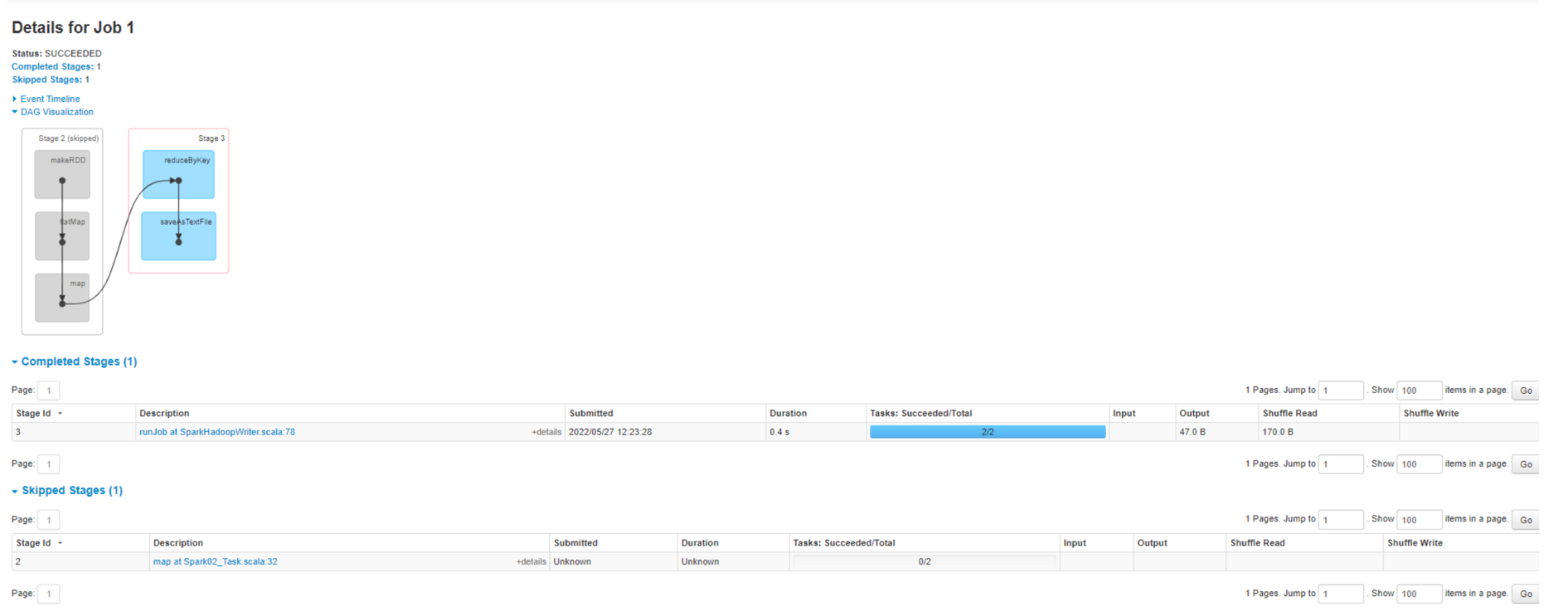
查看Job0的Stage。由于只有1个Shuffle阶段,所以Stage个数为2
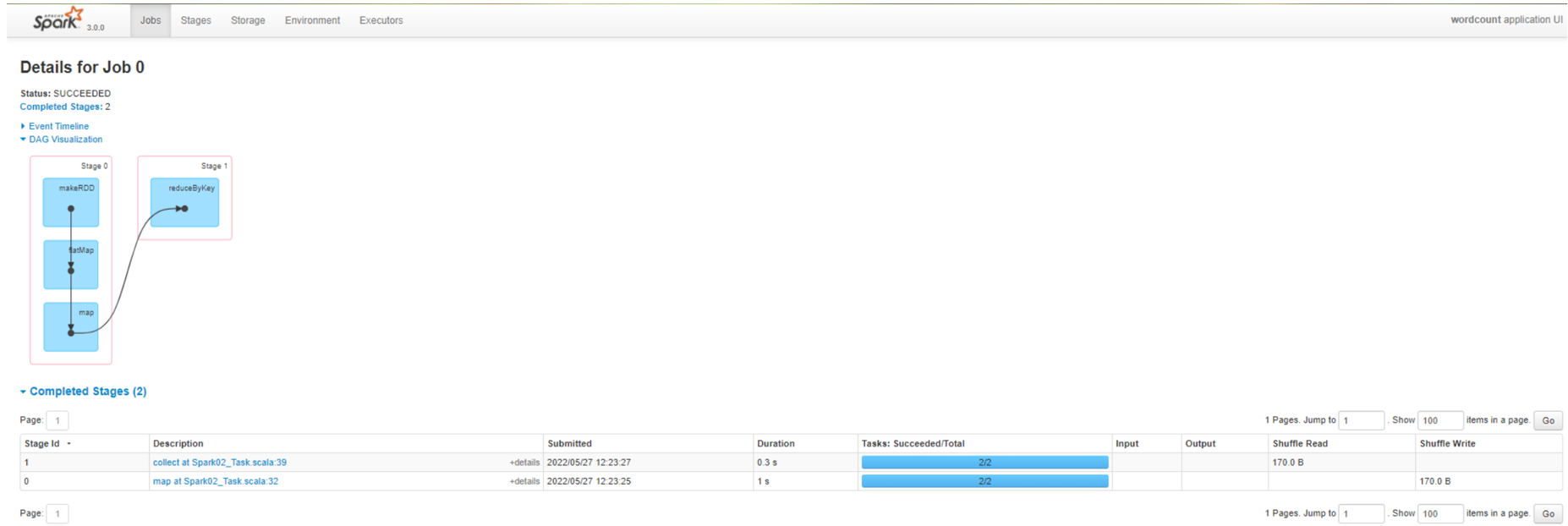
查看Job1的Stage。由于只有1个Shuffle阶段,所以Stage个数为2。
Task 数量:查看Job0的Stage0的Task个数

查看Job0的Stage1的Task个数

注意:如果存在shuffle过程,系统会自动进行缓存,UI界面显示skipped的部分
2、作业提交源码
1、以collect()为例来跟踪作业提交流程,按住 ctrl 点击 collect()
resRDD.collect().foreach(println)
2、此时进入 RDD 抽象类的 collect() 方法,可以看到,这里调用了sc的runJob方法,点击 runJob
/**
 * Return an array that contains all of the elements in this RDD.
 *
 * @note This method should only be used if the resulting array is expected to be small, as
 * all the data is loaded into the driver's memory.
 */
def collect(): Array[T] = withScope {
  val results = sc.runJob(this, (iter: Iterator[T]) => iter.toArray)
  Array.concat(results: _*)
}
3、此时进入里了 SparkContex的runJob方法,只是这里有调用了一个 runJob 方法,再次点击runJob
/**
 * Run a job on all partitions in an RDD and return the results in an array.
 *
 * @param rdd target RDD to run tasks on
 * @param func a function to run on each partition of the RDD
 * @return in-memory collection with a result of the job (each collection element will contain
 * a result from one partition)
 */
def runJob[T, U: ClassTag](rdd: RDD[T], func: Iterator[T] => U): Array[U] = {
  runJob(rdd, func, 0 until rdd.partitions.length)
}
4、这里调用了SparkContext 的 runJob 方法。此时点击 这里的 runJob 方法
/**
 * Run a function on a given set of partitions in an RDD and return the results as an array.
 *
 * @param rdd target RDD to run tasks on
 * @param func a function to run on each partition of the RDD
 * @param partitions set of partitions to run on; some jobs may not want to compute on all
 * partitions of the target RDD, e.g. for operations like `first()`
 * @return in-memory collection with a result of the job (each collection element will contain
 * a result from one partition)
 */
def runJob[T, U: ClassTag](
    rdd: RDD[T],
    func: Iterator[T] => U,
    partitions: Seq[Int]): Array[U] = {
  val cleanedFunc = clean(func)
  runJob(rdd, (ctx: TaskContext, it: Iterator[T]) => cleanedFunc(it), partitions)
}
5、又是一个 runJob在,继续点击
/**
 * Run a function on a given set of partitions in an RDD and return the results as an array.
 * The function that is run against each partition additionally takes `TaskContext` argument.
 *
 * @param rdd target RDD to run tasks on
 * @param func a function to run on each partition of the RDD
 * @param partitions set of partitions to run on; some jobs may not want to compute on all
 * partitions of the target RDD, e.g. for operations like `first()`
 * @return in-memory collection with a result of the job (each collection element will contain
 * a result from one partition)
 */
def runJob[T, U: ClassTag](
    rdd: RDD[T],
    func: (TaskContext, Iterator[T]) => U,
    partitions: Seq[Int]): Array[U] = {
  val results = new Array[U](partitions.size)
  runJob[T, U](rdd, func, partitions, (index, res) => results(index) = res)
  results
}
6、发现还是调用了SparkContext内部的一个 runJob,不过此时可以大概看出一点端倪,最后是调用了dagScheduler 的一个 runJob 方法,下面看下 dagScheduler 内部的 runJob 长什么样
/**
 * Run a function on a given set of partitions in an RDD and pass the results to the given
 * handler function. This is the main entry point for all actions in Spark.
 *
 * @param rdd target RDD to run tasks on
 * @param func a function to run on each partition of the RDD
 * @param partitions set of partitions to run on; some jobs may not want to compute on all
 * partitions of the target RDD, e.g. for operations like `first()`
 * @param resultHandler callback to pass each result to
 */
def runJob[T, U: ClassTag](
    rdd: RDD[T],
    func: (TaskContext, Iterator[T]) => U,
    partitions: Seq[Int],
    resultHandler: (Int, U) => Unit): Unit = {
  if (stopped.get()) {
    throw new IllegalStateException("SparkContext has been shutdown")
  }
  val callSite = getCallSite
  val cleanedFunc = clean(func)
  logInfo("Starting job: " + callSite.shortForm)
  if (conf.getBoolean("spark.logLineage", false)) {
    logInfo("RDD's recursive dependencies:\n" + rdd.toDebugString)
  }
  dagScheduler.runJob(rdd, cleanedFunc, partitions, callSite, resultHandler, localProperties.get)
  progressBar.foreach(_.finishAll())
  rdd.doCheckpoint()
}
7、下面是 DAGScheduler 调用的方法,此处重点可以关注下,作业提交 submitJob,val waiter = submitJob(rdd, func, partitions, callSite, resultHandler, properties)
/**
 * Run an action job on the given RDD and pass all the results to the resultHandler function as
 * they arrive.
 *
 * @param rdd target RDD to run tasks on
 * @param func a function to run on each partition of the RDD
 * @param partitions set of partitions to run on; some jobs may not want to compute on all
 *   partitions of the target RDD, e.g. for operations like first()
 * @param callSite where in the user program this job was called
 * @param resultHandler callback to pass each result to
 * @param properties scheduler properties to attach to this job, e.g. fair scheduler pool name
 *
 * @note Throws `Exception` when the job fails
 */
def runJob[T, U](
    rdd: RDD[T],
    func: (TaskContext, Iterator[T]) => U,
    partitions: Seq[Int],
    callSite: CallSite,
    resultHandler: (Int, U) => Unit,
    properties: Properties): Unit = {
  val start = System.nanoTime
  val waiter = submitJob(rdd, func, partitions, callSite, resultHandler, properties)
  ThreadUtils.awaitReady(waiter.completionFuture, Duration.Inf)
  waiter.completionFuture.value.get match {
    case scala.util.Success(_) =>
      logInfo("Job %d finished: %s, took %f s".format
        (waiter.jobId, callSite.shortForm, (System.nanoTime - start) / 1e9))
    case scala.util.Failure(exception) =>
      logInfo("Job %d failed: %s, took %f s".format
        (waiter.jobId, callSite.shortForm, (System.nanoTime - start) / 1e9))
      // SPARK-8644: Include user stack trace in exceptions coming from DAGScheduler.
      val callerStackTrace = Thread.currentThread().getStackTrace.tail
      exception.setStackTrace(exception.getStackTrace ++ callerStackTrace)
      throw exception
  }
}
8、作业提交逻辑:关注下 eventProcessLoop.post(JobSubmitted
def submitJob[T, U](
    rdd: RDD[T],
    func: (TaskContext, Iterator[T]) => U,
    partitions: Seq[Int],
    callSite: CallSite,
    resultHandler: (Int, U) => Unit,
    properties: Properties): JobWaiter[U] = {
  // Check to make sure we are not launching a task on a partition that does not exist.
  val maxPartitions = rdd.partitions.length
  partitions.find(p => p >= maxPartitions || p < 0).foreach { p =>
    throw new IllegalArgumentException(
      "Attempting to access a non-existent partition: " + p + ". " +
        "Total number of partitions: " + maxPartitions)
  }

  val jobId = nextJobId.getAndIncrement()
  if (partitions.isEmpty) {
    val clonedProperties = Utils.cloneProperties(properties)
    if (sc.getLocalProperty(SparkContext.SPARK_JOB_DESCRIPTION) == null) {
      clonedProperties.setProperty(SparkContext.SPARK_JOB_DESCRIPTION, callSite.shortForm)
    }
    val time = clock.getTimeMillis()
    listenerBus.post(
      SparkListenerJobStart(jobId, time, Seq.empty, clonedProperties))
    listenerBus.post(
      SparkListenerJobEnd(jobId, time, JobSucceeded))
    // Return immediately if the job is running 0 tasks
    return new JobWaiter[U](this, jobId, 0, resultHandler)
  }

  assert(partitions.nonEmpty)
  val func2 = func.asInstanceOf[(TaskContext, Iterator[_]) => _]
  val waiter = new JobWaiter[U](this, jobId, partitions.size, resultHandler)
  eventProcessLoop.post(JobSubmitted(
    jobId, rdd, func2, partitions.toArray, callSite, waiter,
    Utils.cloneProperties(properties)))
  waiter
}
9、提交作业到队列 eventQueue.put(event),查看 eventQueue 逻辑
/**
 * Put the event into the event queue. The event thread will process it later.
 */
def post(event: E): Unit = {
  if (!stopped.get) {
    if (eventThread.isAlive) {
      eventQueue.put(event)
    } else {
      onError(new IllegalStateException(s"$name has already been stopped accidentally."))
    }
  }
}
9、底层调用了 doOnReceive(event) 方法,但是这里是一个抽象类,查看其实现类,ctrl+H
private[scheduler] class DAGSchedulerEventProcessLoop(dagScheduler: DAGScheduler)
  extends EventLoop[DAGSchedulerEvent]("dag-scheduler-event-loop") with Logging {

  private[this] val timer = dagScheduler.metricsSource.messageProcessingTimer

  /**
   * The main event loop of the DAG scheduler.
   */
  override def onReceive(event: DAGSchedulerEvent): Unit = {
    val timerContext = timer.time()
    try {
      doOnReceive(event)
    } finally {
      timerContext.stop()
    }
  }
复制 doOnReceive ,去实现类里查看实现逻辑
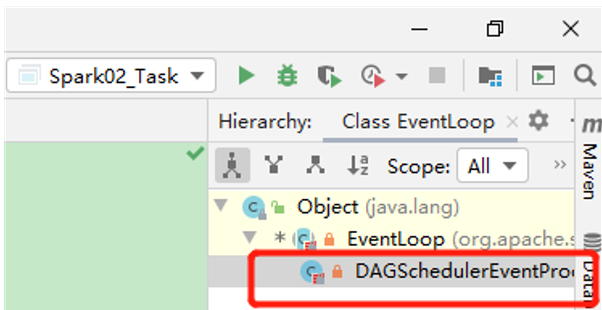
10、实现方法调用了 doOnReceive
/**
 * The main event loop of the DAG scheduler.
 */
override def onReceive(event: DAGSchedulerEvent): Unit = {
  val timerContext = timer.time()
  try {
    doOnReceive(event)
  } finally {
    timerContext.stop()
  }
}
11、查看 doOnReceive 逻辑
private def doOnReceive(event: DAGSchedulerEvent): Unit = event match {
  case JobSubmitted(jobId, rdd, func, partitions, callSite, listener, properties) =>
    dagScheduler.handleJobSubmitted(jobId, rdd, func, partitions, callSite, listener, properties)
12、handleJobSubmitted 在内部创建了 ActiveJob,至此完成落叶提交流程
private[scheduler] def handleJobSubmitted(jobId: Int,
    finalRDD: RDD[_],
    func: (TaskContext, Iterator[_]) => _,
    partitions: Array[Int],
    callSite: CallSite,
    listener: JobListener,
    properties: Properties): Unit = {
  var finalStage: ResultStage = null
  try {
    // New stage creation may throw an exception if, for example, jobs are run on a
    // HadoopRDD whose underlying HDFS files have been deleted.
    finalStage = createResultStage(finalRDD, func, partitions, jobId, callSite)
  } catch {
    case e: BarrierJobSlotsNumberCheckFailed =>
      // If jobId doesn't exist in the map, Scala coverts its value null to 0: Int automatically.
      val numCheckFailures = barrierJobIdToNumTasksCheckFailures.compute(jobId,
        (_: Int, value: Int) => value + 1)

      logWarning(s"Barrier stage in job $jobId requires ${e.requiredConcurrentTasks} slots, " +
        s"but only ${e.maxConcurrentTasks} are available. " +
        s"Will retry up to ${maxFailureNumTasksCheck - numCheckFailures + 1} more times")

      if (numCheckFailures <= maxFailureNumTasksCheck) {
        messageScheduler.schedule(
          new Runnable {
            override def run(): Unit = eventProcessLoop.post(JobSubmitted(jobId, finalRDD, func,
              partitions, callSite, listener, properties))
          },
          timeIntervalNumTasksCheck,
          TimeUnit.SECONDS
        )
        return
      } else {
        // Job failed, clear internal data.
        barrierJobIdToNumTasksCheckFailures.remove(jobId)
        listener.jobFailed(e)
        return
      }

    case e: Exception =>
      logWarning("Creating new stage failed due to exception - job: " + jobId, e)
      listener.jobFailed(e)
      return
  }
  // Job submitted, clear internal data.
  barrierJobIdToNumTasksCheckFailures.remove(jobId)

  val job = new ActiveJob(jobId, finalStage, callSite, listener, properties)
  clearCacheLocs()
  logInfo("Got job %s (%s) with %d output partitions".format(
    job.jobId, callSite.shortForm, partitions.length))
  logInfo("Final stage: " + finalStage + " (" + finalStage.name + ")")
  logInfo("Parents of final stage: " + finalStage.parents)
  logInfo("Missing parents: " + getMissingParentStages(finalStage))

  val jobSubmissionTime = clock.getTimeMillis()
  jobIdToActiveJob(jobId) = job
  activeJobs += job
  finalStage.setActiveJob(job)
  val stageIds = jobIdToStageIds(jobId).toArray
  val stageInfos = stageIds.flatMap(id => stageIdToStage.get(id).map(_.latestInfo))
  listenerBus.post(
    SparkListenerJobStart(job.jobId, jobSubmissionTime, stageInfos, properties))
  submitStage(finalStage)
}

 浙公网安备 33010602011771号