
JAVA博客作业(二)
一、前言
(1)所涉及知识点
①字符串的使用、正则表达式的使用(4.7-1、6.7-1、6.7-2、6.7-3、6.7-4)
②聚合设计(4.7-2、5.7-5)
③继承、封装、多态(4.7-3、6.7-5、6.7-6)
④JAVA集合框架的应用(5.7-4)
⑤排序算法(5.7-2、5.7-3)
(2)题量评估:
题集4:3道 - - - - - - - - - - 较少
题集5:4道 - - - - - - - - - - 较少
题集6:6道 - - - - - - - - - - 一般
(3)难度评估
题集4:3道 - - - - - - - - - - 困难
题集5:4道 - - - - - - - - - - 较难
题集6:6道 - - - - - - - - - - 一般
二、设计与分析
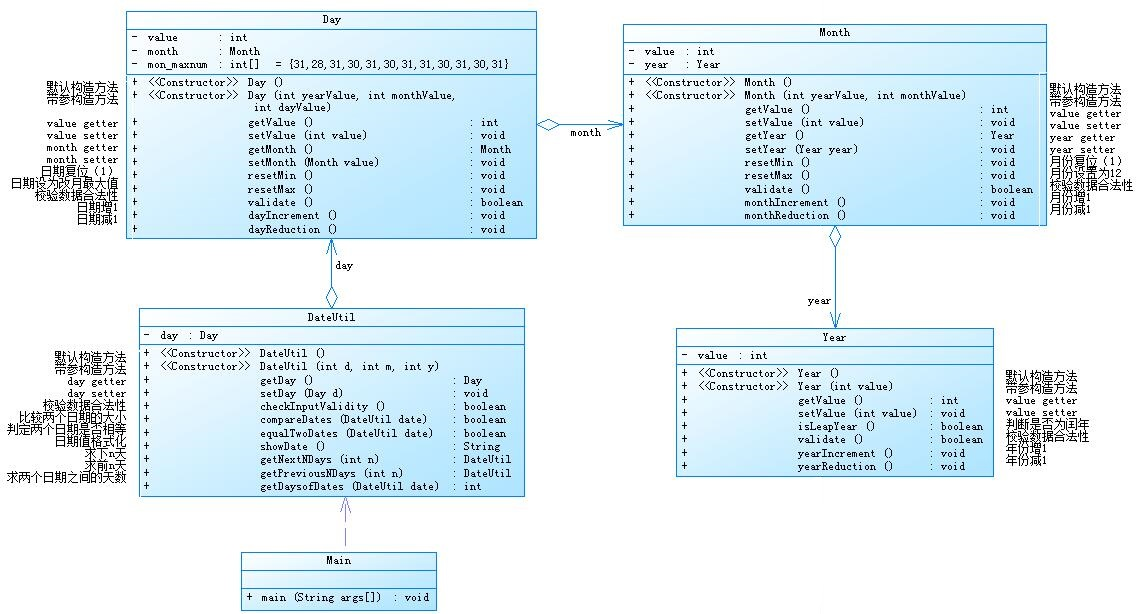
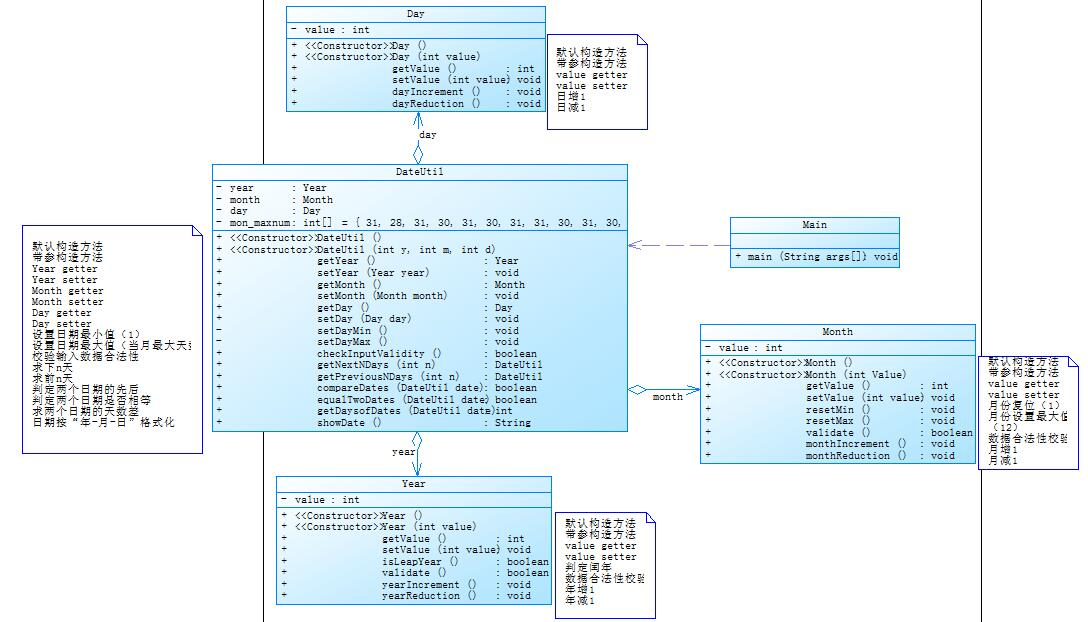
(1)日期问题面向对象设计(聚合一)VS 日期问题面向对象设计(聚合二)
(聚合一)
  1 class Dateutil{
  2     Day day;
  3     int flag=0;
  4     public Dateutil() {
  5
  6     }
  7     public Dateutil(int d,int m,int y) {
  8         this.day = new Day(y,m,d);
  9     }
 10     public void setDay(Day d)
 11     {
 12         this.day=d;
 13
 14     }
 15     public Day getDay()
 16     {
 17         return day;
 18     }
 19
 20     public boolean checkInputValidity()
 21     {
 22         if(day.validate()&&day.month.validate()&&day.month.year.validate())
 23             return true;
 24         else
 25             return false;
 26     }
 27     public boolean compareDates(Dateutil date)
 28     {
 29         if(day.month.year.value>date.day.month.year.value)
 30             return true;
 31         else if(day.month.year.value==date.day.month.year.value)
 32         {
 33             if(day.month.value>date.day.month.value)
 34                 return true;
 35             else if(day.month.value==date.day.month.value)
 36             {
 37                 if(day.value>date.day.value)
 38                     return true;
 39                 else if(day.value<date.day.value)
 40                     return false;
 41             }
 42             else
 43             {
 44                 return false;
 45             }
 46         }
 47         else
 48         {
 49             return false;
 50         }
 51         return false;
 52     }
 53     public boolean equalTwoDates(Dateutil date)
 54     {
 55         if(day.month.year.value==date.day.month.year.value&&day.month.value==date.day.month.value&&day.value==date.day.value)
 56             return true;
 57         else
 58             return false;
 59     }
 60     public String showDate()
 61     {
 62         String abc=null;
 63         abc=String.format("%d-%d-%d",day.month.year.value,day.month.value,day.value);
 64         return abc;
 65     }
 66     public Dateutil getNextNDays(int n)
 67     {
 68         int i=0;
 69         while(i!=n)
 70         {
 71             if(day.month.year.isLeapYear())
 72             {
 73                 day.mon_maxnum[1]=29;
 74             }
 75             else
 76             {
 77                 day.mon_maxnum[1]=28;
 78             }
 79             day.dayIncrement();
 80             if(day.value==day.mon_maxnum[day.month.value-1]+1)
 81             {
 82                 day.month.value++;
 83                 day.resetMin();
 84             }
 85             if(day.month.value==13)
 86             {
 87                 day.month.year.value++;
 88                 day.month.resetMin();
 89             }
 90             i++;
 91         }
 92         return null;
 93     }
 94     public Dateutil getpreviousNDays(int n)
 95     {
 96
 97         int i=0;
 98         while(i!=n)
 99         {
100             if(day.month.year.isLeapYear())
101             {
102                 day.mon_maxnum[1]=29;
103             }
104             else
105             {
106                 day.mon_maxnum[1]=28;
107             }
108             day.dayReduction();
109             if(day.value==0)
110             {
111                 day.month.value--;
112
113                 if(day.month.value==0)
114                 {
115                     day.month.year.value--;
116                     day.month.resetMax();
117                 }
118                 day.resetMax();
119             }
120             i++;
121         }
122         return null;
123     }
124     public int getDaysofDates(Dateutil date)
125     {
126         int x=0,y1 = 0,y2=0,z1=0,z2=0,m=0,n=0;
127
128         if(equalTwoDates(date))
129         {
130             return 0;
131         }
132         else
133         {
134             if(compareDates(date)) {
135                 x=Math.abs(day.month.year.value-date.day.month.year.value);
136                 m=x/4;
137                 if (date.day.month.year.value == 1900 && !date.compareDates(new Dateutil(1900,2,28))) {
138                     m--;
139                 }
140                 for(int i=0;i<day.month.value-1;i++)
141                 {
142                     y1=y1+day.mon_maxnum[i];
143                 }
144                 for(int i=0;i<date.day.month.value-1;i++)
145                 {
146                     y2=y2+date.day.mon_maxnum[i];
147                 }
148                 z1=y1+day.value;
149                 z2=y2+date.day.value;
150                 n=365*x+m+(z1-z2);
151             }else {
152                 x=Math.abs(day.month.year.value-date.day.month.year.value);
153                 m=x/4;
154
155                 if (day.month.year.value == 1900 && !compareDates(new Dateutil(1900,2,28))) {
156                     m--;
157                 }
158                 for(int i=0;i<day.month.value-1;i++)
159                 {
160                     y1=y1+day.mon_maxnum[i];
161                 }
162                 for(int i=0;i<date.day.month.value-1;i++)
163                 {
164                     y2=y2+date.day.mon_maxnum[i];
165                 }
166                 z1=y1+day.value;
167                 z2=y2+date.day.value;
168                 n=365*x+m+(z2-z1);
169             }
170
171
172         }
173         return n;
174     }
175 }
176
177 class Day
178 {
179     int value;
180     Month month;
181     int mon_maxnum[]= {31,28,31,30,31,30,31,31,30,31,30,31};
182     public Day() {
183
184     }
185
186     public Day(int yearValue,int monthValue,int dayValue) {
187         this.month=new Month(yearValue,monthValue);
188         this.value=dayValue;
189
190
191     }
192     public void setValue(int value)
193     {
194         this.value=value;
195     }
196     public int getValue()
197     {
198         return value;
199     }
200     public void setMonth(Month value)
201     {
202         this.month=value;
203     }
204     public Month getMonth()
205     {
206         return month;
207     }
208     public void  resetMin()
209     {
210         value=1;
211     }
212     public void  resetMax()
213     {
214         value=mon_maxnum[month.value-1];
215     }
216     public boolean validate()
217     {
218         if(value<1||value>31)
219             return false;
220         else
221         {
222             if(month.year.isLeapYear())
223             {
224                 if((month.value==2&&value>29)||(month.value==4&&value>30)||(month.value==6&&value>30)||(month.value==9&&value>30)||(month.value==11&&value>30))
225                     return false;
226
227             }
228             else
229             {
230                 if((month.value==2&&value>28)||(month.value==4&&value>30)||(month.value==6&&value>30)||(month.value==9&&value>30)||(month.value==11&&value>30))
231                     return false;
232             }
233         }
234         return true;
235     }
236     public void dayIncrement()
237     {
238         value=value+1;
239     }
240     public void dayReduction()
241     {
242         value=value-1;
243     }
244
245 }
246 class Month
247 {
248     int value;
249     Year year;
250     public Month()
251     {
252
253     }
254     public Month(int yearValue,int monthValue)
255     {
256         this.year= new Year(yearValue);
257         this.value=monthValue;
258     }
259     public void setValue(int value)
260     {
261         this.value=value;
262     }
263     public int getValue()
264     {
265         return value;
266     }
267     public void setYear(Year year)
268     {
269         this.year=year;
270     }
271     public Year getyear()
272     {
273         return year;
274     }
275     public void  resetMin()
276     {
277         value=1;
278     }
279     public void  resetMax()
280     {
281         value=12;
282     }
283     public boolean validate()
284     {
285         if(value<1||value>12)
286             return false;
287         else
288             return true;
289     }
290     public void monthIncrement()
291     {
292         value=value+1;
293     }
294     public void monthReduction()
295     {
296         value=value-1;
297     }
298 }
299 class Year{
300     int value;
301     public Year()
302     {}
303     public Year(int value)
304     {
305         this.value=value;
306     }
307     public void setvalue(int value)
308     {
309         this.value=value;
310     }
311     public int getvalue()
312     {
313         return value;
314     }
315
316     public  boolean isLeapYear()
317     {
318         if((value%4==0)&&(value%100!=0)||value%400==0)
319             return true;
320         return false;
321     }
322     public  boolean validate()
323     {
324
325         if(value<1900||value>2050)
326             return false;
327         else
328             return true;
329     }
330     public void yearIncrement()
331     {
332         value = value+1;
333     }
334     public void yearReduction()
335     {
336         value = value-1;
337     }
(聚合二)
  1 class Year {
  2     private int value = 0;
  3
  4     public Year() {
  5
  6     }
  7
  8     public Year(int value) {
  9         this.value = value;
 10     }
 11
 12     public void setValue(int value) {
 13         this.value = value;
 14     }
 15
 16     public int getValue() {
 17         return this.value;
 18     }
 19
 20     public boolean isLeapYear() {
 21         if (this.value % 400 == 0 || this.value % 4 == 0 && this.value % 100 != 0) {
 22             return true;
 23         } else {
 24             return false;
 25         }
 26     }
 27
 28     public boolean validate() {
 29         if (this.value < 1820 || this.value > 2020) {
 30             return false;
 31         } else {
 32             return true;
 33         }
 34     }
 35
 36     public void yearIncrement() {// 年份加一
 37         this.value++;
 38     }
 39
 40     public void yearReduction() {// 年份减一
 41         this.value--;
 42     }
 43
 44 }
 45
 46 class Month {
 47     private int value = 0;
 48
 49     public Month() {
 50
 51     }
 52
 53     public Month(int value) {
 54         this.value = value;
 55     }
 56
 57     public void setValue(int value) {
 58         this.value = value;
 59     }
 60
 61     public int getValue() {
 62         return this.value;
 63     }
 64
 65     public void resetMin() {
 66         this.value = 1;
 67     }
 68
 69     public void resetMax() {
 70         this.value = 12;
 71     }
 72
 73     public boolean validate() {
 74         if (this.value < 1 || this.value > 12) {
 75             return false;
 76         } else {
 77             return true;
 78         }
 79     }
 80
 81     public void monthIncrement() {// 月份加一
 82         if (this.value == 12) {
 83             this.value = 1;
 84         } else {
 85             this.value++;
 86         }
 87     }
 88
 89     public void monthReduction() {// 月份减一
 90         if (this.value == 1) {
 91             this.value = 12;
 92         } else {
 93             this.value--;
 94         }
 95     }
 96
 97 }
 98
 99 class Day {
100     private int value = 0;
101
102     public Day() {
103
104     }
105
106     public Day(int value) {
107         this.value = value;
108     }
109
110     public void setValue(int value) {
111         this.value = value;
112     }
113
114     public int getValue() {
115         return this.value;
116     }
117
118     public void dayIncrement() {
119         this.value++;
120     }
121
122     public void dayReduction() {
123         this.value--;
124     }
125 }
126
127 class DateUtil {
128     private Year year = new Year();
129     private Month month = new Month();
130     private Day day = new Day();
131     private  int[] mon_maxnum = { 31, 28, 31, 30, 31, 30, 31, 31, 30, 31, 30, 31 };
132
133     public DateUtil() {
134
135     }
136
137     public DateUtil(int year, int month, int day) {
138         this.year.setValue(year);
139         this.month.setValue(month);
140         this.day.setValue(day);
141     }
142
143     public void setYear(Year year) {
144         this.year = year;
145     }
146
147     public Year getYear() {
148         return this.year;
149     }
150
151     public void setMonth(Month month) {
152         this.month = month;
153     }
154
155     public Month getMonth() {
156         return this.month;
157     }
158
159     public void setDay(Day day) {
160         this.day = day;
161     }
162
163     public Day getDay() {
164         return this.day;
165     }
166
167     public void setDayMin() {
168         this.day.setValue(1);
169     }
170
171     public void setDayMax() {
172         if (this.year.isLeapYear() && this.month.getValue() == 2) {
173             this.day.setValue(29);
174         } else {
175             this.day.setValue(this.mon_maxnum[this.month.getValue() - 1]);
176         }
177     }
178
179     public boolean checkInputValidity() {// 校验输入数据合法性
180         int[] day = {31, 29, 31, 30, 31, 30, 31, 31, 30, 31, 30, 31};
181         boolean flag = true;
182         if (this.month.validate() && this.year.validate()) {
183             if (this.year.isLeapYear()) {// 闰年
184                 if(this.day.getValue() < 1 || this.day.getValue() > day[this.month.getValue() - 1]) {
185                     flag = false;
186                 }
187                 else {
188                     flag = true;
189                 }
190             } else {// 非闰年
191                 if(this.day.getValue() < 1 || this.day.getValue() > this.mon_maxnum[this.month.getValue()]) {
192                     flag = false;
193                 }
194                 else {
195                     flag = true;
196                 }
197
198             }
199         }
200         else {
201             flag = false;
202         }
203         return flag;
204
205     }
206     public DateUtil getNextNDays(int n) {// 取得year-month-day的下n天日期
207         int num = 0;// 计算天数
208         int m = 0;
209         int[] theyear = { 0, 31, 28, 31, 30, 31, 30, 31, 31, 30, 31, 30, 31 };
210         if (Math.abs(this.day.getValue() + n) <= theyear[this.month.getValue()]) {// 即不满本月
211             this.day.setValue(this.day.getValue() + n);
212         } else {
213             m = theyear[this.month.getValue()] - this.day.getValue();
214             n = n - m;// 从月末开始计算
215             num = n % 1000;
216             n = n - n % 1000;
217             this.month.monthIncrement();// 月份加一
218             do {
219                 if (this.month.getValue() == 2) {
220                     if (this.year.isLeapYear()) {
221                         theyear[this.month.getValue()] = 29;
222                     } else {
223                         theyear[this.month.getValue()] = 28;
224                     }
225                 }
226                 if (num > theyear[this.month.getValue()]) {
227                     num = num - theyear[this.month.getValue()];
228                     this.month.monthIncrement();//月份加一
229                 if(this.month.getValue() == 1) {
230                     this.year.yearIncrement();
231                 }
232                 }
233
234             } while (num > theyear[this.month.getValue()]);
235             num = num + n;
236             do {
237                 if (this.month.getValue() == 2) {
238                     if (this.year.isLeapYear()) {
239                         theyear[this.month.getValue()] = 29;
240                     } else {
241                         theyear[this.month.getValue()] = 28;
242                     }
243                 }
244                 if (num > theyear[this.month.getValue()]) {
245                     num = num - theyear[this.month.getValue()];
246                     this.month.monthIncrement();//月份加一
247                     if(this.month.getValue() == 1) {
248                         this.year.yearIncrement();
249                     }
250                 }
251             } while (num > theyear[this.month.getValue()]);
252             if (num == 0) {
253                 num = 1;
254             }
255             this.day.setValue(num);
256         }
257         DateUtil obj = new DateUtil();
258         obj.setDay(this.day);
259         obj.setMonth(this.month);
260         obj.setYear(this.year);
261         return obj;
262     }
263     public DateUtil getPreviousNDays(int n) {// 取得year-month-day的前n天日期
264         int[] theyear = { 0, 31, 29, 31, 30, 31, 30, 31, 31, 30, 31, 30, 31 };
265         if (this.day.getValue() > n) {
266             this.day.setValue(this.day.getValue() - n);
267         } else {
268             int num = 0;
269             int year = this.year.getValue();
270             int m = this.month.getValue() - 1;
271             if (m == 0) {
272                 m = 12;
273                 year --;
274                 this.year.setValue(year);
275             }
276             num = n - this.day.getValue();
277             this.day.setValue(1);
278             do {
279                 if (m == 2 && this.year.isLeapYear()) {
280                     theyear[m] = 29;
281                 }
282                 if (m == 2 && !this.year.isLeapYear()) {
283                     theyear[m] = 28;
284                 }
285
286                 if (num > theyear[m]) {
287                     num = num - theyear[m];
288                     m--;
289                     if (m == 0) {
290                         year --;
291                         this.year.setValue(year);
292                         m = 12;
293                     }
294                 }
295
296             } while (num > theyear[m]);
297             num = theyear[m] - num;
298             this.day.setValue(num);
299             this.month.setValue(m);
300             if (m == 0) {
301                 m = 12;
302                 year--;
303                 this.year.setValue(year);
304             }
305             this.month.setValue(m);
306             this.year.setValue(year);
307         }
308         DateUtil obj = new DateUtil();
309         obj.setDay(this.day);
310         obj.setMonth(this.month);
311         obj.setYear(this.year);
312         return obj;
313     }
314     public boolean compareDates(DateUtil date) {// 比较两日期的大小
315         boolean flag = true;// 当前日期先为true否则为false
316         if (this.year.getValue() > date.year.getValue()) {
317             flag = true;
318         }
319         if (this.year.getValue() < date.year.getValue()) {
320             flag = false;
321         }
322         if (this.year.getValue() == date.year.getValue()) {
323             if (this.month.getValue() > date.month.getValue()) {
324                 flag = true;
325             }
326             if (this.month.getValue() < date.month.getValue()) {
327                 flag = false;
328             }
329             if (this.month.getValue() == date.month.getValue()) {
330                 if (this.day.getValue() >= date.day.getValue()) {
331                     flag = true;
332                 } else {
333                     flag = false;
334                 }
335             }
336         }
337         return flag;
338     }
339
340     public boolean equalTwoDates(DateUtil date) {// 判断两个日期是否相等
341         if (this.year.getValue() == date.year.getValue()
342                 && this.month.getValue() == date.month.getValue()
343                 && this.day.getValue() == date.day.getValue()) {
344             return true;
345         } else {
346             return false;
347         }
348     }
349     public int getDaysofDates(DateUtil date) {// 求当前日期与date之间相差的天数
350         int[] year1 = { 0, 31, 29, 31, 30, 31, 30, 31, 31, 30, 31, 30, 31 };// 闰年情况
351         int[] year2 = { 0, 31, 28, 31, 30, 31, 30, 31, 31, 30, 31, 30, 31 };// 非闰年情况
352         int i = 0, num = 0, daynum = 0;
353         int num1 = 0, num2 = 0, numa = 0, numb = 0, numx = 0, numy = 0;
354         if (equalTwoDates(date)) {
355             return num = 0;
356         } else {
357             if (compareDates(date)) {// 后面日期为num1
358                 num1 = this.year.getValue();
359                 numa = this.month.getValue();
360                 numx = this.day.getValue();
361                 num2 = date.year.getValue();
362                 numb = date.month.getValue();
363                 numy = date.day.getValue();
364             } else {
365                 num1 = date.year.getValue();
366                 numa = date.month.getValue();
367                 numx = date.day.getValue();
368                 num2 = this.year.getValue();
369                 numb = this.month.getValue();
370                 numy = this.day.getValue();
371             }
372             for (i = 1; i <= numa; i++) {// 计算大的日期距该年年初的日期时长
373                 this.year.setValue(num1);
374                 if (this.year.isLeapYear()) {
375                     if (i != numa) {
376                         num = num + year1[i];
377                     }
378                     if (i == numa) {
379                         num = num + numx;
380                     }
381                 } else {
382                     if (i != numa) {
383                         num = num + year2[i];
384                     }
385                     if (i == numa) {
386                         num = num + numx;
387                     }
388                 }
389             }
390             for (i = num2; i < num1; i ++) {
391                 this.year.setValue(i);
392                 if (this.year.isLeapYear()) {
393                     num = num + 366;
394                 } else {
395                     num = num + 365;
396                 }
397             }
398             for (i = 1; i <= numb; i++) {// 计算前面的日期距年初的时间
399                 this.year.setValue(num2);
400                 if (this.year.isLeapYear()) {
401                     if (i != numb) {
402                         daynum = daynum + year1[i];
403                     }
404                     if (i == numb) {
405                         daynum = daynum + numy;
406                     }
407                 } else {
408                     if (i != numb) {
409                         daynum = daynum + year2[i];
410                     }
411                     if (i == numb) {
412                         daynum = daynum + numy;
413                     }
414                 }
415             }
416             num = num - daynum;
417         }
418         return num;
419     }
420     public String showDate() {// 格式化日期
421         return this.year.getValue() + "-" + this.month.getValue() + "-"
422                 + this.day.getValue();
423     }
424
425 }
比较:
聚合一仅仅是将类堆叠在一起,并未形成相互之间的声明、调用关系,在聚合二中对类进行了单独明确的声明
(2)图形继承——图形继承与多态——实现图形接口及多态性
封装:是指利用抽象数据类型将数据和基于数据的操作封装在一起,使其构成一个不可分割的独立实体,数据被保护在抽象数据类型的内部,尽可能地隐藏内部的细节,只保留一些对外接口使之与外部发生联系。
语法:private _____ ______ ;
好处:
1、良好的封装能够减少耦合。
2、类内部的结构可以自由修改。
3、可以对成员进行更精确的控制。
4、隐藏信息,实现细节。
继承: 继承是使用已存在的类的定义作为基础建立新类的技术,新类的定义可以增加新的数据或新的功能,也可以用父类的功能,但不能选择性地继承父类。
语法:extend
好处:
1、方便代码复用
2、提高效率
注意:
1、子类拥有父类非private的属性和方法。
2、子类可以拥有自己属性和方法,即子类可以对父类进行扩展。
3、子类可以用自己的方式实现父类的方法。(重写)
多态:指程序中定义的引用变量所指向的具体类型和通过该引用变量发出的方法调用在编程时并不确定,而是在程序运行期间才确定,即一个引用变量倒底会指向哪个类的实例对象,该引用变量发出的方法调用到底是哪个类中实现的方法,必须在由程序运行期间才能决定。
Java实现多态有三个必要条件:继承、重写、向上转型。
继承:在多态中必须存在有继承关系的子类和父类。
重写:子类对父类中某些方法进行重新定义,在调用这些方法时就会调用子类的方法。
向上转型:在多态中需要将子类的引用赋给父类对象,只有这样该引用才能够具备技能调用父类的方法和子类的方法。
代码中涉及的一些新的类与方法:
dateutil()——日期工具类
math.abs()——取值为非负数
题目总结:由思考如何设计一个公用的父类使各个图形可以继承——精简父类,让子类重写父类部分功能,提现子类的意义——封装留下接口,遵循开放封闭原则
(3)正则表达式技术分析&总结
符号使用:
. 匹配除换行符以外的任意字符
\w 匹配字母或数字或下划线或汉字
\s 匹配任意的空白符
\d 匹配数字
\b 匹配单词的开始或结束
^ 匹配字符串的开始(在集合字符里[^a]表示非(不匹配)的意思
$ 匹配字符串的结束
懒惰字符:
| *? | 重复任意次,但尽可能少重复 |
| +? | 重复1次或更多次,但尽可能少重复 |
| ?? | 重复0次或1次,但尽可能少重复 |
| {n,m}? | 重复n到m次,但尽可能少重复 |
| {n,}? | 重复n次以上,但尽可能少重复 |
代码中涉及的一些类
String与StringBuild类的区别:
String 类型和 StringBuffer 类型的主要性能区别其实在于 String 是不可变的对象, 因此在每次对 String 类型进行改变的时候其实都等同于生成了一个新的 String 对象,然后将指针指向新的 String 对象,这样不仅效率低下,而且大量浪费有限的内存空间,所以经常改变内容的字符串最好不要用 String 。
Pattern类:
Pattern类的作用在于编译正则表达式后创建一个匹配模式
Matcher类使用Pattern实例提供的模式信息对正则表达式进行匹配
将String转换为ParseDouble与valueOf的差别:
Double.parseDouble(java.lang.String)的参数只能是String,如果参数改为double类型提示“The method parseDouble(String) in the type Double is not applicable for the arguments (double)”错误。
Double.valueOf()的参数类型可以是浮点型或者是字符串均可。
toCharArray() 方法
将字符串转换为字符数组
Arrays.sort()方法
是对括号中的数组进行排序,时间复杂度O(n*logn),方法返回值为void。 是在原来数组的空间基础上进行升序排序,因此不需要定义一个数组接收它,即不需要返回值。
校验QQ号:
1 public static void check(String a){
2         if(a.length()>4&&a.length()<16&&a.matches("([1-9][0-9]{4,15})"))
3         {
4             System.out.print("你输入的QQ号验证成功");
5         }
6         else
7             System.out.print("你输入的QQ号验证失败");
8     }
验证码校验:
 public static void check(String a){
        if(a.length()==4&&a.matches("[\\p{Alnum}]"))
        {
            System.out.print(a+"属于验证码");
        }
        else
            System.out.print(a+"不属于验证码");
学号校验
public static void check(String a){
        if(a.matches("2020(1[1-7]|61|7[1-3]|8[1-2])(0[1-9]|[1-4][0-9])"))
        {
            System.out.print("正确");
        }
        else
            System.out.print("错误");
    }
水文校验格式:
String time= "(((([1-9])|([1-9][0-9])|([1-9][0-9]{2})|([1-9][0-9]{3})/((([13578]|1[02])/([1-9]|[12][0-9]|3[01]))|(([469]|11)/([1-9]|[12][0-9]|30))|(2/([1-9]|[1][0-9]|2[0-8])))))|(((([1-9][0-9])(0[48]|[2468][048]|[13579][26]))|(([48]|[2468][048]|[3579][26])00))/2/29)) ((([02468])|(1[02468])|(2[02])):00)";//时间校验
String kp="([1-9][0-9]{0,2}(\\.[0-9]{1,3})?)";
String kdkp="([1-9]\\.[0-9]{2})";//开度
大体思路:先将录入的数据整体存入StringBuild中,随后利用正则表达式识别数据分割符号“ | ”,并将数据存入字符串数组方便利用for循环对每一个类型的数据进行正确性校验,并设立flag旗帜,若存在数据错误则使flag置1,待各个位置数值检测完成则检查旗帜,没有错误再进行相关数值计算。
(4)对JAVA集合框架的应用——统计Java程序中关键词的出现次数
String.replace方法的使用:
replace方法对string进行查找和替换,并返回一个新字符串
string.replace(regexp/substr, replacement)
regexp/substr:必需。规定子字符串或要替换的模式的 RegExp 对象。
replacement:必需。一个字符串值。规定了替换文本或生成替换文本的函数。
replace() 方法执行的是查找并替换的操作。它将在 stringObject 中查找与 regexp 相匹配的子字符串,然后用给定的字符来替换这些子串。如果 regexp 具有全局标志 g,那么 replace() 方法将替换所有匹配的子串。否则,它只替换第一个匹配子串。
三、踩坑心得
1.对于正则表达式的使用不熟练,水文检测、关键词校对的题目均有参考CSDN代码
2.水文检测在测试阶段发现不能用一个if( && && && )进行全员的判断,会导致一旦前两个中判错,后面就不会执行,导致错误无法输出
3.对于关键词校对仅能看懂CSDN代码的含义,不懂得运用,无法提出修改方案。在网上的代码中有大量的类,不能明白很多类的使用原因。
四、改进建议
1.水文监测原代码没有进行类的设计,仅仅是面相过程的思想,存在全复杂度过高、不易阅读的问题。对原代码进行了修改,提出了数据校验类、数据类、校验方法类。简化不必要的声明与方法设计。
2.在数据排序作业中,仅仅是声明了三中排序算法的方法,不能提现JAVA的面向对象特点。目前估测可以建立一个数据类,其中包含三中排序算法,该类可以完成数据的存储与排序,封装的结构也方便后续对代码进行功能的增添
3.部分题目的代码设计中存在部分子类的设计很多余,子类继承之后并没有对父类进行较大的增添或是重写,这种子类以后可以不设计。
五、总结
在这一阶段的联系中,着重练习了如何使用正则表达式进行数据的校验检测,String类中各种方法的使用。但是目前存在大量问题。
1.看不懂目前题目提供的类图含义,尤其是各种关系之间的实现
2.自行设计的代码对于各种类之间的关系应该如何设计十分不明确
3.大量的类中的方法不知道含义以及使用条件
4.对于类与整体代码的设计不够简洁明了,仍然存在大量的重复代码

 浙公网安备 33010602011771号