基本思想
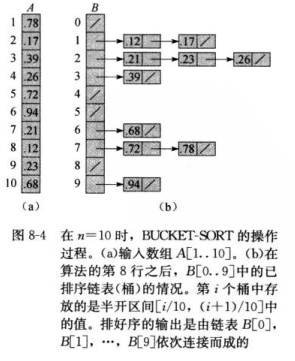
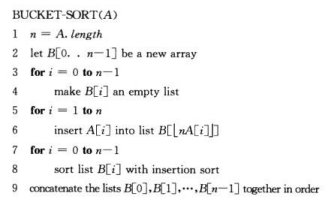
首先桶排序假设输入数据服从均匀分布,输入是由一个随机过程产生,该过程将元素均匀,独立地分布在[0,1)区间上.然后桶排序将[0,1)区间划分成n个相同大小的区间,或称为桶.然后,将n个输入数分别放到各个桶中.因为输入数据是均匀独立地分布在[0,1)上的,所以不会有很多数落在一个桶中.最后为了得到结果,先对每个桶中的数进行排序,然后遍历所有桶,按次序把每个桶中的元素拿出来.
图解
代码
伪代码
C代码
#include <stdio.h>
#include <stdlib.h>
#define N 20
struct node {
	float key;
	struct node * next;
};
void Bucket_sort(float * a, int len)//桶排序
{
	int i;
	struct node ** b = (struct node **)malloc(sizeof(struct node *) * len);
	//桶初始化
	for(i = 0; i < len; i++)
	{
		b[i] = (struct node *)malloc(sizeof(struct node));
		b[i]->key = -999;
		b[i]->next = NULL;
	}
	//插入数据并排序
	for(i = 0; i < len; i++)
	{
		struct node * p = (struct node *)malloc(sizeof(struct node));
		p->key = a[i];
		p->next = NULL;

		int index = a[i]/10;
		struct node * t = b[index];
		//插入排序
		while((t->next!=NULL)&&(t->next->key <= p->key))
			t = t->next;
		p->next = t->next;
		t->next = p;
	}
	int j = 0;
 	for(i = 0; i < len; i++)//从b中导出数据
	{
		struct node * temp = b[i]->next;
		while(temp != NULL)
		{
			a[j++] = temp->key;
			temp = temp->next;
		}
	}
}

void Show(float * a, int len)
{
	int i = 0;
	for(i = 0; i < len; i++)
		printf("%f ", a[i]);
	printf("\n");
}

int main()
{
	float a[] = {0.78, 0.17, 0.39, 0.26, 0.72, 0.94, 0.21, 0.12, 0.23, 0.68};
	int len = sizeof(a) / sizeof(float);
	Show(a,len);
	Bucket_sort(a,len);
	Show(a,len);
	return 0;
}
时间复杂度
时间复杂度为O(n),前提条件是输入数据服从均匀分布,或所有桶的大小的平方和与总的元素数呈线性关系,桶排序也可在线性时间内完成.


 浙公网安备 33010602011771号