
基于mykernel 2.0编写一个操作系统内核
1. 实验要求
- 按照https://github.com/mengning/mykernel 的说明配置mykernel 2.0,熟悉Linux内核的编译;
- 基于mykernel 2.0编写一个操作系统内核,参照https://github.com/mengning/mykernel 提供的范例代码
- 简要分析操作系统内核核心功能及运行工作机制
2. 实验准备
1. 配置好mykernel 2.0
wget https://raw.github.com/mengning/mykernel/master/mykernel-2.0_for_linux-5.4.34.patch
sudo apt install axel
axel -n 20 https://mirrors.edge.kernel.org/pub/linux/kernel/v5.x/linux-5.4.34.tar.xz
xz -d linux-5.4.34.tar.xz
tar -xvf linux-5.4.34.tar
cd linux-5.4.34
patch -p1 < ../mykernel-2.0_for_linux-5.4.34.patch
sudo apt install build-essential libncurses-dev bison flex libssl-dev libelf-dev
make defconfig # Default configuration is based on 'x86_64_defconfig'
make -j$(nproc)
sudo apt install qemu # install QEMU
qemu-system-x86_64 -kernel arch/x86/boot/bzImage
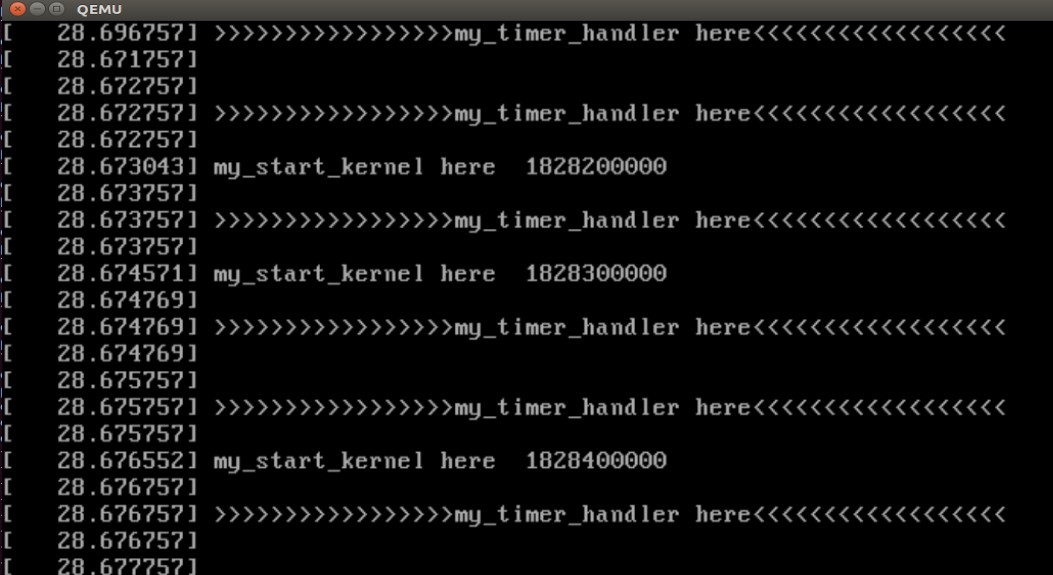
从qemu窗口中您可以看到my_start_kernel在执行,同时my_timer_handler时钟中断处理程序周期性执行。
进入mykernel目录您可以看到qemu窗口输出的内容的代码mymain.c和myinterrupt.c。当前有一个CPU执行C代码的上下文环境,同时具有中断处理程序的上下文环境,我们通过Linux内核代码模拟了一个具有时钟中断和C代码执行环境的硬件平台。
2. 创建一个pch.h
pch.h用来描述进程信息
#define MAX_TASK_NUM        4
#define KERNEL_STACK_SIZE   1024*2
/* CPU-specific state of this task */
struct Thread {
    unsigned long        ip;
    unsigned long        sp;
};

typedef struct PCB{
    int pid;
    volatile long state;    /* -1 unrunnable, 0 runnable, >0 stopped */
    unsigned long stack[KERNEL_STACK_SIZE];
    /* CPU-specific state of this task */
    struct Thread thread;
    unsigned long    task_entry;
    struct PCB *next;
}tPCB;

void my_schedule(void);
3. 修改mymain.c
修改后的mymain.c为
#include <linux/types.h>
#include <linux/string.h>
#include <linux/ctype.h>
#include <linux/tty.h>
#include <linux/vmalloc.h>


#include "mypcb.h"

tPCB task[MAX_TASK_NUM];
tPCB * my_current_task = NULL;
volatile int my_need_sched = 0;

void my_process(void);


void __init my_start_kernel(void)
{
    int pid = 0;
    int i;
    /* Initialize process 0*/
    task[pid].pid = pid;
    task[pid].state = 0;/* -1 unrunnable, 0 runnable, >0 stopped */
    task[pid].task_entry = task[pid].thread.ip = (unsigned long)my_process;
    task[pid].thread.sp = (unsigned long)&task[pid].stack[KERNEL_STACK_SIZE-1];
    task[pid].next = &task[pid];
    /*fork more process */
    for(i=1;i<MAX_TASK_NUM;i++)
    {
        memcpy(&task[i],&task[0],sizeof(tPCB));
        task[i].pid = i;
        task[i].thread.sp = (unsigned long)(&task[i].stack[KERNEL_STACK_SIZE-1]);
        task[i].next = task[i-1].next;
        task[i-1].next = &task[i];
    }
    /* start process 0 by task[0] */
    pid = 0;
    my_current_task = &task[pid];
    asm volatile(
        "movq %1,%%rsp\n\t"     /* set task[pid].thread.sp to rsp */
        "pushq %1\n\t"             /* push rbp */
        "pushq %0\n\t"             /* push task[pid].thread.ip */
        "ret\n\t"                 /* pop task[pid].thread.ip to rip */
        :
        : "c" (task[pid].thread.ip),"d" (task[pid].thread.sp)    /* input c or d mean %ecx/%edx*/
    );
}

int i = 0;

void my_process(void)
{
    while(1)
    {
        i++;
        if(i%10000000 == 0)
        {
            printk(KERN_NOTICE "this is process %d -\n",my_current_task->pid);
            if(my_need_sched == 1)
            {
                my_need_sched = 0;
                my_schedule();
            }
            printk(KERN_NOTICE "this is process %d +\n",my_current_task->pid);
        }
    }
}
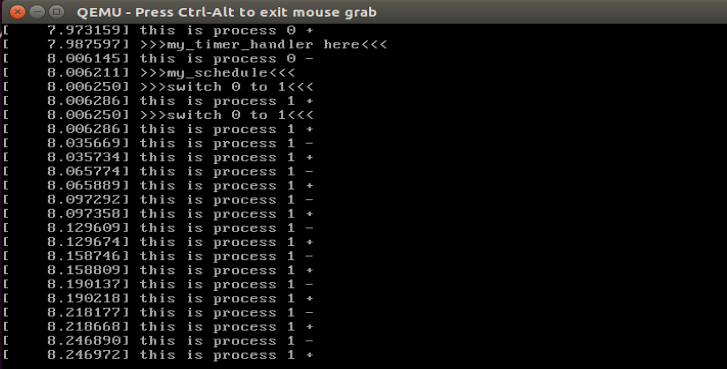
系统启动时,自动启动进程0.之后myprocess无限循环去检测是否需要进行进程切换
4. 修改myinterrupt.c
#include <linux/types.h>
#include <linux/string.h>
#include <linux/ctype.h>
#include <linux/tty.h>
#include <linux/vmalloc.h>

#include "mypcb.h"

extern tPCB task[MAX_TASK_NUM];
extern tPCB * my_current_task;
extern volatile int my_need_sched;
volatile int time_count = 0;

/*
 * Called by timer interrupt.
 * it runs in the name of current running process,
 * so it use kernel stack of current running process
 */
void my_timer_handler(void)
{
    if(time_count%1000 == 0 && my_need_sched != 1)
    {
        printk(KERN_NOTICE ">>>my_timer_handler here<<<\n");
        my_need_sched = 1;
    }
    time_count ++ ;
    return;
}

void my_schedule(void)
{
    tPCB * next;
    tPCB * prev;

    if(my_current_task == NULL
        || my_current_task->next == NULL)
    {
        return;
    }
    printk(KERN_NOTICE ">>>my_schedule<<<\n");
    /* schedule */
    next = my_current_task->next;
    prev = my_current_task;
    if(next->state == 0)/* -1 unrunnable, 0 runnable, >0 stopped */
    {
        my_current_task = next;
        printk(KERN_NOTICE ">>>switch %d to %d<<<\n",prev->pid,next->pid);
        /* switch to next process */
        asm volatile(
            "pushq %%rbp\n\t"         /* save rbp of prev */
            "movq %%rsp,%0\n\t"     /* save rsp of prev */
            "movq %2,%%rsp\n\t"     /* restore  rsp of next */
            "movq $1f,%1\n\t"       /* save rip of prev */
            "pushq %3\n\t"
            "ret\n\t"                 /* restore  rip of next */
            "1:\t"                  /* next process start here */
            "popq %%rbp\n\t"
            : "=m" (prev->thread.sp),"=m" (prev->thread.ip)
            : "m" (next->thread.sp),"m" (next->thread.ip)
        );
    }
    return;
}
myinterrupt用来对时间片进行记录,当时间片到会将my_need_sched置1,从而进行进程切换
5. 运行
3. 总结
通过本实验实现了一个简单的linux进程切换。了解到进程切换的运行机制。

 浙公网安备 33010602011771号