
linux socket编程系统调用栈
@
- 一、网络协议参考模型简介
- 二、SOCKET概述
- 三、SOCKET基本数据结构
- include <stdio.h> /* perror */
- include <stdlib.h> /* exit */
- include <sys/types.h> /* WNOHANG */
- include <sys/wait.h> /* waitpid */
- include <string.h> /* memset */
- include "socketwrapper.h" /* socket layer wrapper */
- define true 1
- define false 0
- define MYPORT 12334 /* 监听的端口 */
- define BACKLOG 10 /* listen的请求接收队列长度 */
- define MAXSIZE 100
- include <stdio.h> /* perror */
- include <stdlib.h> /* exit */
- include <sys/types.h> /* WNOHANG */
- include <sys/wait.h> /* waitpid */
- include <string.h> /* memset */
- include "socketwrapper.h" /* socket layer wrapper */
- define true 1
- define false 0
- define PORT 12334 /* Server的端口 */
- define MAXDATASIZE 100 /*一次可以读的最大字节数 */
- ifndef SOCKET_WRAPER_H
- define SOCKET_WRAPER_H
- include <sys/time.h>
- include <sys/types.h>
- include <unistd.h>
- include <fcntl.h>
- include <sys/socket.h>
- include <errno.h>
- include <arpa/inet.h>
- include <netdb.h> /* gethostbyname */
- define Htons(a) htons(a)
- define Inet_ntoa(a) inet_ntoa(a)
- ifdef CONFIG_MODULES
一、网络协议参考模型简介
国际标准组织(ISO)制定了OSI模型。这个模型把网络通信的工作分为7层,从上至下为应用层、表示层、会话层、
传输层、网络层、数据链路层、物理层。
而TCP/IP协议将OSI的7层模型简化为4层,从上至下分别为应用层、传输层、网络互连层(网际层)、网络接口层。
TCP/IP协议实际是一个协议族,为网际数据通信提供不同层次的通路。
TCP协议处于传输层,实现了从一个应用程序到另一个应用程序的数据传递。应用程序通过目的IP地址和端口号
来区分接收数据的不同应用程序。
二、SOCKET概述
socket接口是TCP/IP网络的API,它定义了许多函数或例程,程序员可以使用它来开发TCP/IP网络上的应用程序,
要学习Internet上的TCP/IP网络编程,必须理解socket接口。socket接口设计者最先将接口放在UNIX操作系统中。
如果了解UNIX系统的输入输出的话,就很容易理解socket了。网络的socket数据传输是一种特殊的I/O,socket
也是一种文件描述符。
三、SOCKET基本数据结构
struct sockaddr {
/* address family, AF_xxx;一般为AF_INET,代表Internet(TCP/IP)地址族的IPv4协议 /
sa_family_t sa_family;
/ 14 bytes of protocol address;包含了远程计算机的IP地址、端口号和套接字的数目,这些数据是混杂在一起的*/
char sa_data[14];
};
/* Structure describing an Internet (IP) socket address. /
#define SOCK_SIZE 16 / sizeof(struct sockaddr) */
struct sockaddr_in {
sa_family_t sin_family; /* Address family /
__be16 sin_port; / Port number /
struct in_addr sin_addr; / Internet address /
/ Pad to size of `struct sockaddr'. */
unsigned char __pad[SOCK_SIZE - sizeof(short int) -
sizeof(unsigned short int) - sizeof(struct in_addr)];
};
1、TCP通信编程
前面简单介绍了TCP/IP协议,事实上该协议是十分复杂的(要是一个人从头开始研究网络协议的话,这辈子可能
啥也没干就过去了)。要编写一个优秀的网络程序也是十分困难的。服务端与客户端TCP通信的过程大致如下:
服务器端:
1. 首先服务器启动,通过调用socket()建立一个套接字
2. 调用bind()将该套接字和本地网络地址联系在一起
3. 调用listen()使套接字做好侦听的准备,并规定它的请求队列的长度
4. 调用accept()来接收连接
客户端:
1. 通过调用socket()建立一个套接字
2. 调用connect()和服务器建立连接。
3. 连接一旦建立,客户机和服务器之间就可以通过调用read和write函数来发送和接收数据了
4. 最后,待数据传送结束之后,双方调用close()关闭套接字,通信关闭。
2、服务器端实例代码
include <stdio.h> /* perror */
include <stdlib.h> /* exit */
include <sys/types.h> /* WNOHANG */
include <sys/wait.h> /* waitpid */
include <string.h> /* memset */
include "socketwrapper.h" /* socket layer wrapper */
define true 1
define false 0
define MYPORT 12334 /* 监听的端口 */
define BACKLOG 10 /* listen的请求接收队列长度 */
define MAXSIZE 100
int main()
{
int numbytes=0;
int sockfd, new_fd; /* 监听端口,数据端口 /
struct sockaddr_in sa; / 自身的地址信息 /
struct sockaddr_in client_addr; / 连接对方的地址信息 /
int sin_size;
char buf[MAXSIZE];
if ((sockfd = socket(PF_INET, SOCK_STREAM, 0)) == -1)
{
perror("socket");
exit(1);
}
sa.sin_family = AF_INET;
sa.sin_port = Htons(MYPORT); / 网络字节顺序 /
sa.sin_addr.s_addr = INADDR_ANY; / 自动填本机IP /
memset(&(sa.sin_zero),0, 8); / 其余部分置0 */
if ( Bind(sockfd, (struct sockaddr *)&sa, sizeof(sa)) == -1)
{
perror("bind");
exit(1);
}
if (Listen(sockfd, BACKLOG) == -1)
{
perror("listen");
exit(1);
}
sin_size = sizeof(struct sockaddr_in);
new_fd = Accept(sockfd, (struct sockaddr )&client_addr, &sin_size);
if (new_fd == -1)
{
perror("accept");
exit(1);
}
printf("Got connection from %s\n", Inet_ntoa(client_addr.sin_addr));
/ 主循环 */
while(1)
{
if ((numbytes=recv(new_fd,buf,MAXSIZE,0))>0)
{
buf[numbytes]=0;
printf("received:%s & length=%d\n",buf,numbytes);
if(send(new_fd,buf,strlen(buf), 0) == -1)
perror("send");
}
}
return true;
}
3、客户端实例代码
include <stdio.h> /* perror */
include <stdlib.h> /* exit */
include <sys/types.h> /* WNOHANG */
include <sys/wait.h> /* waitpid */
include <string.h> /* memset */
include "socketwrapper.h" /* socket layer wrapper */
define true 1
define false 0
define PORT 12334 /* Server的端口 */
define MAXDATASIZE 100 /*一次可以读的最大字节数 */
int main(int argc, char *argv[])
{
int sockfd, numbytes;
char buf[MAXDATASIZE];
struct hostent he; / 主机信息 /
struct sockaddr_in server_addr; / 对方地址信息 /
if (argc != 2)
{
fprintf(stderr,"usage: client hostname\n");
exit(1);
}
/ get the host info /
if ((he=Gethostbyname(argv[1])) == NULL)
{
/ 注意:获取DNS信息时,显示出错需要用herror而不是perror /
/ herror 在新的版本中会出现警告,已经建议不要使用了 */
perror("gethostbyname");
exit(1);
}
if ((sockfd=socket(PF_INET,SOCK_STREAM,0))==-1)
{
perror("socket");
exit(1);
}
server_addr.sin_family = AF_INET;
server_addr.sin_port = Htons(PORT); /* short, NBO */
server_addr.sin_addr = *((struct in_addr )he->h_addr_list[0]);
memset(&(server_addr.sin_zero),0, 8); / 其余部分设成0 */
if (Connect(sockfd, (struct sockaddr *)&server_addr, sizeof(struct sockaddr)) == -1)
{
perror("connect");
exit(1);
}
while(1)
{
printf("Enter Something:");
scanf("%s",buf);
numbytes=send(sockfd,buf,strlen(buf),0);
numbytes=recv(sockfd,buf,MAXDATASIZE,0);
buf[numbytes]='\0';
printf("received:%s\n",buf);
}
Close(sockfd);
return true;
}
4、头文件socketwrapper.h
//
/* Copyright (C) SSE-USTC, 2010 /
/ /
/ FILE NAME : socketwraper.h /
/ PRINCIPAL AUTHOR : Mengning /
/ SUBSYSTEM NAME : ChatSys /
/ MODULE NAME : ChatSys /
/ LANGUAGE : C /
/ TARGET ENVIRONMENT : ANY /
/ DATE OF FIRST RELEASE : 2010/10/18 /
/ DESCRIPTION : the interface to socket layer. */
//
/*
* Revision log:
*
* Created by Mengning,2010/10/18
*
*/
ifndef SOCKET_WRAPER_H
define SOCKET_WRAPER_H
include <sys/time.h>
include <sys/types.h>
include <unistd.h>
include <fcntl.h>
include <sys/socket.h>
include <errno.h>
include <arpa/inet.h>
include <netdb.h> /* gethostbyname */
/* ChatSys Socket - Standard Socket Call Mapping Definition */
#define Socket(x,y,z) socket(x,y,z)
#define Bind(x,y,z) bind(x,y,z)
#define Connect(x,y,z) connect(x,y,z)
#define Listen(x,y) listen(x,y)
#define Read(x,y,z ) read(x,y,z)
#define Accept(x,y,z ) accept(x,y,(socklen_t *)z)
#define Recv(w,x,y,z) recv(w,x,y,z)
#define Recvfrom(a,b,c,d,e,f) recvfrom(a,b,c,d,e,f )
#define Recvmsg(a,b,c) recvmsg(a,b,c)
#define Write(a,b,c) write(a,b,c)
#define Send(a,b,c,d) send(a,b,c,d)
#define Sendto(a,b,c,d,e,f) sendto(a,b,c,d,e,f)
#define Sendmsg(a,b,c) sendmsg(a,b,c)
#define Close(a) close(a)
define Htons(a) htons(a)
define Inet_ntoa(a) inet_ntoa(a)
/* Name /
#define Gethostbyname(a) gethostbyname(a)
#endif / SOCKET_WRAPER_H */
5、程序实现功能
首先运行server,然后运行client。连接建立之后,client通过键盘输入字符,发送到server。
server接收到数据之后,直接返回给client。验证通信是否成功。
实现效果
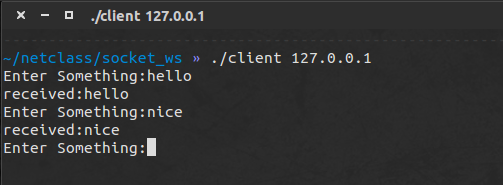
client第一次发送hello,第二次发送nice

server接收到数据
6、探究socket系统调用
-
SYSCALL_DEFINE3(socket, int, family, int, type, int, protocol)
{
int retval;
struct socket sock;
int flags;
/ Check the SOCK_* constants for consistency. */
BUILD_BUG_ON(SOCK_CLOEXEC != O_CLOEXEC);
BUILD_BUG_ON((SOCK_MAX | SOCK_TYPE_MASK) != SOCK_TYPE_MASK);
BUILD_BUG_ON(SOCK_CLOEXEC & SOCK_TYPE_MASK);
BUILD_BUG_ON(SOCK_NONBLOCK & SOCK_TYPE_MASK);flags = type & ~SOCK_TYPE_MASK;
if (flags & ~(SOCK_CLOEXEC | SOCK_NONBLOCK))
return -EINVAL;
type &= SOCK_TYPE_MASK;if (SOCK_NONBLOCK != O_NONBLOCK && (flags & SOCK_NONBLOCK))
flags = (flags & ~SOCK_NONBLOCK) | O_NONBLOCK;retval = sock_create(family, type, protocol, &sock);/重要函数/
if (retval < 0)
goto out;retval = sock_map_fd(sock, flags & (O_CLOEXEC | O_NONBLOCK));/重要函数/
if (retval < 0)
goto out_release;out:
/* It may be already another descriptor 8) Not kernel problem. */
return retval;out_release:
sock_release(sock);
return retval;
}可以看出 SYSCALL_DEFINE3(socket, int, family, int, type, int, protocol)代码中主要是使用了
sock_create()和sock_map_fd()这两个函数。那么接下来先分析sock_create() -
int sock_create(int family, int type, int protocol, struct socket **res)
{
return __sock_create(current->nsproxy->net_ns, family, type, protocol, res, 0);
}可以看出sock_create()实际调用__sock_create(),继续递归
-
int __sock_create(struct net *net, int family, int type, int protocol,
struct socket **res, int kern)
{
int err;
struct socket *sock;
const struct net_proto_family pf;
/
* Check protocol is in range
*/
if (family < 0 || family >= NPROTO)
return -EAFNOSUPPORT;
if (type < 0 || type >= SOCK_MAX)
return -EINVAL;/* Compatibility.
This uglymoron is moved from INET layer to here to avoid
deadlock in module load.
*/
if (family == PF_INET && type == SOCK_PACKET) {
static int warned;
if (!warned) {
warned = 1;
printk(KERN_INFO "%s uses obsolete (PF_INET,SOCK_PACKET)\n",
current->comm);
}
family = PF_PACKET;
}err = security_socket_create(family, type, protocol, kern);
if (err)
return err;/*
* Allocate the socket and allow the family to set things up. if
* the protocol is 0, the family is instructed to select an appropriate
* default.
/
sock = sock_alloc();/重要/
if (!sock) {
if (net_ratelimit())
printk(KERN_WARNING "socket: no more sockets\n");
return -ENFILE; / Not exactly a match, but its the
closest posix thing */
}sock->type = type;
ifdef CONFIG_MODULES
/* Attempt to load a protocol module if the find failed.
*
* 12/09/1996 Marcin: But! this makes REALLY only sense, if the user
* requested real, full-featured networking support upon configuration.
* Otherwise module support will break!
*/
if (rcu_access_pointer(net_families[family]) == NULL)
request_module("net-pf-%d", family);
#endifrcu_read_lock();
pf = rcu_dereference(net_families[family]);
err = -EAFNOSUPPORT;
if (!pf)
goto out_release;/*
* We will call the ->create function, that possibly is in a loadable
* module, so we have to bump that loadable module refcnt first.
*/
if (!try_module_get(pf->owner))
goto out_release;/* Now protected by module ref count */
rcu_read_unlock();err = pf->create(net, sock, protocol, kern);/重要/
if (err < 0)
goto out_module_put;/*
* Now to bump the refcnt of the [loadable] module that owns this
* socket at sock_release time we decrement its refcnt.
*/
if (!try_module_get(sock->ops->owner))
goto out_module_busy;/*
* Now that we're done with the ->create function, the [loadable]
* module can have its refcnt decremented
*/
module_put(pf->owner);
err = security_socket_post_create(sock, family, type, protocol, kern);
if (err)
goto out_sock_release;
*res = sock;return 0;
out_module_busy:
err = -EAFNOSUPPORT;
out_module_put:
sock->ops = NULL;
module_put(pf->owner);
out_sock_release:
sock_release(sock);
return err;out_release:
rcu_read_unlock();
goto out_sock_release;
}其中重要的函数有sock_alloc()和pf->create(net, sock, protocol, kern)函数,递归查看sock_alloc()
-
static struct socket *sock_alloc(void)
{
struct inode *inode;
struct socket *sock;inode = new_inode(sock_mnt->mnt_sb);
if (!inode)
return NULL;sock = SOCKET_I(inode);
kmemcheck_annotate_bitfield(sock, type);
inode->i_ino = get_next_ino();
inode->i_mode = S_IFSOCK | S_IRWXUGO;
inode->i_uid = current_fsuid();
inode->i_gid = current_fsgid();percpu_add(sockets_in_use, 1);
return sock;
} -
struct inode *new_inode(struct super_block *sb)
{
struct inode *inode;spin_lock_prefetch(&inode_sb_list_lock);
inode = alloc_inode(sb);
if (inode) {
spin_lock(&inode->i_lock);
inode->i_state = 0;
spin_unlock(&inode->i_lock);
inode_sb_list_add(inode);
}
return inode;
}
到这里已经快结束了。大致的系统调用栈也已经清晰,最终调用 inode = alloc_inode(sb);

 浙公网安备 33010602011771号