|
|
|
|
|
|
import cv2
import numpy as np

img = np.mat(np.zeros((300,300)))
cv2.imshow("test",img)
cv2.waitKey(0)
import cv2
import numpy as np

img = np.mat(np.zeros((300,300),dtype=np.uint8))
cv2.imshow("test",img)
cv2.waitKey(0)
import cv2
import numpy as np

image = np.mat(np.zeros((300,300)))
imageByteArray = bytearray(image)
print(imageByteArray)
imageBGR = np.array(imageByteArray).reshape(800,900)
cv2.imshow("cool",imageBGR)
cv2.waitKey(0)
import os
import cv2
import numpy as np

randomByteArray = bytearray(os.urandom(120000))
flatNumpyArray = np.array(randomByteArray).reshape(300,400)
cv2.imshow("cool",flatNumpyArray)
cv2.waitKey(0)
import cv2
import numpy as np
img = np.zeros((300,300))
img[0,0] = 255
cv2.imshow("img",img)
cv2.waitKey(0)
import cv2
import numpy as np

img = np.zeros((300,300))
img[:,10] = 255
img[10,:] = 255
cv2.imshow("img",img)
cv2.waitKey(0)
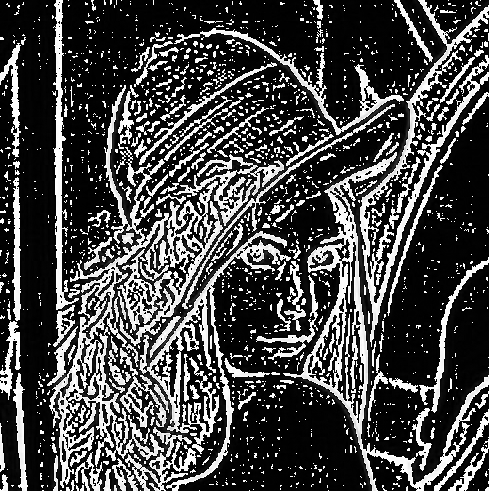
import cv2
import numpy as np

from scipy import ndimage

kernel33 = np.array([[-1,-1,-1],
                     [-1,8,-1],
                     [-1,-1,-1]])

kernel33_D = np.array([[1,1,1],
                       [1,-8,1],
                       [1,1,1]])

img = cv2.imread("G:\\MyLearning\\TensorFlow_deep_learn\\data\\lena.jpg",0)
linghtImg = ndimage.convolve(img,kernel33_D)
cv2.imshow("img",linghtImg)
cv2.waitKey()
![]()
import numpy as np
import cv2
from scipy import ndimage

img = cv2.imread("lena.jpg",0)
blurred = cv2.GaussianBlur(img,(11,11),0)
gaussImg = img - blurred
cv2.imshow("img",gaussImg)
cv2.waitKey()
![]()
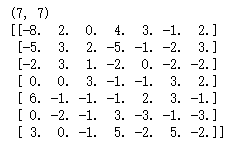
import numpy as np

def convolve(dateMat,kernel):
    m,n = dateMat.shape
    km,kn = kernel.shape
    newMat = np.ones(((m - km + 1),(n - kn + 1)))
    tempMat = np.ones(((km),(kn)))
    for row in range(m - km + 1):
        for col in range(n - kn + 1):
            for m_k in range(km):
                for n_k in range(kn):
                    tempMat[m_k,n_k] = dateMat[(row + m_k),(col + n_k)] * kernel[m_k,n_k]
            newMat[row,col] = np.sum(tempMat)
    return newMat

dateMat = np.mat([
    [1,2,1,2,0,1,0,1,1],
    [0,3,1,1,0,0,1,0,1],
    [1,2,1,0,2,1,1,0,0],
    [2,2,0,1,1,1,1,1,0],
    [3,1,1,0,1,1,0,0,1],
    [1,0,1,1,1,0,0,1,1],
    [1,1,1,1,0,1,1,1,1],
    [1,0,1,1,0,1,0,1,0],
    [0,1,1,1,1,2,0,1,0]
])

kernel = np.mat([
    [1,0,1],
    [0,-4,0],
    [1,0,1]
])

newMat = convolve(dateMat,kernel)
print(np.shape(newMat))
print(newMat)
![]()
发表于
2019-02-07 22:08
吴裕雄
阅读( 303)
评论()
收藏
举报
|
|