java反射之Method的invoke方法实现
https://blog.csdn.net/wenyuan65/article/details/81145900
在框架中经常会会用到method.invoke()方法,用来执行某个的对象的目标方法。以前写代码用到反射时,总是获取先获取Method,然后传入对应的Class实例对象执行方法。然而前段时间研究invoke方法时,发现invoke方法居然包含多态的特性,这是以前没有考虑过的一个问题。那么Method.invoke()方法的执行过程是怎么实现的?它的多态又是如何实现的呢?
本文将从java和JVM的源码实现深入探讨invoke方法的实现过程。
首先给出invoke方法多态特性的演示代码:
-
public class MethodInvoke {
-
-
public static void main(String[] args) throws Exception {
-
Method animalMethod = Animal.class.getDeclaredMethod("print");
-
Method catMethod = Cat.class.getDeclaredMethod("print");
-
-
Animal animal = new Animal();
-
Cat cat = new Cat();
-
animalMethod.invoke(cat);
-
animalMethod.invoke(animal);
-
-
catMethod.invoke(cat);
-
catMethod.invoke(animal);
-
}
-
-
}
-
-
class Animal {
-
-
public void print() {
-
System.out.println("Animal.print()");
-
}
-
-
}
-
-
class Cat extends Animal {
-
-
-
public void print() {
-
System.out.println("Cat.print()");
-
}
-
-
}
代码中,Cat类覆盖了父类Animal的print()方法, 然后通过反射分别获取print()的Method对象。最后分别用Cat和Animal的实例对象去执行print()方法。其中animalMethod.invoke(animal)和catMethod.invoke(cat),示例对象的真实类型和Method的声明Classs是相同的,按照预期打印结果;animalMethod.invoke(cat)中,由于Cat是Animal的子类,按照多态的特性,子类调用父类的的方法,方法执行时会动态链接到子类的实现方法上。因此,这里会调用Cat.print()方法;而catMethod.invoke(animal)中,传入的参数类型Animal是父类,却期望调用子类Cat的方法,因此这一次会抛出异常。代码打印结果为:
-
Cat.print()
-
Animal.print()
-
Cat.print()
-
Exception in thread "main" java.lang.IllegalArgumentException: object is not an instance of declaring class
-
at sun.reflect.NativeMethodAccessorImpl.invoke0(Native Method)
-
at sun.reflect.NativeMethodAccessorImpl.invoke(Unknown Source)
-
at sun.reflect.DelegatingMethodAccessorImpl.invoke(Unknown Source)
-
at java.lang.reflect.Method.invoke(Unknown Source)
-
at com.wy.invoke.MethodInvoke.main(MethodInvoke.java:17)
接下来,我们来看看invoke()方法的实现过程。
-
public Object invoke(Object obj, Object... args) throws IllegalAccessException, IllegalArgumentException, InvocationTargetException
-
{
-
if (!override) {
-
if (!Reflection.quickCheckMemberAccess(clazz, modifiers)) {
-
Class<?> caller = Reflection.getCallerClass(1);
-
-
checkAccess(caller, clazz, obj, modifiers);
-
}
-
}
-
MethodAccessor ma = methodAccessor; // read volatile
-
if (ma == null) {
-
ma = acquireMethodAccessor();
-
}
-
return ma.invoke(obj, args);
-
}
invoke()方法中主要分为两部分:访问控制检查和调用MethodAccessor.invoke()实现方法执行。
首先看一下访问控制检查这一块的逻辑。第一眼看到这里的逻辑的时候,很容易搞不清楚是干嘛的。通俗来讲就是通过方法的修饰符(public/protected/private/package),来判断方法的调用者是否可以访问该方法。这是java的基础内容,不过用代码写出来,一下子不容易想到。访问控制检查分为3步:
- 检查override,如果override为true,跳过检查;否则继续;
- 快速检查,判断该方法的修饰符modifiers是否为public,如果是跳过检查;否则继续;
- 详细检查,通过方法的(protected/private/package)修饰符或方法的声明类(例如子类可以访问父类的protected方法)与调用者caller之间的关系,判断caller是否有权限访问该方法。
override属性是Method的父类AccessibleObject中声明的变量,使得程序可以控制是否跳过访问权限的检查。另外,Method的实例对象中,override属性的初始值设置为false。
-
public void setAccessible(boolean flag) throws SecurityException {
-
SecurityManager sm = System.getSecurityManager();
-
if (sm != null) sm.checkPermission(ACCESS_PERMISSION);
-
setAccessible0(this, flag);
-
}
-
-
private static void setAccessible0(AccessibleObject obj, boolean flag)
-
throws SecurityException
-
{
-
if (obj instanceof Constructor && flag == true) {
-
Constructor<?> c = (Constructor<?>)obj;
-
if (c.getDeclaringClass() == Class.class) {
-
throw new SecurityException("Can not make a java.lang.Class" +
-
" constructor accessible");
-
}
-
}
-
obj.override = flag;
-
}
多说一句,Field同样继承了AccessibleObject,且Field的override也是初始化为false的,也就是说并没有按照变量的修饰符去初始化不同的值。但是我们在调用Field.set(Object obj, Object value)时,如果该Field是private修饰的,会因没有访问权限而抛出异常,因此必须调用setAccessible(true)。此处非常容易理解为因为变量是public的,所以override就被初始化为true。
invoke()方法中,访问控制检查之后,就是通过MethodAccessor.invoke()调用方法。再来看一下代码:
-
MethodAccessor ma = methodAccessor; // read volatile
-
if (ma == null) {
-
ma = acquireMethodAccessor();
-
}
-
return ma.invoke(obj, args);
这里的逻辑很简单,首先将变量methodAccessor赋值给ma,在方法栈中保存一个可以直接引用的本地变量,如果methodAccessor不存在,调用acquireMethodAccessor()方法创建一个。
-
private volatile MethodAccessor methodAccessor;
-
private Method root;
-
-
private MethodAccessor acquireMethodAccessor() {
-
// First check to see if one has been created yet, and take it
-
// if so
-
MethodAccessor tmp = null;
-
if (root != null) tmp = root.getMethodAccessor();
-
if (tmp != null) {
-
methodAccessor = tmp;
-
} else {
-
// Otherwise fabricate one and propagate it up to the root
-
tmp = reflectionFactory.newMethodAccessor(this);
-
setMethodAccessor(tmp);
-
}
-
-
return tmp;
-
}
-
-
void setMethodAccessor(MethodAccessor accessor) {
-
methodAccessor = accessor;
-
// Propagate up
-
if (root != null) {
-
root.setMethodAccessor(accessor);
-
}
-
}
-
-
Method copy() {
-
Method res = new Method(clazz, name, parameterTypes, returnType,
-
exceptionTypes, modifiers, slot, signature,
-
annotations, parameterAnnotations, annotationDefault);
-
res.root = this;
-
res.methodAccessor = methodAccessor;
-
return res;
-
}
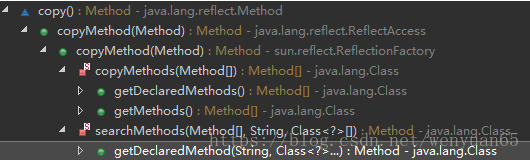
综合acquireMethodAccessor(),setMethodAccessor()以及copy()这三个方法,可以看到一个Method实例对象维护了一个root引用。当调用Method.copy()进行方法拷贝时,root指向了被拷贝的对象。那么当一个Method被多次拷贝后,调用一次setMethodAccessor()方法,就会将root引用所指向的Method的methodAccessor变量同样赋值。例如:D -> C -> B -> A,其中X-> Y表示X = Y.copy(), 当C对象调用setMethodAccessor()时,B和A都会传播赋值methodAccessor, 而D的methodAccessor还是null。紧接着,当D需要获取methodAccessor而调用acquireMethodAccessor()时,D获取root的methodAccessor, 那么D将和ABC持有相同的methodAccessor。
虽然Method中,通过维护root引用意图使相同的方法始终保持只有一个methodAccessor实例,但是上述方法仍然无法保证相同的方法只有一个methodAccessor实例。例如通过copy()使ABCD保持关系:D -> C -> B -> A, 当B对象调用setMethodAccessor()时,B和A都会赋值methodAccessor, 而C、D的methodAccessor还是null。这时D调用acquireMethodAccessor()时,D获取root也就是C的methodAccessor,发现为空,然后就新创建了一个。从而出现了相同的方法中出现了两个methodAccessor实例对象的现象。
在Class.getMethod()、Class.getDeclaredMethod()以及Class.getDeclaredMethod(String name, Class<?>... parameterTypes)方法中最终都会调用copy()方法来保障Method使用的安全性。 在比较极端加巧合的情况下,可能会引起类膨胀的问题,这就是接下来要讲到的MethodAccessor的实现机制。
在前面代码中,MethodAccessor的创建是通过反射工厂ReflectionFactory的newMethodAccessor(Method)方法来创建的。
-
public MethodAccessor newMethodAccessor(Method method) {
-
checkInitted();
-
-
if (noInflation) {
-
return new MethodAccessorGenerator().
-
generateMethod(method.getDeclaringClass(),
-
method.getName(),
-
method.getParameterTypes(),
-
method.getReturnType(),
-
method.getExceptionTypes(),
-
method.getModifiers());
-
} else {
-
NativeMethodAccessorImpl acc =
-
new NativeMethodAccessorImpl(method);
-
DelegatingMethodAccessorImpl res =
-
new DelegatingMethodAccessorImpl(acc);
-
acc.setParent(res);
-
return res;
-
}
-
}
其中, checkInitted()方法检查从配置项中读取配置并设置noInflation、inflationThreshold的值:
-
private static void checkInitted() {
-
if (initted) return;
-
AccessController.doPrivileged(
-
new PrivilegedAction<Void>() {
-
public Void run() {
-
-
if (System.out == null) {
-
// java.lang.System not yet fully initialized
-
return null;
-
}
-
-
String val = System.getProperty("sun.reflect.noInflation");
-
if (val != null && val.equals("true")) {
-
noInflation = true;
-
}
-
-
val = System.getProperty("sun.reflect.inflationThreshold");
-
if (val != null) {
-
try {
-
inflationThreshold = Integer.parseInt(val);
-
} catch (NumberFormatException e) {
-
throw (RuntimeException)
-
new RuntimeException("Unable to parse property sun.reflect.inflationThreshold").
-
initCause(e);
-
}
-
}
-
-
initted = true;
-
return null;
-
}
-
});
-
}
可以通过启动参数-Dsun.reflect.noInflation=false -Dsun.reflect.inflationThreshold=15来设置:

结合字面意思及下面代码理解,这两个配置sun.reflect.noInflation是控制是否立即进行类膨胀,sun.reflect.inflationThreshold是设置类膨胀阈值。
创建MethodAccessor有两种选择,一种是当sun.reflect.noInflation配置项为true时,ReflectionFactory利用MethodAccessor的字节码生成类 MethodAccessorGenerator直接创建一个代理类,通过间接调用原方法完成invoke()任务,具体实现稍后给出。MethodAccessor的另一种实现方式是,创建DelegatingMethodAccessorImpl 委托类,并将执行invoke()方法的具体内容交由NativeMethodAccessorImpl实现,而NativeMethodAccessorImpl最终调用native方法完成invoke()任务。以下是NativeMethodAccessorImpl的invoke()方法实现。
-
public Object invoke(Object obj, Object[] args)
-
throws IllegalArgumentException, InvocationTargetException
-
{
-
if (++numInvocations > ReflectionFactory.inflationThreshold()) {
-
MethodAccessorImpl acc = (MethodAccessorImpl)
-
new MethodAccessorGenerator().
-
generateMethod(method.getDeclaringClass(),
-
method.getName(),
-
method.getParameterTypes(),
-
method.getReturnType(),
-
method.getExceptionTypes(),
-
method.getModifiers());
-
parent.setDelegate(acc);
-
}
-
-
return invoke0(method, obj, args);
-
}
-
-
private static native Object invoke0(Method m, Object obj, Object[] args);
可以看到,当numInvocations数量大于配置项sun.reflect.inflationThreshold即类膨胀阈值时, 使用MethodAccessorGenerator创建一个代理类对象,并且将被委托的NativeMethodAccessorImpl的parent,也就是委托类DelegatingMethodAccessorImpl的委托类设置为这个生成的代理对象。这么说可能有点绕,下面用一幅图表示这个过程。
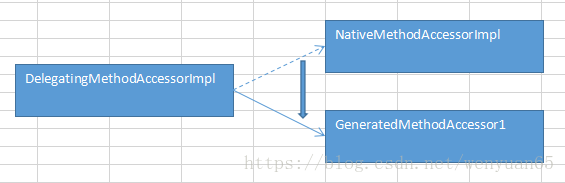
总体来说,当调用invoke()时,按照默认配置,Method首先创建一个DelegatingMethodAccessorImpl对象,并设置一个被委托的NativeMethodAccessorImpl对象,那么method.invoke()就被转换成DelegatingMethodAccessorImpl.invoke(),然后又被委托给NativeMethodAccessorImp.invoke()实现。当NativeMethodAccessorImp.invoke()调用次数超过一定热度时(默认15次),被委托方又被转换成代理类来实现。
之前提到过在极端情况下,同一个方法的Method对象存在多个不同拷贝拷贝时,可能存在多个MethodAccessor对象。那么当多次调用后,必然会生成两个重复功能的代理类。当然,一般情况下,生成两个代理类并没有较大的影响。
其中代理类的具体字节码实现过程较为复杂,大体思想是生成一个如下所示的类:
-
public class GeneratedMethodAccessor1 extends MethodAccessorImpl {
-
-
public GeneratedMethodAccessor1 () {
-
super();
-
}
-
-
public Object invoke(Object obj, Object[] args)
-
throws IllegalArgumentException, InvocationTargetException
-
{
-
if (!(obj instanceof Cat)) {
-
throw new ClassCastException();
-
}
-
if (args != null && args.length != 0) {
-
throw new IllegalArgumentException();
-
}
-
-
try {
-
Cat cat = (Cat) obj;
-
cat.print();
-
return null;
-
} catch (Throwable e) {
-
throw new InvocationTargetException(e, "invoke error");
-
}
-
}
-
-
}
到目前为止,除了在代理的GeneratedMethodAccessor1 类中,方法的执行有多态的特性,而NativeMethodAccessorImp的invoke()实现是在jdk中的完成的。接下来我们将目光移到NativeMethodAccessorImp的native方法invoke0();
首先,在\jdk\src\share\native\sun\reflect路径下找到NativeAccessors.c, 其中有Java_sun_reflect_NativeMethodAccessorImpl _invoke0()方法,根据JNI定义函数名的规则"包名_类名_方法名",这就是我们要找的native方法实现入口。
-
JNIEXPORT jobject JNICALL Java_sun_reflect_NativeMethodAccessorImpl_invoke0
-
(JNIEnv *env, jclass unused, jobject m, jobject obj, jobjectArray args)
-
{
-
return JVM_InvokeMethod(env, m, obj, args);
-
}
方法调用JVM_InvokeMethod(), 一般以JVM_开头的函数定义在jvm.cpp文件中,不熟悉的话可以通过头文件jvm.h看出来。继续追踪,发现jvm.cpp文件位于spot\src\share\vm\prims文件夹下。
-
JVM_ENTRY(jobject, JVM_InvokeMethod(JNIEnv *env, jobject method, jobject obj, jobjectArray args0))
-
JVMWrapper("JVM_InvokeMethod");
-
Handle method_handle;
-
if (thread->stack_available((address) &method_handle) >= JVMInvokeMethodSlack) {
-
method_handle = Handle(THREAD, JNIHandles::resolve(method));
-
Handle receiver(THREAD, JNIHandles::resolve(obj));
-
objArrayHandle args(THREAD, objArrayOop(JNIHandles::resolve(args0)));
-
oop result = Reflection::invoke_method(method_handle(), receiver, args, CHECK_NULL);
-
jobject res = JNIHandles::make_local(env, result);
-
if (JvmtiExport::should_post_vm_object_alloc()) {
-
oop ret_type = java_lang_reflect_Method::return_type(method_handle());
-
assert(ret_type != NULL, "sanity check: ret_type oop must not be NULL!");
-
if (java_lang_Class::is_primitive(ret_type)) {
-
// Only for primitive type vm allocates memory for java object.
-
// See box() method.
-
JvmtiExport::post_vm_object_alloc(JavaThread::current(), result);
-
}
-
}
-
return res;
-
} else {
-
THROW_0(vmSymbols::java_lang_StackOverflowError());
-
}
-
JVM_END
其中oop result = Reflection::invoke_method(method_handle(), receiver, args, CHECK_NULL)是方法的执行过程,在\hotspot\src\share\vm\runtime路径下找到reflection.cpp文件。
-
oop Reflection::invoke_method(oop method_mirror, Handle receiver, objArrayHandle args, TRAPS) {
-
oop mirror = java_lang_reflect_Method::clazz(method_mirror);
-
int slot = java_lang_reflect_Method::slot(method_mirror);
-
bool override = java_lang_reflect_Method::override(method_mirror) != 0;
-
objArrayHandle ptypes(THREAD, objArrayOop(java_lang_reflect_Method::parameter_types(method_mirror)));
-
-
oop return_type_mirror = java_lang_reflect_Method::return_type(method_mirror);
-
BasicType rtype;
-
if (java_lang_Class::is_primitive(return_type_mirror)) {
-
rtype = basic_type_mirror_to_basic_type(return_type_mirror, CHECK_NULL);
-
} else {
-
rtype = T_OBJECT;
-
}
-
-
instanceKlassHandle klass(THREAD, java_lang_Class::as_Klass(mirror));
-
Method* m = klass->method_with_idnum(slot);
-
if (m == NULL) {
-
THROW_MSG_0(vmSymbols::java_lang_InternalError(), "invoke");
-
}
-
methodHandle method(THREAD, m);
-
-
return invoke(klass, method, receiver, override, ptypes, rtype, args, true, THREAD);
-
}
-
-
oop Reflection::invoke(instanceKlassHandle klass, methodHandle reflected_method,
-
Handle receiver, bool override, objArrayHandle ptypes,
-
BasicType rtype, objArrayHandle args, bool is_method_invoke, TRAPS) {
-
ResourceMark rm(THREAD);
-
-
methodHandle method; // actual method to invoke
-
KlassHandle target_klass; // target klass, receiver's klass for non-static
-
-
// Ensure klass is initialized
-
klass->initialize(CHECK_NULL);
-
-
bool is_static = reflected_method->is_static();
-
if (is_static) {
-
// ignore receiver argument
-
method = reflected_method;
-
target_klass = klass;
-
} else {
-
// check for null receiver
-
if (receiver.is_null()) {
-
THROW_0(vmSymbols::java_lang_NullPointerException());
-
}
-
// Check class of receiver against class declaring method
-
if (!receiver->is_a(klass())) {
-
THROW_MSG_0(vmSymbols::java_lang_IllegalArgumentException(), "object is not an instance of declaring class");
-
}
-
// target klass is receiver's klass
-
target_klass = KlassHandle(THREAD, receiver->klass());
-
// no need to resolve if method is private or <init>
-
if (reflected_method->is_private() || reflected_method->name() == vmSymbols::object_initializer_name()) {
-
method = reflected_method;
-
} else {
-
// resolve based on the receiver
-
if (reflected_method->method_holder()->is_interface()) {
-
// resolve interface call
-
if (ReflectionWrapResolutionErrors) {
-
// new default: 6531596
-
// Match resolution errors with those thrown due to reflection inlining
-
// Linktime resolution & IllegalAccessCheck already done by Class.getMethod()
-
method = resolve_interface_call(klass, reflected_method, target_klass, receiver, THREAD);
-
if (HAS_PENDING_EXCEPTION) {
-
// Method resolution threw an exception; wrap it in an InvocationTargetException
-
oop resolution_exception = PENDING_EXCEPTION;
-
CLEAR_PENDING_EXCEPTION;
-
JavaCallArguments args(Handle(THREAD, resolution_exception));
-
THROW_ARG_0(vmSymbols::java_lang_reflect_InvocationTargetException(),
-
vmSymbols::throwable_void_signature(),
-
&args);
-
}
-
} else {
-
method = resolve_interface_call(klass, reflected_method, target_klass, receiver, CHECK_(NULL));
-
}
-
} else {
-
// if the method can be overridden, we resolve using the vtable index.
-
assert(!reflected_method->has_itable_index(), "");
-
int index = reflected_method->vtable_index();
-
method = reflected_method;
-
if (index != Method::nonvirtual_vtable_index) {
-
// target_klass might be an arrayKlassOop but all vtables start at
-
// the same place. The cast is to avoid virtual call and assertion.
-
InstanceKlass* inst = (InstanceKlass*)target_klass();
-
method = methodHandle(THREAD, inst->method_at_vtable(index));
-
}
-
if (!method.is_null()) {
-
// Check for abstract methods as well
-
if (method->is_abstract()) {
-
// new default: 6531596
-
if (ReflectionWrapResolutionErrors) {
-
ResourceMark rm(THREAD);
-
Handle h_origexception = Exceptions::new_exception(THREAD,
-
vmSymbols::java_lang_AbstractMethodError(),
-
Method::name_and_sig_as_C_string(target_klass(),
-
method->name(),
-
method->signature()));
-
JavaCallArguments args(h_origexception);
-
THROW_ARG_0(vmSymbols::java_lang_reflect_InvocationTargetException(),
-
vmSymbols::throwable_void_signature(),
-
&args);
-
} else {
-
ResourceMark rm(THREAD);
-
THROW_MSG_0(vmSymbols::java_lang_AbstractMethodError(),
-
Method::name_and_sig_as_C_string(target_klass(),
-
method->name(),
-
method->signature()));
-
}
-
}
-
}
-
}
-
}
-
}
-
-
// I believe this is a ShouldNotGetHere case which requires
-
// an internal vtable bug. If you ever get this please let Karen know.
-
if (method.is_null()) {
-
ResourceMark rm(THREAD);
-
THROW_MSG_0(vmSymbols::java_lang_NoSuchMethodError(),
-
Method::name_and_sig_as_C_string(klass(),
-
reflected_method->name(),
-
reflected_method->signature()));
-
}
-
-
// In the JDK 1.4 reflection implementation, the security check is
-
// done at the Java level
-
if (!(JDK_Version::is_gte_jdk14x_version() && UseNewReflection)) {
-
-
// Access checking (unless overridden by Method)
-
if (!override) {
-
if (!(klass->is_public() && reflected_method->is_public())) {
-
bool access = Reflection::reflect_check_access(klass(), reflected_method->access_flags(), target_klass(), is_method_invoke, CHECK_NULL);
-
if (!access) {
-
return NULL; // exception
-
}
-
}
-
}
-
-
} // !(Universe::is_gte_jdk14x_version() && UseNewReflection)
-
-
assert(ptypes->is_objArray(), "just checking");
-
int args_len = args.is_null() ? 0 : args->length();
-
// Check number of arguments
-
if (ptypes->length() != args_len) {
-
THROW_MSG_0(vmSymbols::java_lang_IllegalArgumentException(), "wrong number of arguments");
-
}
-
-
// Create object to contain parameters for the JavaCall
-
JavaCallArguments java_args(method->size_of_parameters());
-
-
if (!is_static) {
-
java_args.push_oop(receiver);
-
}
-
-
for (int i = 0; i < args_len; i++) {
-
oop type_mirror = ptypes->obj_at(i);
-
oop arg = args->obj_at(i);
-
if (java_lang_Class::is_primitive(type_mirror)) {
-
jvalue value;
-
BasicType ptype = basic_type_mirror_to_basic_type(type_mirror, CHECK_NULL);
-
BasicType atype = unbox_for_primitive(arg, &value, CHECK_NULL);
-
if (ptype != atype) {
-
widen(&value, atype, ptype, CHECK_NULL);
-
}
-
switch (ptype) {
-
case T_BOOLEAN: java_args.push_int(value.z); break;
-
case T_CHAR: java_args.push_int(value.c); break;
-
case T_BYTE: java_args.push_int(value.b); break;
-
case T_SHORT: java_args.push_int(value.s); break;
-
case T_INT: java_args.push_int(value.i); break;
-
case T_LONG: java_args.push_long(value.j); break;
-
case T_FLOAT: java_args.push_float(value.f); break;
-
case T_DOUBLE: java_args.push_double(value.d); break;
-
default:
-
THROW_MSG_0(vmSymbols::java_lang_IllegalArgumentException(), "argument type mismatch");
-
}
-
} else {
-
if (arg != NULL) {
-
Klass* k = java_lang_Class::as_Klass(type_mirror);
-
if (!arg->is_a(k)) {
-
THROW_MSG_0(vmSymbols::java_lang_IllegalArgumentException(), "argument type mismatch");
-
}
-
}
-
Handle arg_handle(THREAD, arg); // Create handle for argument
-
java_args.push_oop(arg_handle); // Push handle
-
}
-
}
-
-
assert(java_args.size_of_parameters() == method->size_of_parameters(), "just checking");
-
-
// All oops (including receiver) is passed in as Handles. An potential oop is returned as an
-
// oop (i.e., NOT as an handle)
-
JavaValue result(rtype);
-
JavaCalls::call(&result, method, &java_args, THREAD);
-
-
if (HAS_PENDING_EXCEPTION) {
-
// Method threw an exception; wrap it in an InvocationTargetException
-
oop target_exception = PENDING_EXCEPTION;
-
CLEAR_PENDING_EXCEPTION;
-
JavaCallArguments args(Handle(THREAD, target_exception));
-
THROW_ARG_0(vmSymbols::java_lang_reflect_InvocationTargetException(),
-
vmSymbols::throwable_void_signature(),
-
&args);
-
} else {
-
if (rtype == T_BOOLEAN || rtype == T_BYTE || rtype == T_CHAR || rtype == T_SHORT)
-
narrow((jvalue*) result.get_value_addr(), rtype, CHECK_NULL);
-
return box((jvalue*) result.get_value_addr(), rtype, CHECK_NULL);
-
}
-
}
Reflection::invoke_method()中调用Reflection::invoke(),然后在Reflection::invoke()方法中,当反射调用的方法是接口方法时,调用Reflection::resolve_interface_call(),该方法依赖LinkResolver::resolve_interface_call()来完成方法的动态链接过程,具体实现就不在这里展示。
method = resolve_interface_call(klass, reflected_method, target_klass, receiver, CHECK_(NULL));-
methodHandle Reflection::resolve_interface_call(instanceKlassHandle klass, methodHandle method,
-
KlassHandle recv_klass, Handle receiver, TRAPS) {
-
assert(!method.is_null() , "method should not be null");
-
-
CallInfo info;
-
Symbol* signature = method->signature();
-
Symbol* name = method->name();
-
LinkResolver::resolve_interface_call(info, receiver, recv_klass, klass,
-
name, signature,
-
KlassHandle(), false, true,
-
CHECK_(methodHandle()));
-
return info.selected_method();
-
}
如果反射调用的方法是可以被覆盖的方法,例如Animal.print(), Reflection::invoke()最终通过查询虚方法表vtable来确定最终的method。
-
// if the method can be overridden, we resolve using the vtable index.
-
assert(!reflected_method->has_itable_index(), "");
-
int index = reflected_method->vtable_index();
-
method = reflected_method;
-
if (index != Method::nonvirtual_vtable_index) {
-
// target_klass might be an arrayKlassOop but all vtables start at
-
// the same place. The cast is to avoid virtual call and assertion.
-
InstanceKlass* inst = (InstanceKlass*)target_klass();
-
method = methodHandle(THREAD, inst->method_at_vtable(index));
-
}
总结
1.method.invoke()方法支持多态特性,其native实现在方法真正执行之前通过动态连接或者虚方法表来实现。
2.框架中使用method.invoke()执行方法调用时,初始获取method对象时,可以先调用一次setAccessable(true),使得后面每次调用invoke()时,节省一次方法修饰符的判断,略微提升性能。业务允许的情况下,Field同样可以如此操作。
3.委托模式可以解决一种方案的多种实现之间自由切换,而代理模式只能根据传入的被代理对象来实现功能。


 浙公网安备 33010602011771号