
tiger运维走向Python开发_堡垒机项目
堡垒机项目
一 堡垒机的实现
实现思路:
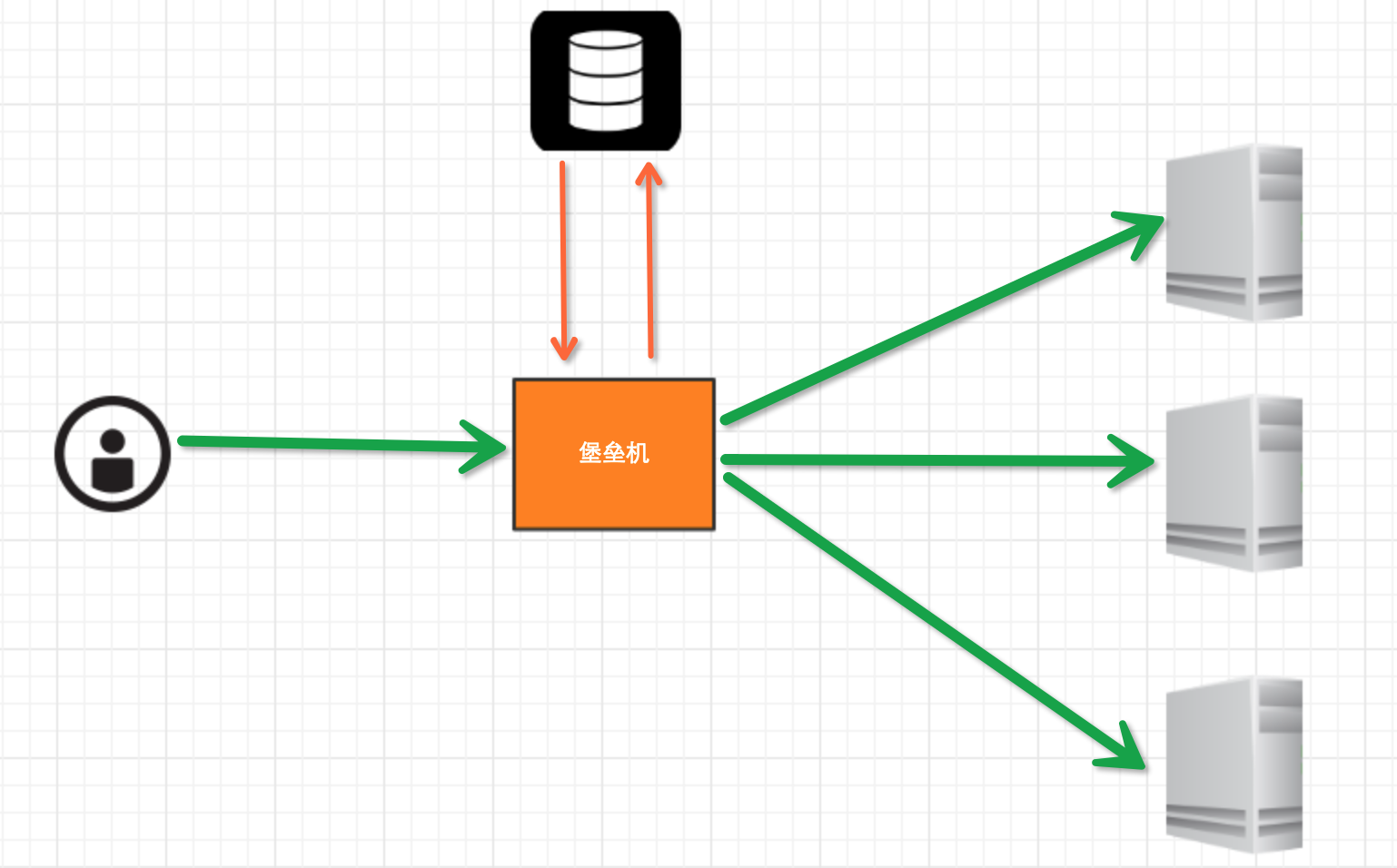
堡垒机执行流程:
- 管理员为用户在服务器上创建账号(将公钥放置服务器,或者使用用户名密码)
- 用户登陆堡垒机,输入堡垒机用户名密码,现实当前用户管理的服务器列表
- 用户选择服务器,并自动登陆
- 执行操作并同时将用户操作记录
注:配置.brashrc实现ssh登陆后自动执行脚本,如:/usr/bin/python /home/lxh/menu.py
二 创建Django项目
1 表结构设计

models.py配置文件


from django.db import models
from django.contrib.auth.models import (
    BaseUserManager, AbstractBaseUser, PermissionsMixin
)
from django.utils.translation import ugettext_lazy as _
from django.utils.safestring import mark_safe
# Create your models here.

class Host(models.Model):
    """主机信息"""
    hostname = models.CharField(max_length=64)
    ip_addr = models.GenericIPAddressField(unique=True)
    port = models.PositiveIntegerField(default=22)
    idc = models.ForeignKey("IDC")
    enabled = models.BooleanField(default=True)

    def __str__(self):
        return "%s(%s)" %(self.hostname, self.ip_addr)
    class Meta:
        verbose_name_plural = "主机信息"

class IDC(models.Model):
    """机房信息"""
    name = models.CharField(max_length=64, unique=True)
    def __str__(self):
        return self.name
    class Meta:
        verbose_name_plural = "机房信息"

class HostGroup(models.Model):
    """主机组"""
    name = models.CharField(max_length=64, unique=True)
    bind_hosts = models.ManyToManyField("BindHost", blank=True, null=True)
    def __str__(self):
        return self.name
    class Meta:
        verbose_name_plural = "主机组"

class UserProfileManager(BaseUserManager):
    def create_user(self, email, name, password=None):
        """
        使用给定的电子邮件,出生日期和密码创建并保存用户。
        """
        if not email:
            raise ValueError('用户必须为Email格式')
        user = self.model(email=self.normalize_email(email), name=name,)

        user.set_password(password)
        self.is_active = True
        user.save(using=self._db)
        return user

    def create_superuser(self, email, name, password):
        """
        使用给定的电子邮件,出生日期和密码创建并保存超级用户。
        """
        user = self.create_user(email,password=password,name=name,)
        user.is_active = True
        user.is_superuser = True
        user.save(using=self._db)
        return user

class UserProfile(AbstractBaseUser, PermissionsMixin):
    """堡垒机账号"""
    email = models.EmailField(verbose_name='email address',max_length=255,unique=True,null=True)
    password = models.CharField(_('password'), max_length=128,
                                help_text=mark_safe('''<a href='password/'>修改密码</a>'''))
    name = models.CharField(max_length=32)
    is_active = models.BooleanField(default=True)
    # is_admin = models.BooleanField(default=False)

    bind_hosts = models.ManyToManyField("BindHost", blank=True)
    host_groups = models.ManyToManyField("HostGroup", blank=True)

    objects = UserProfileManager()

    USERNAME_FIELD = 'email'
    REQUIRED_FIELDS = ['name']

    def get_full_name(self):
        # The user is identified by their email address
        return self.email

    def get_short_name(self):
        # The user is identified by their email address
        return self.email

    def __str__(self):  # __unicode__ on Python 2
        return self.email

    @property
    def is_staff(self):
        "Is the user a member of staff?"
        # 最简单的答案:所有管理员都是工作人员
        return self.is_active

    class Meta:
        verbose_name_plural = "堡垒机账号"


class HostUser(models.Model):
    """主机登录账户"""
    auth_type_choices = ((0, 'ssh-password'), (1, 'ssh-key'))
    auth_type = models.SmallIntegerField(choices=auth_type_choices, default=0)
    username = models.CharField(max_length=64)
    password = models.CharField(max_length=128, blank=True, null=True)

    def __str__(self):
        return "%s:%s" %(self.username,self.password)
    class Meta:
        unique_together = ('auth_type', 'username', 'password') # 配置联合唯一字段
        verbose_name_plural = "主机登录账户"

class BindHost(models.Model):
    """绑定主机和主机账号"""
    host = models.ForeignKey("Host")
    host_user = models.ForeignKey("HostUser")

    def __str__(self):
        return "%s@%s"%(self.host, self.host_user)
    class Meta:
        unique_together = ('host', 'host_user') # 配置联合唯一字段
        verbose_name_plural = "绑定主机和主机账号"
admin.py配置文件
from django.contrib import admin
from django import forms
from django.contrib.auth.models import Group
from django.contrib.auth.admin import UserAdmin as BaseUserAdmin
from django.contrib.auth.forms import ReadOnlyPasswordHashField
from app_lxh import models
# Register your models here.

class UserCreationForm(forms.ModelForm):
    """A form for creating new users. Includes all the required
    fields, plus a repeated password."""
    password1 = forms.CharField(label='Password', widget=forms.PasswordInput)
    password2 = forms.CharField(label='Password confirmation', widget=forms.PasswordInput)

    class Meta:
        model = models.UserProfile
        fields = ('email', 'name')

    def clean_password2(self):
        # Check that the two password entries match
        password1 = self.cleaned_data.get("password1")
        password2 = self.cleaned_data.get("password2")
        if password1 and password2 and password1 != password2:
            raise forms.ValidationError("Passwords don't match")
        return password2

    def save(self, commit=True):
        # Save the provided password in hashed format
        user = super(UserCreationForm, self).save(commit=False)
        user.set_password(self.cleaned_data["password1"])
        if commit:
            user.save()
        return user

class UserChangeForm(forms.ModelForm):
    """A form for updating users. Includes all the fields on
    the user, but replaces the password field with admin's
    password hash display field.
    """
    password = ReadOnlyPasswordHashField()

    class Meta:
        model = models.UserProfile
        fields = ('email', 'password', 'name', 'is_active', 'is_superuser')

    def clean_password(self):
        # Regardless of what the user provides, return the initial value.
        # This is done here, rather than on the field, because the
        # field does not have access to the initial value
        return self.initial["password"]

class UserProfileAdmin(BaseUserAdmin):
    # The forms to add and change user instances
    form = UserChangeForm
    add_form = UserCreationForm

    # The fields to be used in displaying the User model.
    # These override the definitions on the base UserAdmin
    # that reference specific fields on auth.User.
    list_display = ('email', 'name', "is_active",'is_superuser')
    list_filter = ('is_superuser',)
    fieldsets = (
        (None, {'fields': ('email', 'password')}),
        ('Personal', {'fields': ('name',)}),
        ('Permissions', {'fields': ('is_superuser',"is_active","bind_hosts","host_groups","user_permissions","groups")}),
    )
    # add_fieldsets is not a standard ModelAdmin attribute. UserAdmin
    # overrides get_fieldsets to use this attribute when creating a user.
    add_fieldsets = (
        (None, {
            'classes': ('wide',),
            'fields': ('email', 'name', 'password1', 'password2')}
        ),
    )
    search_fields = ('email',)
    ordering = ('email',)
    filter_horizontal = ("bind_hosts","host_groups","user_permissions","groups")

class HostUserAdmin(admin.ModelAdmin):
    list_display = ('username','auth_type','password')


admin.site.register(models.UserProfile,UserProfileAdmin)
admin.site.register(models.Host)
admin.site.register(models.HostGroup)
admin.site.register(models.HostUser,HostUserAdmin)
admin.site.register(models.BindHost)
admin.site.register(models.IDC)
2 在CrazyAss项目下创建堡垒机启动文件user_enterpoint.py
#__author: Tiger lee
# -*- coding:utf-8 -*-
#date: 2017/2/24
#IN Python 3.5

import os
import getpass
import subprocess
from django.contrib.auth import authenticate

class UserPortal(object):
    """用户命令行端交互入口"""
    def __init__(self):
        self.user = None

    def user_auth(self):
        """
        完成用户交互
        :return:
        """
        retry_count = 0
        while retry_count < 3:
            username = input("请输入用户名: ").strip()
            if len(username) == 0:continue
            password = getpass.getpass("请输入密码: ").strip()
            if len(password) == 0:
                print ("密码不能为空")
                continue
            user = authenticate(username = username, password = password)
            if user:
                self.user = user
                # print("welcome login...")
                return
            else:
                print ("用户名或密码错误!")
            retry_count += 1
        else:
            exit("尝试了太多次错误用户名与密码,请稍候再试")

    def interactive(self):
        """
        交互函数
        :return:
        """
        self.user_auth()
        if self.user:
            exit_flag = False
            while not exit_flag:
                # print (self.user.bind_hosts.select_related()) # 这个用户所关联的所有主机
                # print (self.user.host_groups.select_related())
                for index,host_group in enumerate(self.user.host_groups.all()):
                    print ("%s. %s[%s]" %(index, host_group.name, host_group.bind_hosts.all().count()))

                print ("%s. 未分组主机[%s]" %(index+1,self.user.bind_hosts.select_related().count()))
                group_input = input("请输入分组: ").strip()
                if len(group_input) == 0:continue
                if group_input.isdigit():
                    group_input = int(group_input)
                    if group_input >= 0 and group_input < self.user.host_groups.all().count():
                        selected_hostgroup = self.user.host_groups.all()[group_input]
                    elif group_input == self.user.host_groups.all().count(): #  选中了未分组的那组主机
                        selected_hostgroup = self.user # 因为self.user里也有一个bind_hosts, 跟HostGroup.bind_hosts指向的表一样
                    else:
                        print ("无效的主机组")
                        continue

                    while True:
                        for index,bind_host in enumerate(selected_hostgroup.bind_hosts.all()):
                            print ("%s. %s(IP: %s 用户名: %s)" %(index,
                                                              bind_host.host.hostname,
                                                              bind_host.host.ip_addr,
                                                              bind_host.host_user.username))
                        host_input = input("请输入主机: ").strip()
                        if len(host_input) == 0: continue
                        if host_input.isdigit():
                            host_input = int(host_input)
                            if host_input >= 0 and host_input < selected_hostgroup.bind_hosts.all().count():
                                selected_bindhost = selected_hostgroup.bind_hosts.all()[host_input]

                                print ("登录主机", selected_bindhost)
                                self.shell_login(selected_bindhost.host_user.password,
                                                 selected_bindhost.host_user.username,
                                                 selected_bindhost.host.ip_addr)

                        if host_input == "b":
                            break

    def shell_login(self, password, username, ip_addr):
        """
        远程登录主机函数
        :param password:
        :param username:
        :param ip_addr:
        :return:
        """
        login_cmd = 'sshpass -p {password} ssh {user}@{ip} -o "StrictHostKeyChecking no"'.format(
            password = password,
            user = username,
            ip = ip_addr
        )
        print (login_cmd)
        ssh_instance = subprocess.run(login_cmd, shell=True)
        print (".........logout.........")
        return


if __name__ == '__main__':
    os.environ.setdefault("DJANGO_SETTINGS_MODULE", "CrazyAss.settings")
    import django
    django.setup()
    from app_lxh import models

    portal = UserPortal()
    portal.interactive()
3 settings.py配置文件
"""
Django settings for CrazyAss project.

Generated by 'django-admin startproject' using Django 1.10.5.

For more information on this file, see
https://docs.djangoproject.com/en/1.10/topics/settings/

For the full list of settings and their values, see
https://docs.djangoproject.com/en/1.10/ref/settings/
"""

import os

# Build paths inside the project like this: os.path.join(BASE_DIR, ...)
BASE_DIR = os.path.dirname(os.path.dirname(os.path.abspath(__file__)))


# Quick-start development settings - unsuitable for production
# See https://docs.djangoproject.com/en/1.10/howto/deployment/checklist/

# SECURITY WARNING: keep the secret key used in production secret!
SECRET_KEY = 'hod5sh+!$4@n^iv-_(mvowy!0k^$(9sw-10)ns^m$q(t)=ku45'

# SECURITY WARNING: don't run with debug turned on in production!
DEBUG = True

ALLOWED_HOSTS = ["*"]


# Application definition

INSTALLED_APPS = [
    'django.contrib.admin',
    'django.contrib.auth',
    'django.contrib.contenttypes',
    'django.contrib.sessions',
    'django.contrib.messages',
    'django.contrib.staticfiles',
    'app_lxh',
]

MIDDLEWARE = [
    'django.middleware.security.SecurityMiddleware',
    'django.contrib.sessions.middleware.SessionMiddleware',
    'django.middleware.common.CommonMiddleware',
    'django.middleware.csrf.CsrfViewMiddleware',
    'django.contrib.auth.middleware.AuthenticationMiddleware',
    'django.contrib.messages.middleware.MessageMiddleware',
    'django.middleware.clickjacking.XFrameOptionsMiddleware',
]

ROOT_URLCONF = 'CrazyAss.urls'

TEMPLATES = [
    {
        'BACKEND': 'django.template.backends.django.DjangoTemplates',
        'DIRS': [os.path.join(BASE_DIR, 'templates')]
        ,
        'APP_DIRS': True,
        'OPTIONS': {
            'context_processors': [
                'django.template.context_processors.debug',
                'django.template.context_processors.request',
                'django.contrib.auth.context_processors.auth',
                'django.contrib.messages.context_processors.messages',
            ],
        },
    },
]

WSGI_APPLICATION = 'CrazyAss.wsgi.application'


# Database
# https://docs.djangoproject.com/en/1.10/ref/settings/#databases

DATABASES = {
    'default': {
        'ENGINE': 'django.db.backends.sqlite3',
        'NAME': os.path.join(BASE_DIR, 'db.sqlite3'),
    }
}


# Password validation
# https://docs.djangoproject.com/en/1.10/ref/settings/#auth-password-validators

AUTH_PASSWORD_VALIDATORS = [
    {
        'NAME': 'django.contrib.auth.password_validation.UserAttributeSimilarityValidator',
    },
    {
        'NAME': 'django.contrib.auth.password_validation.MinimumLengthValidator',
    },
    {
        'NAME': 'django.contrib.auth.password_validation.CommonPasswordValidator',
    },
    {
        'NAME': 'django.contrib.auth.password_validation.NumericPasswordValidator',
    },
]


# Internationalization
# https://docs.djangoproject.com/en/1.10/topics/i18n/

AUTH_USER_MODEL = "app_lxh.UserProfile"

LANGUAGE_CODE = 'en-us'

TIME_ZONE = 'UTC'

USE_I18N = True

USE_L10N = True

USE_TZ = True


# Static files (CSS, JavaScript, Images)
# https://docs.djangoproject.com/en/1.10/howto/static-files/

STATIC_URL = '/static/'
三 堡垒机的配置
为了保证堡垒机上的安全,需要在linux堡垒机上创建堡垒机登录账户

由于此账户是新创建的,并不能运行在原来账户上安装的django等项目,所以需要将原用户上面的python3.5/site-packages复制一份到此用户目录下


然后就可以切换到此用户来执行CrazyAss项目里面的user_enterpoint.py脚本了

但是我们的目的是一旦登录到这个用户,就自动执行这个脚本,所以需要修改此用户的.bashrc文件,在最后添加此命令:
# 在crazyass用户目录下

crazyass@lxh-virtual-machine:~$ vim .bashrc


# 在.bashrc配置文件最后添加以下代码

#for CrazyAss auditing
python /home/lxh/CrazyAss/user_enterpoint.py
logout
.bashrc文件, 这个文件的作用是此用户登录后自动加载此配置文件,并执行里面的命令

完成! 效果如下

按Ctrl+C退出脚本时,也自动退出此用户
注: 此Django项目只能在linux机器上运行,如要进入admin修改配置,需要启动此项目时, 进入CrazyAss项目下,使用以下命令启动
lxh@lxh-virtual-machine:~/CrazyAss$ python manage.py runserver 0.0.0.0:8000
Performing system checks...

System check identified some issues:

WARNINGS:
app_lxh.HostGroup.bind_hosts: (fields.W340) null has no effect on ManyToManyField.

System check identified 1 issue (0 silenced).
February 26, 2017 - 04:33:13
Django version 1.10.5, using settings 'CrazyAss.settings'
Starting development server at http://0.0.0.0:8000/
Quit the server with CONTROL-C.
...
作者:TigerLee
出处:http://www.cnblogs.com/tiger666/
本文版权归作者和博客园所有,欢迎转载。转载请在留言板处留言给我,且在文章标明原文链接,谢谢!
如果您觉得本篇博文对您有所收获,觉得我还算用心,请点击右下角的 [推荐],谢谢!

 浙公网安备 33010602011771号