

英语_阅读_The Future of Agriculture
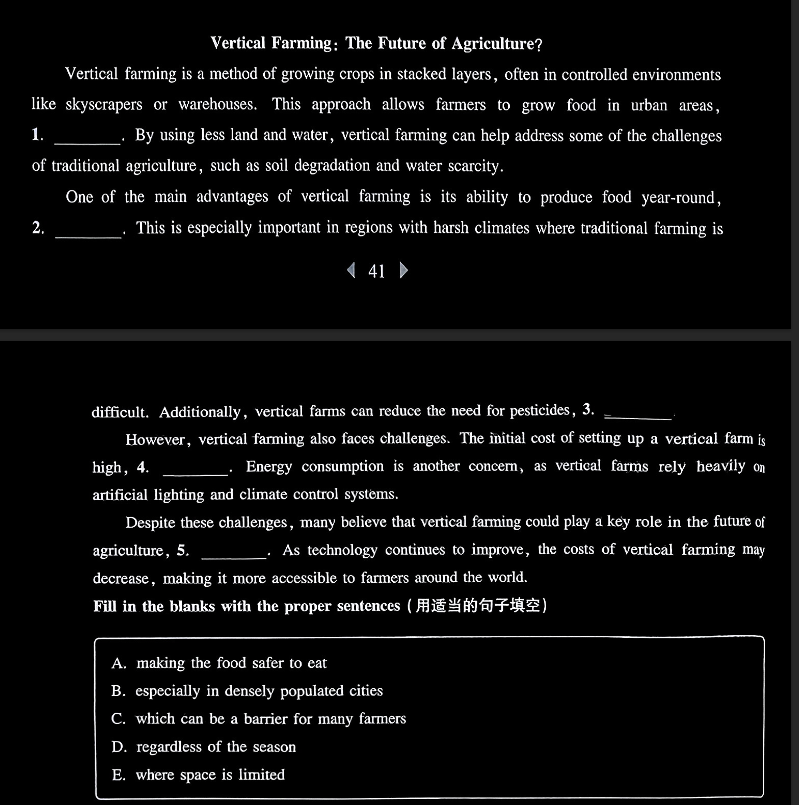
Vertical Farming: The Future of Agriculture? Vertical farming is a method of growing crops in stacked layers, often in controlled environments like skyscrapers or warehouses. This approach allows farmers to grow food in urban areas, (1), By using less land and water, vertical farming can help address some of the challenges of traditional agriculture , such as soil degradation and water scarcity. One of the main advantages of vertical farming is its ability to produce food year-round, (2). This is especially important in regions with harsh climates where traditional farming is difficult. Additionally, vertical farms can reduce the need for pesticides, (3). However, vertical farming also faces challenges. The initial cost of setting up a vertical farm is high, (4). Energy consumption is another concem, as vertical farms rely heavily on artificial lighting and climate control systems. Despite these challenges, many believe that vertical famming could play a key role in the future of agrilture, (5). As technology continues to improve, the costs of vertical farming may decrease , making it more accessible to farmers around the world. A.making the food safer to cat B.especially in densely populated cities C.which can be a barrier for many farmers D.regardless of the season E.where space is limited
正确答案是:
1. E
2. D
3. A
4. C
5. B
解析:
-
第一空强调在“城市地区”种植食物的原因,E 项“where space is limited”(空间有限)最符合逻辑。
-
第二空强调全年生产,D 项“regardless of the season”(不受季节影响)与“year-round”对应。
-
第三空提到减少农药使用,A 项“making the food safer to eat”(使食物更安全)是自然的结果。
-
第四空指出高昂的初始成本,C 项“which can be a barrier for many farmers”(对许多农民来说是障碍)符合语境。
-
第五空讨论垂直农业的未来作用,B 项“especially in densely populated cities”(尤其在人口密集城市)点明适用场景。
Vertical farming is a method of growing crops in stacked layers, often in controlled environments like skyscrapers or warehouses.
垂直农业是一种将作物种植在分层结构中的方法,通常是在如摩天大楼或仓库等受控环境中进行。
This approach allows farmers to grow food in urban areas, where space is limited.
这种方式使农民能够在空间有限的城市地区种植粮食。
By using less land and water, vertical farming can help address some of the challenges of traditional agriculture, such as soil degradation and water scarcity.
通过使用更少的土地和水资源,垂直农业能够帮助解决传统农业面临的一些挑战,如土壤退化和水资源短缺。
One of the main advantages of vertical farming is its ability to produce food year-round, regardless of the season.
垂直农业的主要优势之一是它能够不受季节限制地全年生产食物。
This is especially important in regions with harsh climates where traditional farming is difficult.
这在气候恶劣、传统农业难以进行的地区尤为重要。
Additionally, vertical farms can reduce the need for pesticides, making the food safer to eat.
此外,垂直农场可以减少对农药的需求,使食物更安全可食用。
However, vertical farming also faces challenges.
然而,垂直农业也面临着挑战。
The initial cost of setting up a vertical farm is high, which can be a barrier for many farmers.
建立一个垂直农场的初始成本很高,这对许多农民来说可能是一个障碍。
Energy consumption is another concern, as vertical farms rely heavily on artificial lighting and climate control systems.
能源消耗是另一个顾虑,因为垂直农场严重依赖人工照明和气候控制系统。
Despite these challenges, many believe that vertical farming could play a key role in the future of agriculture, especially in densely populated cities.
尽管存在这些挑战,许多人仍认为垂直农业可能在未来农业中发挥关键作用,特别是在高人口密集的城市中。
As technology continues to improve, the costs of vertical farming may decrease, making it more accessible to farmers around the world.
随着技术不断进步,垂直农业的成本可能会降低,使其对全球更多农民来说更易获得。
==
**Vertical Farming: The Future of Agriculture?**
Vertical farming is a method of growing crops in stacked layers, often in controlled environments like skyscrapers or warehouses. This approach allows farmers to grow food in urban areas, **(1) E. where space is limited**. By using less land and water, vertical farming can help address some of the challenges of traditional agriculture , such as soil degradation and water scarcity.
One of the main advantages of vertical farming is its ability to produce food year-round, **(2) D. regardless of the season**. This is especially important in regions with harsh climates where traditional farming is difficult. Additionally, vertical farms can reduce the need for pesticides, **(3) A. making the food safer to eat**.
However, vertical farming also faces challenges. The initial cost of setting up a vertical farm is high, **(4) C. which can be a barrier for many farmers**. Energy consumption is another concem, as vertical farms rely heavily on artificial lighting and climate control systems.
Despite these challenges, many believe that vertical famming could play a key role in the future of agrilture, **(5) B. especially in densely populated cities**. As technology continues to improve, the costs of vertical farming may decrease , making it more accessible to farmers around the world.

 浙公网安备 33010602011771号