faiss简单测试方法
2. 运行方法
先把仓库克隆到本地,我这边还需要改cmake环境,在project上面加
set(CMAKE_CUDA_COMPILER /usr/local/cuda-11.8/bin/nvcc)
构建
mkdir build
cmake -B build .
编译,只需要编译faiss这部分就可以,(主目录下有很多测试代码,编译很慢,只编译faiss会快很多)
cd build
make -j faiss
这时候可以运行tutorial中的测试文件试试
还是在build文件夹内
make -j 2-IVFFlat
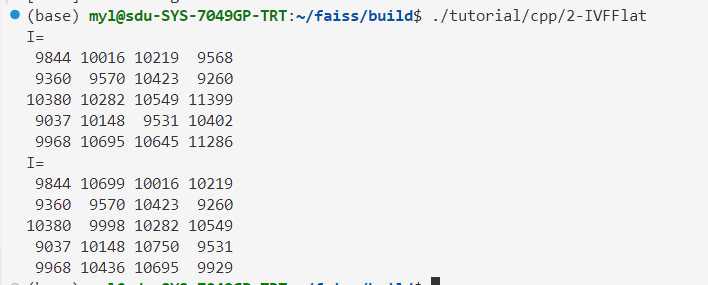
./tutorial/cpp/2-IVFFlat
运行结果为
同样的,可以自己编写测试代码进行测试。
然后如果修改了faiss的代码,需要重新编译运行
make -j 2-IVFFlat
./tutorial/cpp/2-IVFFlat
这就实现了在本地修改测试faiss,可以输出faiss的运行中间结果以及执行时间
2. 测试方法
如果要用源码运行benchmark,可以在faiss目录下(不是faiss/faiss)新建文件夹”test_by_myl“
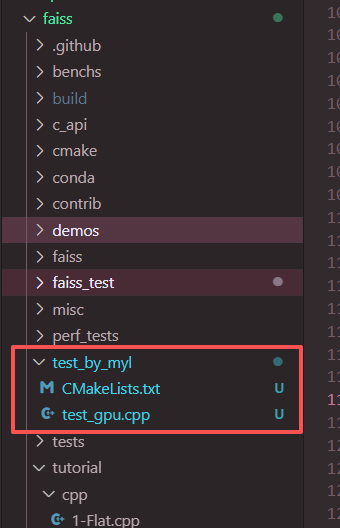
其中test_gpu.cpp文件可以参考


/**
 * Copyright (c) Facebook, Inc. and its affiliates.
 *
 * This source code is licensed under the MIT license found in the
 * LICENSE file in the root directory of this source tree.
 */

#include <cmath>
#include <cstdio>
#include <cstdlib>
#include <random>
#include <string>
#include <fstream>
#include <iomanip>
#include <iostream>
#include <algorithm>

#include <sys/time.h>

#include <faiss/gpu/GpuAutoTune.h>
#include <faiss/gpu/GpuCloner.h>
#include <faiss/gpu/GpuIndexIVFPQ.h>
#include <faiss/gpu/StandardGpuResources.h>
#include <faiss/index_io.h>
#include <faiss/IndexFlat.h>
#include <faiss/IndexIVFPQ.h>

using namespace std;

double elapsed() {
    struct timeval tv;
    gettimeofday(&tv, NULL);
    return tv.tv_sec + tv.tv_usec * 1e-6;
}

size_t SizeOf(ifstream &file){
    file.seekg(0, ios::end);
    size_t file_size = file.tellg();
    file.seekg(0, ios::beg);
    return file_size;
}

int main() {
    // freopen("/home/myl/data/sift1m/pcatest/output.txt","w",stdout);
    double t0 = elapsed();
    string db_name = "/home/myl/test/data/sift1m/sift/sift_base.fvecs";
    string train_name = "/home/myl/test/data/sift1m/sift/sift_learn.fvecs";
    string query_name = "/home/myl/test/data/sift1m/sift/sift_query.fvecs";
    string truth_name = "/home/myl/test/data/sift1m/sift/sift_groundtruth.ivecs";
    // string db_name = "/home/myl/data/sift1m/pcatest/test_base.fvecs";
    // string train_name = "/home/myl/test/data/sift1m/sift/sift_learn.fvecs";
    // string query_name = "/home/myl/data/sift1m/pcatest/test_query.fvecs";
    // string truth_name = "/home/myl/data/sift1m/pcatest/test_gt.ivecs";

    ifstream db_infile(db_name, ios::binary);
    if(!db_infile){
        std::cerr << "Error opening file db_name." << std::endl;
        exit(1);
    }
    ifstream train_infile(train_name, ios::binary);
    if(!db_infile){
        std::cerr << "Error opening file db_name." << std::endl;
        exit(1);
    }
    // ifstream learn_infile(learn_name, ios::binary);
    ifstream query_infile(query_name, ios::binary);
    if(!query_infile){
        std::cerr << "Error opening file query_name." << std::endl;
        exit(1);
    }
    ifstream truth_infile(truth_name, ios::binary);
    if(!truth_infile){
        std::cerr << "Error opening file truth_name." << std::endl;
        exit(1);
    }


    // dimension of the vectors to index
    size_t d = 128;
    size_t nq = SizeOf(query_infile)/((d+1)*4);
    int k = SizeOf(truth_infile)/(nq * 4) - 1;
    float t;

    // size of the database we plan to index
    size_t nb = SizeOf(db_infile)/((d+1)*4);

    // make a set of nt training vectors in the unit cube
    // (could be the database)
    size_t nt = SizeOf(train_infile)/((d+1)*4);
    cerr<<"nq="<<nq<<" k="<<k<<" nb="<<nb<<" nt="<<nt<<endl;
    /*
    printf ("[%.3f s] Begin d=%d nb=%ld nt=%nt dev_no=%d\n",
            elapsed() - t0, d, nb, nt, dev_no);
    */
    // a reasonable number of centroids to index nb vectors
    // int ncentroids = int(3 * sqrt(nb));

    faiss::gpu::StandardGpuResources resources;
    int nlist = 2048;//划分的聚类中心数目
    int m = 16;//PQ码的子聚类中心数目
    int nbits = 8;//每个PQ码的字节数
    int nprobe = 50;//查询时要访问的倒排列表的数量
    int dev_no = 1;//GPU设备编号

    faiss::gpu::GpuIndexIVFPQConfig config;
    config.device = dev_no;
    //创建GPU索引
    faiss::gpu::GpuIndexIVFPQ* index_gpu = new faiss::gpu::GpuIndexIVFPQ(
            &resources, d, nlist, m, nbits, faiss::METRIC_L2, config);

    //将学习集添加到CPU索引中,进行聚类
    { // training
        printf("[%.3f s] Reading %ld vectors from sift_learn.fvecs in %dD for training\n",
               elapsed() - t0,
               nt,
               d);

        // std::vector<float> trainvecs(nt * d);
        float* trainvecs = new float[nt*d];
        for (size_t i = 0; i < nt; i++) {
            train_infile.read((char*)&d, 4);
            for(size_t j = 0; j < d; j++){
                train_infile.read((char*)&t, 4);
                trainvecs[i*d+j] = t;
            }
        }

        printf("[%.3f s] Training the index_cpu\n", elapsed() - t0);

        index_gpu->train(nt, trainvecs);
        delete[] trainvecs;
    }

    {//添加database
        printf("[%.3f s] Reading a dataset from sift_base.fvecs of %ld vectors to index\n",
               elapsed() - t0,
               nb);

        // std::vector<float> database(nb * d);
        float* database = new float[nb*d];
        db_infile.seekg(0, ios::beg);
        for (size_t i = 0; i < nb; i++) {
            db_infile.read((char*)&d, 4);
            for(size_t j = 0; j < d; j++){
                db_infile.read((char*)&t, 4);
                database[i*d+j] = t;
            }
        }

        printf("[%.3f s] Adding the vectors to the index\n", elapsed() - t0);

        index_gpu->add(nb, database);
        delete[] database;
        printf("[%.3f s] done\n", elapsed() - t0);
    }

    //将CPU索引转换为GPU索引
    int gpu_device = 0; // 设定 GPU 设备编号,可以根据实际情况调整
    // faiss::Index* index_gpu_base = faiss::gpu::index_cpu_to_gpu(&resources, gpu_device, index_cpu);

    // 将 faiss::Index 对象强制转换为 faiss::gpu::GpuIndexIVFPQ 类型
    // faiss::gpu::GpuIndexIVFPQ* index_gpu = dynamic_cast<faiss::gpu::GpuIndexIVFPQ*>(index_gpu_base);
    // printf("The CPU index has been converted to the GPU index\n");

    //执行查询
    // std::vector<float> queries;
    float* queries = new float[nq*d];
    // queries.resize(nq * d);
    for (size_t i = 0; i < nq; i++) {
        query_infile.read((char*)&d, 4);
        for(size_t j = 0; j < d; j++){
            query_infile.read((char*)&t, 4);
            queries[i*d+j] = t;
        }
    }

    { // searching the database

        printf("[%.3f s] Searching the %d nearest neighbors "
               "of %ld vectors in the index\n",
               elapsed() - t0,
               k,
               nq);

        std::vector<faiss::idx_t> nns(k * nq);
        std::vector<float> dis(k * nq);

        //设置查询参数
        index_gpu->nprobe = nprobe;//控制要访问的倒排列表的数量

        index_gpu->search(nq, queries, k, dis.data(), nns.data());

        printf("[%.3f s] Query results (vector ids, then distances):\n",
               elapsed() - t0);

        printf("note that the nearest neighbor is not at "
               "distance 0 due to quantization errors\n");

        printf("[%.3f s] Compute recalls\n", elapsed() - t0);

        //读取groundtruth
        int* gt=new int[k*nq];
        double recall=0;
        unsigned int value;
        // for(size_t i=0;i<nq;i++){
        //     truth_infile.read(reinterpret_cast<char*>(&value), sizeof(value));//读取"100"
        //     for(size_t j=0;j<k;j++){
        //         truth_infile.read(reinterpret_cast<char*>(&value), sizeof(value));
        //         gt[i*k + j]=value;
        //         for(size_t m=0;m<k;m++){
        //             if(value == nns[m + i*k]){
        //                 recall=recall+1;
        //                 break;
        //             }
        //         }
        //     }
        // }
        for(size_t i=0;i<nq;i++){
            truth_infile.read(reinterpret_cast<char*>(&value), sizeof(value));//读取"100"
            for(size_t j=0;j<k;j++){
                truth_infile.read(reinterpret_cast<char*>(&value), sizeof(value));
                gt[i*k + j]=value;
                if(j<10){
                    for(size_t m=0;m<10;m++){
                        if(value == nns[m + i*k]){
                            recall=recall+1;
                            break;
                        }
                    }
                }

            }
        }
        recall = recall/(1.0*10*nq);
        printf("recall = %.5f\n",recall);

        // evaluate result by hand.
        int n_1 = 0, n_10 = 0, n_100 = 0;
        for (int i = 0; i < nq; i++) {
            int gt_nn = gt[i * k];
            for (int j = 0; j < k; j++) {
                if (nns[i * k + j] == gt_nn) {
                    if (j < 1)
                        n_1++;
                    if (j < 10)
                        n_10++;
                    if (j < 100)
                        n_100++;
                }
            }
        }
        printf("R@1 = %.4f\n", n_1 / float(nq));
        printf("R@10 = %.4f\n", n_10 / float(nq));
        printf("R@100 = %.4f\n", n_100 / float(nq));
        delete[] gt;
    }

    db_infile.close();
    train_infile.close();
    query_infile.close();
    truth_infile.close();
    delete index_gpu;
    // delete[] trainvecs;
    // delete[] database;
    delete[] queries;

    // fclose(stdout);
    return 0;
}
CMakeLists.txt文件可以参考
add_executable(test_gpu EXCLUDE_FROM_ALL test_gpu.cpp)
target_link_libraries(test_gpu PRIVATE faiss)
然后再在根目录中的CMakeLists.txt加入当前的目录
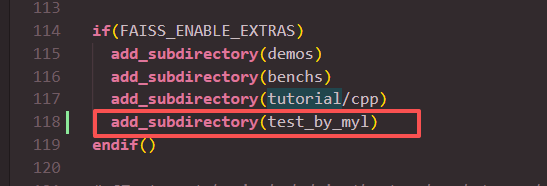
注意这里修改了CMakeLists,所以需要重新cmake
然后make -j faiss
make -j test_gpu
然后就可以运行./test_by_myl/test_gpu

 浙公网安备 33010602011771号