Bert源码阅读笔记
BERT实际上就是tranformer的编码器部分
按照Google的bert源码,做一个MRPC的任务,地址:https://github.com/google-research/bert
官方提供的训练数据长这个样子:每条数据包含两句话及其ID,如果这两句话有关系,quality为1,否则为0,测试数据除了没有quality其他和训练数据一样

代码结构如下:
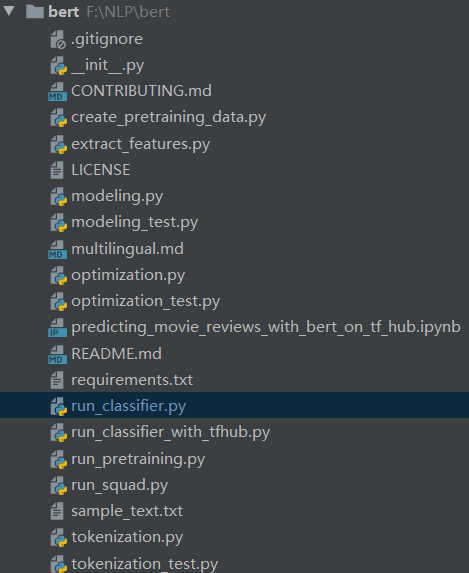
主程序为run_classifier.py,在训练之前,需要对数据预处理,nlp的第一步对句子进行分词,把词表示为字典中的序号
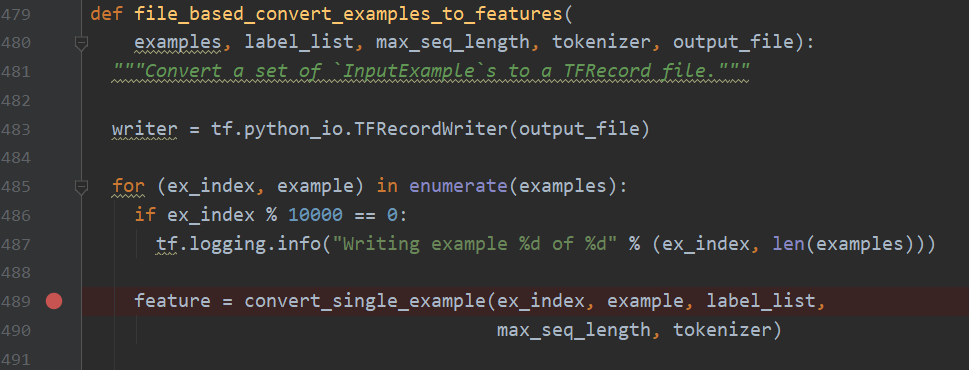
先把数据读到recordwrite,方便tensorflow操作,然后按行读取的训练数据,ex_index是序号,example包含a,b两句话,label_list是["0","1"],然后重点是convert_single_example,它的作用就是把文本表示为字典中的序号,看看它里边有什么:
def convert_single_example(ex_index, example, label_list, max_seq_length,
                           tokenizer):
  """Converts a single `InputExample` into a single `InputFeatures`."""

  if isinstance(example, PaddingInputExample):
    return InputFeatures(
        input_ids=[0] * max_seq_length,
        input_mask=[0] * max_seq_length,
        segment_ids=[0] * max_seq_length,
        label_id=0,
        is_real_example=False)

  label_map = {}
  for (i, label) in enumerate(label_list):            # 把标签表示为字典格式
    label_map[label] = i

  tokens_a = tokenizer.tokenize(example.text_a)       # 对句子a进行分词
  tokens_b = None
  if example.text_b:                                  # 如果有第二句话,也对句子b分词
    tokens_b = tokenizer.tokenize(example.text_b)

  if tokens_b:
    # Modifies `tokens_a` and `tokens_b` in place so that the total
    # length is less than the specified length.
    # Account for [CLS], [SEP], [SEP] with "- 3"
    _truncate_seq_pair(tokens_a, tokens_b, max_seq_length - 3)                  # 如果句子分词数超过了最大长度,进行截断操作,-3是因为要留下开头的[cls],两句话中间的[SEP],
                                                                                  第二句话最后的[SEP]]
  else:
    # Account for [CLS] and [SEP] with "- 2"
    if len(tokens_a) > max_seq_length - 2:                                      # 如果只有一句话,则没有中间的[SEP],只需要-2
      tokens_a = tokens_a[0:(max_seq_length - 2)]

  # The convention in BERT is:
  # (a) For sequence pairs:
  #  tokens:   [CLS] is this jack ##son ##ville ? [SEP] no it is not . [SEP]    # 这里写的很清楚,下面的几句代码就是给句子加上[cls],[SEP],
  #  type_ids: 0     0  0    0    0     0       0 0     1  1  1  1   1 1        # 并且创建一个句子类型的列表,[CLS]、第一句话的词、第一句话最后的[SEP]是0,
  # (b) For single sequences:                                                                                  第二句话的词和最后的[SEP]是1
  #  tokens:   [CLS] the dog is hairy . [SEP]
  #  type_ids: 0     0   0   0  0     0 0
  #
  # Where "type_ids" are used to indicate whether this is the first
  # sequence or the second sequence. The embedding vectors for `type=0` and
  # `type=1` were learned during pre-training and are added to the wordpiece
  # embedding vector (and position vector). This is not *strictly* necessary
  # since the [SEP] token unambiguously separates the sequences, but it makes
  # it easier for the model to learn the concept of sequences.
  #
  # For classification tasks, the first vector (corresponding to [CLS]) is
  # used as the "sentence vector". Note that this only makes sense because
  # the entire model is fine-tuned.
  tokens = []
  segment_ids = []
  tokens.append("[CLS]")
  segment_ids.append(0)
  for token in tokens_a:
    tokens.append(token)
    segment_ids.append(0)
  tokens.append("[SEP]")
  segment_ids.append(0)

  if tokens_b:
    for token in tokens_b:
      tokens.append(token)
      segment_ids.append(1)
    tokens.append("[SEP]")
    segment_ids.append(1)

  input_ids = tokenizer.convert_tokens_to_ids(tokens)     # 把词转换为词典中对应的序号

  # The mask has 1 for real tokens and 0 for padding tokens. Only real
  # tokens are attended to.
  input_mask = [1] * len(input_ids)                       # 下边会对长度不够的句子后边补零,但是补的零对训练没有,所以要用input_mask标记那些是有用的序号,有用的标1,没用的标0

  # Zero-pad up to the sequence length.
  while len(input_ids) < max_seq_length:                  # 对长度不够的句子后边补零,input_mask也补零
    input_ids.append(0)
    input_mask.append(0)
    segment_ids.append(0)

  assert len(input_ids) == max_seq_length
  assert len(input_mask) == max_seq_length
  assert len(segment_ids) == max_seq_length

  label_id = label_map[example.label]                         # 打印结果
  if ex_index < 5:
    tf.logging.info("*** Example ***")
    tf.logging.info("guid: %s" % (example.guid))
    tf.logging.info("tokens: %s" % " ".join(
        [tokenization.printable_text(x) for x in tokens]))
    tf.logging.info("input_ids: %s" % " ".join([str(x) for x in input_ids]))
    tf.logging.info("input_mask: %s" % " ".join([str(x) for x in input_mask]))
    tf.logging.info("segment_ids: %s" % " ".join([str(x) for x in segment_ids]))
    tf.logging.info("label: %s (id = %d)" % (example.label, label_id))

  feature = InputFeatures(
      input_ids=input_ids,
      input_mask=input_mask,
      segment_ids=segment_ids,
      label_id=label_id,
      is_real_example=True)
  return feature
数据数据处理完看模型部分
def create_model(bert_config, is_training, input_ids, input_mask, segment_ids,
                 labels, num_labels, use_one_hot_embeddings):
  """Creates a classification model."""
  model = modeling.BertModel(
      config=bert_config,                              # 从预训练文件中读取神经网络设置,包括隐藏层神经元数量,dropout大小啥的
      is_training=is_training,                         # 是否使用dropout
      input_ids=input_ids,                             # 数据处理后的结果,大小是(batch_size, max_seq_length), 这里是(8,128)
      input_mask=input_mask,                           # 数据处理后的结果,(8, 128)
      token_type_ids=segment_ids,                      # 数据处理后的结果, (8, 128)
      use_one_hot_embeddings=use_one_hot_embeddings)   # TPU需要用这个,其他机器先不用管
首先调用了BertModel,看看这个里面干了啥
class BertModel(object):
    def __init__(self,
               config,
               is_training,
               input_ids,
               input_mask=None,
               token_type_ids=None,
               use_one_hot_embeddings=False,
               scope=None):
    config = copy.deepcopy(config)
    if not is_training:                                                                       # 判断是否使用dropout
      config.hidden_dropout_prob = 0.0
      config.attention_probs_dropout_prob = 0.0

    input_shape = get_shape_list(input_ids, expected_rank=2)
    batch_size = input_shape[0]                   # 8
    seq_length = input_shape[1]                   # 128

    if input_mask is None:            # 如果没有输入input_mask, 默认全都是1, 即没有补零
      input_mask = tf.ones(shape=[batch_size, seq_length], dtype=tf.int32)

    if token_type_ids is None:        # 如果没有输入token_type_ids, 默认全都是0, 即都来自第一句话
      token_type_ids = tf.zeros(shape=[batch_size, seq_length], dtype=tf.int32)

    with tf.variable_scope(scope, default_name="bert"):
      with tf.variable_scope("embeddings"):
        # Perform embedding lookup on the word ids.
        (self.embedding_output, self.embedding_table) = embedding_lookup(
            input_ids=input_ids,
            vocab_size=config.vocab_size,
            embedding_size=config.hidden_size,
            initializer_range=config.initializer_range,
            word_embedding_name="word_embeddings",
            use_one_hot_embeddings=use_one_hot_embeddings)
       #  这部分通过查表做embedding,输入是(8,128), 输出是(8,128,768),即每个词embedding后的维度是768
看一下embedding_lookup里干了啥
def embedding_lookup(input_ids,         # (8,128)
                     vocab_size,        # 预训练模型中包含的词汇数30522
                     embedding_size=128,
                     initializer_range=0.02,
                     word_embedding_name="word_embeddings",       # embedding表的名称
                     use_one_hot_embeddings=False):
  if input_ids.shape.ndims == 2:        # 因为输出维度是三维, 所以先把输入维度变成(8,128,1)
    input_ids = tf.expand_dims(input_ids, axis=[-1])

  embedding_table = tf.get_variable(    # 定义embedding表,(30522,768)batch里的词的embedding是从这里边查出来的
      name=word_embedding_name,
      shape=[vocab_size, embedding_size],
      initializer=create_initializer(initializer_range))
  flat_input_ids = tf.reshape(input_ids, [-1])   # 把输入变成(8*128,1)=(1024, 1)
  if use_one_hot_embeddings:
    one_hot_input_ids = tf.one_hot(flat_input_ids, depth=vocab_size)
    output = tf.matmul(one_hot_input_ids, embedding_table)
  else:
    output = tf.gather(embedding_table, flat_input_ids)    # 查表,得到输入对应的embedding,大小为(1024, 768)

  input_shape = get_shape_list(input_ids)

  output = tf.reshape(output,
                      input_shape[0:-1] + [input_shape[-1] * embedding_size])   # 把embedding大小改为(8,128,768)
  return (output, embedding_table)
除了词本身的embedding,还要考虑词的类型,即token_type_id, 因为对于这个任务, 需要知道这个词是第一句还是第二句,代码如下
def embedding_postprocessor(input_tensor,
                            use_token_type=False,
                            token_type_ids=None,
                            token_type_vocab_size=16,
                            token_type_embedding_name="token_type_embeddings",
                            use_position_embeddings=True,            # 是否考虑位置信息,这个位置是说在每个batch中,长度不是128嘛,每个token的位置0-128
                            position_embedding_name="position_embeddings",
                            initializer_range=0.02,
                            max_position_embeddings=512,
                            dropout_prob=0.1):
  """Performs various post-processing on a word embedding tensor.

  Args:
    input_tensor: float Tensor of shape [batch_size, seq_length,
      embedding_size].
    use_token_type: bool. Whether to add embeddings for `token_type_ids`.
    token_type_ids: (optional) int32 Tensor of shape [batch_size, seq_length].
      Must be specified if `use_token_type` is True.
    token_type_vocab_size: int. The vocabulary size of `token_type_ids`.
    token_type_embedding_name: string. The name of the embedding table variable
      for token type ids.
    use_position_embeddings: bool. Whether to add position embeddings for the
      position of each token in the sequence.
    position_embedding_name: string. The name of the embedding table variable
      for positional embeddings.
    initializer_range: float. Range of the weight initialization.
    max_position_embeddings: int. Maximum sequence length that might ever be
      used with this model. This can be longer than the sequence length of
      input_tensor, but cannot be shorter.
    dropout_prob: float. Dropout probability applied to the final output tensor.

  Returns:
    float tensor with same shape as `input_tensor`.

  Raises:
    ValueError: One of the tensor shapes or input values is invalid.
  """
  input_shape = get_shape_list(input_tensor, expected_rank=3)   # (8,128,786)
  batch_size = input_shape[0]
  seq_length = input_shape[1]
  width = input_shape[2]

  output = input_tensor

  if use_token_type:
    if token_type_ids is None:
      raise ValueError("`token_type_ids` must be specified if"
                       "`use_token_type` is True.")
    token_type_table = tf.get_variable(       类型的embedding表,因为type只有0和1,所以大小是(2, 786)
        name=token_type_embedding_name,
        shape=[token_type_vocab_size, width],
        initializer=create_initializer(initializer_range))
    # This vocab will be small so we always do one-hot here, since it is always
    # faster for a small vocabulary.
    flat_token_type_ids = tf.reshape(token_type_ids, [-1])    # (1024)
    one_hot_ids = tf.one_hot(flat_token_type_ids, depth=token_type_vocab_size)  # 把0,1变成one-hot编码,大小是 (1024,2)
    token_type_embeddings = tf.matmul(one_hot_ids, token_type_table)          # 相乘,做位置的embedding
    token_type_embeddings = tf.reshape(token_type_embeddings,                 # 把形状调整成和输入一样的,方便相加
                                       [batch_size, seq_length, width])
    output += token_type_embeddings      # 输入和位置embedding相加

  if use_position_embeddings:         如果考虑位置, 加上位置的embedding
    assert_op = tf.assert_less_equal(seq_length, max_position_embeddings)
    with tf.control_dependencies([assert_op]):
      full_position_embeddings = tf.get_variable(        位置embedding的大小(512,786),这块给多了,后面会切分
          name=position_embedding_name,
          shape=[max_position_embeddings, width],
          initializer=create_initializer(initializer_range))
      # Since the position embedding table is a learned variable, we create it
      # using a (long) sequence length `max_position_embeddings`. The actual
      # sequence length might be shorter than this, for faster training of
      # tasks that do not have long sequences.
      #
      # So `full_position_embeddings` is effectively an embedding table
      # for position [0, 1, 2, ..., max_position_embeddings-1], and the current
      # sequence has positions [0, 1, 2, ... seq_length-1], so we can just
      # perform a slice.
      position_embeddings = tf.slice(full_position_embeddings, [0, 0],        # 切分为(128,768)
                                     [seq_length, -1])
      num_dims = len(output.shape.as_list())

      # Only the last two dimensions are relevant (`seq_length` and `width`), so
      # we broadcast among the first dimensions, which is typically just
      # the batch size.
      position_broadcast_shape = []
      for _ in range(num_dims - 2):
        position_broadcast_shape.append(1)
      position_broadcast_shape.extend([seq_length, width])         # 扩展为(1,128,768),方便加减
      position_embeddings = tf.reshape(position_embeddings,
                                       position_broadcast_shape)
      output += position_embeddings        # 对8个batch,都加上相同的位置embedding

  output = layer_norm_and_dropout(output, dropout_prob)        # 加dropout后输出
  return output
至此,BERT的第一步embedding完成
然后是mask部分
      with tf.variable_scope("encoder"):
        # This converts a 2D mask of shape [batch_size, seq_length] to a 3D
        # mask of shape [batch_size, seq_length, seq_length] which is used
        # for the attention scores.
        attention_mask = create_attention_mask_from_input_mask(  # 把mask从2D变成3D的,原来对于每个batch,都对应一个二维的mask[1,1,1....0,0],现在把这个mask立起来,放到每个batch里的每个
            input_ids, input_mask)                                 元素上,最后的大小是(8,128,128)
Transformor部分
      self.all_encoder_layers = transformer_model(
            input_tensor=self.embedding_output,         # 之前算的embedding
            attention_mask=attention_mask,              # 之前算的mask
            hidden_size=config.hidden_size,
            num_hidden_layers=config.num_hidden_layers,
            num_attention_heads=config.num_attention_heads,     # 12头的self-attention
            intermediate_size=config.intermediate_size,
            intermediate_act_fn=get_activation(config.hidden_act),
            hidden_dropout_prob=config.hidden_dropout_prob,
            attention_probs_dropout_prob=config.attention_probs_dropout_prob,
            initializer_range=config.initializer_range,
            do_return_all_layers=True)
看看里边干了啥
def transformer_model(input_tensor,
                      attention_mask=None,
                      hidden_size=768,
                      num_hidden_layers=12,
                      num_attention_heads=12,
                      intermediate_size=3072,
                      intermediate_act_fn=gelu,
                      hidden_dropout_prob=0.1,
                      attention_probs_dropout_prob=0.1,
                      initializer_range=0.02,
                      do_return_all_layers=False):
  if hidden_size % num_attention_heads != 0:       # 先判断768够不够12个头分
    raise ValueError(
        "The hidden size (%d) is not a multiple of the number of attention "
        "heads (%d)" % (hidden_size, num_attention_heads))

  attention_head_size = int(hidden_size / num_attention_heads)     # 768/12 = 64
  input_shape = get_shape_list(input_tensor, expected_rank=3)
  batch_size = input_shape[0]
  seq_length = input_shape[1]
  input_width = input_shape[2]

  # The Transformer performs sum residuals on all layers so the input needs
  # to be the same as the hidden size.
  if input_width != hidden_size:                       # 因为最后要做残差连接,所以输入和输出维度要相同
    raise ValueError("The width of the input tensor (%d) != hidden size (%d)" %
                     (input_width, hidden_size))

  # We keep the representation as a 2D tensor to avoid re-shaping it back and
  # forth from a 3D tensor to a 2D tensor. Re-shapes are normally free on
  # the GPU/CPU but may not be free on the TPU, so we want to minimize them to
  # help the optimizer.
  prev_output = reshape_to_matrix(input_tensor)        # 为了方便TPU,做reshape

  all_layer_outputs = []
  for layer_idx in range(num_hidden_layers):
    with tf.variable_scope("layer_%d" % layer_idx):
      layer_input = prev_output

      with tf.variable_scope("attention"):
        attention_heads = []
        with tf.variable_scope("self"):
          attention_head = attention_layer(
              from_tensor=layer_input,          # 因为是self-attention, 所以from tensor和to tensor 一样
              to_tensor=layer_input,
              attention_mask=attention_mask,
              num_attention_heads=num_attention_heads,
              size_per_head=attention_head_size,
              attention_probs_dropout_prob=attention_probs_dropout_prob,
              initializer_range=initializer_range,
              do_return_2d_tensor=True,
              batch_size=batch_size,
              from_seq_length=seq_length,
              to_seq_length=seq_length)
          attention_heads.append(attention_head)

        attention_output = None
        if len(attention_heads) == 1:
          attention_output = attention_heads[0]
        else:
          # In the case where we have other sequences, we just concatenate
          # them to the self-attention head before the projection.
          attention_output = tf.concat(attention_heads, axis=-1)

        # Run a linear projection of `hidden_size` then add a residual
        # with `layer_input`.
        with tf.variable_scope("output"):
          attention_output = tf.layers.dense(
              attention_output,
              hidden_size,
              kernel_initializer=create_initializer(initializer_range))
          attention_output = dropout(attention_output, hidden_dropout_prob)
          attention_output = layer_norm(attention_output + layer_input)          # 残差连接和layer_norm

      # The activation is only applied to the "intermediate" hidden layer.
      with tf.variable_scope("intermediate"):                                    # 再经过两层全连接层
        intermediate_output = tf.layers.dense(
            attention_output,
            intermediate_size,
            activation=intermediate_act_fn,
            kernel_initializer=create_initializer(initializer_range))

      # Down-project back to `hidden_size` then add the residual.
      with tf.variable_scope("output"):
        layer_output = tf.layers.dense(
            intermediate_output,
            hidden_size,
            kernel_initializer=create_initializer(initializer_range))
        layer_output = dropout(layer_output, hidden_dropout_prob)
        layer_output = layer_norm(layer_output + attention_output)
        prev_output = layer_output
        all_layer_outputs.append(layer_output)

  if do_return_all_layers:
    final_outputs = []
    for layer_output in all_layer_outputs:
      final_output = reshape_from_matrix(layer_output, input_shape)
      final_outputs.append(final_output)
    return final_outputs
  else:
    final_output = reshape_from_matrix(prev_output, input_shape)
    return final_output
看一下attention里干了啥
def attention_layer(from_tensor,
                    to_tensor,
                    attention_mask=None,
                    num_attention_heads=1,
                    size_per_head=512,
                    query_act=None,
                    key_act=None,
                    value_act=None,
                    attention_probs_dropout_prob=0.0,
                    initializer_range=0.02,
                    do_return_2d_tensor=False,
                    batch_size=None,
                    from_seq_length=None,
                    to_seq_length=None):
  def transpose_for_scores(input_tensor, batch_size, num_attention_heads,
                           seq_length, width):
    output_tensor = tf.reshape(
        input_tensor, [batch_size, seq_length, num_attention_heads, width])

    output_tensor = tf.transpose(output_tensor, [0, 2, 1, 3])
    return output_tensor

  from_shape = get_shape_list(from_tensor, expected_rank=[2, 3])                   # (1024,768)
  to_shape = get_shape_list(to_tensor, expected_rank=[2, 3])                       #(1024,768)

  if len(from_shape) != len(to_shape):
    raise ValueError(
        "The rank of `from_tensor` must match the rank of `to_tensor`.")

  if len(from_shape) == 3:
    batch_size = from_shape[0]
    from_seq_length = from_shape[1]
    to_seq_length = to_shape[1]
  elif len(from_shape) == 2:
    if (batch_size is None or from_seq_length is None or to_seq_length is None):
      raise ValueError(
          "When passing in rank 2 tensors to attention_layer, the values "
          "for `batch_size`, `from_seq_length`, and `to_seq_length` "
          "must all be specified.")

  # Scalar dimensions referenced here:
  #   B = batch size (number of sequences)
  #   F = `from_tensor` sequence length
  #   T = `to_tensor` sequence length
  #   N = `num_attention_heads`
  #   H = `size_per_head`

  from_tensor_2d = reshape_to_matrix(from_tensor) (1024,,768)
  to_tensor_2d = reshape_to_matrix(to_tensor)

  # `query_layer` = [B*F, N*H]
  query_layer = tf.layers.dense(                # 定义query矩阵,注意输入是from tensor
      from_tensor_2d,
      num_attention_heads * size_per_head,
      activation=query_act,
      name="query",
      kernel_initializer=create_initializer(initializer_range))

  # `key_layer` = [B*T, N*H]
  key_layer = tf.layers.dense(                  # 定义key矩阵, 输入是to tensor
      to_tensor_2d,
      num_attention_heads * size_per_head,
      activation=key_act,
      name="key",
      kernel_initializer=create_initializer(initializer_range))

  # `value_layer` = [B*T, N*H]
  value_layer = tf.layers.dense(               # 定义value矩阵,输入是to tensor
      to_tensor_2d,
      num_attention_heads * size_per_head,
      activation=value_act,
      name="value",
      kernel_initializer=create_initializer(initializer_range))

  # `query_layer` = [B, N, F, H]
  query_layer = transpose_for_scores(query_layer, batch_size,               # reshape成(8,12,128,64),这样方便做內积
                                     num_attention_heads, from_seq_length,
                                     size_per_head)

  # `key_layer` = [B, N, T, H]
  key_layer = transpose_for_scores(key_layer, batch_size, num_attention_heads,
                                   to_seq_length, size_per_head)

  # Take the dot product between "query" and "key" to get the raw
  # attention scores.
  # `attention_scores` = [B, N, F, T]
  attention_scores = tf.matmul(query_layer, key_layer, transpose_b=True)   # (8,12,128,128)
  attention_scores = tf.multiply(attention_scores,
                                 1.0 / math.sqrt(float(size_per_head)))        # 在softmax之前除以根号64

  if attention_mask is not None:
    # `attention_mask` = [B, 1, F, T]
    attention_mask = tf.expand_dims(attention_mask, axis=[1])

    # Since attention_mask is 1.0 for positions we want to attend and 0.0 for
    # masked positions, this operation will create a tensor which is 0.0 for
    # positions we want to attend and -10000.0 for masked positions.
    adder = (1.0 - tf.cast(attention_mask, tf.float32)) * -10000.0        # 把1变成0,把0变成-10000

    # Since we are adding it to the raw scores before the softmax, this is
    # effectively the same as removing these entirely.
    attention_scores += adder                                             # 加到分值上,这样mask里为1的位置不变,为0的位置变成一个极小的负数,一会要做sofemax,极小的负数会变成0
                                                                            表示不考虑后来补的0
  # Normalize the attention scores to probabilities.
  # `attention_probs` = [B, N, F, T]
  attention_probs = tf.nn.softmax(attention_scores)

  # This is actually dropping out entire tokens to attend to, which might
  # seem a bit unusual, but is taken from the original Transformer paper.
  attention_probs = dropout(attention_probs, attention_probs_dropout_prob)

  # `value_layer` = [B, T, N, H]
  value_layer = tf.reshape(
      value_layer,
      [batch_size, to_seq_length, num_attention_heads, size_per_head])         # (8,128,12,64)

  # `value_layer` = [B, N, T, H]
  value_layer = tf.transpose(value_layer, [0, 2, 1, 3])

  # `context_layer` = [B, N, F, H]
  context_layer = tf.matmul(attention_probs, value_layer)                     # value和分数相乘得到结果

  # `context_layer` = [B, F, N, H]
  context_layer = tf.transpose(context_layer, [0, 2, 1, 3])

  if do_return_2d_tensor:
    # `context_layer` = [B*F, N*H]                                          # 因为要算好几层,把最后的结果变成(1024,768)
    context_layer = tf.reshape(
        context_layer,
        [batch_size * from_seq_length, num_attention_heads * size_per_head])
  else:
    # `context_layer` = [B, F, N*H]
    context_layer = tf.reshape(
        context_layer,
        [batch_size, from_seq_length, num_attention_heads * size_per_head])

  return context_layer
最后回到代码主程序
def create_model(bert_config, is_training, input_ids, input_mask, segment_ids,
                 labels, num_labels, use_one_hot_embeddings):
  """Creates a classification model."""
  model = modeling.BertModel(
      config=bert_config,
      is_training=is_training,
      input_ids=input_ids,
      input_mask=input_mask,
      token_type_ids=segment_ids,
      use_one_hot_embeddings=use_one_hot_embeddings)

  # In the demo, we are doing a simple classification task on the entire
  # segment.
  #
  # If you want to use the token-level output, use model.get_sequence_output()
  # instead.
  output_layer = model.get_pooled_output()          # 拿到每句话第一个词也就是[CLS]的编码,对训练来说其他的词不重要,知道结果就行了

  hidden_size = output_layer.shape[-1].value

  output_weights = tf.get_variable(
      "output_weights", [num_labels, hidden_size],
      initializer=tf.truncated_normal_initializer(stddev=0.02))

  output_bias = tf.get_variable(
      "output_bias", [num_labels], initializer=tf.zeros_initializer())

  with tf.variable_scope("loss"):
    if is_training:
      # I.e., 0.1 dropout
      output_layer = tf.nn.dropout(output_layer, keep_prob=0.9)

    logits = tf.matmul(output_layer, output_weights, transpose_b=True)
    logits = tf.nn.bias_add(logits, output_bias)
    probabilities = tf.nn.softmax(logits, axis=-1)
    log_probs = tf.nn.log_softmax(logits, axis=-1)                      # 经过一个全连接层出概率

    one_hot_labels = tf.one_hot(labels, depth=num_labels, dtype=tf.float32)

    per_example_loss = -tf.reduce_sum(one_hot_labels * log_probs, axis=-1)      # 交叉熵算损失
    loss = tf.reduce_mean(per_example_loss)

    return (loss, per_example_loss, logits, probabilities)
BERT的主要部分就是这样

 浙公网安备 33010602011771号