
java---多线程
1. Thraed类和Runnable接口
(1)Thread类
static boolean holdsLock(Object obj) //当前线程是否占有obj对象锁
2. 实现线程的3种方式
(1)实现 java.lang.Runnable接口
1 public class TestRunnable implements Runnable{
2     private int count = 10;
3     @Override
4     public void run() {
5         while(count-->0) {
6             System.out.println("TestRunnable run");
7         }
8     }
9 }
TestRunnable b = new TestRunnable();
new Thread(b).start();
System.out.println("main end");
(2)继承 java.lang.Thread类
1 public class TestThread extends Thread{
2     private int count = 10;
3     public void run(){
4         while(count-->0) {
5             System.out.println("TestThread run");
6         }
7     }
8 }
TestThread a = new TestThread();
a.start();
System.out.println("main end");
run和start的区别:
run封装了线程要执行的代码,直接调用是普通方法
start表示启动线程,由jvm去调用线程的run方法
(3)Callable
是Runnable的扩展,Callable可以抛出异常,且有返回值
import java.util.concurrent.*;

public class Outer {
    public static void main(String[] args) throws InterruptedException, ExecutionException {
        ExecutorService pool = Executors.newFixedThreadPool(2);
        Future<Integer> f1 = pool.submit(new Thread1(100));
        Future<Integer> f2 = pool.submit(new Thread1(200));
        int i1 = f1.get();
        int i2 = f2.get();
        System.out.println(i1);
        System.out.println(i2);
        pool.shutdown();
    }
    static class Thread1 implements Callable<Integer> {
        private int number;
        public Thread1(int number) {this.number = number;}
        @Override
        public Integer call() throws Exception {
            int sum = 0;
            for(int x = 1;x<=number;x++) {
                sum += x;
            }
            return sum;
        }
    }

}
3. 线程生命周期
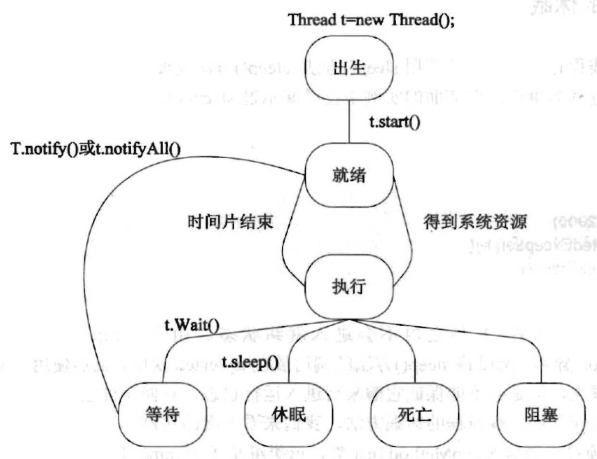
(1)休眠
static void sleep(long millis)
线程进入休眠状态,之后进入就绪状态
可能抛出 InterruptedException 异常
(2)线程加入
存在线程A和B,如果需要插入线程B,让线程B先执行完毕,然后执行线程A:在A的线程中调用B的join方法
void join()
void join(long millis)
在A中调用 B.join()时,A会等待B结束,然后继续执行
若调用B.join(n),A线程尝试获得B的锁,然后等待n毫秒,如果n毫秒后B还没结束,则A继续往下执行(如果不能获得锁,则会一直等待)
(3)线程中断
void interrupt()
在线程外部调用,结束线程,抛出异常
(4)线程礼让
static void yield()
提醒正在运行的线程礼让资源给其它线程,不保证成功。
(5)线程优先级
Thread.MIN_PRIORITY     1
Thread.MAX_PRIORITY    2
Thread.NORM_PRIORITY  5
线程默认优先级为NORM_PRIORITY,子线程继承了父线程的优先级
void setPriority(int newPriority)
int getPriority()
设置优先级的参数:1~10,参数不对会产生 IllegalArgumentException异常
4. 线程同步
(1)同步块
synchronized(Object) {
    //
}
Object:检查对象标志位,如果为0,表明此同步块中存在其它线程在运行,如果为1,则线程可以执行到同步块中并设置标志位为0
(2)同步方法
synchronized void fun() {}
当某个对象调用了同步方法,该对象上其它同步方法必须等待该同步方法执行完毕才能被执行,必须将每个能访问共享资源的方法修饰为synchronized
5. 线程间通信
(1)等待
继承自Object:
void wait()
void wait(long timeout)
调用wait,会释放该线程占有的锁(sleep不会)
(2)唤醒
继承自Object:
void notify()
void notifyAll()
package com;

import java.text.SimpleDateFormat;
import java.util.Date;

public class Outer {
    static boolean flag =true;
    static Object lock = new Object();

    public static void main(String[] args) {
        Thread thread1 = new Thread(new Thread1(),"线程A");
        Thread thread2 = new Thread(new Thread2(),"线程B");
        thread1.start();
        thread2.start();
    }

    static class Thread1 implements Runnable{
        @Override
        public void run() {
            synchronized (lock) {
                while(flag) { //当前线程不满足执行条件
                    try {
                        System.out.println(Thread.currentThread()+":flag is true.wait at "
                                +new SimpleDateFormat("HH:mm:ss").format(new Date()));
                        lock.wait(); //进入等待状态,释放锁lock
                    }catch (InterruptedException e) {

                    }
                }
                //条件满足,继续工作
                System.out.println(Thread.currentThread()+":flag is false.running at "
                        +new SimpleDateFormat("HH:mm:ss").format(new Date()));
            }
        }
    }

    static class Thread2 implements Runnable  {
        @Override
        public void run() {
            synchronized (lock) {
                //另一个线程发出通知,当前代码块执行完才释放锁lock
                System.out.println(Thread.currentThread()+" hold lock.notify at "
                        +new SimpleDateFormat("HH:mm:ss").format(new Date()));
                lock.notifyAll();
                flag = false;
            }
        }
    }
}
6. 守护线程
调用 Thread的成员方法setDaemon(true)
=======================================================================================

 浙公网安备 33010602011771号