

实验4 8086标志寄存器及中断
test01.asm源码:
 1 assume cs:code, ds:data
 2
 3 data segment
 4    x dw 1020h, 2240h, 9522h, 5060h, 3359h, 6652h, 2530h, 7031h
 5    y dw 3210h, 5510h, 6066h, 5121h, 8801h, 6210h, 7119h, 3912h
 6 data ends
 7 code segment
 8 start:
 9     mov ax, data
10     mov ds, ax
11     mov si, offset x
12     mov di, offset y
13     call add128
14
15     mov ah, 4ch
16     int 21h
17
18 add128:
19     push ax
20     push cx
21     push si
22     push di
23
24     sub ax, ax
25
26     mov cx, 8
27 s:  mov ax, [si]
28     adc ax, [di]
29     mov [si], ax
30
31     inc si
32     inc si
33     inc di
34     inc di
35     loop s
36
37     pop di
38     pop si
39     pop cx
40     pop ax
41     ret
42 code ends
43 end start
回答问题:
1.2.1  add指令对标志寄存器中的零标志位ZF(Zero Flag)、进位标志位CF(Carry Flag)是否有影响?
实验结果截图:
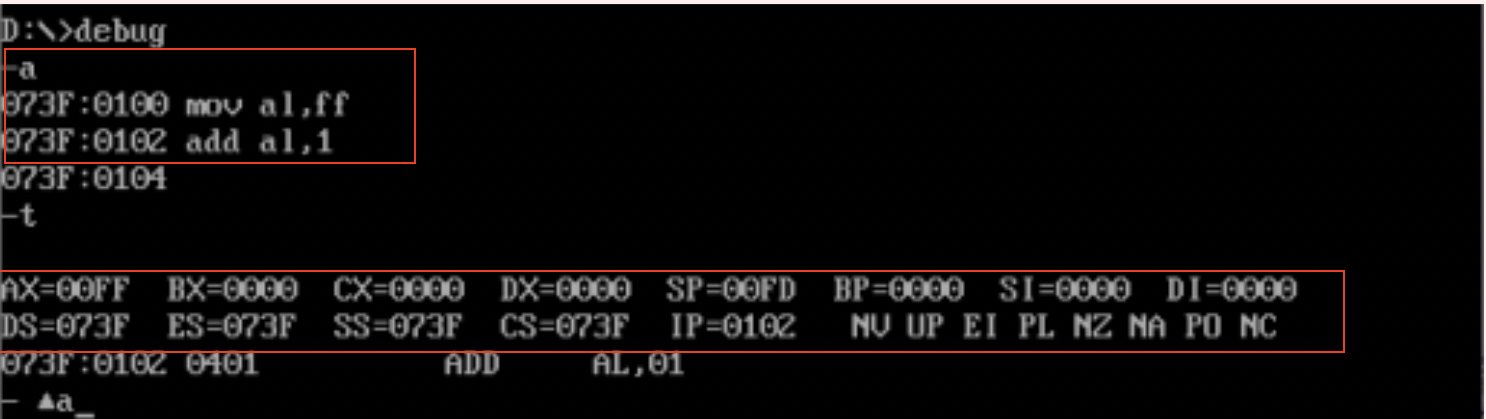
1.2.1.2
分析:--加法指令作为算数运算指令,运算结果将会影响状态标志位,除了INC指令不会影响到位CF,其余指令都会影响到标识位CF和ZF
--进一步地,ZF位从NZ变成了ZR,即就是表示运算结果为0;而CF位从NC变成了CY,从0到1的变化表示进借位发生改变,即表示运算中最高位向更高位产生了进位;
1.2.2 INC指令对标志寄存器中的零标志位ZF(Zero Flag)、进位标志位CF(Carry Flag)是否有影响?
实验截图:
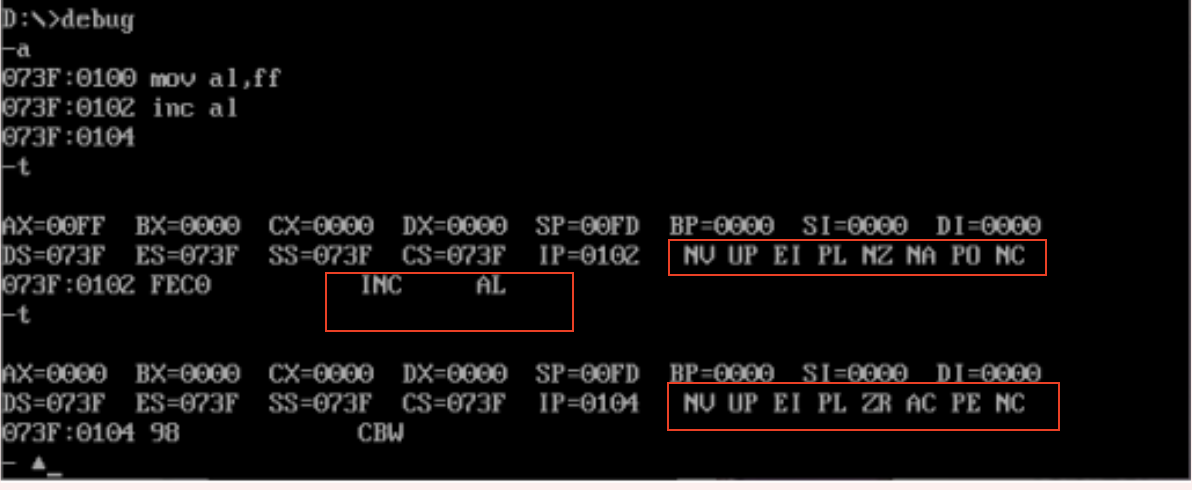
1.2.2.2
分析:-- 形如INC OPR的指令本身的任务是,将制定操作数加一;故而,INC本身是不会改变标志位CF的
-- 相反地,零标志位ZF发生了改变:ZF位从NZ变为ZR,即就是表示运算结果位0,表示运算结果不为0
任务2:
task2源码:
1 assume cs:code, ds:data
 2 data segment
 3         str db 80 dup(?)
 4 data ends
 5
 6 code segment
 7 start:
 8         mov ax, data
 9         mov ds, ax
10         mov si, 0
11 s1:
12         mov ah, 1
13         int 21h
14         mov [si], al
15         cmp al, '#'
16         je next
17         inc si
18         jmp s1
19 next:
20         mov ah, 2
21         mov dl, 0ah
22         int 21h
23
24         mov cx, si
25         mov si, 0
26 s2:     mov ah, 2
27         mov dl, [si]
28         int 21h
29         inc si
30         loop s2
31
32         mov ah, 4ch
33         int 21h
34 code ends
35 end start
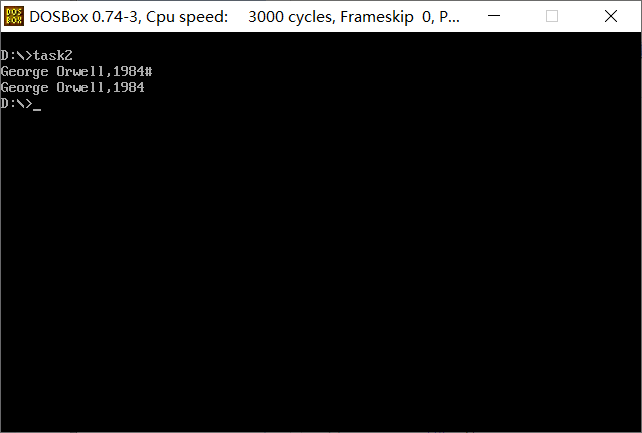
结果截图:
回答问题
1.line11-18,实现的功能是接收从键盘上输入的一串字符,以#结束。
2.line20-22,实现的功能是输出ASCII码为0a(h)的字符,即换行符。
3.line24-30,实现的功能是依次输出先前接收的字符串(#除外)。
任务3:
assume cs:code,ds:data
data segment
    x dw 91, 792, 8536, 65521, 2021
    len equ $ - x
data ends

code segment
start:
    mov ax,data
    mov ds,ax
    mov cx,5
    mov si,0

s1: mov ax,word ptr ds:[si]
    add si,2
    push cx
    call printNumber
    call printSpace
    pop cx
    loop s1

    mov ah,4ch
    int 21h

printNumber:
    mov dx,0
    mov cx,0

s2: mov bx,10
    div bx
    push dx
    mov dx,0
    inc cx
    add ax,0
    jnz s2

s3: pop dx
    add dl,30h
    mov ah,2
    int 21h
    loop s3
    ret

printSpace:
    mov ah,2
    mov dl,20h
    int 21h
    ret

code ends
end start
实验截图:

任务4:
task4.asm源码
assume cs:code, ds:data
data segment
    str db "assembly language, it's not difficult but tedious"
    len equ $ - str
data ends

code segment
start:
    mov ax, data
    mov ds, ax
    mov si, offset str
    mov cx, len
    call strupr
    mov ah, 4ch
    int 21h

strupr:

s1: mov al,ds:[si]
    cmp al,'a'
    jb s2
    cmp al,'z'
    ja s2
    and al,0dfh
    mov ds:[si],al

s2: inc si
    loop s1
    ret

code ends
end start
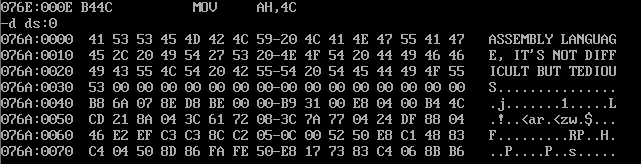
调用前:
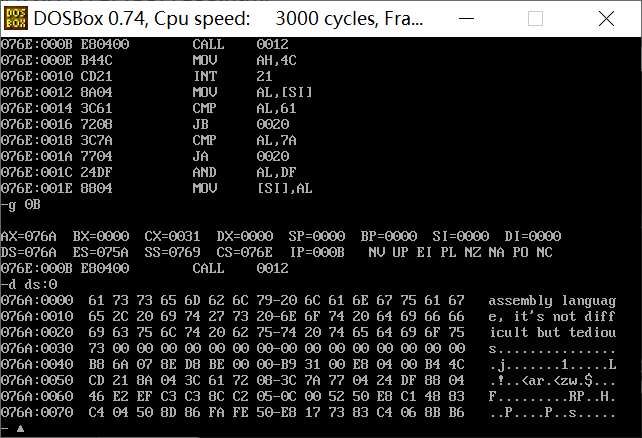
调用后:
任务5:
assume cs:code, ds:data

data segment
    str1 db "yes", '$'
    str2 db "no", '$'
data ends

code segment
start:
    mov ax, data
    mov ds, ax

    mov ah, 1
    int 21h

    mov ah, 2
    mov bh, 0
    mov dh, 24
    mov dl, 70
    int 10h

    cmp al, '7'
    je s1
    mov ah, 9
    mov dx, offset str2
    int 21h

    jmp over

s1: mov ah, 9
    mov dx, offset str1
    int 21h
over:
    mov ah, 4ch
    int 21h
code ends
end start
运行截图:
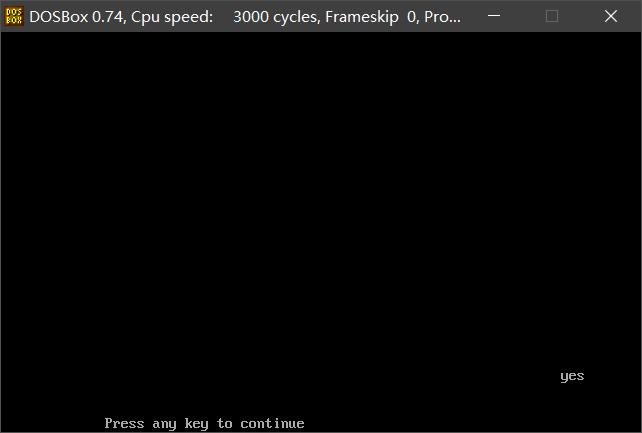
程序的功能是?
功能是判断输入的数是否为7,是则输出yes,不是则输出no
任务6:
task6_1.asm
assume cs:code
code segment
start:
  ; 42 interrupt routine install code
  mov ax, cs
  mov ds, ax
  mov si, offset int42  ; set ds:si
  mov ax, 0
  mov es, ax
  mov di, 200h     ; set es:di
  mov cx, offset int42_end - offset int42
  cld
  rep movsb
  ; set IVT(Interrupt Vector Table)
  mov ax, 0
  mov es, ax
  mov word ptr es:[42*4], 200h
  mov word ptr es:[42*4+2], 0
  mov ah, 4ch
  int 21h
int42:
  jmp short int42_start
  str db "welcome to 2049!"
  len equ $ - str
  ; display string "welcome to 2049!"
int42_start:
  mov ax, cs
  mov ds, ax
  mov si, 202h
  mov ax, 0b800h
  mov es, ax
  mov di, 24*160 + 32*2
  mov cx, len
s: mov al, [si]
  mov es:[di], al
  mov byte ptr es:[di+1], 2
  inc si
  add di, 2
  loop s
  iret
int42_end:
 nop
code ends
end start
task6_2.asm
assume cs:code
code segment
start:
  int 42 ; 调用自己实现的42号软中断
  mov ah, 4ch
  int 21h
code ends
end start
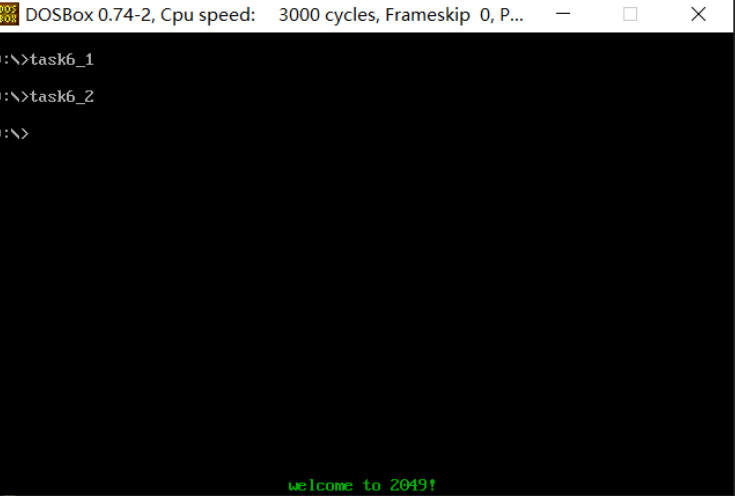
对汇编源程序task6_1.asm进行汇编、链接,得到可执行程序task6_1.exe。运行task6_1.exe,实现将
42号中断处理程序安装到0:200开始的连续内存空间,并设置中断向量表,使得将来通过 int 42 ,系统
可以跳转到中断处理程序。
对汇编源程序task6_2.asm进行汇编、链接,得到可执行程序task6_2.exe。运行task6_2.exe。
两个程序正确编写、汇编、链接,运行后,预期结果如下:
通过此项实现任务,你对中断、软中断的理解
自己选一个未被使用的中断码,实现一个中断例程,并调用测试。给出源码和运行测试截图。(选做*)
8086一共提供了256个中断,中断码为0~255,其中,有些保留作为系统用,有些未使用。可以自
行挑选一个未被使用的中断码,程时自己编写中断例程。
运行结果:

中断:CPU在接收到外部发送的或内部产生的一种特殊信息时,会立即处理特殊信息。
软中断:CPU内部产生特殊信息(如除法错误、单步执行、执行into指令和执行int指令)时,立即处理该情况。

 浙公网安备 33010602011771号