实验三
实验三代码如下:
1、Complex类实现:
#include<iostream>
#include<cmath>
class Complex{

	public:
		Complex(){
		}
		Complex(double x,double y=0){
			a = x;
			b = y;
		}
		Complex(const Complex &t){
			a = t.a;
			b = t.b;
		}
		double get_real()const{
			return a;
		}
		double get_imag()const{
			return b;
		}
		void show()const{
			if(b>0)			std::cout<<a<<"+"<<b<<"i";
			else if(b==0)	std::cout<<a;
			else			std::cout<<a<<b<<"i";
		}
		void add(const Complex &t){
			a = a + t.get_real();
			b = b + t.get_imag();
		}
		friend Complex add(Complex &c1,const Complex &c2);
		friend bool is_equal(Complex &c1,const Complex &c2);
		friend double abs(Complex &c);


	private:
		double a;//实部
		double b;//虚部
};

Complex add(Complex &c1,const Complex &c2){
	return Complex(c1.a+c2.a , c1.b+c2.b);
}
bool is_equal(Complex &c1,const Complex &c2){
	if(c1.a==c2.a && c1.b==c2.b )
		return true;
	else
		return false;
}
double abs(Complex &c){
	return sqrt(c.a*c.a+c.b*c.b);
}
2、测试代码如下:
#include "Complex.cpp"
#include <iostream>

int main()
{
	using namespace std;

    Complex c1(3, -4);
    const Complex c2(4.5);
    Complex c3(c1);

    cout << "c1 = ";
    c1.show();
    cout << endl;

    cout << "c2 = ";
    c2.show();
    cout << endl;
    cout << "c2.imag = " << c2.get_imag() << endl;

    cout << "c3 = ";
    c3.show();
    cout << endl;

    cout << "abs(c1) = ";
    cout << abs(c1) << endl;

    cout << boolalpha;
    cout << "c1 == c3 : " << is_equal(c1, c3) << endl;
    cout << "c1 == c2 : " << is_equal(c1, c2) << endl;

    Complex c4;
    c4 = add(c1, c2);
    cout << "c4 = c1 + c2 = ";
    c4.show();
    cout << endl;

    c1.add(c2);
    cout << "c1 += c2, " << "c1 = ";
    c1.show();
    cout << endl;
}
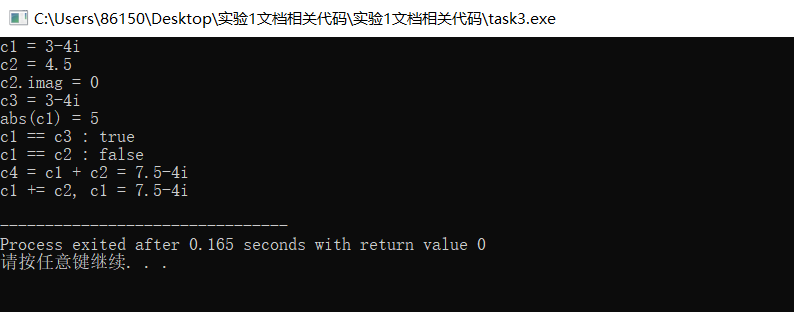
3、实验结果如下:
实验四
实验四代码如下:
1、User类实现:
#include<iostream>
#include<string.h>
using namespace std;
class User{
	public:
		User(char a[],char b[],char c[]){
			strcpy(name,a);
			strcpy(passwd,b);
			strcpy(email,c);
			n++;
		}
		User(char a[]){
			strcpy(name,a);
			strcpy(passwd,"111111");
			strcpy(email,"");
			n++;
		}
		void set_email(){
			cout<<"Enter email address:";
			cin>>email;
			cout<<"email is set successfully...\n";
		}
		void change_passwd(){
			int judge=1;
			cout<<"Enter old password:";
			char temp[50];
			cin>>temp;
			while(strcmp(passwd,temp)!=0){
				cout<<"password input error. Please re-enter again:";
				cin>>temp;
				judge++;
				if(judge==3) {
					cout<<"password input error. Please try after a while.\n";
					return;
				}
			}
			cout<<"Enter new passwd:";
			cin>>passwd;
			cout<<"new passwd is set successfully...\n";
		}
		void print_info(){
			cout<<"name: "<<name<<endl;
			cout<<"passwd: ******"<<endl;
			cout<<"email: "<<email<<endl;
		}
		void static print_n(){
			cout<<"there are "<<n<<" users."<<endl;
		}
	private:
		char name[50];
		char passwd[50];
		char email[50];
		static int n;
};
	int User::n = 0;
2、测试代码如下:
#include "User.cpp"
#include <iostream>

int main()
{
    using namespace std;

    cout << "testing 1......" << endl;
    User user1("Jonny", "92197", "xyz@hotmail.com");
    user1.print_info();

    cout << endl
         << "testing 2......" << endl
         << endl;
    User user2("Leonard");
    user2.change_passwd();
    user2.set_email();
    user2.print_info();

    User::print_n();
}
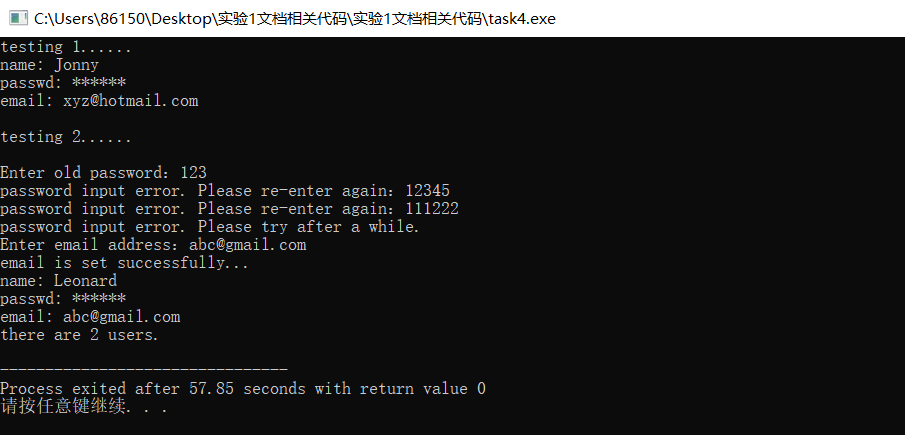
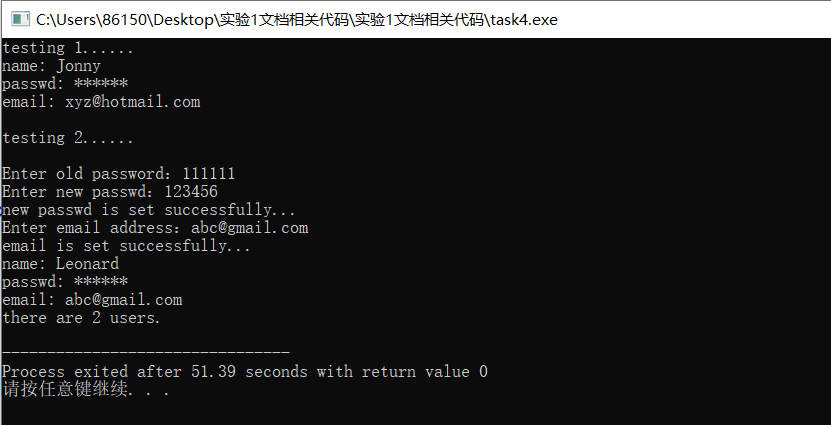
3、实验结果如下:
实验总结
1、头文件中只能声明函数,不能有函数实现;
2、当一个函数的参数为const类型时不能修改参数的值,const的使用遵循不可扩大限定范围但可以缩小范围的原则,非const可调用const的实现函数而const不可调用非const;
3、友元函数声明在哪个类内部,友元函数就可以直接访问该类的成员变量。


 浙公网安备 33010602011771号