
广搜和深搜(BFS和DFS)
邻接链表法,使用稀疏图 (为什么?个人理解:相比于邻接矩阵,这样可以减少存储占用的空间,遍历查询也更快)
小结:DFS遍历顺序:先平行着遍历,只到没有记录就遍历下一个元素,所以我们存放的时候每个链表存的是该节点直接相连接的节点就好
这里存在一个思维方式的升级:我们预知怎样遍历,需先选择好合适的存储结构
参考链接:
https://blog.csdn.net/qq_40609809/article/details/96760864
https://www.cnblogs.com/yellowgg/p/7875459.html


#include <iostream>
#include <string>
#include <vector>
#include <queue>

using namespace std;


//数据结构
//边节点结构,
typedef struct EdgeNode
{
    int adjvex; //用来存储邻节点的位置,
    struct EdgeNode* next; //下一个节点的位置
}EdgeNode;

//顶点表节点结构
typedef struct VexList
{
    string vexs;//用来存储顶点信息
    EdgeNode* firstEdge; //用来存储当前顶点的下一个顶点信息

}VexList;

//动态数组存放顶点表,
typedef struct GraphList
{
    vector<VexList> VexList;
    int vertex, edge; //一个图的顶点数和边数
}GraphList;

//全局变量
bool VisitList[100];

//创建图
void CreateGraphSteem(GraphList* graph)
{
    string v1, v2;
    EdgeNode* e, *p, *q;
    cout << "输入顶点数和边数:" << endl;
    cin >> graph->vertex >> graph->edge;
    cout << "输入顶点的信息:" << endl;
    for (int i = 0;i < graph->vertex;i++)
    {
        VexList tmp;
        cin >> tmp.vexs;
        tmp.firstEdge = nullptr;
        graph->VexList.push_back(tmp);
    }

    for (int j = 0;j < graph->edge;j++)
    {
        int m, n;
        cout << "输入边Vm,Vn:(顶点m,到顶点n有连线)" << endl;
        cin >> m >> n;
        if (graph->VexList[m].firstEdge == nullptr)
        {
            e = new EdgeNode;
            e->adjvex = n;
            e->next = nullptr;
            graph->VexList[m].firstEdge = e;
        }
        else
        {
            //当前m后面有顶点
            EdgeNode* p = graph->VexList[m].firstEdge;
            while (p->next)
            {
                p = p->next;
            }
            //遍历到为空的时候跳出来
            e = new EdgeNode;
            e->adjvex = n;
            e->next = nullptr;
            p->next = e;
        }

        //因为是无向图,所以Vm,n 和Vn,m都要连接起来
        if (graph->VexList[n].firstEdge == nullptr)
        {
            e = new EdgeNode;
            e->adjvex = m;
            e->next = nullptr;
            graph->VexList[n].firstEdge = e;
        }
        else
        {
            //当前m后面有顶点
            EdgeNode* p = graph->VexList[n].firstEdge;
            while (p->next)
            {
                p = p->next;
            }
            //遍历到为空的时候跳出来
            e = new EdgeNode;
            e->adjvex = m;
            e->next = nullptr;
            p->next = e;
        }

    }


}

//打印链接链表
void PrintGraph(GraphList* graph)
{
    cout << "所有建立的邻接链表如下:" << endl;
    for (int i = 0; i < graph->vertex;i++)
    {
        cout << graph->VexList[i].vexs; //先输出顶点信息
        EdgeNode *e = graph->VexList[i].firstEdge;
        while (e)
        {
            cout << "-->" << e->adjvex;
            e = e->next;
        }
        cout << endl;
    }

}

void DestoryGraph(GraphList* praph)
{
    EdgeNode *p = nullptr;
    for (int i = 0;i < praph->vertex;i++)
    {
        p = praph->VexList[i].firstEdge;
        while (p)
        {
            EdgeNode* tmp = p;
            p = p->next;
            delete tmp;
        }

        praph->VexList[i].firstEdge = nullptr;
    }

}

//BFS:边表的遍历,用遍历链表的方式
void BFSTravel(GraphList* graph)
{
    cout << "广度优先搜索" << endl;
    EdgeNode* p;
    queue<int> Q;

    for (int i = 0; i < graph->vertex;i++)
    {
        VisitList[i] = false;

    }

    for (int i = 0; i < graph->vertex;i++)
    {
        if (!VisitList[i])
        {
            VisitList[i] = true;
            cout << graph->VexList[i].vexs << " ";
            Q.push(i);
            while (!Q.empty())
            {
                i = Q.front();
                Q.pop();
                p = graph->VexList[i].firstEdge;
                while (p)
                {
                    if (!VisitList[p->adjvex])
                    {
                        VisitList[p->adjvex] = true;
                        cout << graph->VexList[p->adjvex].vexs << " ";
                        Q.push(p->adjvex);
                    }

                    p = p->next;
                }
            }
        }
    }

}


//深度优先搜索
void DFS(GraphList* graph, int idex)
{
    EdgeNode *p;
    VisitList[idex] = true;
    cout << graph->VexList[idex].vexs << " ";
    p = graph->VexList[idex].firstEdge;
    while (p)
    {
        if (!VisitList[idex])
        {
            DFS(graph, p->adjvex);
        }
        p = p->next;
    }
}

void DFStravel(GraphList* graph)
{
    cout << "深度优先遍历顺序:" << endl;
    for (int i = 0;i < graph->vertex;i++)
    {
        VisitList[i] = false;

    }

    for (int i = 0;i < graph->vertex;i++)
    {
        if (!VisitList[i])
        {
            DFS(graph,i);
        }
    }
    cout << endl;
}

int main()
{


    GraphList graph;
    CreateGraphSteem(&graph);
    PrintGraph(&graph);
    //BFSTravel(&graph);  //邻接法BFS
    DFStravel(&graph);
    DestoryGraph(&graph);
    system("pause");
    return 0;
}
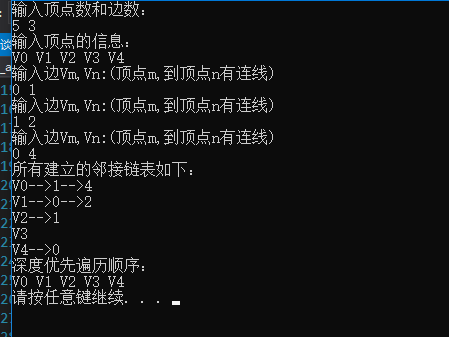
运行实例:如下图

 浙公网安备 33010602011771号