
PINN: Time-dependent 1D problem
Problem Description
Suppose we have a simple partial differential equation as follows.
If we look into another equation (2), you can see this is one of the possible solutions of (1).
Now we will use (2) to create training dataset, build custom loss function according to the concept of PINN, train our model with or without PINN concept.
Training Data Generation
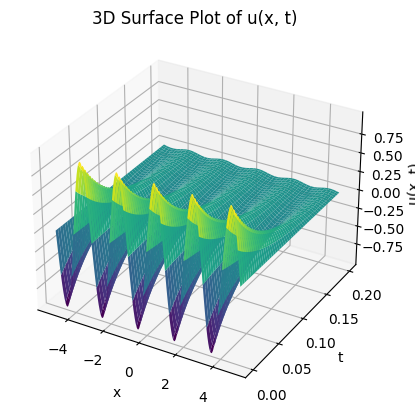
Let’s create our training data first. The sampling domain was set to be \((x,t)\in[-5,5]\times[0,0.2]\)
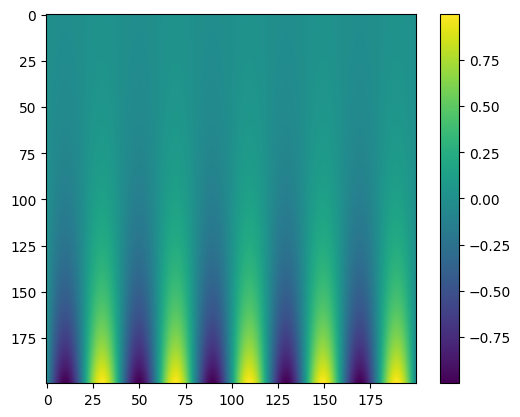
The 3D plot:
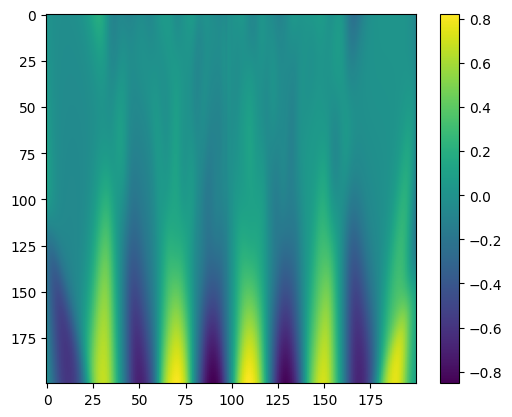
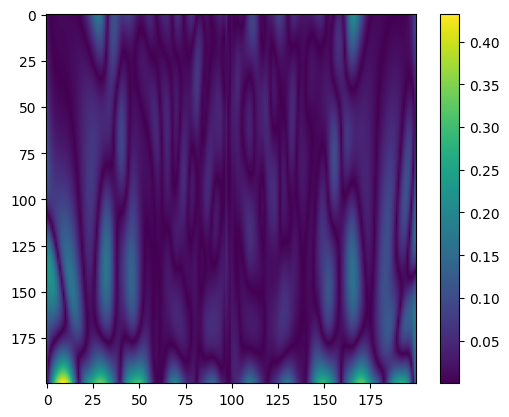
Ordinary Neural Network
Neural Network Architecture: (indim, 100, outdim)
Activation Function: Tanh
Optimization Algorithm: Adam(Learning Rate = 0.1)
Loss Function: MSE
Epochs: 500
Final: Saving model with loss 0.0033...
 |
 |
|---|---|
| Predicted value | Error |
PINN
Neural Network Architecture: (indim, 100, outdim)
Activation Function: Tanh
Optimization Algorithm: Adam(Learning Rate = 0.1)
Loss Function: MSE + Physical and boundary losses
Epochs: 500
Final: Saving model with loss 0.1832...
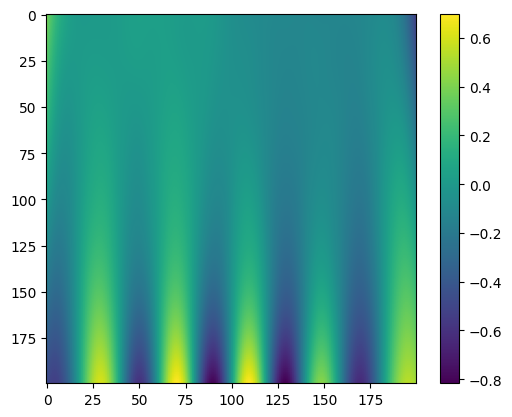 |
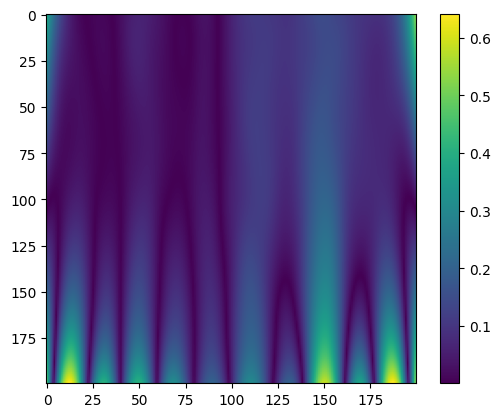 |
|---|---|
| Predicted value | Error |
PINN with LBFGS
Neural Network Architecture: (indim, 100, outdim)
Activation Function: Tanh
Optimization Algorithm: Adam(Learning Rate = 0.1), LBFGS(Learning Rate = 0.01)
Loss Function: MSE + Physical and boundary losses
Epochs: 200(Adam), 30(LBFGS)
Final: Saving model with loss 0.0824...
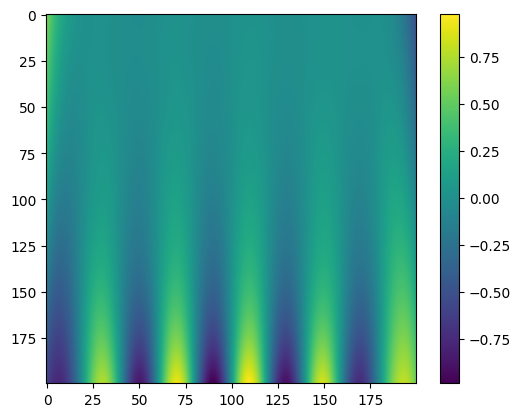 |
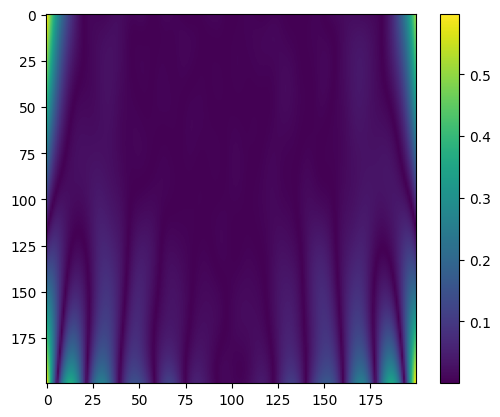 |
|---|---|
| Predicted value | Error |
Conclusion
Using PINN can achieve good results faster within the same number of iterations. The LBFGS optimization algorithm can further optimize the loss based on Adam and achieve better results, but the running speed will be much slower than Adam.
Code
https://github.com/srrdhy/PINN_Tutorial

 浙公网安备 33010602011771号