
bfs(走迷宫)
输入 N=10, M=10(迷宫如下图所示。'#','.','S','G'分别表示墙壁、通道、起点和终点)
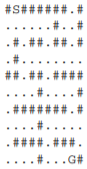
输出 22
const int INF = 100000000;
// 使用pair表示状态时,使用typedef会更加方便一些
typedef pair<int, int> P;
// 输入
char maze[MAX_N][MAX_M + 1]; // 表示迷宫的字符串的数组
int N, M;
int sx, sy; // 起点坐标
int gx, gy; // 终点坐标
int d[MAX_N][MAX_M]; // 到各个位置的最短距离的数组
// 4个方向移动的向量
int dx[4] = { 1, 0, -1, 0 }, dy[4] = { 0, 1, 0, -1 };
// 求从(sx, sy)到(gx, gy)的最短距离
// 如果无法到达,则是INF
int bfs() {
    queue<P> que;
    // 把所有的位置都初始化为INF
    for (int i = 0; i < N; i++)
        for (int j = 0; j < M; j++) d[i][j] = INF;
    // 将起点加入队列,并把这一地点的距离设置为0
    que.push(P(sx, sy));
    d[sx][sy] = 0;

    // 不断循环直到队列的长度为0
    while (que.size()) {
        // 从队列的最前端取出元素
        P p = que.front(); que.pop();
        // 如果取出的状态已经是终点,则结束搜索
        if (p.first == gx && p.second == gy) break;

        // 四个方向的循环
        for (int i = 0; i < 4; i++) {
            // 移动之后的位置记为(nx, ny)
            int nx = p.first + dx[i], ny = p.second + dy[i];

            // 判断是否可以移动以及是否已经访问过(d[nx][ny]!=INF即为已经访问过)
            if (0 <= nx && nx < N && 0 <= ny && ny < M && maze[nx][ny] != '#' &&
                d[nx][ny] == INF) {
                // 可以移动的话,则加入到队列,并且到该位置的距离确定为到p的距离+1
                que.push(P(nx, ny));
                d[nx][ny] = d[p.first][p.second] + 1;
            }
        }
    }
    return d[gx][gy];
}
void solve() {
    int res = bfs();
    printf("%d\n", res);
}

 浙公网安备 33010602011771号