
概要
前面,我们已经学习了ArrayList,并了解了fail-fast机制。这一章我们接着学习List的实现类——LinkedList。
和学习ArrayList一样,接下来呢,我们先对LinkedList有个整体认识,然后再学习它的源码;最后再通过实例来学会使用LinkedList。内容包括:
第1部分 LinkedList介绍
第2部分 LinkedList数据结构
第3部分 LinkedList源码解析(基于JDK1.6.0_45)
第4部分 LinkedList遍历方式
第5部分 LinkedList示例
转载请注明出处:http://www.cnblogs.com/skywang12345/p/3308807.html
第1部分 LinkedList介绍
LinkedList简介
LinkedList 是一个继承于AbstractSequentialList的双向链表。它也可以被当作堆栈、队列或双端队列进行操作。
LinkedList 实现 List 接口,能对它进行队列操作。
LinkedList 实现 Deque 接口,即能将LinkedList当作双端队列使用。
LinkedList 实现了Cloneable接口,即覆盖了函数clone(),能克隆。
LinkedList 实现java.io.Serializable接口,这意味着LinkedList支持序列化,能通过序列化去传输。
LinkedList 是非同步的。
LinkedList构造函数
// 默认构造函数
LinkedList()

// 创建一个LinkedList,保护Collection中的全部元素。
LinkedList(Collection<? extends E> collection)
LinkedList的API
LinkedList的API
boolean       add(E object)
void          add(int location, E object)
boolean       addAll(Collection<? extends E> collection)
boolean       addAll(int location, Collection<? extends E> collection)
void          addFirst(E object)
void          addLast(E object)
void          clear()
Object        clone()
boolean       contains(Object object)
Iterator<E>   descendingIterator()
E             element()
E             get(int location)
E             getFirst()
E             getLast()
int           indexOf(Object object)
int           lastIndexOf(Object object)
ListIterator<E>     listIterator(int location)
boolean       offer(E o)
boolean       offerFirst(E e)
boolean       offerLast(E e)
E             peek()
E             peekFirst()
E             peekLast()
E             poll()
E             pollFirst()
E             pollLast()
E             pop()
void          push(E e)
E             remove()
E             remove(int location)
boolean       remove(Object object)
E             removeFirst()
boolean       removeFirstOccurrence(Object o)
E             removeLast()
boolean       removeLastOccurrence(Object o)
E             set(int location, E object)
int           size()
<T> T[]       toArray(T[] contents)
Object[]     toArray()
AbstractSequentialList简介
在介绍LinkedList的源码之前,先介绍一下AbstractSequentialList。毕竟,LinkedList是AbstractSequentialList的子类。
AbstractSequentialList 实现了get(int index)、set(int index, E element)、add(int index, E element) 和 remove(int index)这些函数。这些接口都是随机访问List的,LinkedList是双向链表;既然它继承于AbstractSequentialList,就相当于已经实现了“get(int index)这些接口”。
此外,我们若需要通过AbstractSequentialList自己实现一个列表,只需要扩展此类,并提供 listIterator() 和 size() 方法的实现即可。若要实现不可修改的列表,则需要实现列表迭代器的 hasNext、next、hasPrevious、previous 和 index 方法即可。
第2部分 LinkedList数据结构
LinkedList的继承关系
java.lang.Object
   ↳     java.util.AbstractCollection<E>
         ↳     java.util.AbstractList<E>
               ↳     java.util.AbstractSequentialList<E>
                     ↳     java.util.LinkedList<E>

public class LinkedList<E>
    extends AbstractSequentialList<E>
    implements List<E>, Deque<E>, Cloneable, java.io.Serializable {}
LinkedList与Collection关系如下图:
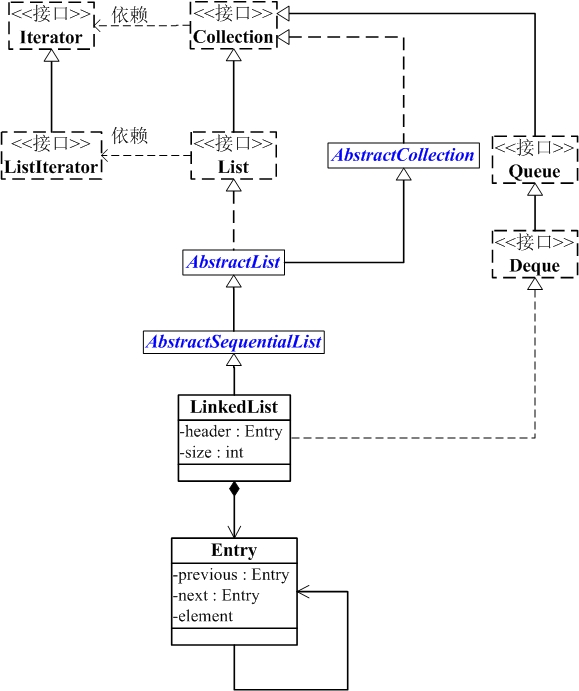
LinkedList的本质是双向链表。
(01) LinkedList继承于AbstractSequentialList,并且实现了Dequeue接口。
(02) LinkedList包含两个重要的成员:header 和 size。
header是双向链表的表头,它是双向链表节点所对应的类Entry的实例。Entry中包含成员变量: previous, next, element。其中,previous是该节点的上一个节点,next是该节点的下一个节点,element是该节点所包含的值。
size是双向链表中节点的个数。
第3部分 LinkedList源码解析(基于JDK1.6.0_45)
为了更了解LinkedList的原理,下面对LinkedList源码代码作出分析。
在阅读源码之前,我们先对LinkedList的整体实现进行大致说明:
LinkedList实际上是通过双向链表去实现的。既然是双向链表,那么它的顺序访问会非常高效,而随机访问效率比较低。
既然LinkedList是通过双向链表的,但是它也实现了List接口{也就是说,它实现了get(int location)、remove(int location)等“根据索引值来获取、删除节点的函数”}。LinkedList是如何实现List的这些接口的,如何将“双向链表和索引值联系起来的”?
实际原理非常简单,它就是通过一个计数索引值来实现的。例如,当我们调用get(int location)时,首先会比较“location”和“双向链表长度的1/2”;若前者大,则从链表头开始往后查找,直到location位置;否则,从链表末尾开始先前查找,直到location位置。
这就是“双线链表和索引值联系起来”的方法。
好了,接下来开始阅读源码(只要理解双向链表,那么LinkedList的源码很容易理解的)。


  1 package java.util;
  2
  3 public class LinkedList<E>
  4     extends AbstractSequentialList<E>
  5     implements List<E>, Deque<E>, Cloneable, java.io.Serializable
  6 {
  7     // 链表的表头,表头不包含任何数据。Entry是个链表类数据结构。
  8     private transient Entry<E> header = new Entry<E>(null, null, null);
  9
 10     // LinkedList中元素个数
 11     private transient int size = 0;
 12
 13     // 默认构造函数:创建一个空的链表
 14     public LinkedList() {
 15         header.next = header.previous = header;
 16     }
 17
 18     // 包含“集合”的构造函数:创建一个包含“集合”的LinkedList
 19     public LinkedList(Collection<? extends E> c) {
 20         this();
 21         addAll(c);
 22     }
 23
 24     // 获取LinkedList的第一个元素
 25     public E getFirst() {
 26         if (size==0)
 27             throw new NoSuchElementException();
 28
 29         // 链表的表头header中不包含数据。
 30         // 这里返回header所指下一个节点所包含的数据。
 31         return header.next.element;
 32     }
 33
 34     // 获取LinkedList的最后一个元素
 35     public E getLast()  {
 36         if (size==0)
 37             throw new NoSuchElementException();
 38
 39         // 由于LinkedList是双向链表;而表头header不包含数据。
 40         // 因而,这里返回表头header的前一个节点所包含的数据。
 41         return header.previous.element;
 42     }
 43
 44     // 删除LinkedList的第一个元素
 45     public E removeFirst() {
 46         return remove(header.next);
 47     }
 48
 49     // 删除LinkedList的最后一个元素
 50     public E removeLast() {
 51         return remove(header.previous);
 52     }
 53
 54     // 将元素添加到LinkedList的起始位置
 55     public void addFirst(E e) {
 56         addBefore(e, header.next);
 57     }
 58
 59     // 将元素添加到LinkedList的结束位置
 60     public void addLast(E e) {
 61         addBefore(e, header);
 62     }
 63
 64     // 判断LinkedList是否包含元素(o)
 65     public boolean contains(Object o) {
 66         return indexOf(o) != -1;
 67     }
 68
 69     // 返回LinkedList的大小
 70     public int size() {
 71         return size;
 72     }
 73
 74     // 将元素(E)添加到LinkedList中
 75     public boolean add(E e) {
 76         // 将节点(节点数据是e)添加到表头(header)之前。
 77         // 即,将节点添加到双向链表的末端。
 78         addBefore(e, header);
 79         return true;
 80     }
 81
 82     // 从LinkedList中删除元素(o)
 83     // 从链表开始查找,如存在元素(o)则删除该元素并返回true;
 84     // 否则,返回false。
 85     public boolean remove(Object o) {
 86         if (o==null) {
 87             // 若o为null的删除情况
 88             for (Entry<E> e = header.next; e != header; e = e.next) {
 89                 if (e.element==null) {
 90                     remove(e);
 91                     return true;
 92                 }
 93             }
 94         } else {
 95             // 若o不为null的删除情况
 96             for (Entry<E> e = header.next; e != header; e = e.next) {
 97                 if (o.equals(e.element)) {
 98                     remove(e);
 99                     return true;
100                 }
101             }
102         }
103         return false;
104     }
105
106     // 将“集合(c)”添加到LinkedList中。
107     // 实际上,是从双向链表的末尾开始,将“集合(c)”添加到双向链表中。
108     public boolean addAll(Collection<? extends E> c) {
109         return addAll(size, c);
110     }
111
112     // 从双向链表的index开始,将“集合(c)”添加到双向链表中。
113     public boolean addAll(int index, Collection<? extends E> c) {
114         if (index < 0 || index > size)
115             throw new IndexOutOfBoundsException("Index: "+index+
116                                                 ", Size: "+size);
117         Object[] a = c.toArray();
118         // 获取集合的长度
119         int numNew = a.length;
120         if (numNew==0)
121             return false;
122         modCount++;
123
124         // 设置“当前要插入节点的后一个节点”
125         Entry<E> successor = (index==size ? header : entry(index));
126         // 设置“当前要插入节点的前一个节点”
127         Entry<E> predecessor = successor.previous;
128         // 将集合(c)全部插入双向链表中
129         for (int i=0; i<numNew; i++) {
130             Entry<E> e = new Entry<E>((E)a[i], successor, predecessor);
131             predecessor.next = e;
132             predecessor = e;
133         }
134         successor.previous = predecessor;
135
136         // 调整LinkedList的实际大小
137         size += numNew;
138         return true;
139     }
140
141     // 清空双向链表
142     public void clear() {
143         Entry<E> e = header.next;
144         // 从表头开始,逐个向后遍历;对遍历到的节点执行一下操作:
145         // (01) 设置前一个节点为null
146         // (02) 设置当前节点的内容为null
147         // (03) 设置后一个节点为“新的当前节点”
148         while (e != header) {
149             Entry<E> next = e.next;
150             e.next = e.previous = null;
151             e.element = null;
152             e = next;
153         }
154         header.next = header.previous = header;
155         // 设置大小为0
156         size = 0;
157         modCount++;
158     }
159
160     // 返回LinkedList指定位置的元素
161     public E get(int index) {
162         return entry(index).element;
163     }
164
165     // 设置index位置对应的节点的值为element
166     public E set(int index, E element) {
167         Entry<E> e = entry(index);
168         E oldVal = e.element;
169         e.element = element;
170         return oldVal;
171     }
172
173     // 在index前添加节点,且节点的值为element
174     public void add(int index, E element) {
175         addBefore(element, (index==size ? header : entry(index)));
176     }
177
178     // 删除index位置的节点
179     public E remove(int index) {
180         return remove(entry(index));
181     }
182
183     // 获取双向链表中指定位置的节点
184     private Entry<E> entry(int index) {
185         if (index < 0 || index >= size)
186             throw new IndexOutOfBoundsException("Index: "+index+
187                                                 ", Size: "+size);
188         Entry<E> e = header;
189         // 获取index处的节点。
190         // 若index < 双向链表长度的1/2,则从前先后查找;
191         // 否则,从后向前查找。
192         if (index < (size >> 1)) {
193             for (int i = 0; i <= index; i++)
194                 e = e.next;
195         } else {
196             for (int i = size; i > index; i--)
197                 e = e.previous;
198         }
199         return e;
200     }
201
202     // 从前向后查找,返回“值为对象(o)的节点对应的索引”
203     // 不存在就返回-1
204     public int indexOf(Object o) {
205         int index = 0;
206         if (o==null) {
207             for (Entry e = header.next; e != header; e = e.next) {
208                 if (e.element==null)
209                     return index;
210                 index++;
211             }
212         } else {
213             for (Entry e = header.next; e != header; e = e.next) {
214                 if (o.equals(e.element))
215                     return index;
216                 index++;
217             }
218         }
219         return -1;
220     }
221
222     // 从后向前查找,返回“值为对象(o)的节点对应的索引”
223     // 不存在就返回-1
224     public int lastIndexOf(Object o) {
225         int index = size;
226         if (o==null) {
227             for (Entry e = header.previous; e != header; e = e.previous) {
228                 index--;
229                 if (e.element==null)
230                     return index;
231             }
232         } else {
233             for (Entry e = header.previous; e != header; e = e.previous) {
234                 index--;
235                 if (o.equals(e.element))
236                     return index;
237             }
238         }
239         return -1;
240     }
241
242     // 返回第一个节点
243     // 若LinkedList的大小为0,则返回null
244     public E peek() {
245         if (size==0)
246             return null;
247         return getFirst();
248     }
249
250     // 返回第一个节点
251     // 若LinkedList的大小为0,则抛出异常
252     public E element() {
253         return getFirst();
254     }
255
256     // 删除并返回第一个节点
257     // 若LinkedList的大小为0,则返回null
258     public E poll() {
259         if (size==0)
260             return null;
261         return removeFirst();
262     }
263
264     // 将e添加双向链表末尾
265     public boolean offer(E e) {
266         return add(e);
267     }
268
269     // 将e添加双向链表开头
270     public boolean offerFirst(E e) {
271         addFirst(e);
272         return true;
273     }
274
275     // 将e添加双向链表末尾
276     public boolean offerLast(E e) {
277         addLast(e);
278         return true;
279     }
280
281     // 返回第一个节点
282     // 若LinkedList的大小为0,则返回null
283     public E peekFirst() {
284         if (size==0)
285             return null;
286         return getFirst();
287     }
288
289     // 返回最后一个节点
290     // 若LinkedList的大小为0,则返回null
291     public E peekLast() {
292         if (size==0)
293             return null;
294         return getLast();
295     }
296
297     // 删除并返回第一个节点
298     // 若LinkedList的大小为0,则返回null
299     public E pollFirst() {
300         if (size==0)
301             return null;
302         return removeFirst();
303     }
304
305     // 删除并返回最后一个节点
306     // 若LinkedList的大小为0,则返回null
307     public E pollLast() {
308         if (size==0)
309             return null;
310         return removeLast();
311     }
312
313     // 将e插入到双向链表开头
314     public void push(E e) {
315         addFirst(e);
316     }
317
318     // 删除并返回第一个节点
319     public E pop() {
320         return removeFirst();
321     }
322
323     // 从LinkedList开始向后查找,删除第一个值为元素(o)的节点
324     // 从链表开始查找,如存在节点的值为元素(o)的节点,则删除该节点
325     public boolean removeFirstOccurrence(Object o) {
326         return remove(o);
327     }
328
329     // 从LinkedList末尾向前查找,删除第一个值为元素(o)的节点
330     // 从链表开始查找,如存在节点的值为元素(o)的节点,则删除该节点
331     public boolean removeLastOccurrence(Object o) {
332         if (o==null) {
333             for (Entry<E> e = header.previous; e != header; e = e.previous) {
334                 if (e.element==null) {
335                     remove(e);
336                     return true;
337                 }
338             }
339         } else {
340             for (Entry<E> e = header.previous; e != header; e = e.previous) {
341                 if (o.equals(e.element)) {
342                     remove(e);
343                     return true;
344                 }
345             }
346         }
347         return false;
348     }
349
350     // 返回“index到末尾的全部节点”对应的ListIterator对象(List迭代器)
351     public ListIterator<E> listIterator(int index) {
352         return new ListItr(index);
353     }
354
355     // List迭代器
356     private class ListItr implements ListIterator<E> {
357         // 上一次返回的节点
358         private Entry<E> lastReturned = header;
359         // 下一个节点
360         private Entry<E> next;
361         // 下一个节点对应的索引值
362         private int nextIndex;
363         // 期望的改变计数。用来实现fail-fast机制。
364         private int expectedModCount = modCount;
365
366         // 构造函数。
367         // 从index位置开始进行迭代
368         ListItr(int index) {
369             // index的有效性处理
370             if (index < 0 || index > size)
371                 throw new IndexOutOfBoundsException("Index: "+index+ ", Size: "+size);
372             // 若 “index 小于 ‘双向链表长度的一半’”,则从第一个元素开始往后查找;
373             // 否则,从最后一个元素往前查找。
374             if (index < (size >> 1)) {
375                 next = header.next;
376                 for (nextIndex=0; nextIndex<index; nextIndex++)
377                     next = next.next;
378             } else {
379                 next = header;
380                 for (nextIndex=size; nextIndex>index; nextIndex--)
381                     next = next.previous;
382             }
383         }
384
385         // 是否存在下一个元素
386         public boolean hasNext() {
387             // 通过元素索引是否等于“双向链表大小”来判断是否达到最后。
388             return nextIndex != size;
389         }
390
391         // 获取下一个元素
392         public E next() {
393             checkForComodification();
394             if (nextIndex == size)
395                 throw new NoSuchElementException();
396
397             lastReturned = next;
398             // next指向链表的下一个元素
399             next = next.next;
400             nextIndex++;
401             return lastReturned.element;
402         }
403
404         // 是否存在上一个元素
405         public boolean hasPrevious() {
406             // 通过元素索引是否等于0,来判断是否达到开头。
407             return nextIndex != 0;
408         }
409
410         // 获取上一个元素
411         public E previous() {
412             if (nextIndex == 0)
413             throw new NoSuchElementException();
414
415             // next指向链表的上一个元素
416             lastReturned = next = next.previous;
417             nextIndex--;
418             checkForComodification();
419             return lastReturned.element;
420         }
421
422         // 获取下一个元素的索引
423         public int nextIndex() {
424             return nextIndex;
425         }
426
427         // 获取上一个元素的索引
428         public int previousIndex() {
429             return nextIndex-1;
430         }
431
432         // 删除当前元素。
433         // 删除双向链表中的当前节点
434         public void remove() {
435             checkForComodification();
436             Entry<E> lastNext = lastReturned.next;
437             try {
438                 LinkedList.this.remove(lastReturned);
439             } catch (NoSuchElementException e) {
440                 throw new IllegalStateException();
441             }
442             if (next==lastReturned)
443                 next = lastNext;
444             else
445                 nextIndex--;
446             lastReturned = header;
447             expectedModCount++;
448         }
449
450         // 设置当前节点为e
451         public void set(E e) {
452             if (lastReturned == header)
453                 throw new IllegalStateException();
454             checkForComodification();
455             lastReturned.element = e;
456         }
457
458         // 将e添加到当前节点的前面
459         public void add(E e) {
460             checkForComodification();
461             lastReturned = header;
462             addBefore(e, next);
463             nextIndex++;
464             expectedModCount++;
465         }
466
467         // 判断 “modCount和expectedModCount是否相等”,依次来实现fail-fast机制。
468         final void checkForComodification() {
469             if (modCount != expectedModCount)
470             throw new ConcurrentModificationException();
471         }
472     }
473
474     // 双向链表的节点所对应的数据结构。
475     // 包含3部分:上一节点,下一节点,当前节点值。
476     private static class Entry<E> {
477         // 当前节点所包含的值
478         E element;
479         // 下一个节点
480         Entry<E> next;
481         // 上一个节点
482         Entry<E> previous;
483
484         /**
485          * 链表节点的构造函数。
486          * 参数说明:
487          *   element  —— 节点所包含的数据
488          *   next      —— 下一个节点
489          *   previous —— 上一个节点
490          */
491         Entry(E element, Entry<E> next, Entry<E> previous) {
492             this.element = element;
493             this.next = next;
494             this.previous = previous;
495         }
496     }
497
498     // 将节点(节点数据是e)添加到entry节点之前。
499     private Entry<E> addBefore(E e, Entry<E> entry) {
500         // 新建节点newEntry,将newEntry插入到节点e之前;并且设置newEntry的数据是e
501         Entry<E> newEntry = new Entry<E>(e, entry, entry.previous);
502         newEntry.previous.next = newEntry;
503         newEntry.next.previous = newEntry;
504         // 修改LinkedList大小
505         size++;
506         // 修改LinkedList的修改统计数:用来实现fail-fast机制。
507         modCount++;
508         return newEntry;
509     }
510
511     // 将节点从链表中删除
512     private E remove(Entry<E> e) {
513         if (e == header)
514             throw new NoSuchElementException();
515
516         E result = e.element;
517         e.previous.next = e.next;
518         e.next.previous = e.previous;
519         e.next = e.previous = null;
520         e.element = null;
521         size--;
522         modCount++;
523         return result;
524     }
525
526     // 反向迭代器
527     public Iterator<E> descendingIterator() {
528         return new DescendingIterator();
529     }
530
531     // 反向迭代器实现类。
532     private class DescendingIterator implements Iterator {
533         final ListItr itr = new ListItr(size());
534         // 反向迭代器是否下一个元素。
535         // 实际上是判断双向链表的当前节点是否达到开头
536         public boolean hasNext() {
537             return itr.hasPrevious();
538         }
539         // 反向迭代器获取下一个元素。
540         // 实际上是获取双向链表的前一个节点
541         public E next() {
542             return itr.previous();
543         }
544         // 删除当前节点
545         public void remove() {
546             itr.remove();
547         }
548     }
549
550
551     // 返回LinkedList的Object[]数组
552     public Object[] toArray() {
553     // 新建Object[]数组
554     Object[] result = new Object[size];
555         int i = 0;
556         // 将链表中所有节点的数据都添加到Object[]数组中
557         for (Entry<E> e = header.next; e != header; e = e.next)
558             result[i++] = e.element;
559     return result;
560     }
561
562     // 返回LinkedList的模板数组。所谓模板数组,即可以将T设为任意的数据类型
563     public <T> T[] toArray(T[] a) {
564         // 若数组a的大小 < LinkedList的元素个数(意味着数组a不能容纳LinkedList中全部元素)
565         // 则新建一个T[]数组,T[]的大小为LinkedList大小,并将该T[]赋值给a。
566         if (a.length < size)
567             a = (T[])java.lang.reflect.Array.newInstance(
568                                 a.getClass().getComponentType(), size);
569         // 将链表中所有节点的数据都添加到数组a中
570         int i = 0;
571         Object[] result = a;
572         for (Entry<E> e = header.next; e != header; e = e.next)
573             result[i++] = e.element;
574
575         if (a.length > size)
576             a[size] = null;
577
578         return a;
579     }
580
581
582     // 克隆函数。返回LinkedList的克隆对象。
583     public Object clone() {
584         LinkedList<E> clone = null;
585         // 克隆一个LinkedList克隆对象
586         try {
587             clone = (LinkedList<E>) super.clone();
588         } catch (CloneNotSupportedException e) {
589             throw new InternalError();
590         }
591
592         // 新建LinkedList表头节点
593         clone.header = new Entry<E>(null, null, null);
594         clone.header.next = clone.header.previous = clone.header;
595         clone.size = 0;
596         clone.modCount = 0;
597
598         // 将链表中所有节点的数据都添加到克隆对象中
599         for (Entry<E> e = header.next; e != header; e = e.next)
600             clone.add(e.element);
601
602         return clone;
603     }
604
605     // java.io.Serializable的写入函数
606     // 将LinkedList的“容量,所有的元素值”都写入到输出流中
607     private void writeObject(java.io.ObjectOutputStream s)
608         throws java.io.IOException {
609         // Write out any hidden serialization magic
610         s.defaultWriteObject();
611
612         // 写入“容量”
613         s.writeInt(size);
614
615         // 将链表中所有节点的数据都写入到输出流中
616         for (Entry e = header.next; e != header; e = e.next)
617             s.writeObject(e.element);
618     }
619
620     // java.io.Serializable的读取函数:根据写入方式反向读出
621     // 先将LinkedList的“容量”读出,然后将“所有的元素值”读出
622     private void readObject(java.io.ObjectInputStream s)
623         throws java.io.IOException, ClassNotFoundException {
624         // Read in any hidden serialization magic
625         s.defaultReadObject();
626
627         // 从输入流中读取“容量”
628         int size = s.readInt();
629
630         // 新建链表表头节点
631         header = new Entry<E>(null, null, null);
632         header.next = header.previous = header;
633
634         // 从输入流中将“所有的元素值”并逐个添加到链表中
635         for (int i=0; i<size; i++)
636             addBefore((E)s.readObject(), header);
637     }
638
639 }
总结:
(01) LinkedList 实际上是通过双向链表去实现的。
它包含一个非常重要的内部类:Entry。Entry是双向链表节点所对应的数据结构,它包括的属性有:当前节点所包含的值,上一个节点,下一个节点。
(02) 从LinkedList的实现方式中可以发现,它不存在LinkedList容量不足的问题。
(03) LinkedList的克隆函数,即是将全部元素克隆到一个新的LinkedList对象中。
(04) LinkedList实现java.io.Serializable。当写入到输出流时,先写入“容量”,再依次写入“每一个节点保护的值”;当读出输入流时,先读取“容量”,再依次读取“每一个元素”。
(05) 由于LinkedList实现了Deque,而Deque接口定义了在双端队列两端访问元素的方法。提供插入、移除和检查元素的方法。每种方法都存在两种形式:一种形式在操作失败时抛出异常,另一种形式返回一个特殊值(null 或 false,具体取决于操作)。
总结起来如下表格:
        第一个元素(头部)                 最后一个元素(尾部)
        抛出异常        特殊值            抛出异常        特殊值
插入    addFirst(e)    offerFirst(e)    addLast(e)        offerLast(e)
移除    removeFirst()  pollFirst()      removeLast()    pollLast()
检查    getFirst()     peekFirst()      getLast()        peekLast()
(06) LinkedList可以作为FIFO(先进先出)的队列,作为FIFO的队列时,下表的方法等价:
队列方法       等效方法
add(e)        addLast(e)
offer(e)      offerLast(e)
remove()      removeFirst()
poll()        pollFirst()
element()     getFirst()
peek()        peekFirst()
(07) LinkedList可以作为LIFO(后进先出)的栈,作为LIFO的栈时,下表的方法等价:
栈方法        等效方法
push(e)      addFirst(e)
pop()        removeFirst()
peek()       peekFirst()
第4部分 LinkedList遍历方式
LinkedList遍历方式
LinkedList支持多种遍历方式。建议不要采用随机访问的方式去遍历LinkedList,而采用逐个遍历的方式。
(01) 第一种,通过迭代器遍历。即通过Iterator去遍历。
for(Iterator iter = list.iterator(); iter.hasNext();)
    iter.next();
(02) 通过快速随机访问遍历LinkedList
int size = list.size();
for (int i=0; i<size; i++) {
    list.get(i);
}
(03) 通过另外一种for循环来遍历LinkedList
for (Integer integ:list)
    ;
(04) 通过pollFirst()来遍历LinkedList
while(list.pollFirst() != null)
    ;
(05) 通过pollLast()来遍历LinkedList
while(list.pollLast() != null)
    ;
(06) 通过removeFirst()来遍历LinkedList
try {
    while(list.removeFirst() != null)
        ;
} catch (NoSuchElementException e) {
}
(07) 通过removeLast()来遍历LinkedList
try {
    while(list.removeLast() != null)
        ;
} catch (NoSuchElementException e) {
}
测试这些遍历方式效率的代码如下:
  1 import java.util.List;
  2 import java.util.Iterator;
  3 import java.util.LinkedList;
  4 import java.util.NoSuchElementException;
  5
  6 /*
  7  * @desc 测试LinkedList的几种遍历方式和效率
  8  *
  9  * @author skywang
 10  */
 11 public class LinkedListThruTest {
 12     public static void main(String[] args) {
 13         // 通过Iterator遍历LinkedList
 14         iteratorLinkedListThruIterator(getLinkedList()) ;
 15
 16         // 通过快速随机访问遍历LinkedList
 17         iteratorLinkedListThruForeach(getLinkedList()) ;
 18
 19         // 通过for循环的变种来访问遍历LinkedList
 20         iteratorThroughFor2(getLinkedList()) ;
 21
 22         // 通过PollFirst()遍历LinkedList
 23         iteratorThroughPollFirst(getLinkedList()) ;
 24
 25         // 通过PollLast()遍历LinkedList
 26         iteratorThroughPollLast(getLinkedList()) ;
 27
 28         // 通过removeFirst()遍历LinkedList
 29         iteratorThroughRemoveFirst(getLinkedList()) ;
 30
 31         // 通过removeLast()遍历LinkedList
 32         iteratorThroughRemoveLast(getLinkedList()) ;
 33     }
 34
 35     private static LinkedList getLinkedList() {
 36         LinkedList llist = new LinkedList();
 37         for (int i=0; i<100000; i++)
 38             llist.addLast(i);
 39
 40         return llist;
 41     }
 42     /**
 43      * 通过快迭代器遍历LinkedList
 44      */
 45     private static void iteratorLinkedListThruIterator(LinkedList<Integer> list) {
 46         if (list == null)
 47             return ;
 48
 49         // 记录开始时间
 50         long start = System.currentTimeMillis();
 51
 52         for(Iterator iter = list.iterator(); iter.hasNext();)
 53             iter.next();
 54
 55         // 记录结束时间
 56         long end = System.currentTimeMillis();
 57         long interval = end - start;
 58         System.out.println("iteratorLinkedListThruIterator:" + interval+" ms");
 59     }
 60
 61     /**
 62      * 通过快速随机访问遍历LinkedList
 63      */
 64     private static void iteratorLinkedListThruForeach(LinkedList<Integer> list) {
 65         if (list == null)
 66             return ;
 67
 68         // 记录开始时间
 69         long start = System.currentTimeMillis();
 70
 71         int size = list.size();
 72         for (int i=0; i<size; i++) {
 73             list.get(i);
 74         }
 75         // 记录结束时间
 76         long end = System.currentTimeMillis();
 77         long interval = end - start;
 78         System.out.println("iteratorLinkedListThruForeach:" + interval+" ms");
 79     }
 80
 81     /**
 82      * 通过另外一种for循环来遍历LinkedList
 83      */
 84     private static void iteratorThroughFor2(LinkedList<Integer> list) {
 85         if (list == null)
 86             return ;
 87
 88         // 记录开始时间
 89         long start = System.currentTimeMillis();
 90
 91         for (Integer integ:list)
 92             ;
 93
 94         // 记录结束时间
 95         long end = System.currentTimeMillis();
 96         long interval = end - start;
 97         System.out.println("iteratorThroughFor2:" + interval+" ms");
 98     }
 99
100     /**
101      * 通过pollFirst()来遍历LinkedList
102      */
103     private static void iteratorThroughPollFirst(LinkedList<Integer> list) {
104         if (list == null)
105             return ;
106
107         // 记录开始时间
108         long start = System.currentTimeMillis();
109         while(list.pollFirst() != null)
110             ;
111
112         // 记录结束时间
113         long end = System.currentTimeMillis();
114         long interval = end - start;
115         System.out.println("iteratorThroughPollFirst:" + interval+" ms");
116     }
117
118     /**
119      * 通过pollLast()来遍历LinkedList
120      */
121     private static void iteratorThroughPollLast(LinkedList<Integer> list) {
122         if (list == null)
123             return ;
124
125         // 记录开始时间
126         long start = System.currentTimeMillis();
127         while(list.pollLast() != null)
128             ;
129
130         // 记录结束时间
131         long end = System.currentTimeMillis();
132         long interval = end - start;
133         System.out.println("iteratorThroughPollLast:" + interval+" ms");
134     }
135
136     /**
137      * 通过removeFirst()来遍历LinkedList
138      */
139     private static void iteratorThroughRemoveFirst(LinkedList<Integer> list) {
140         if (list == null)
141             return ;
142
143         // 记录开始时间
144         long start = System.currentTimeMillis();
145         try {
146             while(list.removeFirst() != null)
147                 ;
148         } catch (NoSuchElementException e) {
149         }
150
151         // 记录结束时间
152         long end = System.currentTimeMillis();
153         long interval = end - start;
154         System.out.println("iteratorThroughRemoveFirst:" + interval+" ms");
155     }
156
157     /**
158      * 通过removeLast()来遍历LinkedList
159      */
160     private static void iteratorThroughRemoveLast(LinkedList<Integer> list) {
161         if (list == null)
162             return ;
163
164         // 记录开始时间
165         long start = System.currentTimeMillis();
166         try {
167             while(list.removeLast() != null)
168                 ;
169         } catch (NoSuchElementException e) {
170         }
171
172         // 记录结束时间
173         long end = System.currentTimeMillis();
174         long interval = end - start;
175         System.out.println("iteratorThroughRemoveLast:" + interval+" ms");
176     }
177
178 }
执行结果:
iteratorLinkedListThruIterator:8 ms
iteratorLinkedListThruForeach:3724 ms
iteratorThroughFor2:5 ms
iteratorThroughPollFirst:8 ms
iteratorThroughPollLast:6 ms
iteratorThroughRemoveFirst:2 ms
iteratorThroughRemoveLast:2 ms
由此可见,遍历LinkedList时,使用removeFist()或removeLast()效率最高。但用它们遍历时,会删除原始数据;若单纯只读取,而不删除,应该使用第3种遍历方式。
无论如何,千万不要通过随机访问去遍历LinkedList!
第5部分 LinkedList示例
下面通过一个示例来学习如何使用LinkedList的常用API
  1 import java.util.List;
  2 import java.util.Iterator;
  3 import java.util.LinkedList;
  4 import java.util.NoSuchElementException;
  5
  6 /*
  7  * @desc LinkedList测试程序。
  8  *
  9  * @author skywang
 10  * @email  kuiwu-wang@163.com
 11  */
 12 public class LinkedListTest {
 13     public static void main(String[] args) {
 14         // 测试LinkedList的API
 15         testLinkedListAPIs() ;
 16
 17         // 将LinkedList当作 LIFO(后进先出)的堆栈
 18         useLinkedListAsLIFO();
 19
 20         // 将LinkedList当作 FIFO(先进先出)的队列
 21         useLinkedListAsFIFO();
 22     }
 23
 24     /*
 25      * 测试LinkedList中部分API
 26      */
 27     private static void testLinkedListAPIs() {
 28         String val = null;
 29         //LinkedList llist;
 30         //llist.offer("10");
 31         // 新建一个LinkedList
 32         LinkedList llist = new LinkedList();
 33         //---- 添加操作 ----
 34         // 依次添加1,2,3
 35         llist.add("1");
 36         llist.add("2");
 37         llist.add("3");
 38
 39         // 将“4”添加到第一个位置
 40         llist.add(1, "4");
 41
 42
 43         System.out.println("\nTest \"addFirst(), removeFirst(), getFirst()\"");
 44         // (01) 将“10”添加到第一个位置。  失败的话,抛出异常!
 45         llist.addFirst("10");
 46         System.out.println("llist:"+llist);
 47         // (02) 将第一个元素删除。        失败的话,抛出异常!
 48         System.out.println("llist.removeFirst():"+llist.removeFirst());
 49         System.out.println("llist:"+llist);
 50         // (03) 获取第一个元素。          失败的话,抛出异常!
 51         System.out.println("llist.getFirst():"+llist.getFirst());
 52
 53
 54         System.out.println("\nTest \"offerFirst(), pollFirst(), peekFirst()\"");
 55         // (01) 将“10”添加到第一个位置。  返回true。
 56         llist.offerFirst("10");
 57         System.out.println("llist:"+llist);
 58         // (02) 将第一个元素删除。        失败的话,返回null。
 59         System.out.println("llist.pollFirst():"+llist.pollFirst());
 60         System.out.println("llist:"+llist);
 61         // (03) 获取第一个元素。          失败的话,返回null。
 62         System.out.println("llist.peekFirst():"+llist.peekFirst());
 63
 64
 65         System.out.println("\nTest \"addLast(), removeLast(), getLast()\"");
 66         // (01) 将“20”添加到最后一个位置。  失败的话,抛出异常!
 67         llist.addLast("20");
 68         System.out.println("llist:"+llist);
 69         // (02) 将最后一个元素删除。        失败的话,抛出异常!
 70         System.out.println("llist.removeLast():"+llist.removeLast());
 71         System.out.println("llist:"+llist);
 72         // (03) 获取最后一个元素。          失败的话,抛出异常!
 73         System.out.println("llist.getLast():"+llist.getLast());
 74
 75
 76         System.out.println("\nTest \"offerLast(), pollLast(), peekLast()\"");
 77         // (01) 将“20”添加到第一个位置。  返回true。
 78         llist.offerLast("20");
 79         System.out.println("llist:"+llist);
 80         // (02) 将第一个元素删除。        失败的话,返回null。
 81         System.out.println("llist.pollLast():"+llist.pollLast());
 82         System.out.println("llist:"+llist);
 83         // (03) 获取第一个元素。          失败的话,返回null。
 84         System.out.println("llist.peekLast():"+llist.peekLast());
 85
 86
 87
 88         // 将第3个元素设置300。不建议在LinkedList中使用此操作,因为效率低!
 89         llist.set(2, "300");
 90         // 获取第3个元素。不建议在LinkedList中使用此操作,因为效率低!
 91         System.out.println("\nget(3):"+llist.get(2));
 92
 93
 94         // ---- toArray(T[] a) ----
 95         // 将LinkedList转行为数组
 96         String[] arr = (String[])llist.toArray(new String[0]);
 97         for (String str:arr)
 98             System.out.println("str:"+str);
 99
100         // 输出大小
101         System.out.println("size:"+llist.size());
102         // 清空LinkedList
103         llist.clear();
104         // 判断LinkedList是否为空
105         System.out.println("isEmpty():"+llist.isEmpty()+"\n");
106
107     }
108
109     /**
110      * 将LinkedList当作 LIFO(后进先出)的堆栈
111      */
112     private static void useLinkedListAsLIFO() {
113         System.out.println("\nuseLinkedListAsLIFO");
114         // 新建一个LinkedList
115         LinkedList stack = new LinkedList();
116
117         // 将1,2,3,4添加到堆栈中
118         stack.push("1");
119         stack.push("2");
120         stack.push("3");
121         stack.push("4");
122         // 打印“栈”
123         System.out.println("stack:"+stack);
124
125         // 删除“栈顶元素”
126         System.out.println("stack.pop():"+stack.pop());
127
128         // 取出“栈顶元素”
129         System.out.println("stack.peek():"+stack.peek());
130
131         // 打印“栈”
132         System.out.println("stack:"+stack);
133     }
134
135     /**
136      * 将LinkedList当作 FIFO(先进先出)的队列
137      */
138     private static void useLinkedListAsFIFO() {
139         System.out.println("\nuseLinkedListAsFIFO");
140         // 新建一个LinkedList
141         LinkedList queue = new LinkedList();
142
143         // 将10,20,30,40添加到队列。每次都是插入到末尾
144         queue.add("10");
145         queue.add("20");
146         queue.add("30");
147         queue.add("40");
148         // 打印“队列”
149         System.out.println("queue:"+queue);
150
151         // 删除(队列的第一个元素)
152         System.out.println("queue.remove():"+queue.remove());
153
154         // 读取(队列的第一个元素)
155         System.out.println("queue.element():"+queue.element());
156
157         // 打印“队列”
158         System.out.println("queue:"+queue);
159     }
160 }
运行结果:
Test "addFirst(), removeFirst(), getFirst()"
llist:[10, 1, 4, 2, 3]
llist.removeFirst():10
llist:[1, 4, 2, 3]
llist.getFirst():1

Test "offerFirst(), pollFirst(), peekFirst()"
llist:[10, 1, 4, 2, 3]
llist.pollFirst():10
llist:[1, 4, 2, 3]
llist.peekFirst():1

Test "addLast(), removeLast(), getLast()"
llist:[1, 4, 2, 3, 20]
llist.removeLast():20
llist:[1, 4, 2, 3]
llist.getLast():3

Test "offerLast(), pollLast(), peekLast()"
llist:[1, 4, 2, 3, 20]
llist.pollLast():20
llist:[1, 4, 2, 3]
llist.peekLast():3

get(3):300
str:1
str:4
str:300
str:3
size:4
isEmpty():true


useLinkedListAsLIFO
stack:[4, 3, 2, 1]
stack.pop():4
stack.peek():3
stack:[3, 2, 1]

useLinkedListAsFIFO
queue:[10, 20, 30, 40]
queue.remove():10
queue.element():20
queue:[20, 30, 40]
更多内容
01. Java 集合系列目录
03. Java 集合系列03之 ArrayList详细介绍(源码解析)和使用示例
04. Java 集合系列08之 List总结(LinkedList, ArrayList等使用场景和性能分析)
05. Java 集合系列18之 Iterator和Enumeration比较


 浙公网安备 33010602011771号