LeetCode 1325 - Delete Leaves With a Given Value (Medium)
Given a binary tree root and an integer target, delete all the leaf nodes with value target.
Note that once you delete a leaf node with value target, if it's parent node becomes a leaf node and has the value target, it should also be deleted (you need to continue doing that until you can't).
Example 1:
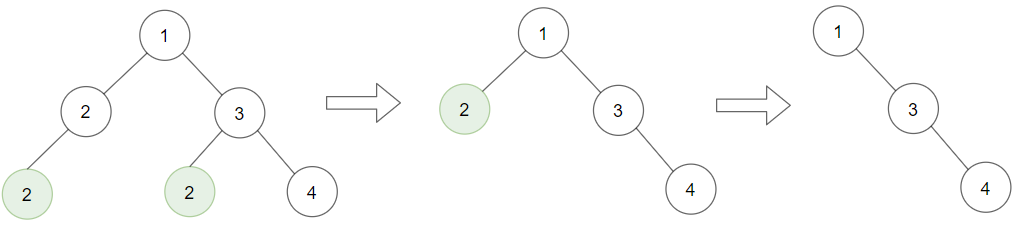
Input: root = [1,2,3,2,null,2,4], target = 2
Output: [1,null,3,null,4]
Explanation: Leaf nodes in green with value (target = 2) are removed (Picture in left).
After removing, new nodes become leaf nodes with value (target = 2) (Picture in center).
Example 2:
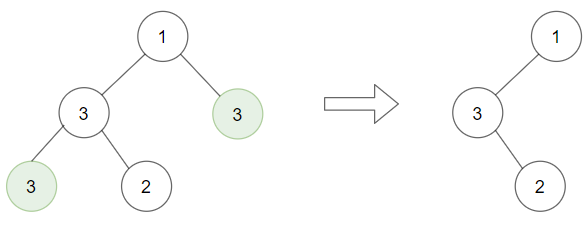
Input: root = [1,3,3,3,2], target = 3
Output: [1,3,null,null,2]
Example 3:
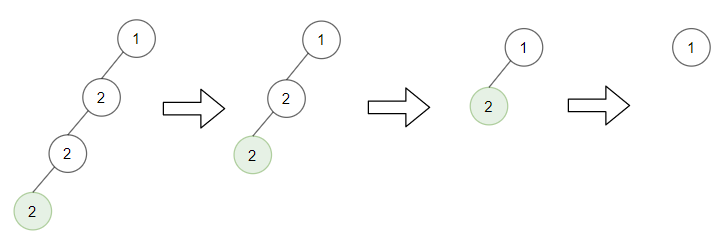
Input: root = [1,2,null,2,null,2], target = 2
Output: [1]
Explanation: Leaf nodes in green with value (target = 2) are removed at each step.
Example 4:
Input: root = [1,1,1], target = 1
Output: []
Example 5:
Input: root = [1,2,3], target = 1
Output: [1,2,3]
Constraints:
1 <= target <= 1000- The given binary tree will have between
1and3000nodes. - Each node's value is between
[1, 1000].
方法: recursion
time complexity:O(n) space complexity:O(logn)
# Definition for a binary tree node.
# class TreeNode:
#     def __init__(self, val=0, left=None, right=None):
#         self.val = val
#         self.left = left
#         self.right = right
class Solution:
    def removeLeafNodes(self, root: TreeNode, target: int) -> TreeNode:

        if root:
            if root.left:
                root.left = self.removeLeafNodes(root.left, target)
            if root.right:
                root.right = self.removeLeafNodes(root.right, target)
            if root.val != target or root.left or root.right:
                return root

 浙公网安备 33010602011771号