

cs61a 2018 spring Lab4 Lists and Data Abstraction 笔记
list
Lists are Python data structures that can store multiple values.
list comprehensions
[<expression> for <element> in <sequence> if <conditional>]The syntax is designed to read like English: “Compute the expression for each element in the sequence if the conditional is true.”
>>> [i**2 for i in [1, 2, 3, 4] if i % 2 == 0]
[4, 16]
It would be like this:
>>> lst = []
>>> for i in [1, 2, 3, 4]:
...     if i % 2 == 0:
...         lst += [i**2]
>>> lst
[4, 16]
Data Abstraction
An abstract data type consists of two types of functions:
Constructors: functions that build the abstract data type.
Selectors: functions that retrieve information from the data type
However, we does not need to know how constructors and selectors are implemented.
Questions
link indexs
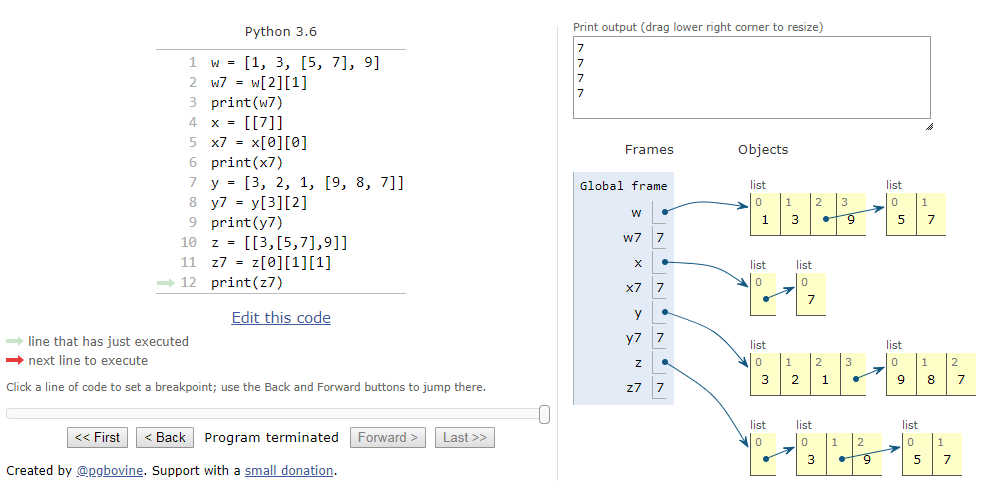
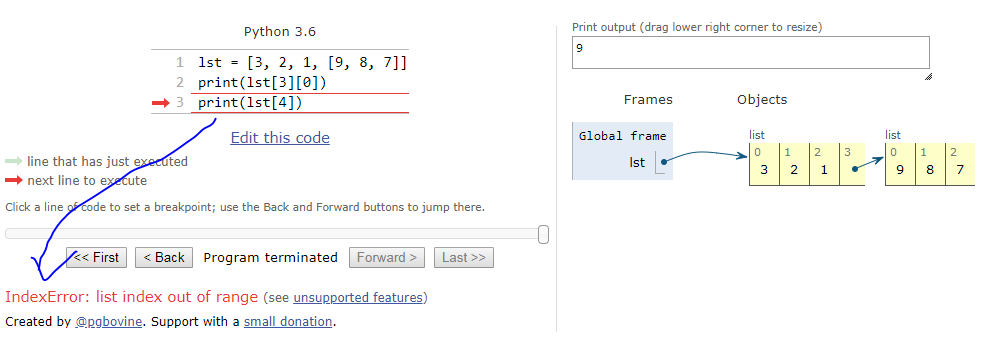
What would Python display?
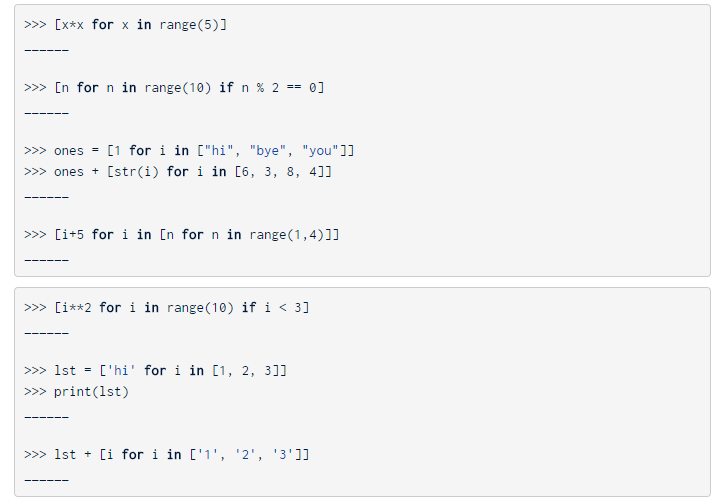
check the answer:
p1 = [x*x for x in range(5)]
print('p1=',p1)
p2 = [n for n in range(10) if n % 2 == 0]
print('p2=',p2)
ones = [1 for i in ["hi", "bye", "you"]]
print('ones=',ones)
p3 = ones + [str(i) for i in [6, 3, 8, 4]]
print('ones_again=',ones)
print('p3=', p3)
p4 = [i+5 for i in [n for n in range(1,4)]]
print('p4=',p4)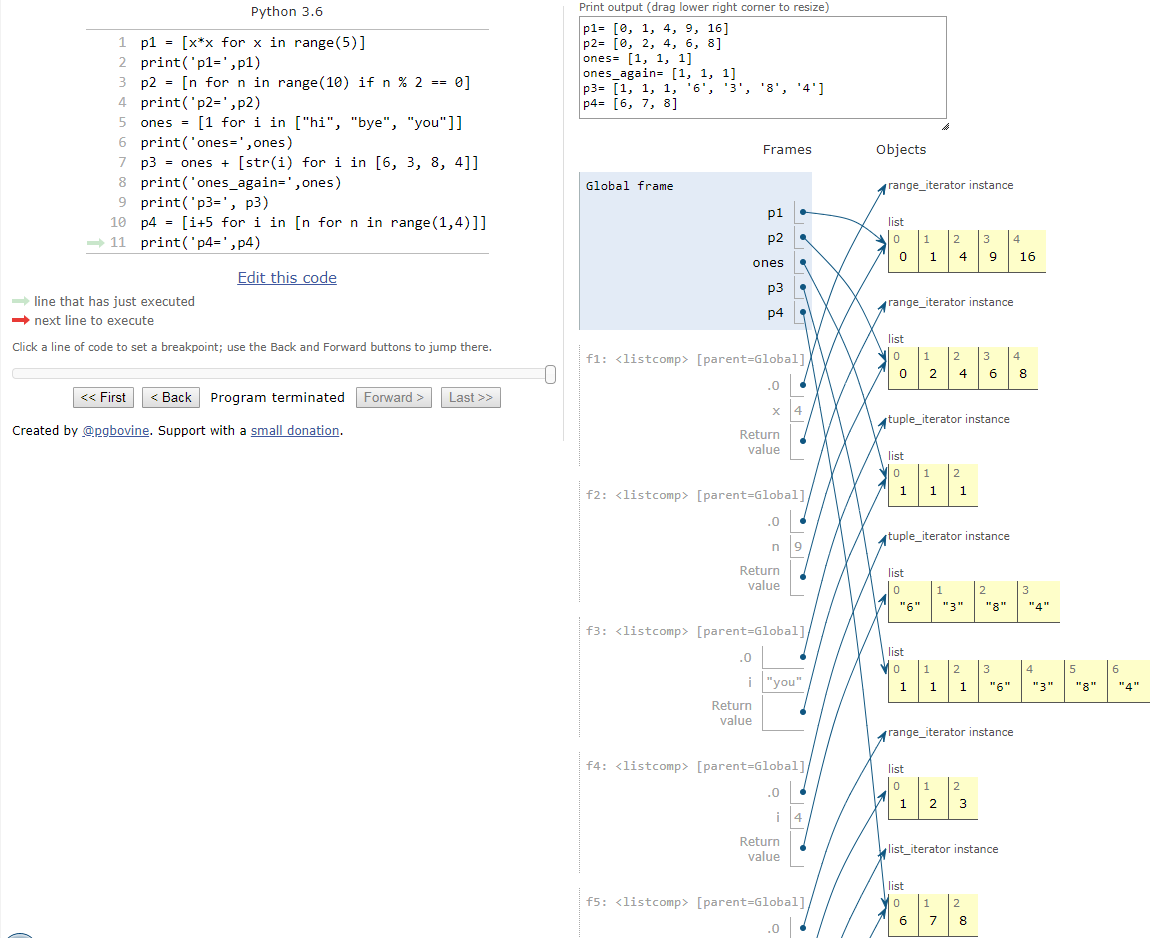
p5 = [i**2 for i in range(10) if i<3]
print("p5=",p5)
lst = ['hi' for i in [1,2,3]]
print(lst)
p6 = lst + [i for i in ['1', '2', '3']]
print('p6=',p6)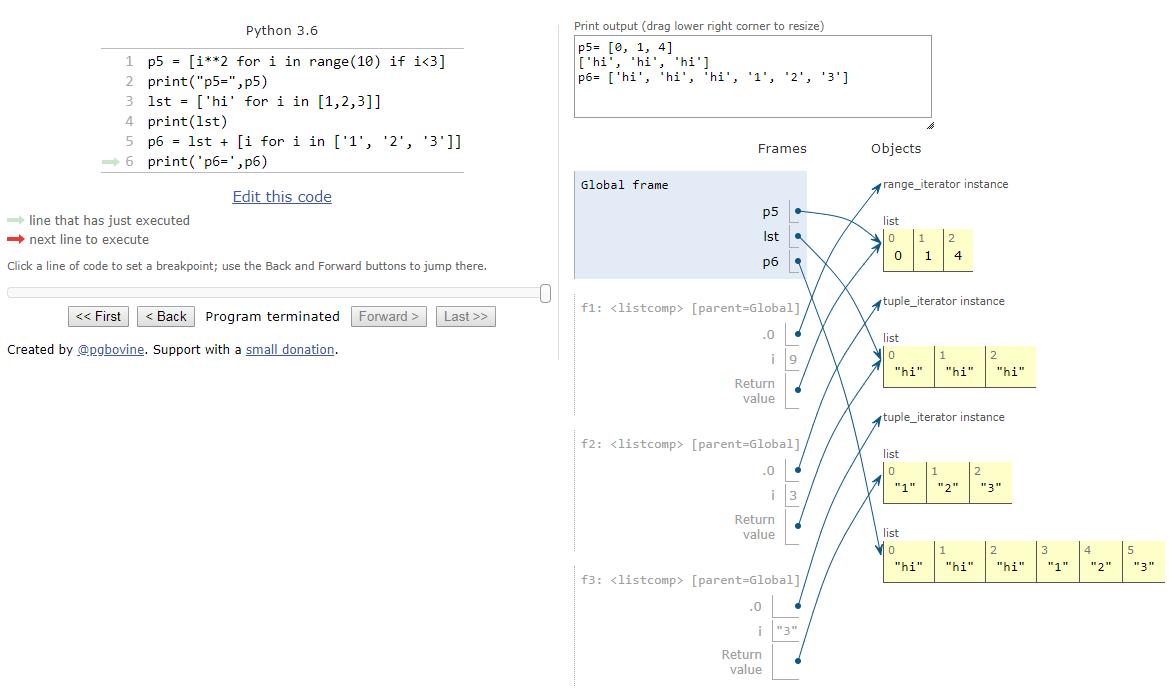
If This Not That
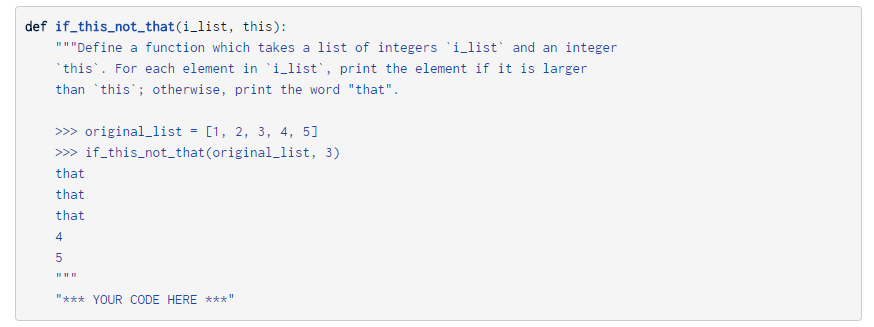
def if_this_not_that(i_list, this):
    """Define a function which takes a list of integers `i_list` and an integer
    `this`. For each element in `i_list`, print the element if it is larger
    than `this`; otherwise, print the word "that".

    >>> original_list = [1, 2, 3, 4, 5]
    >>> if_this_not_that(original_list, 3)
    that
    that
    that
    4
    5
    """

    for n in i_list:
        if n <= this:
            print("that")
        else:
            print(n)


from doctest import run_docstring_examples
run_docstring_examples(if_this_not_that, globals(), True)

lst = [1, 2, 3, 4, 5, 3, 6, 1, 2, 7, 9]
if_this_not_that(lst, 5)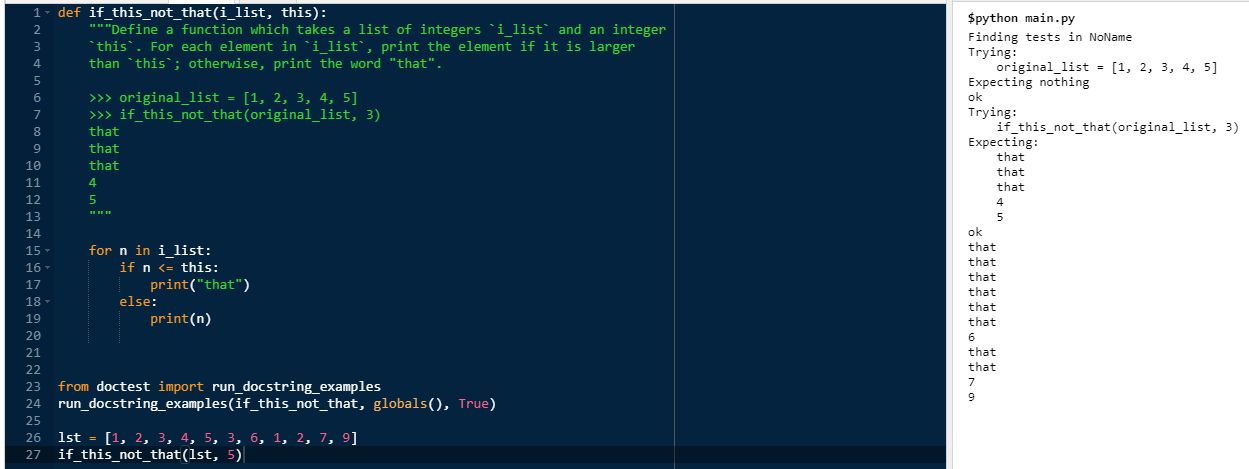
City Data Abstraction
Q4 distance
from math import sqrt
def distance(city1, city2):
    """
    >>> city1 = make_city('city1', 0, 1)
    >>> city2 = make_city('city2', 0, 2)
    >>> distance(city1, city2)
    1.0
    >>> city3 = make_city('city3', 6.5, 12)
    >>> city4 = make_city('city4', 2.5, 15)
    >>> distance(city3, city4)
    5.0
    """
    city1_lat = city1.get_lat(city1)
    city1_lon = city1.get_lon(city1)
    city2_lat = city2.get_lat(city2)
    city2_lon = city.get_lon(city2)
    return sqrt((city2_lat-city1_lat)**2+(city2_lon-city1_lon)**2)
Q5 Closer city
def closer_city(lat, lon, city1, city2):
    """
    Returns the name of either city1 or city2, whichever is closest to
    coordinate (lat, lon).

    >>> berkeley = make_city('Berkeley', 37.87, 112.26)
    >>> stanford = make_city('Stanford', 34.05, 118.25)
    >>> closer_city(38.33, 121.44, berkeley, stanford)
    'Stanford'
    >>> bucharest = make_city('Bucharest', 44.43, 26.10)
    >>> vienna = make_city('Vienna', 48.20, 16.37)
    >>> closer_city(41.29, 174.78, bucharest, vienna)
    'Bucharest'
    """
    city3 = make_city('city3', lat,lon)
    if distance(city1,city3)<distance(city2,city3):
        return "city1"
    else:
        return "city2"
Q7: Flatten
Write a function flatten that takes a (possibly deep) list and “flattens” it.
def flatten(lst):
    """Returns a flattened version of lst.

    >>> flatten([1, 2, 3])     # normal list
    [1, 2, 3]
    >>> x = [1, [2, 3], 4]      # deep list
    >>> flatten(x)
    [1, 2, 3, 4]
    >>> x = [[1, [1, 1]], 1, [1, 1]] # deep list
    >>> flatten(x)
    [1, 1, 1, 1, 1, 1]
    """
    "*** YOUR CODE HERE ***"
Reference
a = [1,[2,3],[1,[3,[5]]]]

def flatten(lst):
    templst = list()
    for x in lst:
        if type(x) != list:
            templst.append(x)
        else:
            lstterm = flatten(x)
            templst.extend(lstterm)
    return templst

b = flatten(a)
print(b)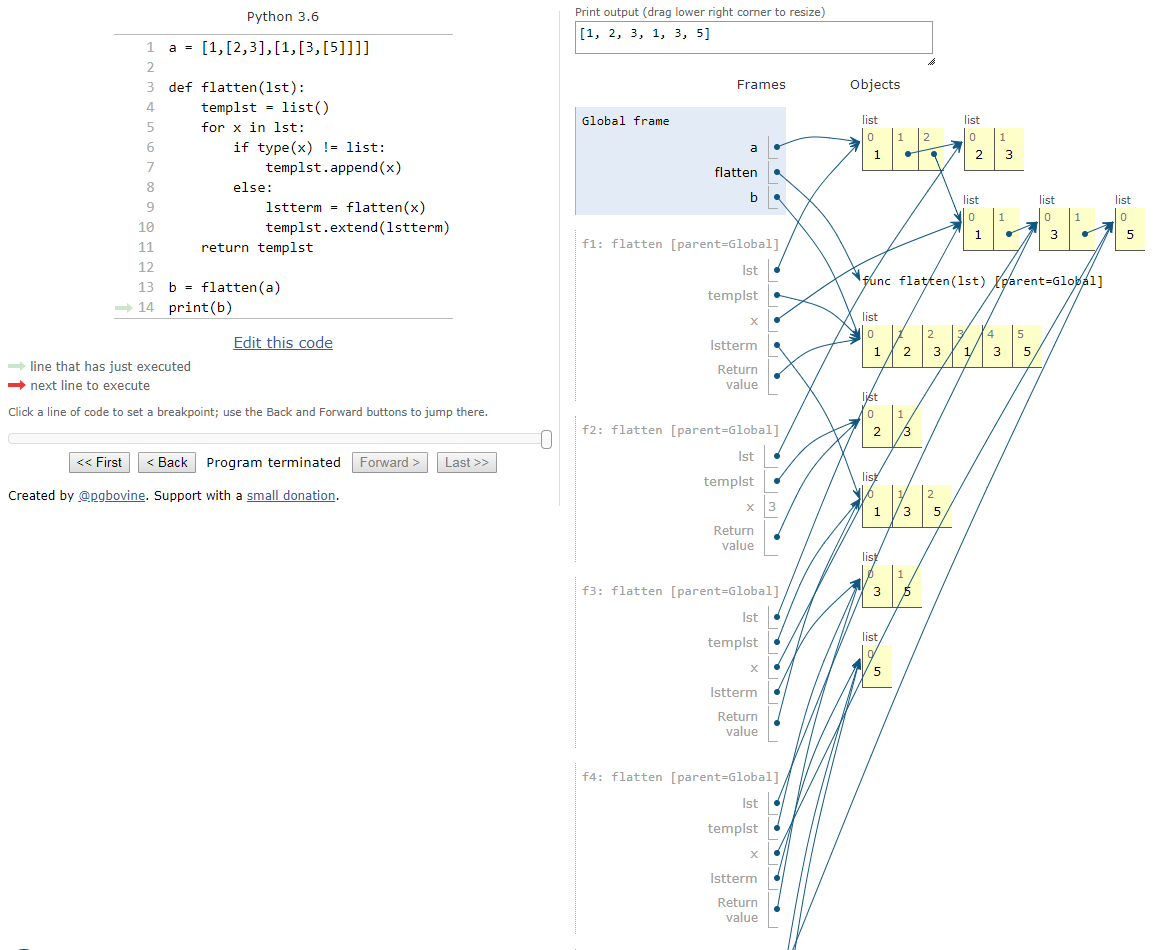
Q8: Merge
Write a function merge that takes 2 sorted lists lst1 and lst2, and returns a new list that contains all the elements in the two lists in sorted order.
def merge(lst1, lst2):
    """Merges two sorted lists.

    >>> merge([1, 3, 5], [2, 4, 6])
    [1, 2, 3, 4, 5, 6]
    >>> merge([], [2, 4, 6])
    [2, 4, 6]
    >>> merge([1, 2, 3], [])
    [1, 2, 3]
    >>> merge([5, 7], [2, 4, 6])
    [2, 4, 5, 6, 7]
    """
    "*** YOUR CODE HERE ***"
Reference
def merge(lst1, lst2):
    """Merges two sorted lists.

    >>> merge([1, 3, 5], [2, 4, 6])
    [1, 2, 3, 4, 5, 6]
    >>> merge([], [2, 4, 6])
    [2, 4, 6]
    >>> merge([1, 2, 3], [])
    [1, 2, 3]
    >>> merge([5, 7], [2, 4, 6])
    [2, 4, 5, 6, 7]
    """

    lst3 = lst1 +lst2
    lst3.sort()
    return lst3


from doctest import run_docstring_examples
run_docstring_examples(merge, globals(), True)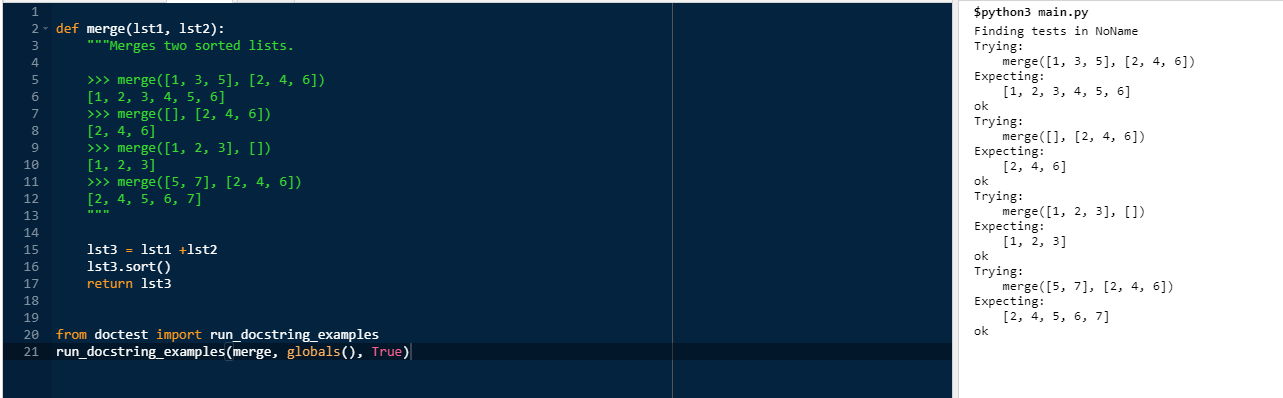
Lab 4: Lists and Data Abstraction https://inst.eecs.berkeley.edu/~cs61a/sp18/lab/lab04/

 浙公网安备 33010602011771号