
[leetcode] Dijkstra
Leetcode:
- 743. Network Delay Time - Standard Dijkstra
- 1976. Number of Ways to Arrive at Destination - Number of Shortest Paths
Template
struct node_t
{
    int vex, cost;
    node_t(int v, int c) : vex(v), cost(c) {}
    bool operator<(const node_t &n) const { return cost > n.cost; }
};
unordered_map<int, unordered_map<int, int>> graph;
/* @n - There are `n` vertices in the graph.
 * @start - The source of shortest path.
 * @return - The length of shortest path from `start` to the others vertices.
 * The number of vertices in range of [0, n).
 */
vector<int> dijkstra(int n, int start)
{
    vector<bool> vis(n, false);
    vector<int> dis(n, 0x3f3f3f3f);
    dis[start] = 0;
    priority_queue<node_t> q;  // min-heap
    q.emplace(start, 0);
    while (!q.empty())
    {
        int u = q.top().vex;
        q.pop();
        if (vis[u]) continue;
        vis[u] = true;
        // graph[u][v] = c
        for (auto [v, c] : graph[u])
        {
            if (!vis[v] && dis[v] > dis[u] + c)
            {
                dis[v] = dis[u] + c;
                q.emplace(v, dis[v]);
            }
        }
    }
    return dis;
}
Print the Path
Exercises: https://www.acwing.com/problem/content/description/4199/
Print one of the shortest path.
const int64_t INF = LLONG_MAX / 2;
struct node_t
{
    int64_t vex, cost;
    node_t(int64_t v, int64_t c) : vex(v), cost(c) {}
    bool operator<(const node_t &n) const { return cost > n.cost; }
};
unordered_map<int, unordered_map<int, int>> graph;
/* @n - There are `n` vertices in the graph.
 * @start - The source of shortest path.
 * @return - The length of shortest path from `start` to the others vertices.
 * @pre - pre.size == n, and filled with -1.
 * The number of each vertex is in range of [0, n).
 */
vector<int64_t> dijkstra(int n, int start, vector<int> &pre)
{
    // pre = vector<int>(n, -1);
    vector<bool> vis(n, false);
    vector<int64_t> dis(n, INF);
    dis[start] = 0;
    priority_queue<node_t> q; // min-heap
    q.emplace(start, 0);
    while (!q.empty())
    {
        int u = q.top().vex;
        q.pop();
        if (vis[u])
            continue;
        vis[u] = true;
        // graph[u][v] = c
        for (auto [v, c] : graph[u])
        {
            if (!vis[v] && dis[v] > dis[u] + c)
            {
                dis[v] = dis[u] + c;
                q.emplace(v, dis[v]);
                pre[v] = u;
            }
        }
    }
    return dis;
}

/* Print the shortest path to `dest`. Such path must exist.
 * The `start` is defined by dijkstra.
 * @pre - The result argument of `dijkstra`.
 * @dis - The returned value of `dijkstra`.
 */
vector<int> getPath(vector<int64_t> &dis, vector<int> &pre, int dest)
{
    if (dis[dest] == INF) return {};
    int vex = dest;
    vector<int> path{vex};
    while (pre[vex] != -1)
    {
        path.emplace_back(pre[vex]);
        vex = pre[vex];
    }
    reverse(begin(path), end(path));
    return path;
}
Leetcode
Network Delay Time
Leetcode: https://leetcode.com/problems/network-delay-time/
You are given a network of n nodes, labeled from 1 to n. You are also given times, a list of travel times as directed edges times[i] = (ui, vi, wi), where ui is the source node, vi is the target node, and wi is the time it takes for a signal to travel from source to target.
We will send a signal from a given node k. Return the time it takes for all the n nodes to receive the signal. If it is impossible for all the n nodes to receive the signal, return -1.

Input: times = [[2,1,1],[2,3,1],[3,4,1]], n = 4, k = 2
Output: 2
Solution
The answer is the max-value of all the shortest path (which are starting at k).
struct node_t
{
    int vex, cost;
    node_t(int v, int c) : vex(v), cost(c) {}
    /* to make a min-heap with priority_queue<node_t> */
    bool operator<(const node_t &n) const { return cost > n.cost; }
};
class Solution {
public:
    unordered_map<int, unordered_map<int, int>> graph;
    const int INF = 0x3f3f3f3f;
    int networkDelayTime(vector<vector<int>>& times, int n, int k) {
        /* the id of vertices should minus 1 */
        for (auto &v : times)
            graph[v[0] - 1][v[1] - 1] = v[2];

        auto dis = dijkstra(n, k - 1);
        int res = 0;
        for (int i = 0; i < n; ++i)
        {
            if (dis[i] == INF) return -1;
            res = max(dis[i], res);
        }
        return res;
    }

    vector<int> dijkstra(int n, int start)
    {
        vector<bool> vis(n, false);
        vector<int> dis(n, INF);
        dis[start] = 0;

        priority_queue<node_t> que;
        que.emplace(start, 0);
        while (!que.empty())
        {
            int u = que.top().vex;
            que.pop();
            if (vis[u]) continue;
            vis[u] = 1;
            // graph[u][v] = c
            for (auto [v, c] : graph[u])
                if (!vis[v] && dis[v] > dis[u] + c)
                    dis[v] = dis[u] + c, que.emplace(v, dis[v]);
        }
        return dis;
    }
};
Number of Ways to Arrive at Destination
Leetcode: https://leetcode.com/problems/number-of-ways-to-arrive-at-destination/
You are in a city that consists of n intersections numbered from 0 to n - 1 with bi-directional roads between some intersections. The inputs are generated such that you can reach any intersection from any other intersection and that there is at most one road between any two intersections.
You are given an integer n and a 2D integer array roads where roads[i] = [ui, vi, timei] means that there is a road between intersections ui and vi that takes timei minutes to travel. You want to know in how many ways you can travel from intersection 0 to intersection n - 1 in the shortest amount of time.
Return the number of ways you can arrive at your destination in the shortest amount of time. Since the answer may be large, return it modulo 1e9 + 7.
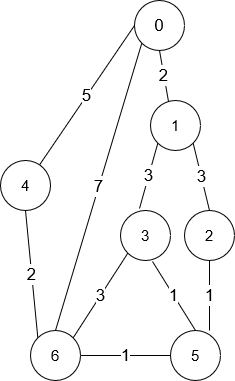
Input: n = 7, roads = [[0,6,7],[0,1,2],[1,2,3],[1,3,3],[6,3,3],[3,5,1],[6,5,1],[2,5,1],[0,4,5],[4,6,2]]
Output: 4
Explanation: The shortest amount of time it takes to go from intersection 0 to intersection 6 is 7 minutes.
The four ways to get there in 7 minutes are:
- 0 -> 6
- 0 -> 4 -> 6
- 0 -> 1 -> 2 -> 5 -> 6
- 0 -> 1 -> 3 -> 5 -> 6
Solution
The problem here is to get the number of shortest path.
Let dp[i] denote the number of shortest path from start to i in Dijkstra algorithm. Then we have
where \((j, i) \in P\) denotes j is the previous vertex in one shortest path. Please note that there may exist multiple shortest paths.
Here is the code. The type of cost should be int64_t.
struct node_t
{
    int vex;
    int64_t cost;
    node_t(int v, int64_t c) : vex(v), cost(c) {}
    bool operator<(const node_t &n) const { return cost > n.cost; }
};
class Solution {
public:
    const int MOD = 1e9 + 7;
    const int64_t INF = LLONG_MAX / 2 - 1;
    unordered_map<int, unordered_map<int, int>> graph;

    int countPaths(int n, vector<vector<int>>& roads) {
        for (auto &v : roads)
            graph[v[0]][v[1]] = graph[v[1]][v[0]] = v[2];
        return dijkstra(n, 0);
    }

    int dijkstra(int n, int start)
    {
        vector<bool> vis(n, false);
        vector<int64_t> dis(n, INF), dp(n, 0);
        dis[start] = 0, dp[start] = 1;

        priority_queue<node_t> q;
        q.emplace(start, 0);
        while (!q.empty())
        {
            int u = q.top().vex;
            q.pop();
            if (vis[u]) continue;
            vis[u] = 1;
            // graph[u][v] = c
            for (auto [v, c] : graph[u])
            {
                if (vis[v]) continue;
                if (dis[v] == dis[u] + c)
                    dp[v] = (dp[v] + dp[u]) % MOD;
                if (dis[v] > dis[u] + c)
                {
                    dp[v] = dp[u];
                    dis[v] = dis[u] + c;
                    q.emplace(v, dis[v]);
                }
            }
        }
        return dp[n - 1];
    }
};

 浙公网安备 33010602011771号