
spring依赖注入(DI)及bean的作用域
Spring配置
别名
alias 设置别名 , 为bean设置别名 , 可以设置多个别名
<!--设置别名:在获取Bean的时候可以使用别名获取-->
<alias name="userT" alias="userNew"/>
Bean的配置
<!--bean就是java对象,由Spring创建和管理-->
<!--
   id 是bean的标识符,要唯一,如果没有配置id,name就是默认标识符
   如果配置id,又配置了name,那么name是别名
   name可以设置多个别名,可以用逗号,分号,空格隔开
   如果不配置id和name,可以根据applicationContext.getBean(.class)获取对象;
class是bean的全限定名=包名+类名-->
<bean id="hello" name="hello2 h2,h3;h4" class="com.kuang.pojo.Hello">
   <property name="name" value="Spring"/>
</bean>
import
团队的合作通过import来实现 .
<import resource="{path}/beans.xml"/>
一、构造器注入
通过无参构造方法来创建
1、User.java
public class User {

   private String name;

   public User() {
       System.out.println("user无参构造方法");
  }

   public void setName(String name) {
       this.name = name;
  }

   public void show(){
       System.out.println("name="+ name );
  }

}
2、beans.xml
<?xml version="1.0" encoding="UTF-8"?>
<beans xmlns="http://www.springframework.org/schema/beans"
      xmlns:xsi="http://www.w3.org/2001/XMLSchema-instance"
      xsi:schemaLocation="http://www.springframework.org/schema/beans
       http://www.springframework.org/schema/beans/spring-beans.xsd">

   <bean id="user" class="com.kuang.pojo.User">
       <property name="name" value="kuangshen"/>
   </bean>

</beans>
3、测试类
@Test
public void test(){
   ApplicationContext context = new ClassPathXmlApplicationContext("beans.xml");
   //在执行getBean的时候, user已经创建好了 , 通过无参构造
   User user = (User) context.getBean("user");
   //调用对象的方法 .
   user.show();
}
结果可以发现,在调用show方法之前,User对象已经通过无参构造初始化了!
通过有参构造方法来创建
1、UserT . java
public class UserT {

   private String name;

   public UserT(String name) {
       this.name = name;
  }

   public void setName(String name) {
       this.name = name;
  }

   public void show(){
       System.out.println("name="+ name );
  }

}
2、beans.xml 有三种方式编写
<!-- 第一种根据index参数下标设置 -->
<bean id="userT" class="com.kuang.pojo.UserT">
   <!-- index指构造方法 , 下标从0开始 -->
   <constructor-arg index="0" value="kuangshen2"/>
</bean>

<!-- 第二种根据参数名字设置 -->
<bean id="userT" class="com.kuang.pojo.UserT">
   <!-- name指参数名 -->
   <constructor-arg name="name" value="kuangshen2"/>
</bean>

<!-- 第三种根据参数类型设置 -->
<bean id="userT" class="com.kuang.pojo.UserT">
   <constructor-arg type="java.lang.String" value="kuangshen2"/>
</bean>
3、测试
@Test
public void testT(){
   ApplicationContext context = new ClassPathXmlApplicationContext("beans.xml");
   UserT user = (UserT) context.getBean("userT");
   user.show();
}
结论:在配置文件加载的时候。其中管理的对象都已经初始化了!
二、Set注入(重点)
要求被注入的属性 , 必须有set方法 , set方法的方法名由set + 属性首字母大写 , 如果属性是boolean类型 , 没有set方法 , 是 is .
测试pojo类 :
Address.java
 public class Address {

     private String address;

     public String getAddress() {
         return address;
    }

     public void setAddress(String address) {
         this.address = address;
    }
 }
Student.java
 package com.kuang.pojo;

 import java.util.List;
 import java.util.Map;
 import java.util.Properties;
 import java.util.Set;

 public class Student {

     private String name;
     private Address address;
     private String[] books;
     private List<String> hobbys;
     private Map<String,String> card;
     private Set<String> games;
     private String wife;
     private Properties info;

     public void setName(String name) {
         this.name = name;
    }

     public void setAddress(Address address) {
         this.address = address;
    }

     public void setBooks(String[] books) {
         this.books = books;
    }

     public void setHobbys(List<String> hobbys) {
         this.hobbys = hobbys;
    }

     public void setCard(Map<String, String> card) {
         this.card = card;
    }

     public void setGames(Set<String> games) {
         this.games = games;
    }

     public void setWife(String wife) {
         this.wife = wife;
    }

     public void setInfo(Properties info) {
         this.info = info;
    }

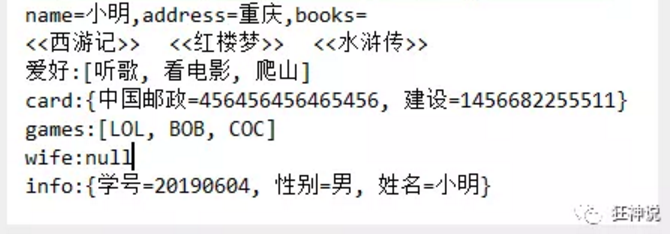
     public void show(){
         System.out.println("name="+ name
                 + ",address="+ address.getAddress()
                 + ",books="
        );
         for (String book:books){
             System.out.print("<<"+book+">>\t");
        }
         System.out.println("\n爱好:"+hobbys);

         System.out.println("card:"+card);

         System.out.println("games:"+games);

         System.out.println("wife:"+wife);

         System.out.println("info:"+info);

    }
 }
- 1、常量注入
 <bean id="student" class="com.kuang.pojo.Student">
     <property name="name" value="小明"/>
 </bean>
测试:
 @Test
 public void test01(){
     ApplicationContext context = new ClassPathXmlApplicationContext("applicationContext.xml");

     Student student = (Student) context.getBean("student");

     System.out.println(student.getName());

 }
- 2、Bean注入
注意点:这里的值是一个引用,ref
 <bean id="addr" class="com.kuang.pojo.Address">
     <property name="address" value="重庆"/>
 </bean>

 <bean id="student" class="com.kuang.pojo.Student">
     <property name="name" value="小明"/>
     <property name="address" ref="addr"/>
 </bean>
- 3、数组注入
 <bean id="student" class="com.kuang.pojo.Student">
     <property name="name" value="小明"/>
     <property name="address" ref="addr"/>
     <property name="books">
         <array>
             <value>西游记</value>
             <value>红楼梦</value>
             <value>水浒传</value>
         </array>
     </property>
 </bean>
- 4、List注入
 <property name="hobbys">
     <list>
         <value>听歌</value>
         <value>看电影</value>
         <value>爬山</value>
     </list>
 </property>
- 5、Map注入
 <property name="card">
     <map>
         <entry key="中国邮政" value="456456456465456"/>
         <entry key="建设" value="1456682255511"/>
     </map>
 </property>
- 6、set注入
 <property name="games">
     <set>
         <value>LOL</value>
         <value>BOB</value>
         <value>COC</value>
     </set>
 </property>
- 7、Null注入
 <property name="wife">
 	<null/>
 </property>
- 8、Properties注入
 <property name="info">
     <props>
         <prop key="学号">20190604</prop>
         <prop key="性别">男</prop>
         <prop key="姓名">小明</prop>
     </props>
 </property>
测试结果:
p命名和c命名注入
User.java :【注意:这里没有有参构造器!】
 public class User {
     private String name;
     private int age;

     public void setName(String name) {
         this.name = name;
    }

     public void setAge(int age) {
         this.age = age;
    }

     @Override
     public String toString() {
         return "User{" +
                 "name='" + name + '\'' +
                 ", age=" + age +
                 '}';
    }
 }
1、P命名空间注入 : 需要在头文件中加入约束文件
导入约束 : xmlns:p="http://www.springframework.org/schema/p"
导入约束 : xmlns:c="http://www.springframework.org/schema/c"
解决:把有参构造器加上,这里也能知道,c 就是所谓的构造器注入!
测试代码:
 @Test
 public void test02(){
     ApplicationContext context = new ClassPathXmlApplicationContext("applicationContext.xml");
     User user = (User) context.getBean("user");
     System.out.println(user);
 }
Bean的作用域
在Spring中,那些组成应用程序的主体及由Spring IoC容器所管理的对象,被称之为bean。简单地讲,bean就是由IoC容器初始化、装配及管理的对象 .
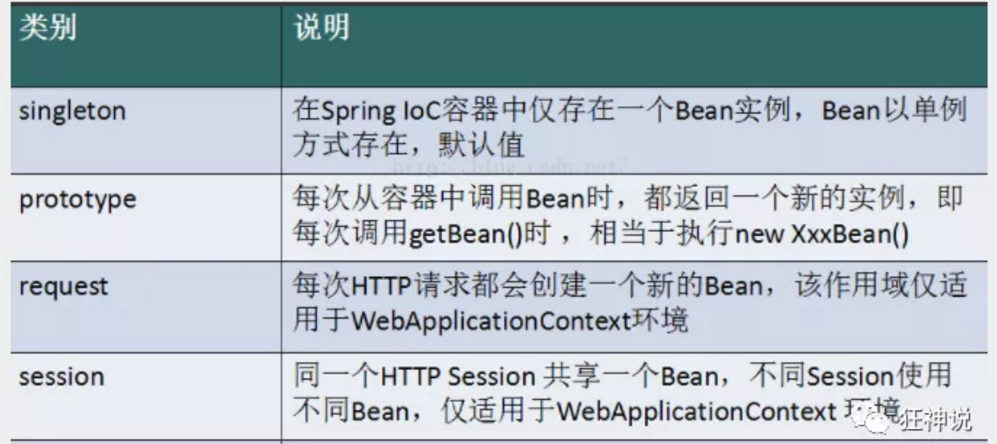
几种作用域中,request、session作用域仅在基于web的应用中使用(不必关心你所采用的是什么web应用框架),只能用在基于web的Spring ApplicationContext环境。
Singleton
当一个bean的作用域为Singleton,那么Spring IoC容器中只会存在一个共享的bean实例,并且所有对bean的请求,只要id与该bean定义相匹配,则只会返回bean的同一实例。Singleton是单例类型,就是在创建起容器时就同时自动创建了一个bean的对象,不管你是否使用,他都存在了,每次获取到的对象都是同一个对象。注意,Singleton作用域是Spring中的缺省作用域。要在XML中将bean定义成singleton,可以这样配置:
<bean id="ServiceImpl" class="cn.csdn.service.ServiceImpl" scope="singleton">
测试:
 @Test
 public void test03(){
     ApplicationContext context = new ClassPathXmlApplicationContext("applicationContext.xml");
     User user = (User) context.getBean("user");
     User user2 = (User) context.getBean("user");
     System.out.println(user==user2);
 }
Prototype
当一个bean的作用域为Prototype,表示一个bean定义对应多个对象实例。Prototype作用域的bean会导致在每次对该bean请求(将其注入到另一个bean中,或者以程序的方式调用容器的getBean()方法)时都会创建一个新的bean实例。Prototype是原型类型,它在我们创建容器的时候并没有实例化,而是当我们获取bean的时候才会去创建一个对象,而且我们每次获取到的对象都不是同一个对象。根据经验,对有状态的bean应该使用prototype作用域,而对无状态的bean则应该使用singleton作用域。在XML中将bean定义成prototype,可以这样配置:
 <bean id="account" class="com.foo.DefaultAccount" scope="prototype"/>
  或者
 <bean id="account" class="com.foo.DefaultAccount" singleton="false"/>
Request
当一个bean的作用域为Request,表示在一次HTTP请求中,一个bean定义对应一个实例;即每个HTTP请求都会有各自的bean实例,它们依据某个bean定义创建而成。该作用域仅在基于web的Spring ApplicationContext情形下有效。考虑下面bean定义:
<bean id="loginAction" class=cn.csdn.LoginAction" scope="request"/>
针对每次HTTP请求,Spring容器会根据loginAction bean的定义创建一个全新的LoginAction bean实例,且该loginAction bean实例仅在当前HTTP request内有效,因此可以根据需要放心的更改所建实例的内部状态,而其他请求中根据loginAction bean定义创建的实例,将不会看到这些特定于某个请求的状态变化。当处理请求结束,request作用域的bean实例将被销毁。
Session
当一个bean的作用域为Session,表示在一个HTTP Session中,一个bean定义对应一个实例。该作用域仅在基于web的Spring ApplicationContext情形下有效。考虑下面bean定义:
<bean id="userPreferences" class="com.foo.UserPreferences" scope="session"/>
针对某个HTTP Session,Spring容器会根据userPreferences bean定义创建一个全新的userPreferences bean实例,且该userPreferences bean仅在当前HTTP Session内有效。与request作用域一样,可以根据需要放心的更改所创建实例的内部状态,而别的HTTP Session中根据userPreferences创建的实例,将不会看到这些特定于某个HTTP Session的状态变化。当HTTP Session最终被废弃的时候,在该HTTP Session作用域内的bean也会被废弃掉。

 浙公网安备 33010602011771号