
大数据—Java面向对象
 1 * 类中方法的声明测试
 2  * 1. 之前用过的一些方法:
 3  *  Scanner类的nextInt() \ next()
 4  *  Math类的random() \ sqrt(double d)
 5  *  Arrays类的equals(int[] arr1,int[] arr2) \ toString(int[] arr) \ sort(int[] arr)
 6  *           \ binarySearch(int[] arr,int value)
 7  *
 8  * 2. 类中方法声明的格式:
 9  *   权限修饰符  返回值类型  方法名(形参列表){
10  *          方法体
11  *   }
12  *   说明:关于方法中的特殊关键字:static\final\abstract\...暂时先不考虑。
13  *
14  * 3. 方法声明的详细说明:
15  *   3.1 权限修饰符:指名当前方法被调用权限的大小。
16  *       涉及到的权限修饰符有:private 、 缺省 、 protected 、 public。 详细细节见《封装性》
17  *       目前,大家在声明方法时,默认使用public即可。
18  *   3.2  返回值类型 :
19  *       > 可以分为:有具体的返回值类型  vs  没有返回值类型:void
20  *       > 有具体的返回值类型,可以使用任何的变量类型。比如:基本数据类型、引用数据类型
21  *       > 有具体的返回值类型的方法,在调用方法结束后,一定要返回满足要求的返回值类型的变量或常量
22  *     补充:return的使用:
23  *         在有具体返回值类型的方法中,一定需要使用“return + 变量/常量”的方法给方法返回指定的数据。
24  *         如果方法没有返回值类型,也可以使用"return;"结构,表示结束当前方法的执行。
25  *
26  *    3.3 方法名:属于标识符,命名时满足标识符命名的规则和规范。“见名知意”
27  *    3.4 形参列表:
28  *      格式:参数类型1 参数名1,参数类型2,参数名2,...
29  *      方法在声明时,不要给形参列表的变量赋值。当我们调用方法时,才给形参列表赋值:实参。
30  *    3.5 方法体:执行方法时,主要操作的逻辑。
31
32   * 4. 如何确定定义一个方法时,要不要声明返回值类型?要不要声明形参?
33  *    ① 看题目要求。
34  *    ② 具体问题具体分析。
代码演示
 1 public class PersonTest {
 2     public static void main(String[] args) {
 3         Person p = new Person();
 4         p.printNumber();
 5         int hour = 8;
 6         p.sleep(hour);
 7
 8         System.out.println("##############");
 9         p.eat();
10
11     }
12 }
13
14 class Person{
15     String name;
16     int age;
17     Account acct;
18
19     public void printNumber(){
20
21         for(int i = 0;i < 100;i++){
22             if(i == 40){
23                 return;//用于结束方法
24             }
25             System.out.println(i);
26         }
27
28         System.out.println("hello!");
29     }
30
31     public Account getAccount(){
32         boolean flag = true;
33         if(flag){
34             return null;
35         }
36
37         return new Account();
38
39     }
40
41     public int getValue(){
42         return 1;
43 //        return age;
44     }
45
46     public void sleep(int hour){
47         System.out.println("昨天睡了" + hour + "小时");
48     }
49
50     public void eat(){
51         System.out.println("人需要吃饭,补充营养");
52         System.out.println("name = " + name);
53
54         sleep(10);
55
56 //        eat();
57
58     }
59
60 }
61
62 class Account{//账户
63
64 }
补充说明
* 5. > 可以在当前类的方法中使用当前类定义的属性或其他的方法
* > 方法内不能定义新的方法。
课后练习
 1 /**
 2  * 2.利用面向对象的编程方法,设计类Circle计算圆的面积。
 3  *
 4  * @author shkstart
 5  * @create 2020-07-01 11:37
 6  */
 7 public class CircleTest {
 8
 9     public static void main(String[] args) {
10         Circle c1 = new Circle();
11
12         c1.radius = 1.2;
13         //对应方式一
14 //        double area = c1.findArea();
15 //        System.out.println("圆的半径为:" + c1.radius + ",面积为:" + area);
16
17         //对应方式二:
18         c1.findArea();
19     }
20
21 }
22
23 class Circle{//圆
24     double radius;//半径
25
26     //求圆的面积的方法
27     //方式一:
28 //    public double findArea(){
29 //        return Math.PI * radius * radius;
30 //    }
31     //方式二:
32     public void findArea(){
33         System.out.println(Math.PI * radius * radius);
34     }
35
36     //错误的:
37 //    public double findArea(double r){
38 //        return Math.PI * r * r;
39 //    }
40
41
42 }
1 * 1. 什么是方法的重载?同一个类中,相同方法名,不同参数列表的方法之间构成重载。
2  *
3  *   “两同一不同”:同一个类,相同方法名;参数个数 或 参数类型不同
4  *
5  * 2. 方法的重载与权限修饰符、返回值类型、形参名没有关系!
代码演示
 1 public class OverLoadTest {
 2     public static void main(String[] args) {
 3         OverLoadTest test = new OverLoadTest();
 4         test.show();
 5
 6         test.show(1,2);
 7     }
 8
 9     public void show(){
10         System.out.println("hello");
11     }
12     public void show(int a){
13         System.out.println("萨瓦迪卡");
14     }
15
16      void show(String info){
17         System.out.println(info);
18     }
19     public int show(int i,int j){
20         return i + j;
21     }
22     private void show(int i,String info){
23
24     }
25     public void show(String info,int i){
26
27     }
28 //    public void show(String info1,int j){
29 //
30 //    }
31
32 //    public String show(String info,int i){
33 //          return info + i;
34 //    }
35
36
37
38 }
重点
1 * 3. 我们在调用类中的方法时,是如何确定调用的是某一个确定的方法呢?
2  *    通过方法名确定  ---> 进一步通过形参列表确定
 1 /**
 2  *  可变形参方法的使用
 3  *
 4  *  1. JDK5.0新增的特性。
 5  *  2. 格式为:形参类型 ... 形参名
 6  *  3. 当调用可变形参的方法时,实参可以为0个,1个,2个,。。。
 7  *  4. 可变形参的方法与方法同名的其他方法之间构成重载(排除第5点)
 8  *  5. 一个类中,不能同时出现可变形参的方法 和 与其方法名相同且可变形参类型相同的数组的方法。
 9  *  6. 如果一个方法中声明有可变形参,则可变形参一定声明在方法参数的最后。
10  *  7. 一个方法的形参中,最多声明一个可变个数的形参结构。
11  *
12  *
13  * @author shkstart
14  * @create 2020-07-01 14:59
15  */
16 public class ArgsTest {
17     public static void main(String[] args) {
18
19 //        int[] arr = new int[0];
20
21         ArgsTest test = new ArgsTest();
22 //        test.show();
23 //        test.show("abc");
24         test.show("abc","123","xyz");
25 //
26         test.show(new String[]{"abc","def"});
27     }
28
29     public void show(){
30         System.out.println("show()");
31     }
32     public void show(String s){
33         System.out.println("show(String s)");
34     }
35
36     public void show(int i){
37         System.out.println("show(int i)");
38     }
39
40     public void show(String ... info){
41         System.out.println("show(String ... info)");
42         for(int i = 0;i < info.length;i++){
43             System.out.println(info[i]);
44         }
45     }
46
47 //    public void show(String[] info){
48 //          for(int i = 0;i < info.length;i++){
49 //                System.out.println(info[i]);
50 //          }
51 //    }
52
53     //错误的
54 //    public void show(String ... info,String i){
55 //
56 //    }
57
58
59 }
* 1. 如果传递的是基本数据类型的变量,则将变量本身保存的数据值传递过去
* 2. 如果传递的是引用数据类型的变量,则将变量本身保存的地址值传递过去
 1 public class VariableTest {
 2
 3     public static void main(String[] args) {
 4         int m = 10;
 5         //对于基本数据类型变量来说:
 6         int n = m;
 7         n = 20;
 8         System.out.println("m = " + m);//10
 9
10         //对于引用数据类型变量来说:
11         Order o1 = new Order();
12         o1.num = 10;
13         //
14         Order o2 = o1;
15         o2.num = 20;
16
17         System.out.println("o1.num = " + o1.num);
18
19         //
20         int[] array1 = new int[]{2,3,5,7,11};
21         int[] array2 = array1;
22         array2[0] = 0;
23         System.out.println(array1[0]);//0
24
25     }
26 }
27 class Order{
28     int num;
29 }
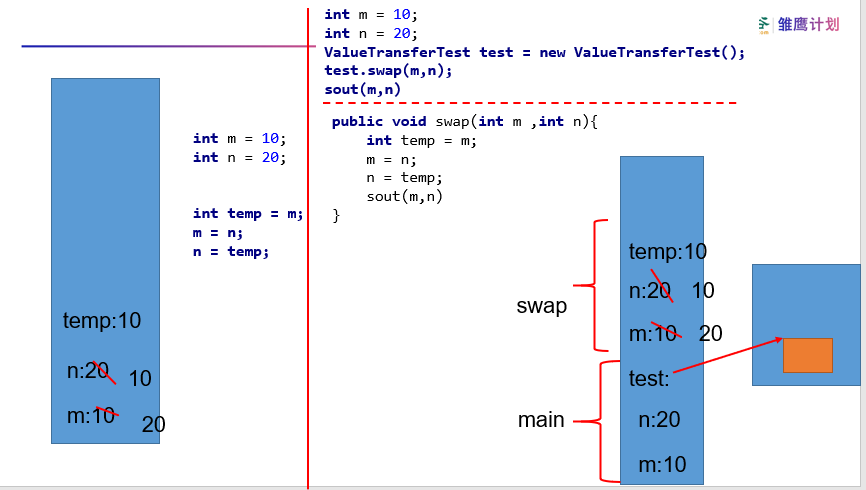
* 1. 形参:方法声明时,小括号内的参数。
* 实参:方法调用时,实际传递给形参的数据
*
* 2. 如果方法的形参是基本数据类型的变量,则将实参保存的数据值传递给形参变量。
* 如果方法的形参是引用数据类型的变量,则将实参保存的地址值传递给形参变量。
基本数据类型
 1 public class ValueTransferTest {
 2     public static void main(String[] args) {
 3         int m = 10;
 4         int n = 20;
 5
 6         System.out.println("m = " + m + ", n = " + n);
 7
 8         //交换两个变量的值
 9 //        int temp = m;
10 //        m = n;
11 //        n = temp;
12         ValueTransferTest test = new ValueTransferTest();
13         test.swap(m,n);
14
15         System.out.println("m = " + m + ", n = " + n);
16     }
17
18     public void swap(int m ,int n){
19         int temp = m;
20         m = n;
21         n = temp;
22     }
23 }
对应图示
引用数据类型
 1 public class ValueTransferTest1 {
 2
 3     public static void main(String[] args) {
 4         Data data = new Data();
 5         data.m = 10;
 6         data.n = 20;
 7         System.out.println("m = " + data.m +", n = " + data.n);
 8
 9         //交换的操作
10         ValueTransferTest1 test = new ValueTransferTest1();
11         test.swap(data);
12         System.out.println("m = " + data.m +", n = " + data.n);
13
14         System.out.println(data);//com.atguigu.java1.Data@1540e19d
15
16 //        User user = data;
17     }
18
19     public void swap(Data data1){
20         int temp = data1.m ;
21         data1.m = data1.n;
22         data1.n = temp;
23     }
24 }
25 class Data{
26     int m ;
27     int n;
28 }
29
30 class User{
31
32 }
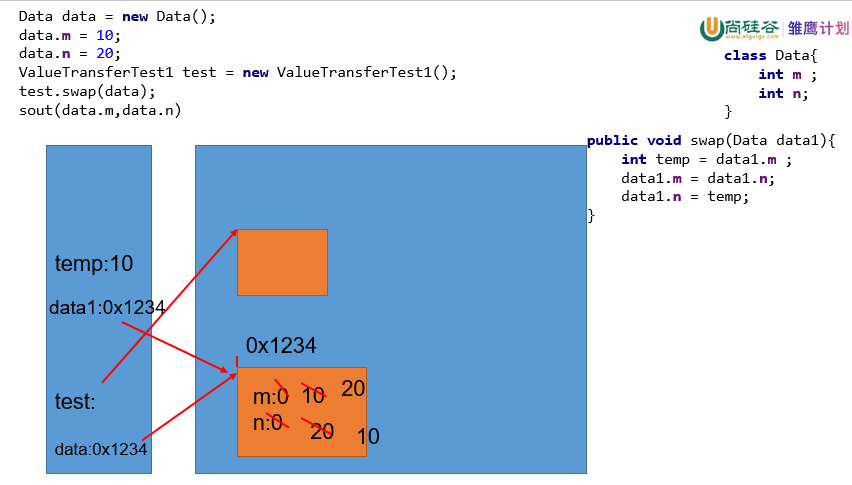
 1 /**
 2  * @author shkstart
 3  * @create 2020-07-01 16:23
 4  */
 5 public class ValueTransferTest2 {
 6
 7     public static void main(String[] args) {
 8
 9         int[] arr = new int[]{34, 4, 2, 6, 6, 4, 7, -87, 0, 55, 98};
10
11         System.out.println(Arrays.toString(arr));
12
13         ValueTransferTest2 test = new ValueTransferTest2();
14         test.sort(arr, "ascend");
15
16         System.out.println(Arrays.toString(arr));
17
18     }
19
20     public void sort(int[] arr, String sortMethod) {
21         if ("ascend".equals(sortMethod)) {//从小到大
22             for (int i = 0; i < arr.length - 1; i++) {
23                 for (int j = 0; j < arr.length - 1 - i; j++) {
24                     if (arr[j] > arr[j + 1]) {
25                         //最初的写法:正确
26 //                        int temp = arr[j];
27 //                        arr[j] = arr[j + 1];
28 //                        arr[j + 1] = temp;
29                         //错误的写法
30 //                        swap(arr[j], arr[j + 1]);
31                         //正确的写法
32                         swap(arr,j,j+1);
33                     }
34                 }
35             }
36
37         } else if ("descend".equals(sortMethod)) {//从大到小
38             for (int i = 0; i < arr.length - 1; i++) {
39                 for (int j = 0; j < arr.length - 1 - i; j++) {
40                     if (arr[j] < arr[j + 1]) {
41                         //最初的写法:正确
42 //                        int temp = arr[j];
43 //                        arr[j] = arr[j + 1];
44 //                        arr[j + 1] = temp;
45                         //错误的写法
46 //                        swap(arr[j], arr[j + 1]);
47                         //正确的写法
48                         swap(arr,j,j+1);
49                     }
50                 }
51             }
52         } else {
53             System.out.println("排序方式错误!");
54         }
55     }
56
57 //    public void swap(int i,int j){
58 //        int temp = i;
59 //        i = j;
60 //        j = temp;
61 //    }
62
63     public void swap(int[] arr, int i, int j) {
64         int temp = arr[i];
65         arr[i] = arr[j];
66         arr[j] = temp;
67     }
68 }
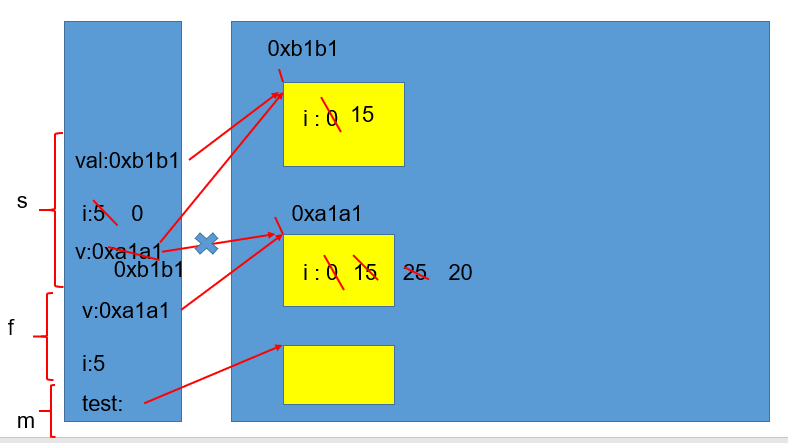
 1 public class TransferTest3 {
 2     public static void main(String args[]) {
 3         TransferTest3 test = new TransferTest3();
 4         test.first();
 5     }
 6     public void first() {
 7         int i = 5;
 8         Value v = new Value();
 9         v.i = 25;
10         second(v, i);
11         System.out.println(v.i);
12     }
13     public void second(Value v, int i) {
14         i = 0;
15         v.i = 20;
16         Value val = new Value();
17         v = val;
18         System.out.println(v.i + " " + i);
19     }
20 }
21
22 class Value {
23     int i = 15;
24 }
对应的图示:
 1 /**
 2  *  关于面向对象内容中的NullPointerException的说明:
 3  *  凡是引用数据类型的变量(对象、数组),如果取值为null时,通过此变量调用其内部结构的话,一定就是
 4  *  NullPointerException的异常。
 5  *
 6  * @author shkstart
 7  * @create 2020-07-01 9:15
 8  */
 9 public class NullPointerExceptionTest {
10     public static void main(String[] args) {
11         User u1 = new User();
12 //        u1 = null;
13 //        u1.name = "孔江江";
14 //        u1.show();
15         System.out.println(u1.name);
16 //        System.out.println(u1.name.toString());
17     }
18 }
19
20 class User{
21     String name;
22     int age;
23     public void show(){
24         String str = null;
25         System.out.println("我是一个用户");
26     }
27 }
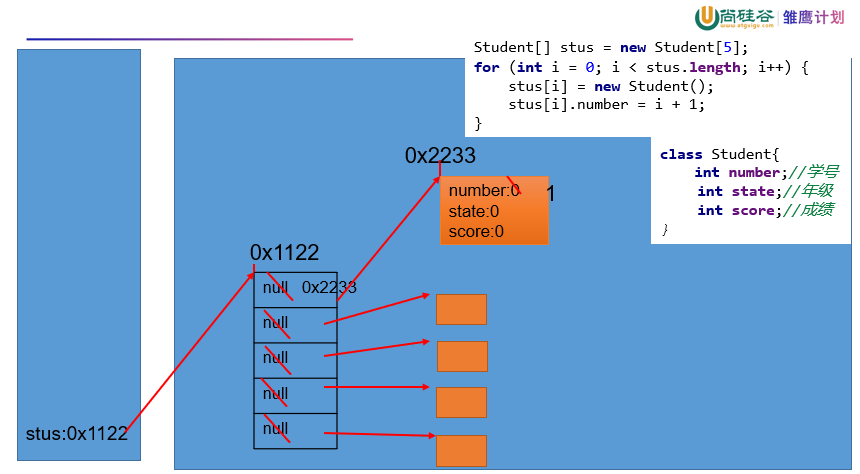
 1 /**
 2  * 定义类Student,包含三个属性:学号number(int),年级state(int),成绩score(int)。
 3  * 创建20个学生对象,学号为1到20,年级和成绩都由随机数确定。
 4  * 问题一:打印出3年级(state值为3)的学生信息。
 5  * 问题二:使用冒泡排序按学生成绩排序,并遍历所有学生信息
 6  *
 7  * 提示:
 8  * 1) 生成随机数:Math.random(),返回值类型double;
 9  * 2) 四舍五入取整:Math.round(double d),返回值类型long。
10  *
11  * @author shkstart
12  * @create 2020-07-01 11:56
13  */
14 public class StudentArrayTest {
15     public static void main(String[] args) {
16         int[] arr = new int[10];
17         String[] arr1 = new String[10];
18
19 //      创建20个学生对象
20         Student[] stus = new Student[20];//虚位以待
21         for (int i = 0; i < stus.length; i++) {
22             stus[i] = new Student();
23             //给每一个学生的属性赋值
24             //学号
25             stus[i].number = i + 1;
26             //年级:1-6
27             stus[i].state = (int)(Math.random() * 6 + 1);
28             //成绩:0-100
29             stus[i].score = (int)(Math.random() * 101);
30         }
31
32         //问题一:打印出3年级(state值为3)的学生信息。
33 //        for (int i = 0; i < stus.length; i++) {
34 //            if(stus[i].state == 3){
35 //                stus[i].info();
36 //            }
37 //        }
38         //问题二:使用冒泡排序按学生成绩排序,并遍历所有学生信息
39         for(int i = 0;i < stus.length - 1;i++){
40             for(int j = 0;j < stus.length - 1 - i;j++){
41                 if(stus[j].score > stus[j + 1].score){
42                     Student temp = stus[j];
43                     stus[j] = stus[j + 1];
44                     stus[j + 1] = temp;
45                 }
46             }
47         }
48
49         for (int i = 0; i < stus.length; i++) {
50             stus[i].info();
51         }
52     }
53 }
54
55 class Student{
56     int number;//学号
57     int state;//年级
58     int score;//成绩
59
60     public void info(){
61         System.out.println("number : " + number + ", state : " + state + ", score : " + score);
62     }
63 }
对应的内存解析

 浙公网安备 33010602011771号