【数据结构和算法】之栈
一、概念
- 栈是一种“操作受限”的线性表
- 当某个数据集合只涉及在一端插入和删除数据,并且满足后进先出、先进后出的特性,我们就应该首选“栈”这种数据结构。
二、栈的类型
栈既可以用数组来实现,也可以用链表来实现。
- 顺序栈:用数组实现的栈
- 链式栈:用链表实现的栈
三、时间和空间复杂度
时间复杂度
入栈:O(1)
出栈:O(1)
四、算法应用
1、栈在函数调用中的应用


 int main() {
        int a = 1;
        int ret = 0;
        int res = 0;
        ret = add(3, 5);
        res = a + ret;
        printf("%d", res);
        reuturn 0;
    }

    int add(int x, int y) {
        int sum = 0;
        sum = x + y;
        return sum;
    }
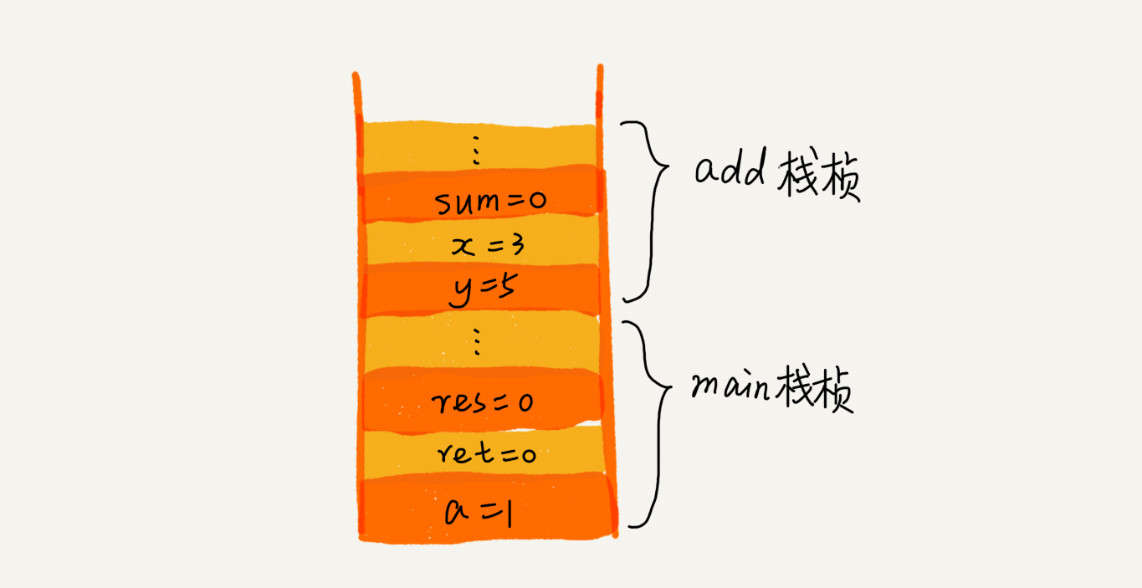
从代码中我们可以看出,main() 函数调用了 add() 函数,获取计算结果,并且与临时变量 a 相加,最后打印 res 的值。为了让你清晰地看到这个过程对应的函数栈里出栈、入栈的操作,我画了一张图。图中显示的是,在执行到 add() 函数时,函数调用栈的情况。
2、栈在表达式求值中的应用
我们再来看栈的另一个常见的应用场景,编译器如何利用栈来实现表达式求值。
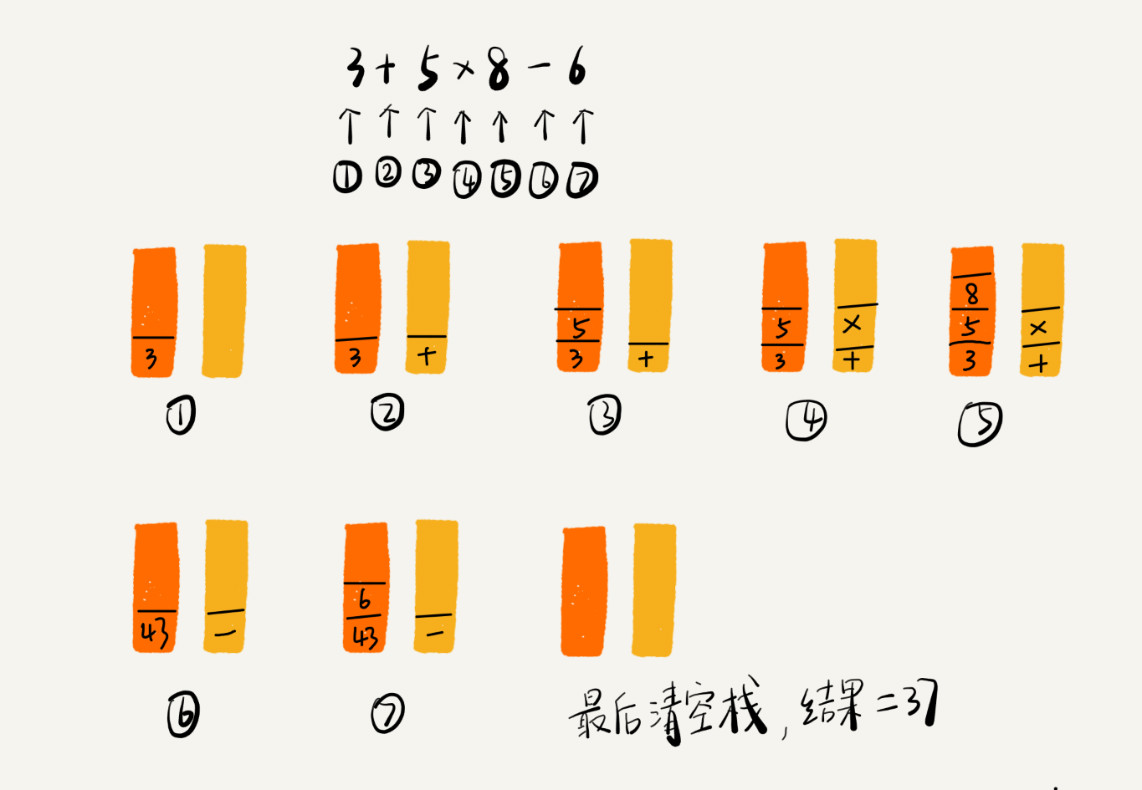
编译器就是通过两个栈来实现的。其中一个保存操作数的栈,另一个是保存运算符的栈。我们从左向右遍历表达式,当遇到数字,我们就直接压入操作数栈;当遇到运算符,就与运算符栈的栈顶元素进行比较。
如果比运算符栈顶元素的优先级高,就将当前运算符压入栈;如果比运算符栈顶元素的优先级低或者相同,从运算符栈中取栈顶运算符,从操作数栈的栈顶取 2 个操作数,然后进行计算,再把计算完的结果压入操作数栈,继续比较。
将 3+5*8-6 这个表达式的计算过程画成了一张图,你可以结合图来理解我刚讲的计算过程。
3、栈在括号匹配中的应用
我们同样简化一下背景。我们假设表达式中只包含三种括号,圆括号 ()、方括号[]和花括号{},并且它们可以任意嵌套。比如,{[] ()[{}]}或[{()}([])]等都为合法格式,而{[}()]或[({)]为不合法的格式。那我现在给你一个包含三种括号的表达式字符串,如何检查它是否合法呢?这里也可以用栈来解决。我们用栈来保存未匹配的左括号,从左到右依次扫描字符串。当扫描到左括号时,则将其压入栈中;当扫描到右括号时,从栈顶取出一个左括号。如果能够匹配,比如“(”跟“)”匹配,“[”跟“]”匹配,“{”跟“}”匹配,则继续扫描剩下的字符串。如果扫描的过程中,遇到不能配对的右括号,或者栈中没有数据,则说明为非法格式。当所有的括号都扫描完成之后,如果栈为空,则说明字符串为合法格式;否则,说明有未匹配的左括号,为非法格式。
五、栈的实现
1、数组栈
/**
 * count 充当计数,也充当了栈的指针
 **/
public class ArrayStack {

    public static void main(String[] args) {
        ArrayStack arrayStack = new ArrayStack(10);
        arrayStack.putData(1);
        arrayStack.putData(2);
        arrayStack.putData(3);
        arrayStack.putData(4);
        arrayStack.putData(5);
        arrayStack.putData(6);
        arrayStack.putData(7);
        arrayStack.putData(8);
        arrayStack.putData(9);
        arrayStack.putData(10);
        try {
            arrayStack.putData(11);
        }catch (Exception e){
            e.printStackTrace();
            System.out.println("栈满");
        }


        for(int i=0;i<10;i++){
            System.out.println(arrayStack.pollData());
        }

        try {
            arrayStack.pollData();
        }catch (Exception e){
            e.printStackTrace();
            System.out.println("栈空");
        }


    }


    //容量
    private int capacity;
    //存储栈的数据
    private int[] tab;
    //栈元素个数 && 担任栈的指针角色
    private int count;

    public ArrayStack(int capacity){
        this.capacity =capacity;
        this.count=0;
        this.tab = new int[capacity];

    }


    /**
     * 向栈中放入一个元素
     * @param data
     */
    public void putData(int data){
        //判断栈是否已经满了
        if(this.count == this.capacity){
            throw new IllegalArgumentException("栈满");
        }
        //放入元素
        tab[count++]=data;

    }


    public int pollData(){
        //判断栈已经是空的了
        if(this.count == 0){
            throw new IllegalArgumentException("栈空");
        }
       return tab[--count];

    }


}
2、链表栈
/**
 * 链表栈:尾巴节点进队,尾巴节点出队
 *
 **/
public class LinkStack {

    public static void main(String[] args) {
        LinkStack linkStack = new LinkStack(10);
        linkStack.putData(1);
        linkStack.putData(2);
        linkStack.putData(3);
        linkStack.putData(4);
        linkStack.putData(5);
        linkStack.putData(6);
        linkStack.putData(7);
        linkStack.putData(8);
        linkStack.putData(9);
        linkStack.putData(10);

        try {
            linkStack.putData(11);
        }catch (Exception e){
            e.printStackTrace();
            System.out.println("栈满");
        }


        for(int i=0;i<10;i++){
            System.out.println(linkStack.popData());
        }

        try {
            linkStack.popData();
        }catch (Exception e){
            e.printStackTrace();
            System.out.println("栈空");
        }
    }


    private final Node nodeTag = new Node(-1);
    private int capacity;
    private Node head;
    private Node tail;
    private int count;


    public LinkStack(int capacity){
        this.capacity = capacity;
        this.head=this.tail = nodeTag;
        this.count=0;
    }

    /**
     * 向栈中加入元素
     * @param data
     */
    public void putData(int data){
        if(count==capacity){
            throw new IllegalArgumentException("栈满");
        }

        Node node = new Node(data);

        if(head==tail){
            head.next=node;
            node.pre=head;
            this.tail=node;
        }else{
            this.tail.next=node;
            node.pre=this.tail;
            this.tail=node;
        }
        count++;
    }

    /**
     * 从栈中弹出元素
     * @return
     */
    public int popData(){
        if(count==0){
            throw new IllegalArgumentException("栈空");
        }
        int result;
        if(tail.pre == nodeTag){
            //表示,栈中只有一个元素
            result = this.tail.value;
            this.head.next = null;
            this.tail = this.head;
        }else{
            result = this.tail.value;
            Node pre = this.tail.pre;
            pre.next=null;
            this.tail.pre=null;
            this.tail = pre;
        }
        this.count--;
        return result;
    }


    private static class Node{
        private Node pre;
        private Node next;
        private int value;

        public Node(int value){
            this.value=value;
        }
    }
}
3、数组双栈
/**
 * leftIndex 和 rightIndex 的指向,都是在左栈 和 右栈 认为当前位置待存储数据的位置
 * =>左栈空:leftIndex==0                 左栈满:leftIndex>rightIndex
 * =>右栈空:rightIndex = tab.length-1    右栈满:rightIndex<leftIndex
 * 案例没有对数据进行清空,是基于指针移动的覆盖形式完成数据的正确性。这个在实际应用时需要注意。
 **/
public class DoubleStack {

    public static void main(String[] args) {
        DoubleStack doubleStack = new DoubleStack(10);
        doubleStack.putLeftData(1);
        doubleStack.putLeftData(2);
        doubleStack.putLeftData(3);
        doubleStack.putLeftData(4);
        doubleStack.putLeftData(5);
        doubleStack.putLeftData(6);


        doubleStack.putRightData(7);
        doubleStack.putRightData(8);
        doubleStack.putRightData(9);
        doubleStack.putRightData(10);

        try {
            doubleStack.putLeftData(11);
        }catch (Exception e){
            System.out.println("左栈满");
        }

        try {
            doubleStack.putRightData(12);
        }catch (Exception e){
            System.out.println("右栈满");
        }

        //弹栈
        for(int i=0;i<6;i++){
            System.out.println( doubleStack.popLeftData());
        }

        //弹栈
        for(int i=0;i<4;i++){
            System.out.println( doubleStack.popRightData());
        }


        //栈空
        try {
            doubleStack.popLeftData();
        }catch (Exception e){
            System.out.println("左栈空");
        }


        //栈空
        try {
            doubleStack.popRightData();
        }catch (Exception e){
            System.out.println("右栈空");
        }
    }


    /**
     * 存放数据的空间
     */
    private int[] tab;
    /**
     * 双栈共享的容量
     */
    private int capacity;
    /**
     * 左栈的索引
     */
    private int leftIndex;
    /**
     * 右栈的索引
     */
    private int rightIndex;


    public DoubleStack(int capacity ){
        if(capacity<=0){
            throw new IllegalArgumentException("参数异常");
        }
        this.capacity = capacity;
        this.tab = new int[this.capacity];
        this.leftIndex = 0;
        this.rightIndex = this.tab.length-1;
    }


    /**
     * 向左栈加入数据
     * @param data
     */
    public void putLeftData(int data){
        //step1:判断栈满
        if(leftIndex>rightIndex){
            throw new IllegalArgumentException("左栈满");
        }
        //step2:设置相应的数值
        tab[leftIndex++]=data;
    }

    /**
     * 从左栈弹出数据
     * @return
     */
    public int popLeftData(){
        if(leftIndex==0){
            throw  new IllegalArgumentException("左栈空");
        }
        return tab[--leftIndex];
    }

    /**
     * 向右栈加入数据
     * @param data
     */
    public void putRightData(int data){
        //step1:判断栈满
        if(rightIndex<leftIndex){
            throw  new IllegalArgumentException("右栈满");
        }
        tab[rightIndex--]=data;
    }

    /**
     * 从右栈弹出数据
     * @return
     */
    public int popRightData(){
        if(rightIndex==tab.length-1){
            throw  new IllegalArgumentException("右栈空");
        }
        return tab[++rightIndex];
    }


}

 浙公网安备 33010602011771号