Definitin clarify: Precison, Resolution, Accuracy
Quote from here: (part of it)
Precision, Accuracy, and Resolution
Too many people use the terms "precision" and "accuracy" interchangeably. They shouldn't. Precision and accuracy are completely different concepts. Let's explore what they really mean, and how to tell the difference. While we're at it, we will also throw in "resolution", which is also too-often confused with precision.
This article first distinguishes between resolution and precision, then between precision and accuracy. In each case, we will start with an example chosen to make the point clear, then take one or two examples from clubmaking measurement to show why it's important to clubmakers.
Precision vs Resolution
First the definitions:
- Resolution is the fineness to which an instrument can be read.
- Precision is the fineness to which an instrument can be read repeatably and reliably.
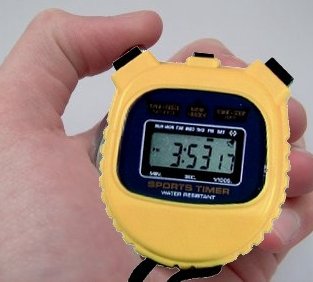
| There is a difference. Let's see it with an example. Here are two stopwatches. One is analog and the other is digital. Both are manually actuated; this is an important point in the distinction. First, let's look at the resolution of the two stopwatches:
What about the precision? Precision is reliable, repeatable measurement. The total measurement system includes the human that activates the watch in either case. And experiments have shown that a human takes about 1/10 of a second to react to a stimulus and turn it into a button press. So...
|
 |
 |
This raises an important point. The advent of digital instrumentation gave rise to a mindset that equated resolution with precision. Digital readouts make it very easy to see what the resolution of an instrument was. Most people simply assume, "Hey, the guys who designed this made it to read to five digits, so it must be good to five digits!" Whatever "good" means. Resolution? Yes. Precision? Well, maybe.
How about a few real-life examples from clubmaker's instruments.
Digital Scales
In my article about testing digital scales, I warn about measuring the same weight twice in a row. That is because some manufacturers of digital scales realized that their precision was not up to their resolution. For instance, the resolution might be 1 gram; but they were not able, without significant added expense, to get the precision below 3 grams. Instead of cutting the resolution to 3 grams -- which would also be honest but expensive-- and potentially confusing -- they just left the resolution at one gram.
But they realized that customers might be annoyed by discovering this unfortunate fact of life. So they came up with a "cheater circuit" that recognizes if the load being weighed is within 3 grams (or maybe 5 grams, just to be safe) of the last thing weighed. If so, then just display the previous answer, instead of what you actually got this time. So, if you are trying to determine the repeatability of your scale, be sure to "cleanse the palate" with a completely different weight between weighings.
Frequency Meter
Typically, a clubmaker's frequency meter has a resolution of 1cpm. But John Kaufman has made a version of his very successful Club Scout frequency meter, with a resolution of 1/10 of a cpm (0.1cpm). It is reasonable to ask, what is its precision?
John has assured us that he does indeed get repeatable readings to 0.1cpm, and I believe him. It isn't hard to build electronics to do this. But I also believe him when he says that technique and setup must be watched when you're trying to attain this precision. Think about things like:
- The stability of the clamp, and the bench to which it is mounted.
- The repeatability of the clamp to the same pressure each time a shaft is clamped.
- The repeatability of your technique for pulling and releasing the shaft.
- The security with which the tip weight (or clubhead) is attached to the shaft.
Any of these could be perfectly good for a precision of 1cpm, but might introduce fluctuating readings with a resolution of 0.1cpm. In order to achieve the resolution that John has built into the electronics, your clamp, bench, and technique must be good for 0.1cpm repeatability.
Accuracy vs Precision
It's not hard to wrap your mind around repeatability, which is the difference between resolution and precision. The difference between precision and accuracy is correctness -- and that is sometimes a little harder to cope with. To make it easier, we'll use a very graphic example [1].
 Imagine you have a rifle with a telescopic sight. When you shoot with it, you get a pattern like the one at the left. Not very good. Imagine you have a rifle with a telescopic sight. When you shoot with it, you get a pattern like the one at the left. Not very good.So you decide there is something wrong with your telescopic sight. You get better optics -- sharper, and greater magnification. Does that solve the problem? |
 No it does not! You now have a much tighter distribution. But, on average, you're just as far from the bull's eye. The real problem was not that the scope did not show the target well enough; the scope was aligned wrong. No it does not! You now have a much tighter distribution. But, on average, you're just as far from the bull's eye. The real problem was not that the scope did not show the target well enough; the scope was aligned wrong.One way of expressing it is, "You have greatly improved the precision, but the accuracy did not get better." That is:
|
 OK, so we can improve precision without improving accuracy. Does it work the other way, too? Can we improve accuracy without improving precision? OK, so we can improve precision without improving accuracy. Does it work the other way, too? Can we improve accuracy without improving precision?We can, as this picture shows. If, instead of working on the optics of the sighting scope, we had just aligned it properly, here's the pattern we would have gotten. No improvement in precision, but plenty of improved accuracy. |
 Finally, just to complete the picture, here's high accuracy with high precision. This would result from working on both the alignment and the optics. Finally, just to complete the picture, here's high accuracy with high precision. This would result from working on both the alignment and the optics. |
On to the promised examples from clubmaking instrumentation.


 浙公网安备 33010602011771号