// 一元二次方程求解
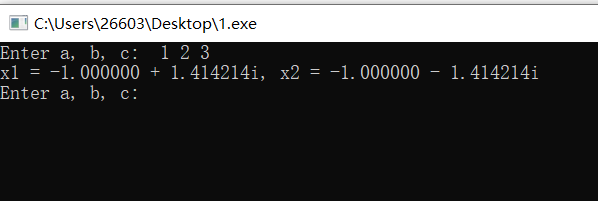
// 重复执行, 直到按Ctrl+D或Ctrl+E结束
//
#include <math.h>
#include <stdio.h>
#include <stdlib.h>
int main() {
    float a, b, c, x1, x2;
    float delta, real, imag;

    printf("Enter a, b, c:  ");

    while(scanf("%f%f%f", &a, &b, &c)) {
        if(a == 0)
            printf("not quadratic equation.\n");
        else {
            delta = b*b - 4*a*c;

            if(delta >= 0) {
                x1 = (-b + sqrt(delta)) / (2*a);
                x2 = (-b - sqrt(delta)) / (2*a);
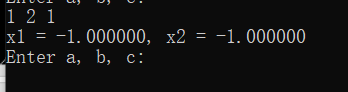
                printf("x1 = %f, x2 = %f\n", x1, x2);
            }
            else {
                real = -b/(2*a);
                imag = sqrt(-delta) / (2*a);
                printf("x1 = %f + %fi, x2 = %f - %fi\n", real, imag, real, imag);
            }
        }

        printf("Enter a, b, c:\n");
    }
    system("pause");
    return 0;
}
![]()
![]()
// 猜数游戏
// 程序运行时自动生成1~100之间的随机数,提示用户猜
// 如果用户猜的数等于随机数,提示用户猜对了,程序结束
// 否则,如果用户猜的数小于随机数,提示用户低了,用户继续猜
// 如果用户猜的数大于随机数,提示用户高了,用户继续猜
// 程序循环运行直到用户猜对为止

#include <stdio.h>
#include <stdlib.h>
#include <time.h>

int main() {
    int guessNumber; // 存放程序运行时生成的1~100之间的随机整数
    int ans;     // 存放用户猜的数字

    srand((time(0)));  // 以时间函数作为随机种子
    guessNumber = 1 + rand()%100;  // 生成1~100之间的随机数

    do {
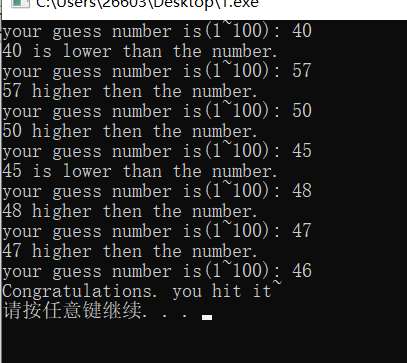
        printf("your guess number is(1~100): ");
        scanf("%d", &ans);
        if(ans < guessNumber)
            printf("%d is lower than the number.\n", ans);
        else if(ans > guessNumber)
            printf("%d higher then the number.\n", ans);
    }while(ans != guessNumber);

    printf("Congratulations. you hit it~\n");

    system("pause"); // 在devc中运行时,这一行可以去掉

    return 0;
}
![]()
#include <stdio.h>
#include <stdlib.h>
int main() {
    int number, max, min, n;

    n=1;
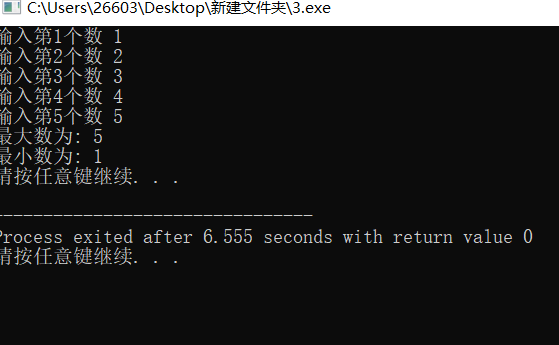
    printf("输入第%d个数 ", n);
    scanf("%d", &number);
    max = number;
    min = number;

    while(n<5) {
        n++;
        printf("输入第%d个数 ", n);
        scanf("%d", &number);

        if(number>max)
            max = number;
        else if(number<min)
            min = number;
    }

    printf("最大数为: %d\n", max);
    printf("最小数为: %d\n", min);

    system("pause");

    return 0;
}
![]()
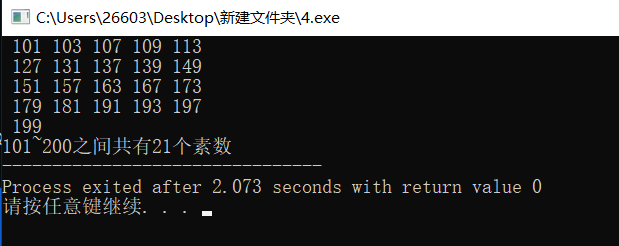
//编程输出101-200之间所有素数,并输出这一区间内素数个数。
#include<stdio.h>
#include<math.h>
int isprime(int n);
int main()
{
    int i,m=0;
    for(i=101;i<=200;i++)
    {
        if(isprime(i))
        {
             printf("%4d",i);
             m++;
             if(m%5==0)
             printf("\n");
             }     }
    printf("\n");
    printf("101~200之间共有%d个素数",m);

    return 0;
}
int isprime(int n)
{
    int k;
    for(k=2;k<=sqrt(n);k++)
        if(n%k==0)
          return 0;
 return 1;
}
![]()
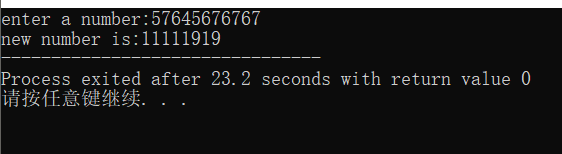
//将一个长整型数s的每一数位上的奇数依次取出来,构成一个新的数,起高位仍在高位,低位仍在低位
#include<stdio.h>
//long int isprime(long int m);
int main()
{
    printf("enter a number:");
    int k,i=1;
    long int a,b=0;
    scanf("%lu",&a);

    while(a>0){
       k=a%10;
       a=a/10;
       if(k%2==1){
            b=b+k*i;
           i=10*i;}}

    printf("new number is:%lu",b);
    return 0;
}
![]()