Gray code counters (having one bit change per counter transition) are often used in FIFO design and digital communication.
Here I will show two styles gray code counter.
Style #1
First style gray code counter uses a single set of flip-flops as the Gray code register with accompanying Gray-tobinary conversion, binary increment, and binary-to-Gray conversion.
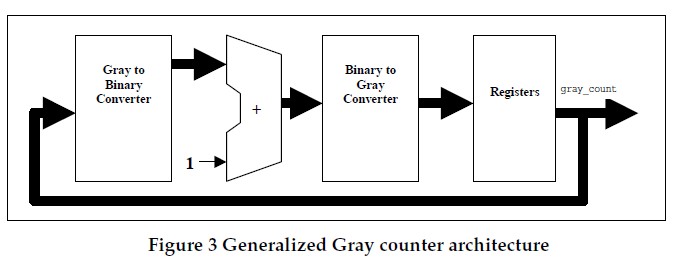
 module gray_counter(
- input iclk,
- input irst_n,
- input ivalid,
- output reg [3:0] gray);
- wire [3:0] bin_counter;
- wire [3:0] gray_counter;
-
- reg [3:0] G2B_counter;
- // convert gray to bin;
- always@(ocounter)
- begin
- G2B_counter[3] = gray[3];
- G2B_counter[2] = gray[2] ^ G2B_counter[3];
- G2B_counter[1] = gray[1] ^ G2B_counter[2];
- G2B_counter[0] = gray[0] ^ G2B_counter[1];
- end
- //binary counter increased by one
- assign bin_counter = bin_counter +ivalid;
- //convert bin to gray
- assign gray_counter = (bin_counter >>1) ^ bin_counter;
- always@(posedge iclk or negedge irst_n)
- begin
- if(!irst_n)
- begin
- gray <= 4'b0;
- end
- else
- begin
- gray <= gray_counter;
- end
- end
- endmodule
Style #2
A second Gray code counter style, the one described below, uses two sets of registers, one a binary counter and a second to capture a binary-to-Gray converted value. The intent of this Gray code counter style #2 is to utilize the binary carry structure, simplify the Gray-to-binary conversion; reduce combinational logic, and increase the upper frequency limit of the Gray code counter.

module graycounter(2
input iclk,3
input irst_n,4
input ivalid,5
output [ADDSIZE-1 : 0] bin,6
output reg [ADDSIZE : 0] gray);7
8
parameter ADDSIZE = 4;9
10
wire[ADDSIZE : 0] binnext;11
wire[ADDSIZE : 0] graynext;12
reg[ADDSIZE : 0] bin_o;13
14
assign binnext = bin_o + ivalid;15
16
assign graynext = (binnext >>1) ^ binnext;17
18
assign bin = bin_o[ADDSIZE-1 : 0];19
20
always@(posedge iclk or negedge irst_n )21
if(!irst_n)22
 {bin_o, gray} <= 0;
23
else24
{bin_o, gray} <= {binnext, graynext};25
26
27
endmodule28
29
30
31
Reference:
1.Vijay A. Nebhrajani," Asynchronous FIFO Architectures" part2
2. Clifford E. Cummings, Sunburst Design, Inc " Simulation and Synthesis Techniques for Asynchronous
FIFO Design"

 浙公网安备 33010602011771号