
第四章 微服务架构分层设计
字数 2573,阅读大约需 13 分钟
第四章 微服务架构分层设计
在实际项目中,很多团队对微服务的理解停留在"把单体应用拆小"的层面。但真正的微服务架构需要精心设计的分层结构,就像建造一座大厦,需要清晰的蓝图和稳固的地基。
4.1 整体架构设计
4.1.1 微服务架构的核心组件
经过多个项目的实践,我发现一个健壮的微服务架构通常包含以下核心组件。让我用一张图来展示这些组件的关系:
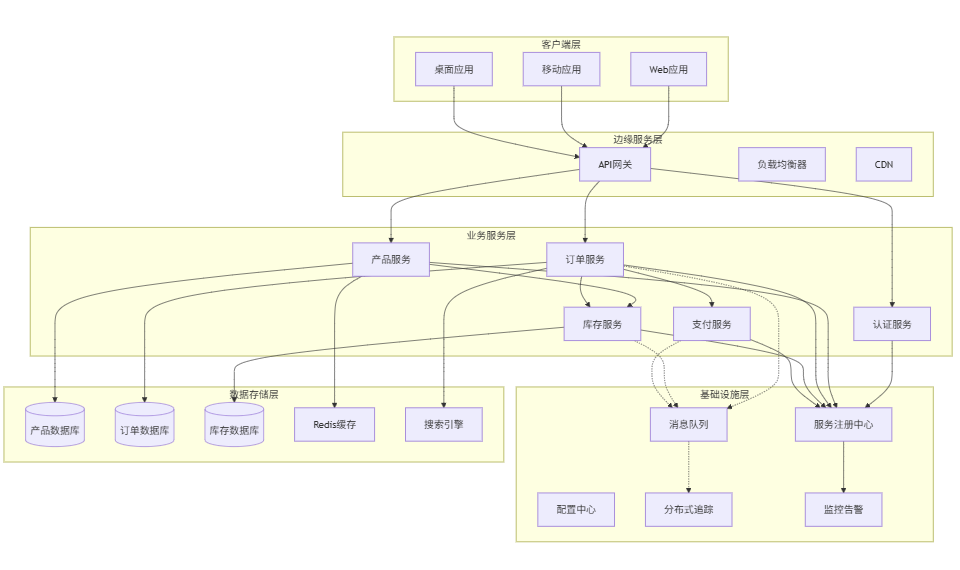
让我详细解释每个组件的作用和实践经验:
1. API网关:系统的门面
API网关不仅仅是路由转发,它是整个系统的战略要地。在实际项目中,我通常使用Ocelot(.NET生态)或Kong作为网关。
- • 描述: 微服务架构的单一入口点。它负责将客户端请求路由到相应的微服务,并处理一些横切关注点(如认证、授权、限流、缓存、日志、监控)。
- • 重要性: 简化客户端与微服务之间的交互,提供统一的 API 接口,并增强安全性。
// Ocelot配置示例
{
  "Routes": [
    {
      "DownstreamPathTemplate": "/api/products/{everything}",
      "DownstreamScheme": "http",
      "DownstreamHostAndPorts": [
        {
          "Host": "product-service",
          "Port": 80
        }
      ],
      "UpstreamPathTemplate": "/products/{everything}",
      "UpstreamHttpMethod": [ "Get", "Post", "Put", "Delete" ],
      "AuthenticationOptions": {
        "AuthenticationProviderKey": "Bearer",
        "AllowedScopes": [ "product_api" ]
      },
      "RateLimitOptions": {
        "ClientWhitelist": [],
        "EnableRateLimiting": true,
        "Period": "1s",
        "PeriodTimespan": 1,
        "Limit": 10
      }
    }
  ],
  "GlobalConfiguration": {
    "BaseUrl": "https://api.yourdomain.com"
  }
}
2. 服务注册与发现
在Docker和Kubernetes环境中,服务实例的IP是动态变化的,服务发现变得至关重要。
// 使用Consul作为服务注册中心
public class ConsulServiceRegistry : IServiceRegistry
{
    private readonly ConsulClient _consulClient;
    private readonly ILogger<ConsulServiceRegistry> _logger;

    public ConsulServiceRegistry(IConfiguration configuration, ILogger<ConsulServiceRegistry> logger)
    {
        _consulClient = new ConsulClient(config =>
        {
            config.Address = new Uri(configuration["Consul:Address"]);
        });
        _logger = logger;
    }

    public async Task RegisterServiceAsync(string serviceName, string serviceId, string serviceAddress, int servicePort)
    {
        var registration = new AgentServiceRegistration()
        {
            ID = serviceId,
            Name = serviceName,
            Address = serviceAddress,
            Port = servicePort,
            Check = new AgentServiceCheck()
            {
                HTTP = $"http://{serviceAddress}:{servicePort}/health",
                Interval = TimeSpan.FromSeconds(10),
                Timeout = TimeSpan.FromSeconds(5),
                DeregisterCriticalServiceAfter = TimeSpan.FromMinutes(1)
            }
        };

        await _consulClient.Agent.ServiceRegister(registration);
        _logger.LogInformation($"Service {serviceName} registered with Consul");
    }

    public async Task UnregisterServiceAsync(string serviceId)
    {
        await _consulClient.Agent.ServiceDeregister(serviceId);
        _logger.LogInformation($"Service {serviceId} unregistered from Consul");
    }
}

// 在Program.cs中注册服务
var app = builder.Build();

var consulRegistry = app.Services.GetRequiredService<ConsulServiceRegistry>();
var lifetime = app.Services.GetRequiredService<IHostApplicationLifetime>();
var config = app.Configuration;

var serviceId = $"{config["Service:Name"]}-{Guid.NewGuid()}";
var serviceAddress = config["Service:Address"] ?? "localhost";
var servicePort = int.Parse(config["Service:Port"] ?? "5000");

lifetime.ApplicationStarted.Register(async () =>
{
    await consulRegistry.RegisterServiceAsync(
        config["Service:Name"],
        serviceId,
        serviceAddress,
        servicePort);
});

lifetime.ApplicationStopping.Register(async () =>
{
    await consulRegistry.UnregisterServiceAsync(serviceId);
});
3. 配置中心
集中管理配置是微服务运维的关键。
// 使用Apollo配置中心
public class ApolloConfigurationProvider : ConfigurationProvider
{
    private readonly ApolloClient _apolloClient;
    private readonly ILogger<ApolloConfigurationProvider> _logger;

    public ApolloConfigurationProvider(ApolloOptions options, ILogger<ApolloConfigurationProvider> logger)
    {
        _apolloClient = new ApolloClient(options);
        _logger = logger;
    }

    public override void Load()
    {
        try
        {
            var configurations = _apolloClient.GetConfigurationsAsync().Result;

            foreach (var config in configurations)
            {
                Data[config.Key] = config.Value;
            }

            // 监听配置变更
            _apolloClient.OnConfigChanged += (sender, args) =>
            {
                _logger.LogInformation($"Configuration changed: {args.Namespace}");
                OnReload();
            };
        }
        catch (Exception ex)
        {
            _logger.LogError(ex, "Failed to load configuration from Apollo");
        }
    }
}
4.2 微服务内部分层设计
每个微服务内部也需要清晰的分层结构。我通常采用这样的分层:
ProductService/
├── src/
│   ├── ProductService.Api/           # API层(控制器)
│   ├── ProductService.Application/   # 应用层(用例、CQRS)
│   ├── ProductService.Domain/        # 领域层(实体、值对象)
│   ├── ProductService.Infrastructure/# 基础设施层(数据访问、外部服务)
│   └── ProductService.Shared/        # 共享组件
4.2.1 API层(Presentation Layer)
负责处理HTTP请求,验证输入,返回响应。
[ApiController]
[Route("api/v1/[controller]")]
[Authorize]
public class ProductsController : ControllerBase
{
    private readonly IMediator _mediator;
    private readonly ILogger<ProductsController> _logger;

    public ProductsController(IMediator mediator, ILogger<ProductsController> logger)
    {
        _mediator = mediator;
        _logger = logger;
    }

    [HttpGet("{id}")]
    [ProducesResponseType(typeof(ProductDto), StatusCodes.Status200OK)]
    [ProducesResponseType(StatusCodes.Status404NotFound)]
    public async Task<ActionResult<ProductDto>> GetById(Guid id)
    {
        _logger.LogInformation("Getting product {ProductId}", id);

        var query = new GetProductByIdQuery(id);
        var result = await _mediator.Send(query);

        return result.Match<ActionResult<ProductDto>>(
            product => Ok(product),
            notFound => NotFound());
    }

    [HttpPost]
    [ProducesResponseType(typeof(ProductDto), StatusCodes.Status201Created)]
    [ProducesResponseType(typeof(ValidationProblemDetails), StatusCodes.Status400BadRequest)]
    public async Task<ActionResult<ProductDto>> Create([FromBody] CreateProductCommand command)
    {
        var result = await _mediator.Send(command);

        return result.Match<ActionResult<ProductDto>>(
            product => CreatedAtAction(
                nameof(GetById),
                new { id = product.Id },
                product),
            validationError => BadRequest(validationError));
    }
}
4.2.2 应用层(Application Layer)
协调领域对象完成业务用例,不包含业务规则。
// CQRS命令处理器
public class CreateProductCommandHandler : IRequestHandler<CreateProductCommand, Result<ProductDto>>
{
    private readonly IProductRepository _repository;
    private readonly IUnitOfWork _unitOfWork;
    private readonly IMapper _mapper;
    private readonly ILogger<CreateProductCommandHandler> _logger;

    public CreateProductCommandHandler(
        IProductRepository repository,
        IUnitOfWork unitOfWork,
        IMapper mapper,
        ILogger<CreateProductCommandHandler> logger)
    {
        _repository = repository;
        _unitOfWork = unitOfWork;
        _mapper = mapper;
        _logger = logger;
    }

    public async Task<Result<ProductDto>> Handle(CreateProductCommand request, CancellationToken cancellationToken)
    {
        _logger.LogInformation("Creating product {ProductName}", request.Name);

        // 验证产品名称唯一性
        var existingProduct = await _repository.GetByNameAsync(request.Name);
        if (existingProduct != null)
        {
            return Result.Failure<ProductDto>("Product name already exists");
        }

        // 创建领域实体
        var product = Product.Create(
            request.Name,
            request.Description,
            Money.Create(request.Price, request.Currency),
            request.CategoryId);

        // 保存到数据库
        await _repository.AddAsync(product);
        await _unitOfWork.SaveChangesAsync();

        // 发布领域事件
        await _unitOfWork.PublishDomainEventsAsync();

        _logger.LogInformation("Product created {ProductId}", product.Id);

        return Result.Success(_mapper.Map<ProductDto>(product));
    }
}
4.2.3 领域层(Domain Layer)
包含业务逻辑的核心,是系统的灵魂。
// 聚合根
public class Product : AggregateRoot
{
    private Product() { } // EF Core需要

    private Product(string name, string description, Money price, Guid categoryId)
    {
        Id = Guid.NewGuid();
        Name = name;
        Description = description;
        Price = price;
        CategoryId = categoryId;
        CreatedAt = DateTime.UtcNow;
        Status = ProductStatus.Draft;
    }

    public string Name { get; private set; }
    public string Description { get; private set; }
    public Money Price { get; private set; }
    public Guid CategoryId { get; private set; }
    public ProductStatus Status { get; private set; }
    public DateTime CreatedAt { get; private set; }

    // 值对象集合
    private readonly List<ProductImage> _images = new();
    public IReadOnlyCollection<ProductImage> Images => _images.AsReadOnly();

    // 工厂方法
    public static Product Create(string name, string description, Money price, Guid categoryId)
    {
        if (string.IsNullOrWhiteSpace(name))
            throw new BusinessRuleException("Product name cannot be empty");

        if (price.Amount <= 0)
            throw new BusinessRuleException("Product price must be greater than zero");

        var product = new Product(name, description, price, categoryId);

        // 添加领域事件
        product.AddDomainEvent(new ProductCreatedEvent(product.Id, product.Name));

        return product;
    }

    // 领域行为
    public void UpdatePrice(Money newPrice)
    {
        if (newPrice.Amount <= 0)
            throw new BusinessRuleException("Price must be greater than zero");

        var oldPrice = Price;
        Price = newPrice;

        // 发布价格变更事件
        AddDomainEvent(new ProductPriceChangedEvent(Id, oldPrice, newPrice));
    }

    public void AddImage(string url, string altText)
    {
        if (_images.Count >= 10)
            throw new BusinessRuleException("Product cannot have more than 10 images");

        var image = new ProductImage(url, altText);
        _images.Add(image);
    }

    public void Publish()
    {
        if (Status != ProductStatus.Draft)
            throw new BusinessRuleException("Only draft products can be published");

        if (_images.Count == 0)
            throw new BusinessRuleException("Product must have at least one image to be published");

        Status = ProductStatus.Published;
        AddDomainEvent(new ProductPublishedEvent(Id));
    }
}

// 值对象
public record Money
{
    public decimal Amount { get; }
    public string Currency { get; }

    private Money(decimal amount, string currency)
    {
        Amount = amount;
        Currency = currency;
    }

    public static Money Create(decimal amount, string currency)
    {
        if (string.IsNullOrWhiteSpace(currency))
            throw new BusinessRuleException("Currency is required");

        if (currency.Length != 3)
            throw new BusinessRuleException("Currency must be 3 characters");

        return new Money(amount, currency.ToUpper());
    }

    // 值对象相等性
    protected override IEnumerable<object> GetEqualityComponents()
    {
        yield return Amount;
        yield return Currency;
    }
}
4.2.4 基础设施层(Infrastructure Layer)
提供技术实现,如数据持久化、外部服务调用等。
// Entity Framework Core仓储实现
public class ProductRepository : IProductRepository
{
    private readonly ProductDbContext _context;

    public ProductRepository(ProductDbContext context)
    {
        _context = context;
    }

    public async Task<Product> GetByIdAsync(Guid id)
    {
        return await _context.Products
            .Include(p => p.Images)
            .FirstOrDefaultAsync(p => p.Id == id);
    }

    public async Task<Product> GetByNameAsync(string name)
    {
        return await _context.Products
            .FirstOrDefaultAsync(p => p.Name == name);
    }

    public async Task AddAsync(Product product)
    {
        await _context.Products.AddAsync(product);
    }

    public void Update(Product product)
    {
        _context.Products.Update(product);
    }

    public async Task<IEnumerable<Product>> GetPublishedProductsAsync(int page, int pageSize)
    {
        return await _context.Products
            .Where(p => p.Status == ProductStatus.Published)
            .OrderByDescending(p => p.CreatedAt)
            .Skip((page - 1) * pageSize)
            .Take(pageSize)
            .ToListAsync();
    }
}

// DbContext配置
public class ProductDbContext : DbContext
{
    public ProductDbContext(DbContextOptions<ProductDbContext> options)
        : base(options)
    {
    }

    public DbSet<Product> Products { get; set; }

    protected override void OnModelCreating(ModelBuilder modelBuilder)
    {
        base.OnModelCreating(modelBuilder);

        // 配置聚合根
        modelBuilder.Entity<Product>(entity =>
        {
            entity.HasKey(e => e.Id);
            entity.Property(e => e.Id).ValueGeneratedNever();

            // 配置值对象
            entity.OwnsOne(e => e.Price, price =>
            {
                price.Property(p => p.Amount).HasColumnName("Price_Amount");
                price.Property(p => p.Currency).HasColumnName("Price_Currency").HasMaxLength(3);
            });

            // 配置枚举
            entity.Property(e => e.Status)
                .HasConversion<string>()
                .HasMaxLength(20);

            // 配置集合
            entity.HasMany(e => e.Images)
                .WithOne()
                .HasForeignKey("ProductId");
        });

        // 配置领域事件
        modelBuilder.Ignore<ProductCreatedEvent>();
        modelBuilder.Ignore<ProductPriceChangedEvent>();
    }
}
4.3 跨服务通信设计
微服务之间的通信是架构设计的重点。我通常采用混合通信模式:
4.3.1 同步通信(REST/gRPC)
适用于实时性要求高的场景:
// gRPC服务定义
service InventoryService {
    rpc CheckStock (CheckStockRequest) returns (CheckStockResponse);
    rpc ReserveStock (ReserveStockRequest) returns (ReserveStockResponse);
    rpc ReleaseStock (ReleaseStockRequest) returns (ReleaseStockResponse);
}

// .NET gRPC客户端
public class InventoryServiceClient : IInventoryService
{
    private readonly InventoryService.InventoryServiceClient _client;
    private readonly ILogger<InventoryServiceClient> _logger;

    public InventoryServiceClient(GrpcChannel channel, ILogger<InventoryServiceClient> logger)
    {
        _client = new InventoryService.InventoryServiceClient(channel);
        _logger = logger;
    }

    public async Task<bool> CheckStockAsync(Guid productId, int quantity)
    {
        try
        {
            var request = new CheckStockRequest
            {
                ProductId = productId.ToString(),
                Quantity = quantity
            };

            var response = await _client.CheckStockAsync(request);
            return response.Available;
        }
        catch (RpcException ex)
        {
            _logger.LogError(ex, "Error checking stock for product {ProductId}", productId);
            throw new ServiceUnavailableException("Inventory service is unavailable");
        }
    }
}
4.3.2 异步通信(消息队列)
适用于解耦服务和处理长时间运行的业务:
// 定义集成事件
public record OrderCreatedEvent : IntegrationEvent
{
    public Guid OrderId { get; init; }
    public Guid CustomerId { get; init; }
    public List<OrderItem> Items { get; init; }
    public DateTime CreatedAt { get; init; }
}

// 事件发布者
public class EventPublisher : IEventPublisher
{
    private readonly IPublishEndpoint _publishEndpoint;
    private readonly ILogger<EventPublisher> _logger;

    public EventPublisher(IPublishEndpoint publishEndpoint, ILogger<EventPublisher> logger)
    {
        _publishEndpoint = publishEndpoint;
        _logger = logger;
    }

    public async Task PublishAsync<T>(T integrationEvent) where T : IntegrationEvent
    {
        try
        {
            await _publishEndpoint.Publish(integrationEvent);
            _logger.LogInformation("Published event {EventType}", typeof(T).Name);
        }
        catch (Exception ex)
        {
            _logger.LogError(ex, "Error publishing event {EventType}", typeof(T).Name);
            throw;
        }
    }
}

// 事件消费者
public class OrderCreatedEventConsumer : IConsumer<OrderCreatedEvent>
{
    private readonly IInventoryService _inventoryService;
    private readonly ILogger<OrderCreatedEventConsumer> _logger;

    public OrderCreatedEventConsumer(IInventoryService inventoryService, ILogger<OrderCreatedEventConsumer> logger)
    {
        _inventoryService = inventoryService;
        _logger = logger;
    }

    public async Task Consume(ConsumeContext<OrderCreatedEvent> context)
    {
        var orderCreatedEvent = context.Message;

        try
        {
            _logger.LogInformation("Processing order created event for order {OrderId}", orderCreatedEvent.OrderId);

            // 预留库存
            foreach (var item in orderCreatedEvent.Items)
            {
                var reserved = await _inventoryService.ReserveStockAsync(
                    item.ProductId,
                    item.Quantity);

                if (!reserved)
                {
                    _logger.LogWarning("Failed to reserve stock for product {ProductId}", item.ProductId);
                    // 发布库存不足事件
                    await context.Publish(new StockInsufficientEvent
                    {
                        OrderId = orderCreatedEvent.OrderId,
                        ProductId = item.ProductId,
                        RequestedQuantity = item.Quantity
                    });
                    return;
                }
            }

            _logger.LogInformation("Successfully reserved stock for order {OrderId}", orderCreatedEvent.OrderId);
        }
        catch (Exception ex)
        {
            _logger.LogError(ex, "Error processing order created event for order {OrderId}", orderCreatedEvent.OrderId);
            throw;
        }
    }
}
4.4 小结
微服务架构的分层设计不是一蹴而就的,它需要根据业务需求、团队规模和技术栈来不断演进。记住几个关键原则:
- 1. 清晰的层次边界:每一层都有明确的职责
- 2. 依赖倒置:领域层不依赖其他层
- 3. 技术异构:不同服务可以选择最合适的技术栈
- 4. 渐进式演进:从单体到微服务是一个渐进的过程
最重要的是,不要为了微服务而微服务。我见过很多项目盲目追求微服务,结果导致系统复杂度急剧上升,维护成本暴增。微服务架构是为了解决特定问题而存在的,只有当单体架构真正成为瓶颈时,才需要考虑微服务化。

 浙公网安备 33010602011771号