
矩阵快速幂
讲矩阵快速幂之前,先讲讲它的一些前置知识。
一.矩阵
矩阵是一个按照矩形排列的二维数表,由行和列组成,通常用大写字母\(A、B、C\)表示。
一般来说,一个\(n \times m\) 的矩阵\(A\)可以表示为:
\( A=\begin{bmatrix} a_{1,1} & a_{1,2} & a_{1,3} & \cdots & a_{1,m} \\ a_{2,1} & a_{2,2} & a_{2,3} & \cdots & a_{2,m} \\ \vdots & \vdots & \vdots & \ddots & \vdots \\ a_{n,1} & a_{n,2} & a_{n,3} & \cdots & a_{n,m} \\ \end{bmatrix} \)
其中\(n、m\)分别表示行数和列数,\(a_{i,j}\)表示第\(i\)行第\(j\)列的元素。
二、矩阵加法
对于两个同型(都为\(n \times m\)的矩阵)的矩阵\(A、B\)而言,它们相加的和、矩阵\(C\)也是$ n \times m$的,即:
\( A=\begin{bmatrix} a_{1,1} & a_{1,2} & a_{1,3} & \cdots & a_{1,m} \\ a_{2,1} & a_{2,2} & a_{2,3} & \cdots & a_{2,m} \\ \vdots & \vdots & \vdots & \ddots & \vdots \\ a_{n,1} & a_{n,2} & a_{n,3} & \cdots & a_{n,m} \\ \end{bmatrix} \) \(+\) \( B=\begin{bmatrix} b_{1,1} & b_{1,2} & b_{1,3} & \cdots & b_{1,m} \\ b_{2,1} & b_{2,2} & b_{2,3} & \cdots & b_{2,m} \\ \vdots & \vdots & \vdots & \ddots & \vdots \\ b_{n,1} & b_{n,2} & b_{n,3} & \cdots & b_{n,m} \\ \end{bmatrix} \) \(=\) \( C=\begin{bmatrix} c_{1,1} & c_{1,2} & c_{1,3} & \cdots & c_{1,m} \\ c_{2,1} & c_{2,2} & c_{2,3} & \cdots & c_{2,m} \\ \vdots & \vdots & \vdots & \ddots & \vdots \\ c_{n,1} & c_{n,2} & c_{n,3} & \cdots & c_{n,m} \\ \end{bmatrix} \)
其中\(\forall c_{i,j},c_{i,j}=a_{i,j}+b_{i,j}\)。
易证得矩阵加法满足交换律和结合律,即\(A+B=B+A\),\(A+(B+C)=(A+B)+C\)。
例.B2104
红的不能再红的板子题,不讲了,看代码。
点击查看代码
#include<iostream>
#include<cstdio>
using namespace std;
const int N=520;
const int M=520;
int n,m,a[N][M],b[N][M],c[N][M];
int main(){
	cin>>n>>m;
	for(int i=1;i<=n;i++){
		for(int j=1;j<=m;j++){
			cin>>a[i][j];
		}
	}
	for(int i=1;i<=n;i++){
		for(int j=1;j<=m;j++){
			cin>>b[i][j];
		}
	}
	for(int i=1;i<=n;i++){
		for(int j=1;j<=m;j++){
			c[i][j]=a[i][j]+b[i][j];
		}
	}
	for(int i=1;i<=n;i++){
		for(int j=1;j<=m;j++){
			cout<<c[i][j]<<" ";
		}
		cout<<endl;
	}
	return 0;
}
三、矩阵乘法
什么是矩阵乘法呢?对于一个\(n \times m\)的矩阵\(A\),和一个\(m \times p\)的矩阵\(B\),它们相乘会得到一个\(n \times p\)的矩阵\(C=A \times B\),且
\(\forall c_{i,j},c_{i,j}=\sum\limits_{k=1}^{m} {a_{i,k} \times b_{k,j} }\)
举个栗子,
\(
A=\begin{bmatrix}
6 & 8 & 5 \\
3 & 4 & 1 \\
\end{bmatrix}
\),\(
B=\begin{bmatrix}
1 & 3 & 6 & 6 \\
2 & 8 & 4 & 4 \\
5 & 6 & 1 & 8 \\
\end{bmatrix}
\) 则 \(
C=\begin{bmatrix}
47 & 112 & 73 & 108 \\
16 & 47 & 35 & 42 \\
\end{bmatrix}
\)。
矩阵乘法满足结合律和分配律,不满足交换律。
※数字乘里有单位1,矩阵乘里也有单位矩阵,一个\(n \times n\)的单位矩阵\(A\)形如:
\( A=\begin{bmatrix} 1 & 0 & 0 & \cdots & 0 \\ 0 & 1 & 0 & \cdots & 0 \\ \vdots & \vdots & \vdots & \ddots & \vdots \\ 0 & 0 & 0 & \cdots & 1 \\ \end{bmatrix} \)
也就是\(\forall i \in [1,n],s_{i,i}=1\),而其他位置是0。
显然,根据上面的矩阵乘法规则,任意\(m \times n\)的矩阵\(B\)与之相乘,结果仍然是\(B\)。
例:B2105
板子题没什么好说的。
点击查看代码
#include<iostream>
#include<cstdio>
using namespace std;
const int N=520;
const int M=520;
const int K=520;
int n,m,k,a[N][M],b[M][K],c[N][K];
int main(){
	cin>>n>>m>>k;
	for(int i=1;i<=n;i++){
		for(int j=1;j<=m;j++){
			cin>>a[i][j];
		}
	}
	for(int i=1;i<=m;i++){
		for(int j=1;j<=k;j++){
			cin>>b[i][j];
		}
	}
    //矩阵乘法,套公式就行
	for(int i=1;i<=n;i++){
		for(int j=1;j<=k;j++){
			for(int h=1;h<=m;h++){
				c[i][j]+=a[i][h]*b[h][j];
			}
		}
	}
	for(int i=1;i<=n;i++){
		for(int j=1;j<=k;j++){
			cout<<c[i][j]<<" ";
		}
		cout<<endl;
	}
	return 0;
}
四、龟速乘
龟速乘是一种解决大整数相乘问题的算法,其核心思想为:
\(a \times b\)等价于\(\underbrace{a + a + a + \cdots + a}_{b\text{ 个 a}}\)
而$\forall b \in N,b=2^{k1} + 2^{k2} + \cdots + 2^{kn} $。
所以\(\underbrace{a + a + a + \cdots + a}_{b\text{ 个 a}}=a \times 2^{k1} + a \times 2^{k2} + \cdots + a \times 2^{kn}\)。
龟速乘就是将这样的\(2^i\)次方的a取模后相加,这样就不会爆long long了。
具体来说,先将b末位1取出,再加上对应个数的a,然后把这个1除掉,如此循环直到b=0。
而在找b末位1的过程中,a每次都要乘2,这样等到找到末位1时,a的值就是要累加的值了。
例.P10446
刚才讲过了,不说思路了。
点击查看代码
#include<iostream>
#include<cstdio>
using namespace std;
long long a,b,p,ans;
int main(){
	scanf("%lld%lld%lld",&a,&b,&p);
	while(b){//b等于0就结束了
		if(b&1){
			ans=(ans+a)%p;//如果b这个二进制位是1就累加进去
		}
		a=(a+a)%p;//a的更新
		b>>=1;//清除掉这个二进制位
	}
	printf("%lld",ans);
	return 0;
}
五.快速幂
快速幂的思想和龟速乘如出一辙,都是将b分解为二进制数位($b=2^{k1} + 2^{k2} + \cdots + 2^{kn} $)。龟速乘是a个\(2^{ki}\)累加,而快速幂,由于\(a^{k1 + k2 + \cdots +kn}=a^{k1} \times a^{k2} \times \cdots \times a^{kn}\)(这条性质不知道的找xm补课去),所以改成a个\(2^{ki}\)累乘就行了。
例.P1226
刚才讲过了,不说思路了。
点击查看代码
#include<iostream>
#include<cstdio>
using namespace std;
long long a,b,p,ans=1;
int main(){
	scanf("%lld%lld%lld",&a,&b,&p);
	printf("%lld^%lld mod %lld=",a,b,p);
	while(b){
		if(b&1){
			ans=(ans*a)%p;
		}
		a=(a*a)%p;
		b>>=1;
	}
	printf("%lld",ans);
	return 0;
}
----------------------------------------------------------并不华丽的分割线----------------------------------------------------------
好了,前置知识终于讲完了,终于可以讲矩阵快速幂了。
六.矩阵快速幂
什么是个矩阵快速幂呢?其实就是将矩阵乘法和快速幂融合出的产物。
具体地说,就是把快速幂里的数字乘改成矩阵乘。然后它就是矩阵快速幂了。
矩阵快速幂有一个非常典型的应用,就是矩阵加速——可以将一些递推式转换为矩阵幂,通过构造矩阵、矩阵快速幂的方式,把时间复杂度降到\(O(logn)\)。
当然,这还是很考验数学功底的。而且并不是所有递推式都可以用矩阵幂表示。
总之,我们还是先看它最基本的例题吧。
例1.P3390
刚才已经讲过思想了,现在咱讲讲代码。
如何将数字乘变成矩阵乘呢?一种常用的办法是将\(*\)号重载成矩阵乘法,这样把矩阵放进结构体就好了。具体可以参考一下代码:
点击查看代码
#include<iostream>
#include<cstdio>
#include<cstring>
using namespace std;
const int N=100;
const int MOD=1e9+7;
long long n,k;
struct sw{
	long long mx[N][N];
}a,b,s;
sw operator *(const sw a,const sw b){//这里就是运算符重载了,里面就是普通的矩阵乘
	sw c;
	memset(c.mx,0,sizeof c.mx);
	for(int i=1;i<=n;i++){
		for(int j=1;j<=n;j++){
			for(int p=1;p<=n;p++){
				c.mx[i][j]=(c.mx[i][j]+(a.mx[i][p]*b.mx[p][j])%MOD)%MOD;
			}
		}
	}
	return c;
}
int main(){
	scanf("%lld%lld",&n,&k);
	for(int i=1;i<=n;i++){
		for(int j=1;j<=n;j++){
			scanf("%d",&a.mx[i][j]);
		}
	}
    //数字乘里s是单位1,这里s得变成单位矩阵
	for(int i=1;i<=n;i++) s.mx[i][i]=1;
    //快速幂
	while(k){
		if(k&1) s=s*a;
		a=a*a;
		k>>=1;
	}
	for(int i=1;i<=n;i++){
		for(int j=1;j<=n;j++){
			printf("%d ",s.mx[i][j]);
		}
		printf("\n");
	}
	return 0;
}
例2.P10502
我们规定\(solve(k)=A^1+A^2+ \cdots +A^k\)。
如果正常一个个求大抵会超时。这里我们注意到:
当k=1时显然结果为\(A\)。
当k为奇数时,把后面的高次幂项提出一个\(A^{(k-1)/2}\):
\(solve(k)=A^1+A^2+ \cdots +A^k=(A^1+A^2+ \cdots +A^{(k-1)/2})+A^{(k-1)/2} \times (A^1+A^2+ \cdots +A^{(k-1)/2})+A^k=solve((k-1)/2) + solve((k-1)/2) \times A^{(k-1)/2} + A^k\)。
当k为偶数时,同样把后面的高次幂项提出一个\(A^{k/2}\):
\(solve(k)=A^1+A^2+ \cdots +A^k=(A^1+A^2+ \cdots +A^{k/2})+A^{k/2}(A^1+A^2+ \cdots +A^{k/2})=solve(k/2) + solve(k/2) \times A^{k/2}\)
此时它就被转化成了一个分治+矩阵快速幂的题目。
代码:
点击查看代码
#include<bits/stdc++.h>
using namespace std;
typedef long long ll;

const int N=35;
ll n,k,mod;
struct sw{
	ll mx[N][N];
}a;

sw operator *(const sw a,const sw b){//矩阵乘
	sw c;
	for(int i=1;i<=n;i++){//不使用memset来减小时间复杂度
		for(int j=1;j<=n;j++){
			c.mx[i][j]=0;
		}
	}
	for(int i=1;i<=n;i++){
		for(int j=1;j<=n;j++){
			for(int k=1;k<=n;k++){
				c.mx[i][j]=(c.mx[i][j]+(a.mx[i][k]*b.mx[k][j])%mod)%mod;
			}
		}
	}
	return c;
}

sw operator +(const sw a,const sw b){//矩阵加
	sw c;
	for(int i=1;i<=n;i++){
		for(int j=1;j<=n;j++){
			c.mx[i][j]=(a.mx[i][j]+b.mx[i][j])%mod;
		}
	}
	return c;
}

sw qpow(sw a,ll b){//矩阵快速幂
	sw s;
	for(int i=1;i<=n;i++){
		for(int j=1;j<=n;j++){
			if(i==j){
				s.mx[i][j]=1;
			}
			else{
				s.mx[i][j]=0;
			}
		}
	}
	while(b){
		if(b&1){
			s=s*a;
		}
		a=a*a;b>>=1;
	}
	return s;
}

sw solve(sw a,ll x){//分治部分,和文字部分基本一致
	if(x==1){
		return a;
	}
	sw mid=solve(a,x/2);sw pw=qpow(a,x/2);//solve(a,x/2)、qpow(a,x/2)只算了一遍,大大减小时间复杂度
	if(x&1){
		return mid*pw+mid+qpow(a,x);
	}
	else{
		return mid*pw+mid;
	}
}

int main(){
	scanf("%lld%lld%lld",&n,&k,&mod);
	for(int i=1;i<=n;i++){
		for(int j=1;j<=n;j++){
			scanf("%lld",&a.mx[i][j]);
		}
	}
	sw ans=solve(a,k);
	for(int i=1;i<=n;i++){
		for(int j=1;j<=n;j++){
			printf("%lld ",ans.mx[i][j]);
		}
		printf("\n");
	}
	return 0;
}
----------------------------------------------------------并不华丽的分割线----------------------------------------------------------
接下来就是它的重要应用了——矩阵加速,就是我们刚才说过的。它的难点在于构造矩阵,很考验一个OIer的数学功底。
update on 2025.08.09:
重新学习了一遍矩阵快速幂,矩阵加速的适用式为齐次线性式,也就是形如
\(f_i=a_1f_1+a_2f_2+ \cdots +a_{i-1}f_{i-1}\)
其中\(a_1,a_2,\cdots,a_{i-1}\)均为常数,\(f_i\)只与前\(i-1\)项有关。
例3.P1962
算是最最简单的矩阵加速了(少有的绿题),重点说说构造矩阵。
答案求\(F_n\),而\(F_n=F_{n-1}+F_{n-2}\),所以只要有两项就能递推出下一项,所以基础矩阵只需要两个元素(一开始是\(F_1、F_2\)),递推矩阵是\(2 \times 2\)的。
那么当我们已知\(F_{n-1}、F_{n-2}\)时如何转移出来\(F_n、F_{n-1}\)呢?
\( \begin{bmatrix} F_{n-1} & F_{n-2} \\ \end{bmatrix} \) \(\times\) \( \begin{bmatrix} ? & ? \\ ? & ? \\ \end{bmatrix} \) \(=\) \( \begin{bmatrix} F_{n} & F_{n-1} \\ \end{bmatrix} \)
首先根据刚才的公式(\(F_n=F_{n-1}+F_{n-2}\)),第一行第一列和第二行第一列应该填1,否则无法转移出\(F_n\)。
\( \begin{bmatrix} F_{n-1} & F_{n-2} \\ \end{bmatrix} \) \(\times\) \( \begin{bmatrix} 1 & ? \\ 1 & ? \\ \end{bmatrix} \) \(=\) \( \begin{bmatrix} F_{n} & F_{n-1} \\ \end{bmatrix} \)
其次\(F_{n-1}=1 \times F_{n-1} +0 \times F_{n-2}\),所以第一行第二列填1、第二行第二列应该填0,才能转移出\(F_{n-1}\)。
\( \begin{bmatrix} F_{n-1} & F_{n-2} \\ \end{bmatrix} \) \(\times\) \( \begin{bmatrix} 1 & 1 \\ 1 & 0 \\ \end{bmatrix} \) \(=\) \( \begin{bmatrix} F_{n} & F_{n-1} \\ \end{bmatrix} \)
这样转移矩阵就是\( \begin{bmatrix} 1 & 1 \\ 1 & 0 \\ \end{bmatrix} \)。
而同理,\( \begin{bmatrix} F_{n-2} & F_{n-3} \\ \end{bmatrix} \) \(\times\) \( \begin{bmatrix} 1 & 1 \\ 1 & 0 \\ \end{bmatrix} \) \(=\) \( \begin{bmatrix} F_{n-1} & F_{n-2} \\ \end{bmatrix} \),所以\( \begin{bmatrix} F_{n-2} & F_{n-3} \\ \end{bmatrix} \) \(\times\) \( \begin{bmatrix} 1 & 1 \\ 1 & 0 \\ \end{bmatrix}^2 \) \(=\) \( \begin{bmatrix} F_{n} & F_{n-1} \\ \end{bmatrix} \)
以此类推,\(
\begin{bmatrix}
F_{2} & F_{1} \\
\end{bmatrix}
\) \(\times\) \(
\begin{bmatrix}
1 & 1 \\
1 & 0 \\
\end{bmatrix}^{n-2}
\) \(=\) \(
\begin{bmatrix}
F_{n} & F_{n-1} \\
\end{bmatrix}
\)。
而\(
\begin{bmatrix}
F_{2} & F_{1} \\
\end{bmatrix}
\) \(=\) \(
\begin{bmatrix}
1 & 1 \\
\end{bmatrix}
\),所以只要将转移矩阵^(n-2),再乘上初始的基础矩阵,所得矩阵的第一项就是答案。
代码:
点击查看代码
#include<bits/stdc++.h>
using namespace std;
typedef long long ll;

const int mod=1e9+7;
ll n;
struct sw{
	ll mx[3][3];
}a,ans,qwq;
//重载乘号(矩阵乘)
sw operator *(const sw &a,const sw &b){
	sw c;
	for(int i=1;i<=2;i++){
		for(int j=1;j<=2;j++){
			c.mx[i][j]=0;
		}
	}
	for(int i=1;i<=2;i++){
		for(int j=1;j<=2;j++){
			for(int k=1;k<=2;k++){
				c.mx[i][j]=(c.mx[i][j]+(a.mx[i][k]*b.mx[k][j])%mod)%mod;
			}
		}
	}
	return c;
}

int main(){
	scanf("%lld",&n);
	ll b=n-2;//别忘了这里开ll
	//初始化
	a.mx[1][1]=a.mx[1][2]=a.mx[2][1]=1;
	ans.mx[1][1]=ans.mx[2][2]=1;
	qwq.mx[1][1]=qwq.mx[1][2]=1;
	if(n<=2){
		printf("1");
		return 0;
	}
	//矩阵快速幂
	while(b){
		if(b&1){
			ans=ans*a;
		}
		a=a*a;b>>=1;
	}
	qwq=qwq*ans;
	printf("%lld ",qwq.mx[1][1]%mod);
	return 0;
}
例4.P1349
和刚才的题大同小异,只给最终结论:\( \begin{bmatrix} F_{2} & F_{1} \\ \end{bmatrix} \) \(\times\) \( \begin{bmatrix} p & 1 \\ q & 0 \\ \end{bmatrix}^{n-2} \) \(=\) \( \begin{bmatrix} F_{n} & F_{n-1} \\ \end{bmatrix} \)
代码:
点击查看代码
#include<bits/stdc++.h>
using namespace std;
typedef long long ll;

ll p,q,a1,a2,n,mod;
struct sw{
	ll mx[3][3];
}a,ans,qwq;
//重载乘号(矩阵乘)
sw operator *(const sw &a,const sw &b){
	sw c;
	for(int i=1;i<=2;i++){
		for(int j=1;j<=2;j++){
			c.mx[i][j]=0;
		}
	}
	for(int i=1;i<=2;i++){
		for(int j=1;j<=2;j++){
			for(int k=1;k<=2;k++){
				c.mx[i][j]=(c.mx[i][j]+(a.mx[i][k]*b.mx[k][j])%mod)%mod;
			}
		}
	}
	return c;
}

int main(){
	scanf("%lld%lld%lld%lld%lld%lld",&p,&q,&a1,&a2,&n,&mod);
	ll b=n-2;//别忘了这里开ll
	//初始化
	a.mx[1][1]=p,a.mx[1][2]=1,a.mx[2][1]=q;
	ans.mx[1][1]=ans.mx[2][2]=1;
	qwq.mx[1][1]=a2,qwq.mx[1][2]=a1;
	if(n==1){
		printf("%lld",a1);
		return 0;
	}
	if(n==2){
		printf("%lld",a2);
		return 0;
	}
	//矩阵快速幂
	while(b){
		if(b&1){
			ans=ans*a;
		}
		a=a*a;b>>=1;
	}
	qwq=qwq*ans;
	printf("%lld ",qwq.mx[1][1]%mod);
	return 0;
}
例5.P1939
由于第n项由第n-3和n-1项推得,所以矩阵只有两项的话会有些难办。
所以我们构造\(\begin{bmatrix} F_{n} & F_{n-1} & F_{n-2} \\ \end{bmatrix}\)的矩阵,由\(\begin{bmatrix} F_{n-1} & F_{n-2} & F_{n-3} \\ \end{bmatrix}\)转移来,那么 易得 转移矩阵为:
\(
\begin{bmatrix}
1 & 1 & 0 \\
0 & 0 & 1 \\
1 & 0 & 0 \\
\end{bmatrix}
\)
而最终结论为:
\(
\begin{bmatrix}
F_{3} & F_{2} & F_{1} \\
\end{bmatrix}
\) \(\times\) \(
\begin{bmatrix}
1 & 1 & 0 \\
0 & 0 & 1 \\
1 & 0 & 0 \\
\end{bmatrix}^{n-3}
\) \(=\) \(
\begin{bmatrix}
F_{n} & F_{n-1} & F_{n-2} \\
\end{bmatrix}
\)
代码:
点击查看代码
#include<bits/stdc++.h>
using namespace std;
typedef long long ll;

const ll mod=1e9+7;
ll T,n;
struct sw{
	ll mx[5][5];
}s,a,qwq;
sw operator *(const sw a,const sw b){//矩阵乘
	sw c;
	for(int i=1;i<=3;i++){
		for(int j=1;j<=3;j++){
			c.mx[i][j]=0;
		}
	}
	for(int i=1;i<=3;i++){
		for(int j=1;j<=3;j++){
			for(int k=1;k<=3;k++){
				c.mx[i][j]=(c.mx[i][j]+(a.mx[i][k]*b.mx[k][j])%mod)%mod;
			}
		}
	}
	return c;
}

int main(){
	scanf("%lld",&T);
	while(T--){
		scanf("%lld",&n);
		if(n<=3){
			printf("1\n");
			continue;
		}
		//多测记得清空
		memset(s.mx,0,sizeof s.mx);
		memset(a.mx,0,sizeof a.mx);
		//初始化
		qwq.mx[1][1]=1,qwq.mx[1][2]=1,qwq.mx[1][3]=1;
		a.mx[1][1]=1;a.mx[1][2]=1;a.mx[2][3]=1;a.mx[3][1]=1;
		s.mx[1][1]=s.mx[2][2]=s.mx[3][3]=1;
		ll b=n-3;
		while(b){//快速幂
			if(b&1){
				s=s*a;
			}
			a=a*a;b>>=1;
		}
		qwq=qwq*s;
		printf("%lld\n",qwq.mx[1][1]%mod);
	}
	return 0;
}
例6.P5175
难点也在于构造矩阵。这里要用到我们小学二年级就学过的和的平方公式:\((x+y)^2=x^2+2xy+y^2\)。
这样\(a_n^2=x^2a_{n-1}^2+y^2a_{n-2}^2+2xya_{n-1}a_{n-2}\)。
由于题目求\(\sum\limits_{i=1}^{n} {a_{i}^2}\),所以我们定义\(s_i=\sum\limits_{i=1}^{n} {a_{i}^2}\)。
则我们的初始矩阵设置成\(\begin{bmatrix} s_{n} & a_{n}^2 & a_{n-1}^2 & a_na_{n-1} \\ \end{bmatrix}\),转移关系式也就呼之欲出:
\(
\begin{bmatrix}
s_{n-1} & a_{n-1}^2 & a_{n-2}^2 & a_{n-1}a_{n-2} \\
\end{bmatrix}
\) \(\times\) \(
\begin{bmatrix}
1 & 0 & 0 & 0 \\
x^2 & x^2 & 1 & x \\
y^2 & y^2 & 0 & 0 \\
2xy & 2xy & 0 & y \\
\end{bmatrix}
\) \(=\) \(
\begin{bmatrix}
s_{n} & a_{n}^2 & a_{n-1}^2 & a_na_{n-1} \\
\end{bmatrix}
\)
(这里由于\(a_n=x \times a_{n-1} + y \times a_{n-2}\),所以\(a_na_{n-1}=x \times a_{n-1}^2 + y \times a_{n-1}a_{n-2}\))
所以倒推到\(a_1、a_2\)就是这样:
\( \begin{bmatrix} s_{2} & a_{2}^2 & a_{1}^2 & a_{2}a_{1} \\ \end{bmatrix} \) \(\times\) \( \begin{bmatrix} 1 & 0 & 0 & 0 \\ x^2 & x^2 & 1 & x \\ y^2 & y^2 & 0 & 0 \\ 2xy & 2xy & 0 & y \\ \end{bmatrix}^{n-2} \) \(=\) \( \begin{bmatrix} s_{n} & a_{n}^2 & a_{n-1}^2 & a_na_{n-1} \\ \end{bmatrix} \)
代码:
点击查看代码
#include<bits/stdc++.h>
using namespace std;
typedef long long ll;

const ll mod=1e9+7;
int T;
ll n,a1,a2,x,y;
struct sw{
	ll mx[5][5];
}s,a,qwq;
sw operator *(const sw a,const sw b){
	sw c;
	for(int i=1;i<=4;i++){
		for(int j=1;j<=4;j++){
			c.mx[i][j]=0;
		}
	}
	for(int i=1;i<=4;i++){
		for(int j=1;j<=4;j++){
			for(int k=1;k<=4;k++){
				c.mx[i][j]=(c.mx[i][j]+(a.mx[i][k]*b.mx[k][j])%mod)%mod;
			}
		}
	}
	return c;
}

int main(){
	scanf("%d",&T);
	while(T--){
		scanf("%lld%lld%lld%lld%lld",&n,&a1,&a2,&x,&y);
		if(n==1){
			printf("%lld\n",a1*a1%mod);
			continue;
		}
		if(n==2){
			printf("%lld\n",(a1*a1%mod+a2*a2%mod)%mod);
			continue;
		}
		memset(s.mx,0,sizeof s.mx);memset(a.mx,0,sizeof a.mx);
		s.mx[1][1]=s.mx[2][2]=s.mx[3][3]=s.mx[4][4]=1;
		qwq.mx[1][1]=(a1*a1%mod+a2*a2%mod)%mod;
		qwq.mx[1][2]=(a2*a2)%mod;qwq.mx[1][3]=(a1*a1)%mod;qwq.mx[1][4]=(a1*a2)%mod;
		a.mx[1][1]=a.mx[2][3]=1;
		a.mx[2][1]=a.mx[2][2]=(x*x)%mod;
		a.mx[3][1]=a.mx[3][2]=(y*y)%mod;
		a.mx[4][1]=a.mx[4][2]=((2*x%mod)*y)%mod;
		a.mx[2][4]=x%mod;a.mx[4][4]=y%mod;
		ll b=n-2;
		while(b){
			if(b&1){
				s=s*a;
			}
			a=a*a;b>>=1;
		}
		qwq=qwq*s;
		printf("%lld\n",qwq.mx[1][1]%mod);
	}
	return 0;
}
例7.P9510
几乎是纯数学题……
拿出草稿本和铅笔,这个题得好好推导一下。(不懂的可以找xm、szj或者其他数学dalao。)
由于过程有亿些复杂,所以不写Markdown,用图片表示推理过程。
先放结论:原式=\(fib(n)^2fib(n+1)+fib(n)fib(n+1)\)
证明过程见下图。
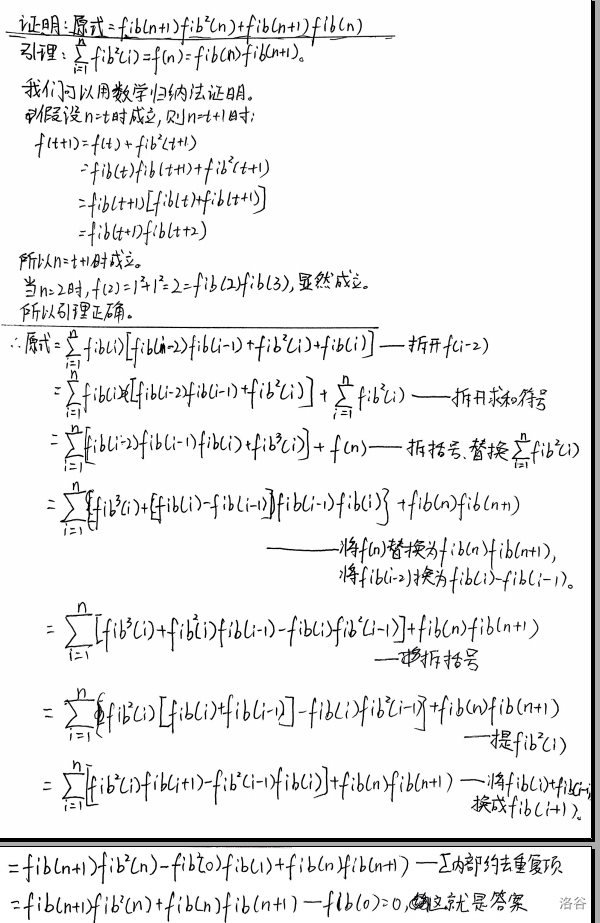
而fib(n)、fib(n+1)只需要一次矩阵快速幂(幂次为n-1)就能一次性求出来。
然后根据推导式计算即可。
注意这个题很卡常,记得常数优化一下。
代码:
点击查看代码
#include<cstdio>
#define gc() (p1==p2&&(p2=(p1=buf)+fread(buf,1,1000096,stdin),p1==p2)?EOF:*p1++)
using namespace std;

long long T,n,mod;
char *p1,*p2,buf[1000100];
struct sw{
	long long mx[3][3];
}a,ans,qwq;
inline sw operator *(const sw &a,const sw &b){
	sw c;
	for(int i=1;i<=2;i++){
		for(int j=1;j<=2;j++){
			c.mx[i][j]=0;
		}
	}
	c.mx[1][1]=(a.mx[1][1]*b.mx[1][1]+a.mx[1][2]*b.mx[2][1])%mod;
	c.mx[2][1]=(a.mx[2][1]*b.mx[1][1]+a.mx[2][2]*b.mx[2][1])%mod;
	c.mx[1][2]=(a.mx[1][1]*b.mx[1][2]+a.mx[1][2]*b.mx[2][2])%mod;
	c.mx[2][2]=(a.mx[2][1]*b.mx[1][2]+a.mx[2][2]*b.mx[2][2])%mod;
	return c;
}

inline long long read(){
    long long x=0;char c=gc();
    while(c<48)c=gc();
    while(c>47)x=(x<<3)+(x<<1)+(c&15),c=gc();
    return x;
}
inline void write(long long x){
	if(x<0) x=-x,putchar('-');
	if(x>9) write(x/10);
	putchar(x%10+'0');
}

int main(){
	T=read();
	while(T--){
		n=read();mod=read();
		if(n==1){
			write(2%mod);//mod是2~1e9+7的,所以千万记得取模!!!否则喜提80pts
			printf("\n");
			continue;
		}
		if(n==2){
			write(4%mod);
			printf("\n");
			continue;
		}
		long long b=n-1;
		a.mx[1][1]=a.mx[1][2]=a.mx[2][1]=1;a.mx[2][2]=0;
		ans.mx[1][1]=ans.mx[2][2]=1;ans.mx[1][2]=ans.mx[2][1]=0;
		qwq.mx[1][1]=qwq.mx[1][2]=1;
		while(b){
			if(b&1){
				ans=ans*a;
			}
			a=a*a;b>>=1;
		}
		qwq=qwq*ans;
		write((qwq.mx[1][1]*qwq.mx[1][2])%mod*(qwq.mx[1][2]+1)%mod);
		printf("\n");
	}
	return 0;
}
课外拓展:P1357
是个状压DP+矩阵加速优化,感兴趣的可以看看。
参考资料:
1.各题题解(不一一展开)
2.快速幂课件(不展开,应该都有)
3.b站视频(声音很小,记得先调大音量)

 浙公网安备 33010602011771号