
检查
#pytorch检验代码
import torch
import torch.nn as nn
import torch.nn.functional as F


class Net(nn.Module):

    def __init__(self):
        super(Net, self).__init__()
        # 1 input image channel, 6 output channels, 5x5 square convolution
        # kernel
        self.conv1 = nn.Conv2d(1, 6, 5)
        self.conv2 = nn.Conv2d(6, 16, 5)
        # an affine operation: y = Wx + b
        self.fc1 = nn.Linear(16 * 5 * 5, 120)
        self.fc2 = nn.Linear(120, 84)
        self.fc3 = nn.Linear(84, 10)

    def forward(self, x):
        # Max pooling over a (2, 2) window
        x = F.max_pool2d(F.relu(self.conv1(x)), (2, 2))
        # If the size is a square you can only specify a single number
        x = F.max_pool2d(F.relu(self.conv2(x)), 2)
        x = x.view(-1, self.num_flat_features(x))
        x = F.relu(self.fc1(x))
        x = F.relu(self.fc2(x))
        x = self.fc3(x)
        return x

    def num_flat_features(self, x):
        size = x.size()[1:]  # all dimensions except the batch dimension
        num_features = 1
        for s in size:
            num_features *= s
        return num_features


net = Net()
print(net)
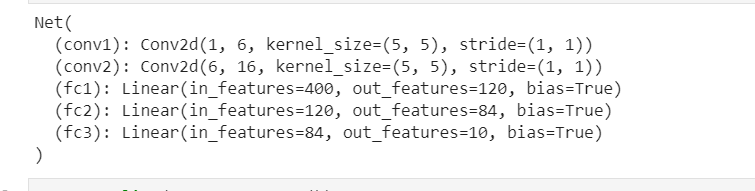
params = list(net.parameters())
print(len(params))
print(params[0].size())  # conv1's .weight
input = torch.randn(1, 1, 32, 32)
out = net(input)
print(out)
net.zero_grad()
out.backward(torch.randn(1, 10))
output = net(input)
target = torch.randn(10)  # a dummy target, for example
target = target.view(1, -1)  # make it the same shape as output
criterion = nn.MSELoss()

loss = criterion(output, target)
print(loss)
print(loss.grad_fn)  # MSELoss
print(loss.grad_fn.next_functions[0][0])  # Linear
print(loss.grad_fn.next_functions[0][0].next_functions[0][0])  # ReLU
net.zero_grad()     # zeroes the gradient buffers of all parameters

print('conv1.bias.grad before backward')
print(net.conv1.bias.grad)

loss.backward()

print('conv1.bias.grad after backward')
print(net.conv1.bias.grad)





#检查TensorFlow
import tensorflow as tf
from tensorflow import keras

# Helper libraries
import numpy as np
import matplotlib.pyplot as plt

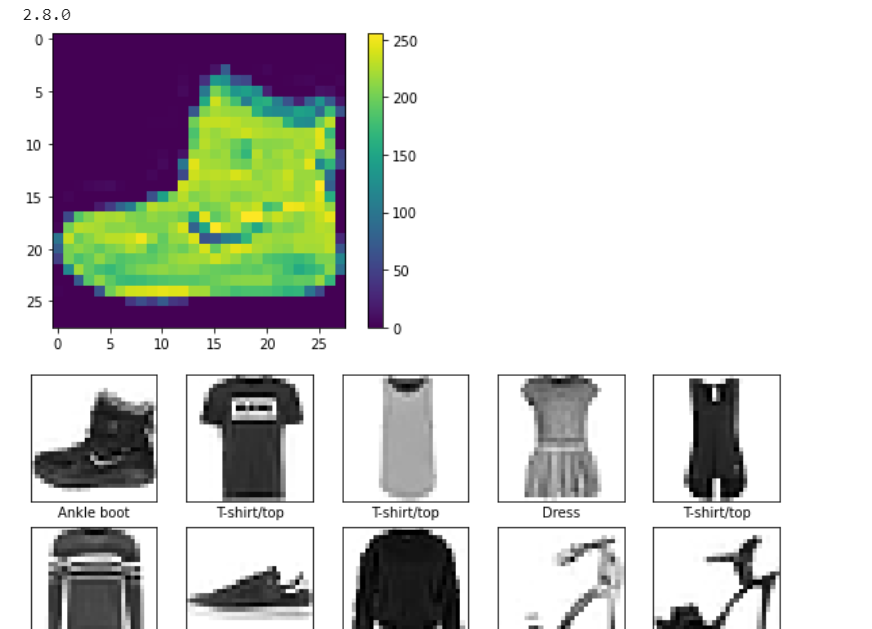
print(tf.__version__)

fashion_mnist = keras.datasets.fashion_mnist

(train_images, train_labels), (test_images, test_labels) = fashion_mnist.load_data()

class_names = ['T-shirt/top', 'Trouser', 'Pullover', 'Dress', 'Coat',
               'Sandal', 'Shirt', 'Sneaker', 'Bag', 'Ankle boot']


plt.figure()
plt.imshow(train_images[0])
plt.colorbar()
plt.grid(False)
plt.show()

train_images = train_images / 255.0

test_images = test_images / 255.0

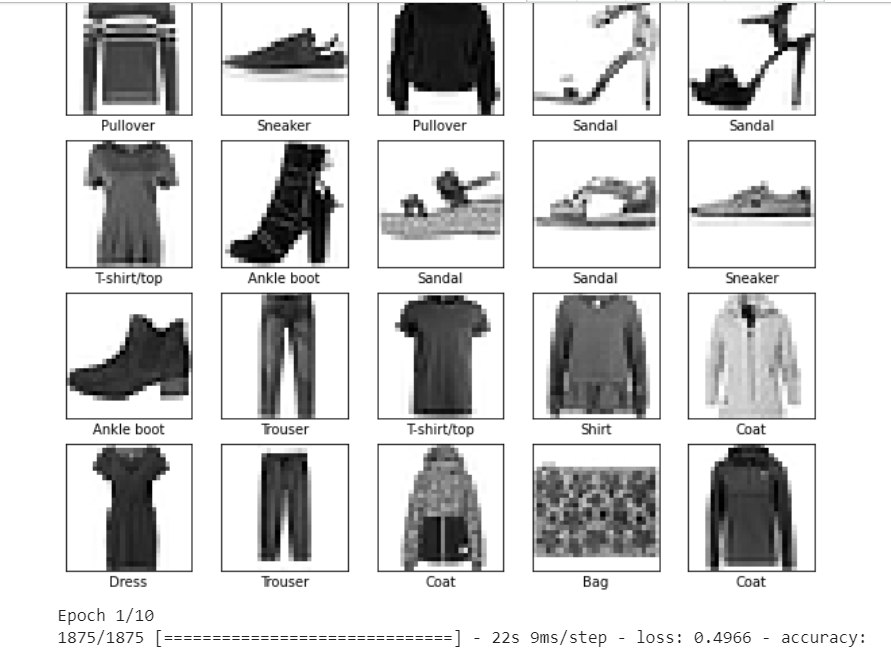
plt.figure(figsize=(10,10))
for i in range(25):
    plt.subplot(5,5,i+1)
    plt.xticks([])
    plt.yticks([])
    plt.grid(False)
    plt.imshow(train_images[i], cmap=plt.cm.binary)
    plt.xlabel(class_names[train_labels[i]])
plt.show()

model = keras.Sequential([
    keras.layers.Flatten(input_shape=(28, 28)),
    keras.layers.Dense(128, activation='relu'),
    keras.layers.Dense(10)
])

model.compile(optimizer='adam',
              loss=tf.keras.losses.SparseCategoricalCrossentropy(from_logits=True),
              metrics=['accuracy'])

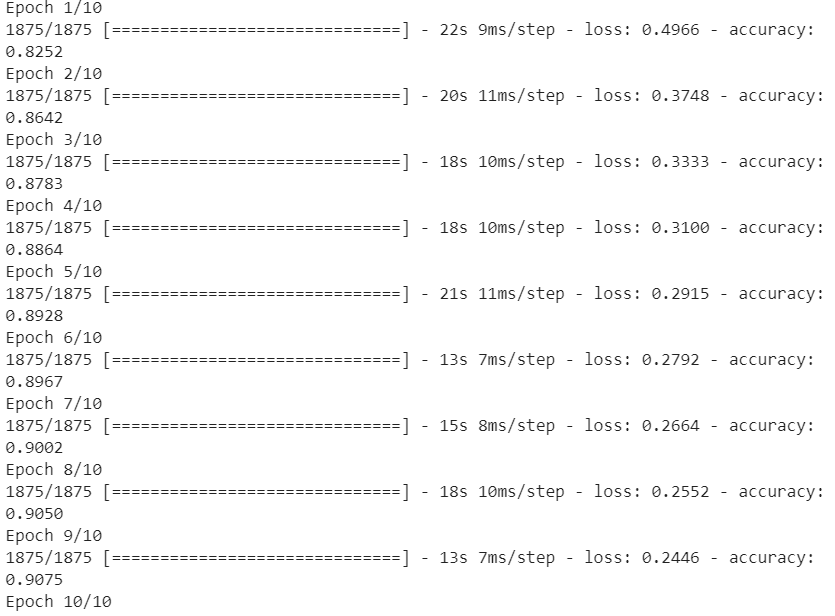
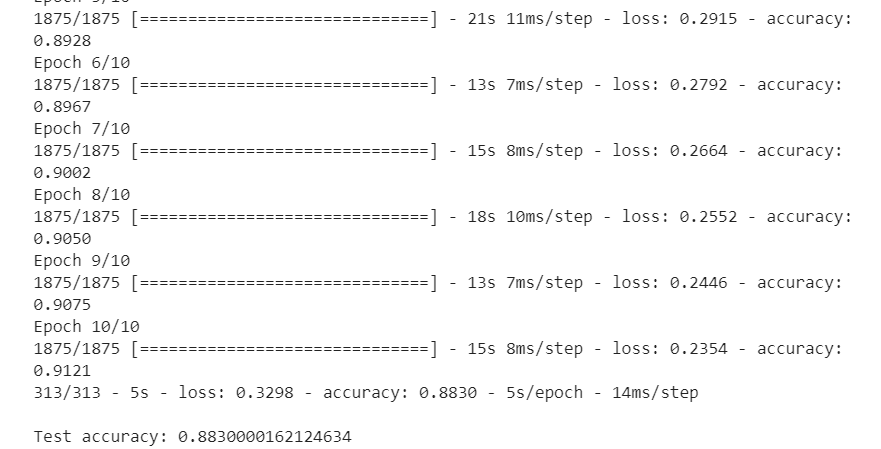
model.fit(train_images, train_labels, epochs=10)

test_loss, test_acc = model.evaluate(test_images,  test_labels, verbose=2)

print('\nTest accuracy:', test_acc)
probability_model = tf.keras.Sequential([model,
                                         tf.keras.layers.Softmax()])

predictions = probability_model.predict(test_images)
def plot_image(i, predictions_array, true_label, img):
  predictions_array, true_label, img = predictions_array, true_label[i], img[i]
  plt.grid(False)
  plt.xticks([])
  plt.yticks([])

  plt.imshow(img, cmap=plt.cm.binary)

  predicted_label = np.argmax(predictions_array)
  if predicted_label == true_label:
    color = 'blue'
  else:
    color = 'red'

  plt.xlabel("{} {:2.0f}% ({})".format(class_names[predicted_label],
                                100*np.max(predictions_array),
                                class_names[true_label]),
                                color=color)
#猫狗识别代码
import tensorflow as tf
from tensorflow import keras
from tensorflow.keras import layers, regularizers
import numpy as np
import os
import cv2
import matplotlib.pyplot as plt


os.environ["CUDA_VISIBLE_DEVICES"] = "1"
resize = 224
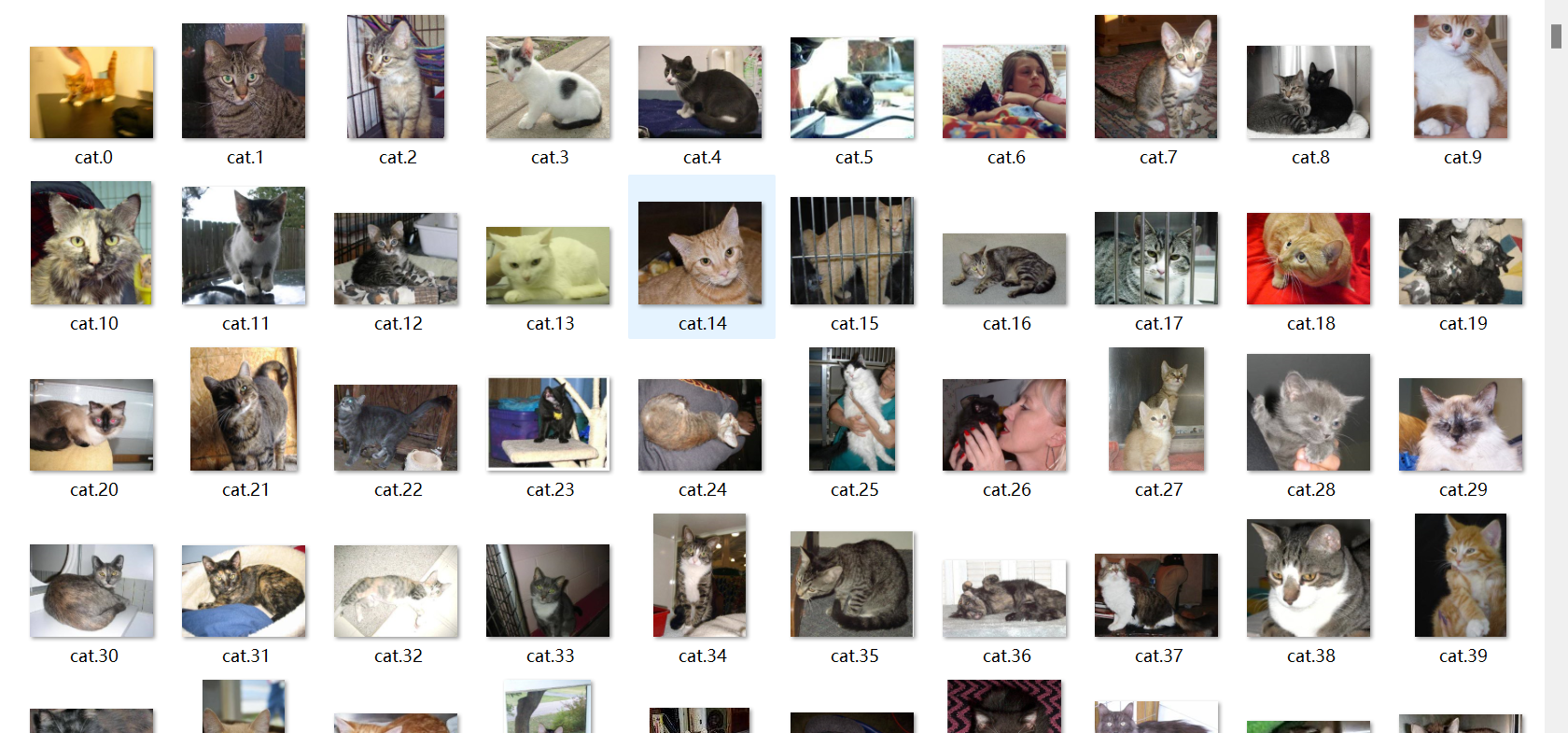
path ="train/"

def load_data():
    imgs = os.listdir(path)
    num = len(imgs)
    train_data = np.empty((5000, resize, resize, 3), dtype="int32")
    train_label = np.empty((5000, ), dtype="int32")
    test_data = np.empty((5000, resize, resize, 3), dtype="int32")
    test_label = np.empty((5000, ), dtype="int32")
    for i in range(5000):
        if i % 2:
            train_data[i] = cv2.resize(cv2.imread(path+'/'+ 'dog.' + str(i) + '.jpg'), (resize, resize))
            train_label[i] = 1
        else:
            train_data[i] = cv2.resize(cv2.imread(path+'/' + 'cat.' + str(i) + '.jpg'), (resize, resize))
            train_label[i] = 0
    for i in range(5000, 10000):
        if i % 2:
            test_data[i-5000] = cv2.resize(cv2.imread(path+'/' + 'dog.' + str(i) + '.jpg'), (resize, resize))
            test_label[i-5000] = 1
        else:
            test_data[i-5000] = cv2.resize(cv2.imread(path+'/' + 'cat.' + str(i) + '.jpg'), (resize, resize))
            test_label[i-5000] = 0
    return train_data, train_label, test_data, test_label
def vgg16():
    weight_decay = 0.0005
    nb_epoch = 100
    batch_size = 32

    # layer1
    model = keras.Sequential()
    model.add(layers.Conv2D(64, (3, 3), padding='same',
                     input_shape=(224, 224, 3), kernel_regularizer=regularizers.l2(weight_decay)))
    model.add(layers.Activation('relu'))
    model.add(layers.BatchNormalization())
    model.add(layers.Dropout(0.3))
    # layer2
    model.add(layers.Conv2D(64, (3, 3), padding='same', kernel_regularizer=regularizers.l2(weight_decay)))
    model.add(layers.Activation('relu'))
    model.add(layers.BatchNormalization())
    model.add(layers.MaxPooling2D(pool_size=(2, 2)))
    # layer3
    model.add(layers.Conv2D(128, (3, 3), padding='same', kernel_regularizer=regularizers.l2(weight_decay)))
    model.add(layers.Activation('relu'))
    model.add(layers.BatchNormalization())
    model.add(layers.Dropout(0.4))
    # layer4
    model.add(layers.Conv2D(128, (3, 3), padding='same', kernel_regularizer=regularizers.l2(weight_decay)))
    model.add(layers.Activation('relu'))
    model.add(layers.BatchNormalization())
    model.add(layers.MaxPooling2D(pool_size=(2, 2)))
    # layer5
    model.add(layers.Conv2D(256, (3, 3), padding='same', kernel_regularizer=regularizers.l2(weight_decay)))
    model.add(layers.Activation('relu'))
    model.add(layers.BatchNormalization())
    model.add(layers.Dropout(0.4))
    # layer6
    model.add(layers.Conv2D(256, (3, 3), padding='same', kernel_regularizer=regularizers.l2(weight_decay)))
    model.add(layers.Activation('relu'))
    model.add(layers.BatchNormalization())
    model.add(layers.Dropout(0.4))
    # layer7
    model.add(layers.Conv2D(256, (3, 3), padding='same', kernel_regularizer=regularizers.l2(weight_decay)))
    model.add(layers.Activation('relu'))
    model.add(layers.BatchNormalization())
    model.add(layers.MaxPooling2D(pool_size=(2, 2)))
    # layer8
    model.add(layers.Conv2D(512, (3, 3), padding='same', kernel_regularizer=regularizers.l2(weight_decay)))
    model.add(layers.Activation('relu'))
    model.add(layers.BatchNormalization())
    model.add(layers.Dropout(0.4))
    # layer9
    model.add(layers.Conv2D(512, (3, 3), padding='same', kernel_regularizer=regularizers.l2(weight_decay)))
    model.add(layers.Activation('relu'))
    model.add(layers.BatchNormalization())
    model.add(layers.Dropout(0.4))
    # layer10
    model.add(layers.Conv2D(512, (3, 3), padding='same', kernel_regularizer=regularizers.l2(weight_decay)))
    model.add(layers.Activation('relu'))
    model.add(layers.BatchNormalization())
    model.add(layers.MaxPooling2D(pool_size=(2, 2)))
    # layer11
    model.add(layers.Conv2D(512, (3, 3), padding='same', kernel_regularizer=regularizers.l2(weight_decay)))
    model.add(layers.Activation('relu'))
    model.add(layers.BatchNormalization())
    model.add(layers.Dropout(0.4))
    # layer12
    model.add(layers.Conv2D(512, (3, 3), padding='same', kernel_regularizer=regularizers.l2(weight_decay)))
    model.add(layers.Activation('relu'))
    model.add(layers.BatchNormalization())
    model.add(layers.Dropout(0.4))
    # layer13
    model.add(layers.Conv2D(512, (3, 3), padding='same', kernel_regularizer=regularizers.l2(weight_decay)))
    model.add(layers.Activation('relu'))
    model.add(layers.BatchNormalization())
    model.add(layers.MaxPooling2D(pool_size=(2, 2)))
    model.add(layers.Dropout(0.5))
    # layer14
    model.add(layers.Flatten())
    model.add(layers.Dense(512, kernel_regularizer=regularizers.l2(weight_decay)))
    model.add(layers.Activation('relu'))
    model.add(layers.BatchNormalization())
    # layer15
    model.add(layers.Dense(512, kernel_regularizer=regularizers.l2(weight_decay)))
    model.add(layers.Activation('relu'))
    model.add(layers.BatchNormalization())
    # layer16
    model.add(layers.Dropout(0.5))
    model.add(layers.Dense(2))
    model.add(layers.Activation('softmax'))

    return model
#if __name__ == '__main__':
train_data, train_label, test_data, test_label = load_data()
train_data = train_data.astype('float32')
test_data = test_data.astype('float32')
train_label = keras.utils.to_categorical(train_label, 2)
test_label = keras.utils.to_categorical(test_label, 2)
#定义训练方法,超参数设置
model = vgg16()
sgd = tf.keras.optimizers.SGD(learning_rate=0.01, decay=1e-6, momentum=0.9, nesterov=True) #设置优化器为SGD
model.compile(loss='categorical_crossentropy', optimizer=sgd, metrics=['accuracy'])
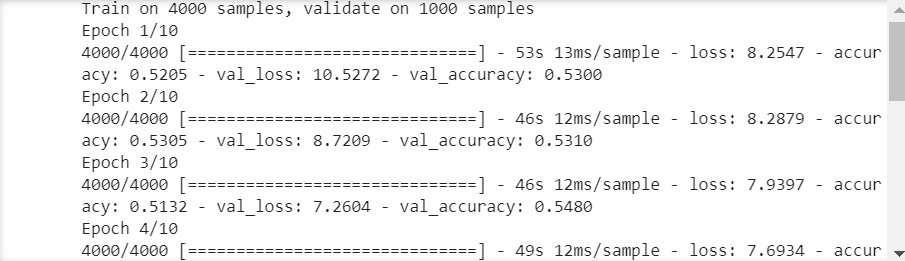
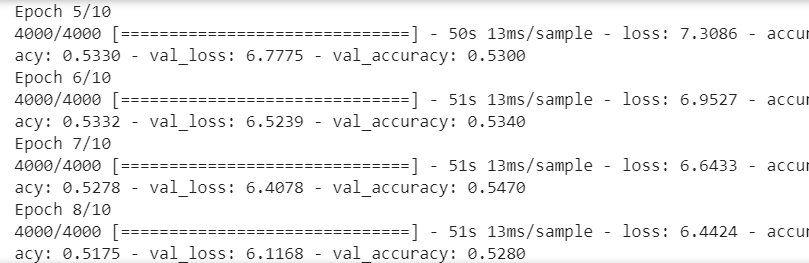
history = model.fit(train_data, train_label,
              batch_size=20,
              epochs=10,
              validation_split=0.2,  #把训练集中的五分之一作为验证集
              shuffle=True)
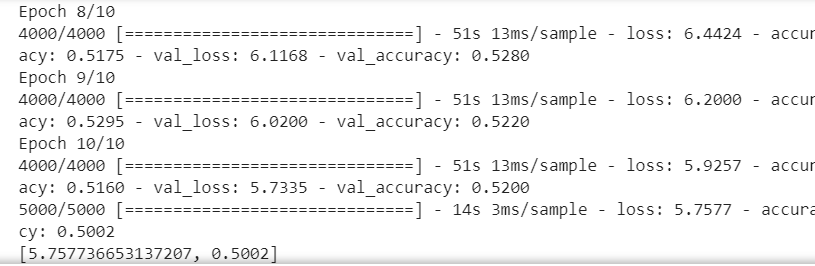
scores = model.evaluate(test_data,test_label,verbose=1)
print(scores)
model.save('model/vgg16dogcat.h5')
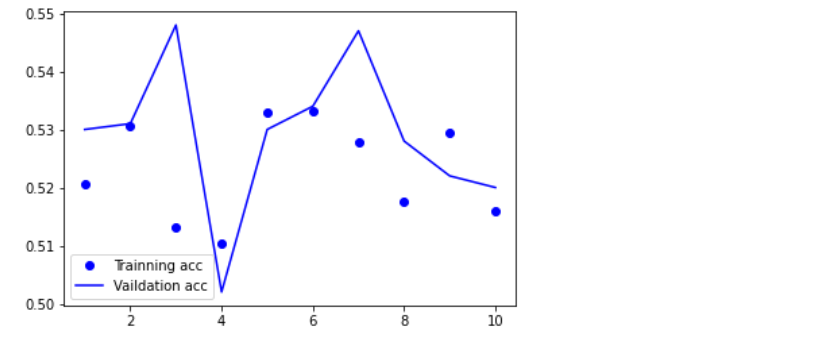
acc = history.history['accuracy'] # 获取训练集准确性数据
val_acc = history.history['val_accuracy'] # 获取验证集准确性数据
loss = history.history['loss'] # 获取训练集错误值数据
val_loss = history.history['val_loss'] # 获取验证集错误值数据
epochs = range(1, len(acc) + 1)
plt.plot(epochs, acc, 'bo', label='Trainning acc') # 以epochs为横坐标,以训练集准确性为纵坐标
plt.plot(epochs, val_acc, 'b', label='Vaildation acc') # 以epochs为横坐标,以验证集准确性为纵坐标
plt.legend() # 绘制图例,即标明图中的线段代表何种含义
plt.show()
#BP神经网络检验代码
#2022-03-22
#导入相应的库
import numpy as np
import torch
import torch.nn as nn
import torch.nn.functional as F
import os
from scipy import stats
import pandas as pd
#数据的导入
titanic_data = pd.read_csv(r"C:\Users\86133\Desktop\titanic3.csv")
print(titanic_data.columns )#打印列名
#用哑变量将指定字段转成one-hot
titanic_data = pd.concat([titanic_data,
pd.get_dummies(titanic_data['sex']),
pd.get_dummies(titanic_data['embarked'],prefix="embark"),
pd.get_dummies(titanic_data['pclass'],prefix="class")], axis=1)
#处理None值
titanic_data["age"] = titanic_data["age"].fillna(titanic_data["age"].mean())
titanic_data["fare"] = titanic_data["fare"].fillna(titanic_data["fare"].mean())#乘客票价
#删去无用的列
titanic_data = titanic_data.drop(['name','ticket','cabin','boat','body','home.dest','sex','embarked','pclass'], axis=1)
print(titanic_data.columns )
titanic_data.to_excel(r"C:\Users\86133\Desktop\data_survived.xlsx")
#分离样本和标签
labels = titanic_data["survived"].to_numpy()
data_features = titanic_data.drop(['survived'], axis=1)
data = data_features.to_numpy()
#样本的属性名称
feature_names = list(titanic_data.columns)
#将样本分为训练和测试两部分
from sklearn.model_selection import train_test_split
train_features,test_features,train_labels,test_labels = train_test_split(data,labels,test_size=0.3,random_state=10)
class Mish(nn.Module):#Mish激活函数
def __init__(self):
super().__init__()
print("Mish activation loaded...")
def forward(self,x):
x = x * (torch.tanh(F.softplus(x)))
return x
torch.manual_seed(0) #设置随机种子
#构建一个三层网络12-8-2
class ThreelinearModel(nn.Module):
def __init__(self):
super().__init__()
self.linear1 = nn.Linear(12, 5)
self.mish1 = Mish()
self.linear2 = nn.Linear(5, 9)
self.mish2 = Mish()
self.linear3 = nn.Linear(9, 7)
self.mish3 = Mish()
self.linear4 = nn.Linear(7, 12)
self.mish4 = Mish()
self.linear5 = nn.Linear(12, 8)
self.softmax = nn.Softmax(dim=1)
self.criterion = nn.CrossEntropyLoss() #定义交叉熵函数
def forward(self, x): #定义一个全连接网络
lin1_out = self.linear1(x)
out1 = self.mish1(lin1_out)
out2 = self.mish2(self.linear2(out1))
return self.softmax(self.linear3(out2))
def getloss(self,x,y): #实现LogicNet类的损失值计算接口
y_pred = self.forward(x)
loss = self.criterion(y_pred,y)#计算损失值得交叉熵
return loss
net = ThreelinearModel()#模型实例化
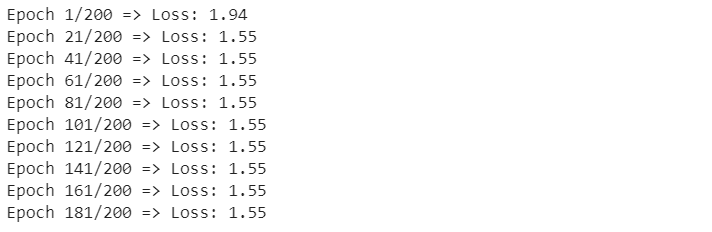
num_epochs = 200 #迭代数次
optimizer = torch.optim.Adam(net.parameters(), lr=0.04) #优化器选择Adam,只有一个参数学习率
#把特征和标签值转成torch张量形式
input_tensor = torch.from_numpy(train_features).type(torch.FloatTensor)
label_tensor = torch.from_numpy(train_labels)
losses = []#定义列表,用于接收每一步的损失值
for epoch in range(num_epochs):
loss = net.getloss(input_tensor,label_tensor)
losses.append(loss.item())
optimizer.zero_grad()#清空之前的梯度。
loss.backward()#反向传播损失值
optimizer.step()#更新参数
if epoch % 20 == 0:
print ('Epoch {}/{} => Loss: {:.2f}'.format(epoch+1, num_epochs, loss.item()))
#.item()方法 是得到一个元素张量里面的元素值
os.makedirs('models', exist_ok=True)
#os.makedirs自动创建一个文件夹models
#如果exist_ok为True,则在目标目录已存在的情况下不会触发FileExistsError异常。
torch.save(net.state_dict(), 'models/titanic_model.pht') #保存模型
import matplotlib.pyplot as plt
def moving_average(a, w=10):#定义函数计算移动平均损失值
    if len(a) < w:
        return a[:]
    return [val if idx < w else sum(a[(idx-w):idx])/w for idx, val in enumerate(a)]
#enumerate() 函数用于将一个可遍历的数据对象(如列表、元组或字符串)组合为一个索引序列,同时列出数据和数据下标,一般用在 for 循环当中。
def plot_losses(losses):
    avgloss= moving_average(losses) #获得损失值的移动平均值
    print(len(avgloss))
    plt.figure(1)
    plt.subplot(211)
    plt.plot(range(len(avgloss)), avgloss, 'b--')
    plt.xlabel('step number')
    plt.ylabel('Training loss')
    plt.title('step number vs. Training loss')
    plt.show()
#输出训练结果
out_probs = net(input_tensor).detach().numpy()
out_classes = np.argmax(out_probs, axis=1)
print("Train Accuracy:", sum(out_classes == train_labels) / len(train_labels))

#测试模型
test_input_tensor = torch.from_numpy(test_features).type(torch.FloatTensor)
out_probs = net(test_input_tensor).detach().numpy()
out_classes = np.argmax(out_probs, axis=1)
print("Test Accuracy:", sum(out_classes == test_labels) / len(test_labels))


 浙公网安备 33010602011771号