
Python学习笔记第18天
谏言:穷则独善其身,达则兼善天下
# 创建RandomWalk类
import matplotlib.pyplot as plt
from random import choice

class RandomWalk():
    """一个生成随机漫步数据的表"""

    def __init__(self,num_points=5000):
        """初始化随机漫步的属性"""
        self.num_points=num_points

        # 所有随机漫步都始于(0,0)
        self.x_values=[0]
        self.y_values=[0]
    def fill_walk(self):
        """计算随机漫步包含的所有点"""
        # 不断漫步,直到列表达到指定的长度
        while len(self.x_values) <self.num_points:
            # 决定前进方向以及沿着个方向前进的距离
            x_direction = choice([1,-1])
            x_distance = choice([0,1,2,3,4])
            x_step=x_direction * x_distance

            y_direction = choice([1,-1])
            y_distance = choice([0,1,2,3,4])
            y_step=y_direction * y_distance

            # 拒绝原地踏步
            if x_step==0 and y_step==0:
                continue

            # 计算下一个点的x和y值
            next_x=self.x_values[-1]+x_step
            next_y=self.y_values[-1]+y_step

            self.x_values.append(next_x)
            self.y_values.append(next_y)

while True:
    # from random_walk import RandomWalk
    # 创建一个RandomWalk实例,并将其包含的点都会指出来
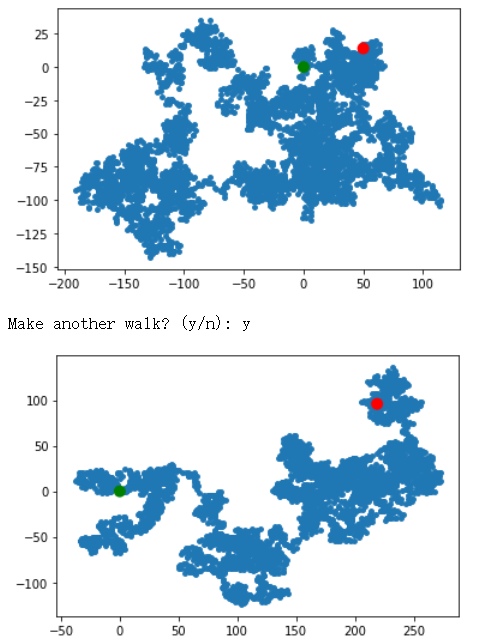
    rw=RandomWalk()
    rw.fill_walk()
    plt.scatter(rw.x_values,rw.y_values,s=15)


    plt.scatter(0,0,c='green',edgecolors='none',s=100)
    plt.scatter(rw.x_values[-1], rw.y_values[-1], c='red', edgecolors='none', s=100)

    # 隐藏坐标轴

    plt.show()

    keep_running = input("Make another walk? (y/n): ")
    if keep_running == 'n':
        break
import matplotlib.pyplot as plt
from random import choice

class RandomWalk():
    """一个生成随机漫步数据的表"""

    def __init__(self,num_points=5000):
        """初始化随机漫步的属性"""
        self.num_points=num_points

        # 所有随机漫步都始于(0,0)
        self.x_values=[0]
        self.y_values=[0]
    def fill_walk(self):
        """计算随机漫步包含的所有点"""
        # 不断漫步,直到列表达到指定的长度
        while len(self.x_values) <self.num_points:
            # 决定前进方向以及沿着个方向前进的距离
            x_direction = choice([1,-1])
            x_distance = choice([0,1,2,3,4])
            x_step=x_direction * x_distance

            y_direction = choice([1,-1])
            y_distance = choice([0,1,2,3,4])
            y_step=y_direction * y_distance

            # 拒绝原地踏步
            if x_step==0 and y_step==0:
                continue

            # 计算下一个点的x和y值
            next_x=self.x_values[-1]+x_step
            next_y=self.y_values[-1]+y_step

            self.x_values.append(next_x)
            self.y_values.append(next_y)

while True:
    # from random_walk import RandomWalk
    # 创建一个RandomWalk实例,并将其包含的点都会指出来
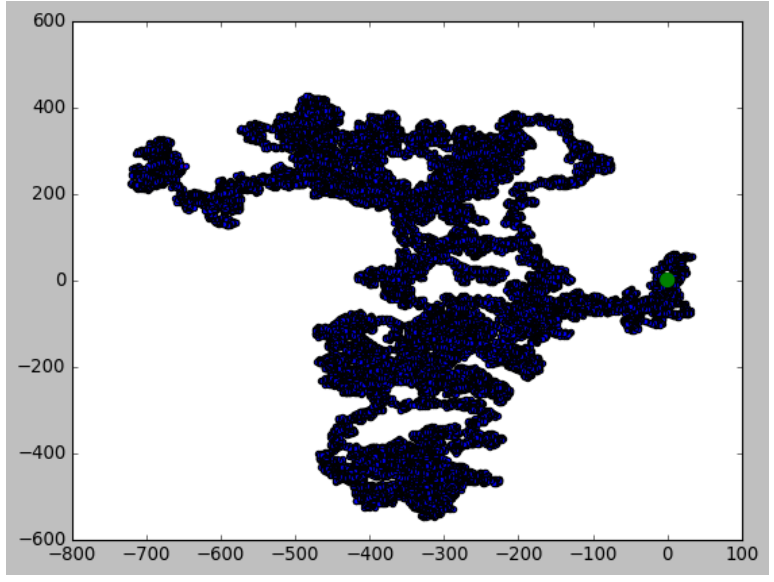
    rw=RandomWalk(50000)
    rw.fill_walk()
    plt.scatter(rw.x_values,rw.y_values,s=15)


    plt.scatter(0,0,c='green',edgecolors='none',s=100)
    plt.scatter(rw.x_values[-1], rw.y_values[-1], c='red', edgecolors='none', s=1)

    # 隐藏坐标轴

    plt.show()

    keep_running = input("Make another walk? (y/n): ")
    if keep_running == 'n':
        break
import matplotlib.pyplot as plt
from random import choice

class RandomWalk():
    """一个生成随机漫步数据的表"""

    def __init__(self,num_points=5000):
        """初始化随机漫步的属性"""
        self.num_points=num_points

        # 所有随机漫步都始于(0,0)
        self.x_values=[0]
        self.y_values=[0]
    def fill_walk(self):
        """计算随机漫步包含的所有点"""
        # 不断漫步,直到列表达到指定的长度
        while len(self.x_values) <self.num_points:
            # 决定前进方向以及沿着个方向前进的距离
            x_direction = choice([1,-1])
            x_distance = choice([0,1,2,3,4])
            x_step=x_direction * x_distance

            y_direction = choice([1,-1])
            y_distance = choice([0,1,2,3,4])
            y_step=y_direction * y_distance

            # 拒绝原地踏步
            if x_step==0 and y_step==0:
                continue

            # 计算下一个点的x和y值
            next_x=self.x_values[-1]+x_step
            next_y=self.y_values[-1]+y_step

            self.x_values.append(next_x)
            self.y_values.append(next_y)

while True:
    # from random_walk import RandomWalk
    # 创建一个RandomWalk实例,并将其包含的点都会指出来
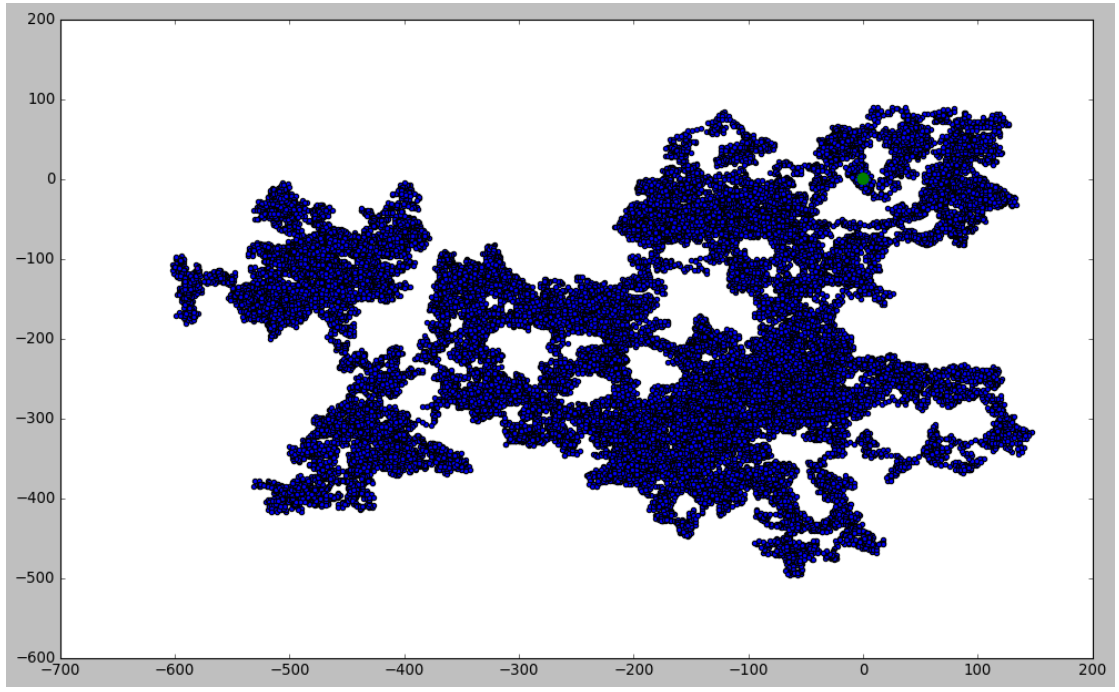
    rw=RandomWalk(50000)
    rw.fill_walk()
    # 设置窗口的尺寸
    plt.figure(figsize=(15, 9))
    plt.scatter(rw.x_values,rw.y_values,s=15)


    plt.scatter(0,0,c='green',edgecolors='none',s=100)
    plt.scatter(rw.x_values[-1], rw.y_values[-1], c='red', edgecolors='none', s=1)

    # 隐藏坐标轴

    plt.show()

    keep_running = input("Make another walk? (y/n): ")
    if keep_running == 'n':
        break
import matplotlib.pyplot as plt

# from random_walk import RandomWalk

# Keep making new walks, as long as the program is active.
while True:
    # Make a random walk.
    rw = RandomWalk(50000)
    rw.fill_walk()

    # Plot the points in the walk.
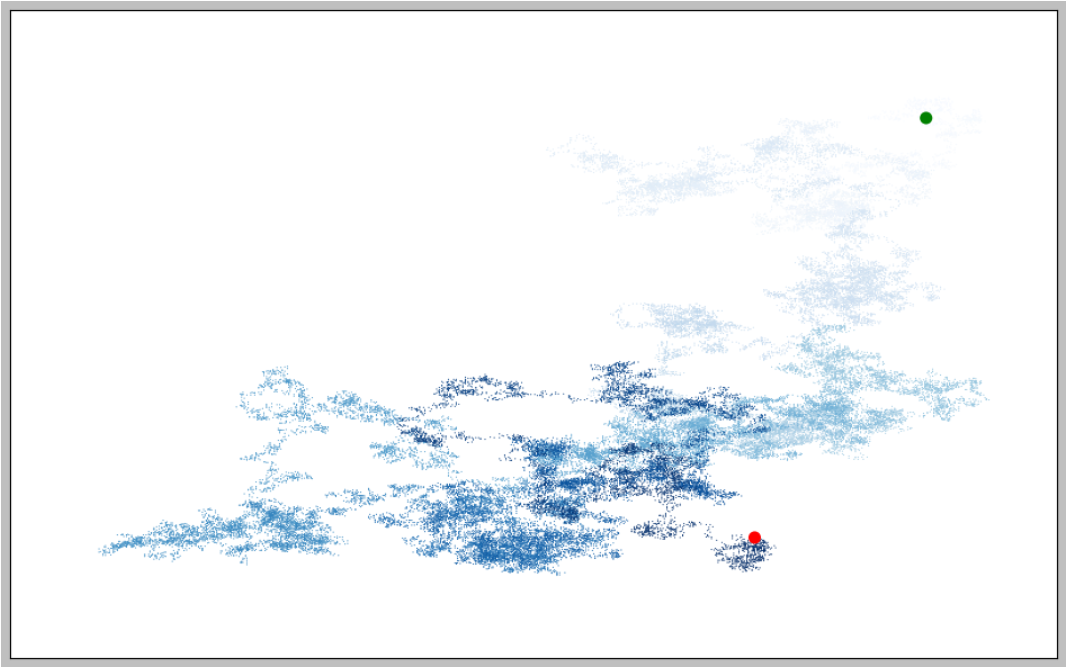
    plt.style.use('classic')
    fig, ax = plt.subplots(figsize=(15, 9))
    point_numbers = range(rw.num_points)
    ax.scatter(rw.x_values, rw.y_values, c=point_numbers, cmap=plt.cm.Blues,
        edgecolors='none', s=1)

    # Emphasize the first and last points.
    ax.scatter(0, 0, c='green', edgecolors='none', s=100)
    ax.scatter(rw.x_values[-1], rw.y_values[-1], c='red', edgecolors='none',
        s=100)

    # Remove the axes.
    ax.get_xaxis().set_visible(False)
    ax.get_yaxis().set_visible(False)

    plt.show()

    keep_running = input("Make another walk? (y/n): ")
    if keep_running == 'n':
        break
# 使用Pygal模拟骰子
# die.py
from random import randint

class Die():
    """表示一个骰子的类"""
    def __init__(self,num_sides=6):
        self.num_sides=num_sides

    def roll(self):
        """返回一个位于1和骰子面数之间的随机值"""
        return randint(1,self.num_sides)


# die_visual.py
# from die import Die
die=Die()
# 掷几次骰子,并将结果存储在一个列表中
results=[]
for roll_num in range(100):
    result =die.roll()
    results.append(result)
print(results)
[5, 3, 3, 4, 2, 5, 2, 1, 4, 4, 1, 4, 2, 3, 2, 6, 4, 3, 4, 1, 1, 5, 4, 5, 6, 5, 1, 3, 6, 5,
3, 3, 5, 3, 2, 4, 2, 2, 1, 1, 3, 2, 4, 3, 6, 4, 3, 1, 6, 6, 4, 1, 2, 3, 4, 6, 6, 4, 4, 6,
 6, 4, 6, 4, 1, 3, 3, 4, 3, 2, 6, 6, 5, 5, 1, 4, 1, 5, 3, 1, 6, 1, 1, 1, 2, 2, 6, 5, 4,
 1, 3, 4, 5, 3, 5, 2, 4, 6, 6, 1]
# die.py
from random import randint

class Die():
    """表示一个骰子的类"""
    def __init__(self,num_sides=6):
        self.num_sides=num_sides

    def roll(self):
        """返回一个位于1和骰子面数之间的随机值"""
        return randint(1,self.num_sides)


# die_visual.py
# from die import Die
die=Die()
# 掷几次骰子,并将结果存储在一个列表中
results=[]
for roll_num in range(1000):
    result =die.roll()
    results.append(result)
frequencies=[]
for value in range(1,die.num_sides+1):
    frequency= results.count(value)
    frequencies.append(frequency)
print(frequencies)
[180, 169, 156, 151, 177, 167]

 浙公网安备 33010602011771号