寻找数组中第K大是数
- 解题思路
1. 初始化数组来存放序列
2. 遍历序列元素
3. 将第k大的数据存入结果数组中
4. 调用Arraylist的sort方法从大到小排序
5. 输出
- 代码
import java.util.ArrayList;
import java.util.Scanner;

public class sor{
    public static void main(String[] args) {
        Scanner sc = new Scanner(System.in);
        // 序列长度
        int n = sc.nextInt();

        //存放序列
        ArrayList<Integer> list = new ArrayList<>();
        // 存放排序的序列
        ArrayList<Integer> lists = new ArrayList<>();

        //初始化序列
        for (int i = 0;i < n;i++){
            list.add(i,sc.nextInt());
        }
        // 询问个数
        int m = sc.nextInt();

        // 遍历个数
        for (int i = 0;i < m;i++){
            // 初始位置第l个数
            int l = sc.nextInt();
            // 到达位置第r个数
            int r = sc.nextInt();
            // 询问第K大的数
            int K = sc.nextInt();

            // 存入数组
            for (int j = l - 1;j < r;j++){
                lists.add(list.get(j));
            }

            // 从大到小排序
            lists.sort(null);
            // 输出询问的答案
            System.out.println(lists.get(lists.size() - K));

            lists.clear();
        }
    }
}
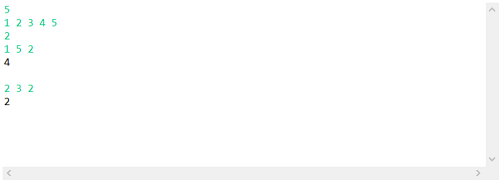
- 运行结果
![]()
二叉树的先、中、后 序遍历与层级遍历
- 解题思路
1.先序遍历:根在前,从左往右,一棵树的根永远在左子树前面,左子树又永远在右子树前面
2.中序遍历:根在中,从左往右,一棵树的左子树永远在根前面,根永远在右子树前
3.后序遍历:根在后,从左往右,一棵树的左子树永远在右子树前面,右子树永远在根前面
4.层级遍历:就是按层,从上到下,从左到右遍历
- 代码
import java.util.LinkedList;
public class Tree{


        public static void main(String[] args) {
            /*
                作业要求:叉树的先、中、后 序遍历与层级遍历
                自己实现四个方法,main方法中调用,将结果打印到控制台
             */
            /*  二叉树的结构
                         A
                        / \
                       T   6
                      /
                     D
                   /   \
                  N     5
                 / \    /
                B   4  1
                     \
                      9
             */
            Node root = into();
            // 先序遍历
            System.out.println("\n"+"前序遍历");
            A(root);
            // 中序遍历
            System.out.println("\n"+"中序遍历");
            B(root);
            // 后续遍历
            System.out.println("\n"+"后续遍历");
            C(root);
            // 层级遍历
            System.out.println("\n"+"层级遍历");
            D(root);

        }

        private static void A(Node node) {
            // TODO 先序遍历
            System.out.print(node.data + "\t");
            if(node.l != null){
                A(node.l);
            }
            if(node.r != null){
                A(node.r);
            }

        }
        private static void B(Node node) {
            // TODO 中序遍历
            if(node.l != null){
                B(node.l);
            }
            System.out.print(node.data + "\t");
            if(node.r != null){
                B(node.r);
            }
        }
        private static void C(Node node) {
            // TODO 后续遍历
            if(node.l != null){
                C(node.l);
            }
            if(node.r != null){
                C(node.r);
            }
            System.out.print(node.data + "\t");
        }

        private static void D(Node node) {
            // TODO 层级遍历
            if(node == null) {
                return ;
            }
            LinkedList<Node> queue = new LinkedList<>();
            Node current = null;
            queue.offer(node);
            while(!queue.isEmpty()) {
                current = queue.poll();
                System.out.print(current.data+ "\t");
                if(current.l != null) {
                    queue.offer(current.l);
                }
                if(current.r != null) {
                    queue.offer(current.r);
                }
            }
        }

        // 构建一颗树,返回根节点
        private static Node into(){
            Node root = new Node("A");
            Node node1 = new Node("T");
            Node node2 = new Node("D");
            Node node3 = new Node("N");
            Node node4 = new Node("B");
            Node node5 = new Node("6");
            Node node6 = new Node("5");
            Node node7 = new Node("4");
            Node node8 = new Node("9");
            Node node9 = new Node("1");
            root.l = node1;
            node1.l = node2;
            node2.l = node3;
            node2.r = node6;
            node3.r = node7;
            node7.r = node8;
            node6.l = node9;
            node3.l = node4;
            root.r = node5;
            return root;
        }

        // 节点
        static class Node{
            // 数据
            Object data;
            // 左孩子
            Node l;
            // 右孩子
            Node r;

            public Node(){}

            public Node(Object data) {
                this.data = data;
                this.l = null;
                this.r = null;
            }

            public Node(Object data, Node l, Node r) {
                this.data = data;
                this.l = l;
                this.r = r;
            }
        }
}
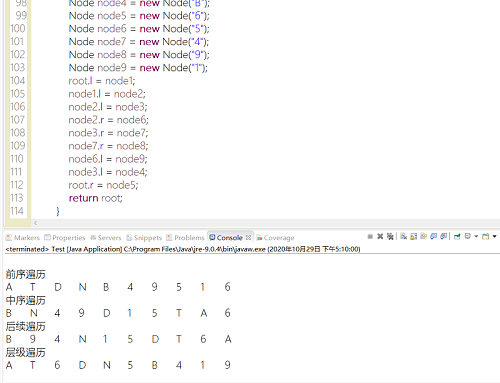
- 运行结果
![]()


 浙公网安备 33010602011771号