


实验二
实验任务一:
源代码:
T.h


 1 #pragma once
 2 #include<string>
 3 class T
 4 {
 5     public:
 6         T(int x = 0, int y = 0);   // 普通构造函数
 7         T(const T& t);  // 复制构造函数
 8         T(T&& t);
 9         // 移动构造函数
10         ~T();
11         // 析构函数
12         void adjust(int ratio);
13         void display() const;
14     private:
15         int m1, m2;
16         // 类属性、方法
17     public:
18         static int get_cnt();
19     public:
20         static const std::string doc;
21         static const int max_cnt;
22     private:
23         static int cnt;
24         friend void func();
25 };
26 void func();
T.cpp
 1 #include "T.h"
 2 #include <iostream>
 3 #include <string>
 4 // 类T实现
 5 // static成员数据类外初始化
 6 const std::string T::doc{ "a simple class sample" };
 7 const int T::max_cnt = 999;
 8 int T::cnt = 0;
 9 // 类方法
10 int T::get_cnt() {
11     return cnt;
12 }
13 T::T(int x, int y) : m1{ x }, m2{ y } {
14     ++cnt;
15     std::cout << "T constructor called.\n";
16 }
17 T::T(const T& t) : m1{ t.m1 }, m2{ t.m2 } {
18     ++cnt;
19     std::cout << "T copy constructor called.\n";
20 }
21 T::T(T&& t) : m1{ t.m1 }, m2{ t.m2 } {
22     ++cnt;
23     std::cout << "T move constructor called.\n";
24 }
25 T::~T() {
26     --cnt;
27     std::cout << "T destructor called.\n";
28 }
29 void T::adjust(int ratio) {
30     m1 *= ratio;
31     m2 *= ratio;
32 }
33 void T::display() const {
34     std::cout << "(" << m1 << ", " << m2 << ")";
35 }
36 // 普通函数实现
37 void func() {
38     T t5(42);
39     t5.m2 = 2049;
40     std::cout << "t5 = "; t5.display(); std::cout << '\n';
41 }
task1.cpp
 1 #include "T.h"
 2 #include <iostream>
 3 void test_T();
 4
 5 int main() {
 6     std::cout << "test Class T: \n";
 7     test_T();
 8     std::cout << "\ntest friend func: \n";
 9     func();
10 }
11 void test_T() {
12     using std::cout;
13     using std::endl;
14     cout << "T info: " << T::doc << endl;
15     cout << "T objects'max count: " << T::max_cnt << endl;
16     cout << "T objects'current count: " << T::get_cnt() << endl << endl;
17     T t1;
18     cout << "t1 = "; t1.display(); cout << endl;
19     T t2(3, 4);
20     cout << "t2 = "; t2.display(); cout << endl;
21     T t3(t2);
22     t3.adjust(2);
23     cout << "t3 = "; t3.display(); cout << endl;
24     T t4(std::move(t2));
25     cout << "t4 = "; t4.display(); cout << endl;
26     cout << "test: T objects'current count: " << T::get_cnt() << endl;
27 }
运行结果截图:
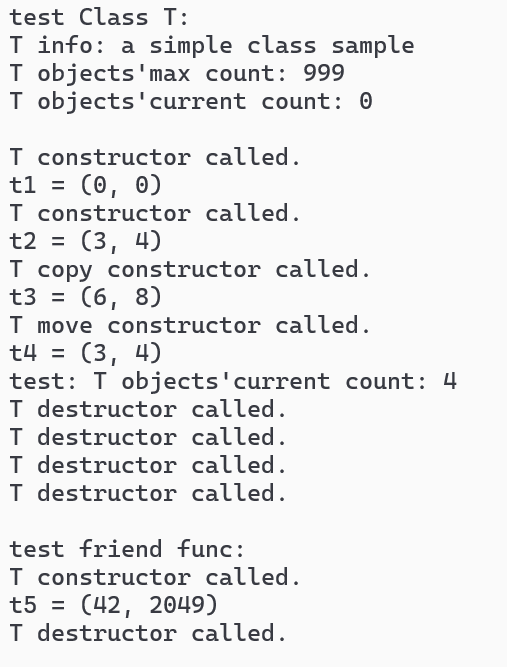
回答问题:
1.
.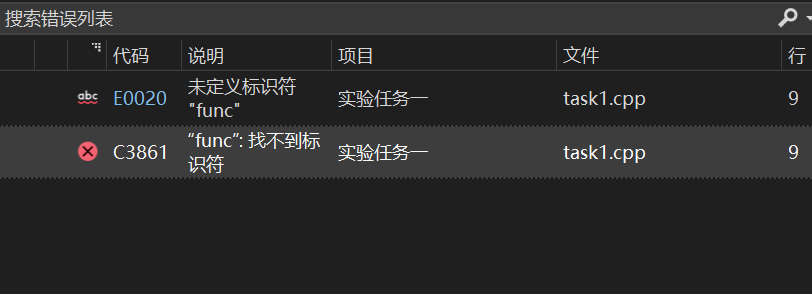
不能,原因:在类 T 内部声明func()为友元函数时,仅仅表示func可以访问 T 的私有成员,但func本身的函数声明仍需在类外部进行。当去掉类外部的func()的声明后,在程序运行时,编译器无法找到func的函数声明,导致编译错误。
2.(1)普通构造函数 T(int x=0,int y=0);
功能:初始化对象的私有成员变量 m1 和 m2,若无声明,则默认m1,m2=0;
调用时机:T.cpp line49 :T t5(42) ;默认m2=0。
task1.cpp line22 :T ti; line 25:T t2(3,4);
(2)复制构造函数 T(const T &t);
功能:通过已定义的对象 t 复制其成员变量 m1 和 m2 到新对象中;
调用时机:task1.cpp line28: T t3(t2); 将t2中的对象值m1,m2复制到对象t3中。
(3)移动构造函数 T(T &&t);
功能:通过 “右值引用” 获取临时对象 t 的成员变量 m1 和 m2,直接复用资源,减少内存开销。
调用时机:task1.cpp line32:T t4(std::move(t2)); 用std::move()右值引用,初始化t4.
(4)析构函数 ~T();
功能:清理被销毁的对象。
调用时机:函数(main函数等)执行结束时,局部对象销毁时等。
3.

不能。原因:在原代码中,T.cpp的 line8-10 是 T类静态成员 doc,max_cnt,cnt的定义。这些定义是关于 T 类的完整声明(在 T.h 中),且必须在类外部(即全局作用域,且 T 类已声明的前提下)进行定义。当将这些代码剪切到 T.h 的末尾时,虽然 T 类已声明,但静态成员的定义语法要求必须在类外部。在实际编译时,编译器会严格检查静态成员定义与类的作用域关联,由于头文件可能被多次包含,且静态成员定义不允许重复,这种将定义放入头文件的做法会导致链接错误,即重复定义。
实验任务二:
源代码:
Complex.h
 1 #pragma once
 2 #include<string>
 3 using namespace std;
 4 class Complex
 5 {
 6
 7 private:
 8      double real, imag;
 9 public:
10     Complex(double x = 0, double y = 0);
11     Complex(const Complex& t);
12
13
14     static const string doc;
15
16
17     double get_real() const { return real; };
18     double get_imag() const { return imag; };
19
20     void add(const Complex& t) {
21         real += t.real;
22         imag += t.imag;
23     }
24
25     friend void output(const Complex &t);
26     friend double abs(const Complex &t);
27     friend Complex add(const Complex &c1,const Complex &c2);
28     friend bool is_equal(Complex c1, Complex c2);
29     friend bool is_not_equal(Complex c1, Complex c2);
30
31 };
32 void output(const Complex &t);
33 double abs(const Complex &t);
34 Complex add(const Complex &c1,const  Complex &c2);
35 bool is_equal(Complex c1, Complex c2);
36 bool is_not_equal(Complex c1, Complex c2);
Complex.cpp
 1 #include "Complex.h"
 2 #include<string>
 3 #include<iostream>
 4 #include<cmath>
 5 using namespace std;
 6 const string Complex::doc{ "a simplified complex class" };
 7
 8 Complex::Complex(double x, double y) {
 9     real = x;
10     imag = y;
11 }
12 Complex::Complex(const Complex& t) {
13     real = t.real;
14     imag = t.imag;
15 }
16
17
18 void output(const Complex &t) {
19     if (t.imag >= 0)
20         cout << t.real << '+' << t.imag << 'i' << '\n';
21
22     else
23         cout << t.real << '-' << -t.imag << 'i' << '\n';
24
25 }
26 double abs(const Complex& t) {
27     double ans ;
28     ans = sqrt(t.real * t.real + t.imag * t.imag);
29     return ans;
30 }
31 Complex add(const Complex &c1, const Complex &c2) {
32     Complex c;
33     c.real = c1.real + c2.real;
34     c.imag = c1.imag + c2.imag;
35     return c;
36 }
37 bool is_equal(Complex c1, Complex c2) {
38     return ((c1.real == c2.real) && (c1.imag == c2.imag));
39 }
40 bool is_not_equal(Complex c1, Complex c2) {
41     return ((c1.real != c2.real) || (c1.imag != c2.imag));
42 }
task2.cpp
 1 // 待补足头文件
 2 // xxx
 3 #include"Complex.h"
 4 #include <iostream>
 5 #include <iomanip>
 6 #include <complex>
 7 void test_Complex();
 8 void test_std_complex();
 9 int main() {
10     std::cout << "*******测试1: 自定义类Complex*******\n";
11     test_Complex();
12     std::cout << "\n*******测试2: 标准库模板类complex*******\n";
13     test_std_complex();
14 }
15 void test_Complex() {
16     using std::cout;
17     using std::endl;
18     using std::boolalpha;
19     cout << "类成员测试: " << endl;
20     cout << Complex::doc << endl << endl;
21     cout << "Complex对象测试: " << endl;
22     Complex c1;
23     Complex c2(3, -4);
24     Complex c3(c2);
25     Complex c4 = c2;
26     const Complex c5(3.5);
27     cout << "c1 = "; output(c1); cout << endl;
28     cout << "c2 = "; output(c2); cout << endl;
29     cout << "c3 = "; output(c3); cout << endl;
30     cout << "c4 = "; output(c4); cout << endl;
31     cout << "c5.real = " << c5.get_real()
32         << ", c5.imag = " << c5.get_imag() << endl << endl;
33     cout << "复数运算测试: " << endl;
34     cout << "abs(c2) = " << abs(c2) << endl;
35     c1.add(c2);
36     cout << "c1 += c2, c1 = "; output(c1); cout << endl;
37     cout << boolalpha;
38     cout << "c1 == c2 : " << is_equal(c1, c2) << endl;
39     cout << "c1 != c2 : " << is_not_equal(c1, c2) << endl;
40     c4 = add(c2, c3);
41     cout << "c4 = c2 + c3, c4 = "; output(c4); cout << endl;
42 }
43 void test_std_complex() {
44     using std::cout;
45     using std::endl;
46     using std::boolalpha;
47     cout << "std::complex<double>对象测试: " << endl;
48     std::complex<double> c1;
49     std::complex<double> c2(3, -4);
50     std::complex<double> c3(c2);
51     std::complex<double> c4 = c2;
52     const std::complex<double> c5(3.5);
53     cout << "c1 = " << c1 << endl;
54     cout << "c2 = " << c2 << endl;
55     cout << "c3 = " << c3 << endl;
56     cout << "c4 = " << c4 << endl;
57     cout << "c5.real = " << c5.real()
58         << ", c5.imag = " << c5.imag() << endl << endl;
59     cout << "复数运算测试: " << endl;
60     cout << "abs(c2) = " << abs(c2) << endl;
61     c1 += c2;
62     cout << "c1 += c2, c1 = " << c1 << endl;
63     cout << boolalpha;
64     cout << "c1 == c2 : " << (c1 == c2) << endl;
65     cout << "c1 != c2 : " << (c1 != c2) << endl;
66     c4 = c2 + c3;
67     cout << "c4 = c2 + c3, c4 = " << c4 << endl;
68 }
运行测试截图:
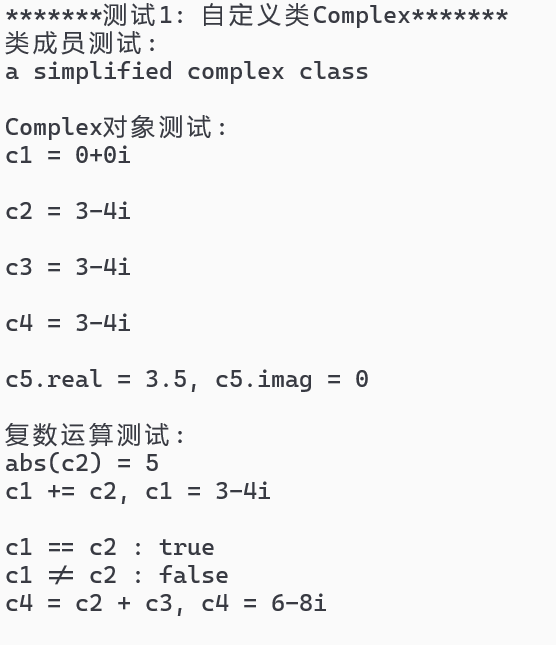
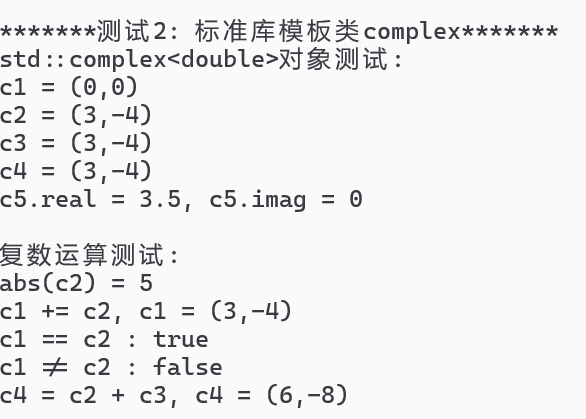
比较自定义类Complex和标准库模板类complex的使用,回答问题:
问题1: 比较自定义类Complex和标准库模板类complex的用法,在使用形式上,哪一种更简洁?函数和运算内在有关联吗?
标准库模板更简洁。有关联,数学逻辑基本一致,标准库更为简洁。
问题2:
2-1:自定义Complex中, output/abs/add/ 等均设为友元,它们真的需要访问 私有数据 吗?(回答“是/否”并 给出理由)
是;理由:output 需要读取 real 和 imag 才能格式化输出;abs 需要用 real 和 imag 计算模长;add 需要将两个复数的 real 和 imag 分别相加。若不声明为友元,这些函数无法直接访问私有成员,只能通过 get_real() 和 get_imag() 间接获取,而设为友元后,它们可以直接访问,简化了代码。
2-2:标准库 std::complex 是否把 abs 设为友元?(查阅 cppreference后回答)
根据 cppreference ,abs 是一个非成员函数(全局函数),而非 std::complex 的友元。std::complex 提供了 real() 和 imag() 成员函数(公有的访问接口),abs 函数通过这两个接口获取实部和虚部,无需作为友元直接访问私有成员。
2-3:什么时候才考虑使用 friend?总结你的思考
需要直接访问私有成员的函数(如output函数)或者两个关系紧密的类,可以通过设立友元来减少代码量。但应谨慎使用友元,避免其破坏类的封闭性。实践中优先使用公有成员函数实现。
问题3: 如果构造对象时禁用=形式,即遇到Complex c4 = c2;编译报错,类Complex的设计应如何调整?
删除拷贝构造函数,可以使用 = delete 显式删除拷贝构造函数,使其无法被调用。Complex(const Complex&t) = delete;
实验任务三
源代码:
PlayerControl.h
 1 #pragma once
 2 #include <string>
 3 enum class ControlType { Play, Pause, Next, Prev, Stop, Unknown };
 4 class PlayerControl {
 5 public:
 6     PlayerControl();
 7
 8     ControlType parse(const std::string& control_str);   // 实现std::string --> ControlType转换
 9     void execute(ControlType cmd) const;   // 执行控制操作(以打印输出模拟)
10     static int get_cnt();
11
12 private:
13     static int total_cnt;
14 };
PlayerControl.cpp
 1 #include "PlayerControl.h"
 2 #include <iostream>
 3 #include <algorithm>
 4 int PlayerControl::total_cnt = 0;
 5 PlayerControl::PlayerControl() {}
 6 // 待补足
 7 // 1. 将输入字符串转为小写,实现大小写不敏感
 8 // 2. 匹配"play"/"pause"/"next"/"prev"/"stop"并返回对应枚举
 9 // 3. 未匹配的字符串返回ControlType::Unknown
10  // 4. 每次成功调用parse时递增total_cnt
11 ControlType PlayerControl::parse(const std::string& control_str) {
12     std::string s;
13     for (auto c : control_str) {
14         s += tolower(c);
15     }
16     ControlType ans;
17     if (s == "play") {
18         ans = ControlType::Play;
19     }
20     else if (s == "pause") {
21         ans = ControlType::Pause;
22     }
23     else if (s == "next") {
24         ans = ControlType::Next;
25     }
26     else if (s == "prev") {
27         ans = ControlType::Prev;
28     }
29     else if (s == "stop") {
30         ans = ControlType::Stop;
31     }
32     else {
33         ans = ControlType::Unknown;  // 未匹配的命令
34     }
35     total_cnt++;
36     return ans;
37 }
38 void PlayerControl::execute(ControlType cmd) const {
39     switch (cmd) {
40     case ControlType::Play:  std::cout << "[play] Playing music...\n"; break;
41     case ControlType::Pause: std::cout << "[Pause] Music paused\n";    break;
42     case ControlType::Next:  std::cout << "[Next] Skipping to next track\n"; break;
43     case ControlType::Prev:  std::cout << "[Prev] Back to previous track\n"; break;
44     case ControlType::Stop:  std::cout << "[Stop] Music stopped\n"; break;
45     default:                 std::cout << "[Error] unknown control\n"; break;
46     }
47 }
48 int PlayerControl::get_cnt() {
49     return total_cnt;
50 }
tesk3
 1 #include "PlayerControl.h"
 2 #include <iostream>
 3 void test() {
 4     PlayerControl controller;
 5     std::string control_str;
 6     std::cout << "Enter Control: (play/pause/next/prev/stop/quit):\n";
 7     while (std::cin >> control_str) {
 8         if (control_str == "quit")
 9             break;
10
11         ControlType cmd = controller.parse(control_str);
12         controller.execute(cmd);
13         std::cout << "Current Player control: " << PlayerControl::get_cnt() << "\n\n";
14     }
15 }
16 int main() {
17     test();
18 }
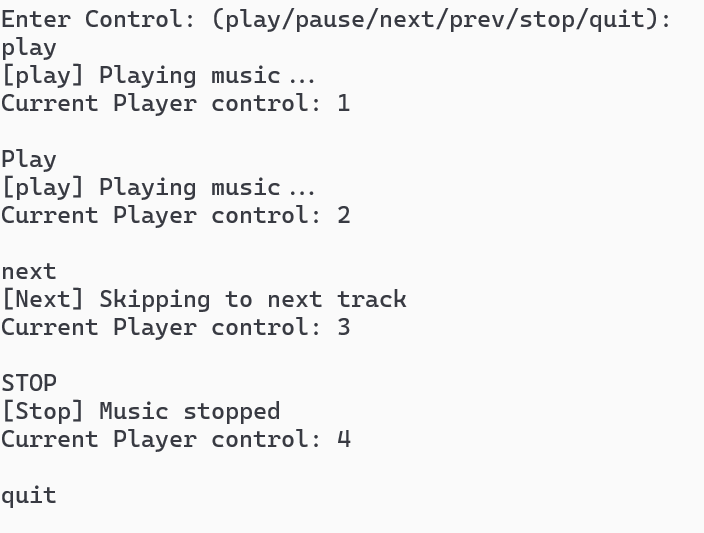
运行测试截图
实验任务四:
源代码:
Fraction.h
 1 #pragma once
 2 #include<string>
 3 #include<cstdlib>
 4 #include<numeric>
 5
 6 using namespace std;
 7
 8 class Fraction
 9 {
10
11 private:
12     int up, down;
13 public:
14     static const string doc;
15
16     Fraction(int x, int y = 1)  {
17         bool sign;
18         if (x > 0 && y < 0 || x < 0 && y>0) sign = 0;
19         else sign = 1;
20         up = abs(x);down = abs(y);
21         int r = gcd(up, down);
22         up /= r;down /= r;
23         if (!sign) up = -up;
24     }
25     Fraction(const Fraction& t) :up{ t.up }, down{t.down}{}
26
27     int get_up() const{ return up; }
28     int get_down() const{ return down; }
29     Fraction negative()const {
30         return Fraction(-up,down);
31
32     }
33
34     friend void output(const Fraction &t);
35     friend Fraction add(const Fraction &f1, const Fraction &f2);
36     friend Fraction sub(const Fraction &f1, const Fraction &f2);
37     friend Fraction mul(const Fraction &f1, const Fraction &f2);
38     friend Fraction div(const Fraction &f1, const Fraction &f2);
39 };
40 void output(const Fraction& t);
41 Fraction add(const Fraction& f1, const Fraction& f2);
42 Fraction sub(const Fraction& f1, const Fraction& f2);
43 Fraction mul(const Fraction& f1, const Fraction& f2);
44 Fraction div(const Fraction& f1, const Fraction& f2);
Fraction.cpp
 1 #include "Fraction.h"
 2 #include<iostream>
 3 #include<string>
 4 #include<cstdlib>
 5 #include<numeric>
 6 using namespace std;
 7
 8 const string Fraction::doc{ "Fraction类 v 0.01版." };
 9
10 void output(const Fraction& t) {
11     if (t.get_down() == 0) {
12         cout << "分母不能为0" ;
13         return;
14     }
15     if (t.get_down() != 1)
16         cout << t.get_up() << '/' << t.get_down() ;
17     else
18         cout << t.get_up() ;
19 }
20 Fraction add(const Fraction& f1, const Fraction& f2) {
21     int up1 = f1.get_up(), down1 = f1.get_down(),
22         up2 = f2.get_up(), down2 = f2.get_down();
23     if (up1 > 0 && down1 < 0 ) {
24         up1 = -up1;
25         down1 = -down1;
26     }
27     else {
28         down1 = abs(down1);
29     }
30     if (up2 > 0 && down2 < 0) {
31         up2 = -up2;
32         down2 = -down2;
33     }
34     else {
35         down2 = abs(down2);
36     }
37     int r = gcd(down1, down2);
38     int up, down;
39     up = up1 * (down2 / r) + up2 * (down1 / r);
40     down = down1 * down2 / r;
41
42     return Fraction(up, down);
43 }
44 Fraction sub(const Fraction& f1, const Fraction& f2) {
45     return add(f1,f2.negative());
46 }
47 Fraction mul(const Fraction& f1, const Fraction& f2) {
48     return Fraction(f1.get_up() * f2.get_up(), f1.get_down() * f2.get_down());
49 }
50 Fraction div(const Fraction& f1, const Fraction& f2) {
51     return Fraction(f1.get_up() * f2.get_down(), f1.get_down() * f2.get_up());
52 }
task4.cpp
 1 #include "Fraction.h"
 2 #include <iostream>
 3 void test1();
 4 void test2();
 5 int main() {
 6     std::cout << "测试1: Fraction类基础功能测试\n";
 7     test1();
 8     std::cout << "\n测试2: 分母为0测试: \n";
 9     test2();
10 }
11 void test1() {
12     using std::cout;
13     using std::endl;
14     cout << "Fraction类测试: " << endl;
15     cout << Fraction::doc << endl << endl;
16     Fraction f1(5);
17     Fraction f2(3, -4), f3(-18, 12);
18     Fraction f4(f3);
19     cout << "f1 = "; output(f1); cout << endl;
20     cout << "f2 = "; output(f2); cout << endl;
21     cout << "f3 = "; output(f3); cout << endl;
22     cout << "f4 = "; output(f4); cout << endl;
23
24     const Fraction f5(f4.negative());
25     cout << "f5 = "; output(f5); cout << endl;
26     cout << "f5.get_up() = " << f5.get_up()
27         << ", f5.get_down() = " << f5.get_down() << endl;
28     cout << "f1 + f2 = "; output(add(f1, f2)); cout << endl;
29     cout << "f1 - f2 = "; output(sub(f1, f2)); cout << endl;
30     cout << "f1 * f2 = "; output(mul(f1, f2)); cout << endl;
31     cout << "f1 / f2 = "; output(div(f1, f2)); cout << endl;
32     cout << "f4 + f5 = "; output(add(f4, f5)); cout << endl;
33 }
34 void test2() {
35     using std::cout;
36     using std::endl;
37     Fraction f6(42, 55), f7(0, 3);
38     cout << "f6 = "; output(f6); cout << endl;
39     cout << "f7 = "; output(f7); cout << endl;
40     cout << "f6 / f7 = "; output(div(f6, f7)); cout << endl;
41 }
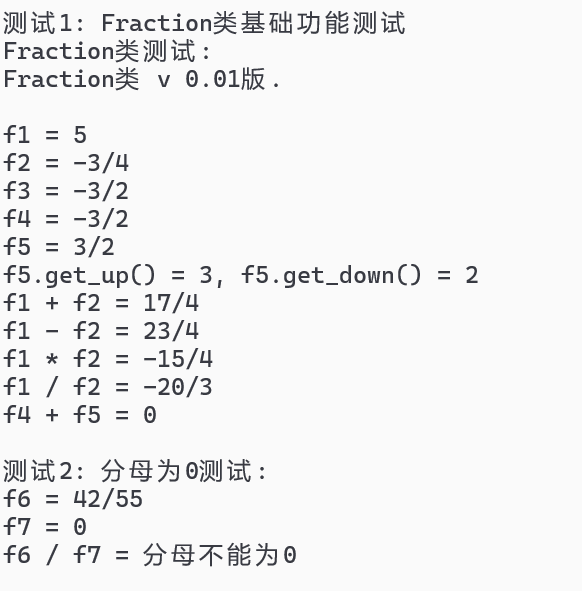
运行结果截图:
分数的输出和计算, output/add/sub/mul/div ,你选择的是哪一种设计方案?(友元/自由函数/命名空间+自由函数/类+static) 你的决策理由?如友元方案的优缺点、静态成员函数方案的适用场景、命名空间方案的考虑因素等
友元;理由:代码简洁,无需通过get_up()/get_down()接口间接访问私有成员,直接操作分子和分母,代码编写更为灵活。但友元也存在明显缺点:破坏封装性,权限失控,扩展性差等。静态成员函数方案的适用场景:提供 “与类相关但独立于对象实例” 的功能。命名空间通过隔离作用域、强化模块化、支持扩展、兼容灵活的运算符重载等特性,为分数类的运算和输出功能提供了清晰、可维护的设计框架。其核心是在 “不破坏类封装” 的前提下,将相关功能组织成独立模块,同时避免命名冲突和代码冗余,尤其适合需要长期维护、功能可能扩展的场景。

 浙公网安备 33010602011771号