
A theory of information need for information retrieval that connects information to knowledge (阅读笔记)
注释
(2023/9/16 下午9:27:06)
摘要
“A Theory of Information Need for Information Retrieval That Connects Information to Knowledge” (Cole, 2011, p. 1216) 🔤将信息与知识联系起来的信息检索的信息需求理论🔤
“proposes a theory of information need for information retrieval (IR)” (Cole, 2011, p. 1216) 🔤提出信息检索(IR)的信息需求理论🔤
“Information need traditionally denotes the start state for someone seeking information, which includes information search using an IR system.” (Cole, 2011, p. 1216) 传统上,信息需求是指某人寻求信息的起始状态,其中包括使用红外系统进行信息搜索。
“The dominant, computer science perspective is that the user needs to find an answer to a well-defined question which is easy for the user to formulate into a query to the system.” (Cole, 2011, p. 1216) 占主导地位的计算机科学观点是,用户需要找到明确定义的问题的答案,该答案很容易让用户将其表述为对系统的查询。
简介
“The goal of the present article” (Cole, 2011, p. 1216) 本文的目标
“to carefully analyze Taylor’s (1968)influential four-level information need model, which posits the deepest level as intangible and nonspecifiable—“a description of an area of doubt” that is “inexpressible in linguistic terms” (Taylor, 1968, pp. 179, 182). Starting from Taylor’s four-level model of information need, we will show a theoretical outline for a knowledgebased rather than the purely information-based theory of information need of present IR system design, a nuance Taylor acknowledged “may” be at the heart of his model (Taylor, 1968, p. 189).” (Cole, 2011, p. 1216) 仔细分析泰勒(1968)颇具影响力的四级信息需求模型,该模型将最深层的信息需求视为无形且不可指定的——“对可疑领域的描述”,“无法用语言术语表达”(泰勒,1968,第 179 页) ,182)。从泰勒的信息需求四层模型开始,我们将展示当前 IR 系统设计的基于知识而非纯粹基于信息的信息需求理论的理论轮廓,泰勒承认“可能”是他的理论的核心。(泰勒,1968 年,第 189 页)。

(Cole, 2011, p. 1217) 意义构建

(Cole, 2011, p. 1217) 进化适应/觅食
“Information Behaviors—i.e., information need is analyzed in terms of the Information Behaviors which it initiates.” (Cole, 2011, p. 1217) 信息行为——即,根据信息需求引发的信息行为来分析信息需求。
“information seeking, search and use; problem, problematic situation and task; sense making and evolutionary adaptation/information foraging” (Cole, 2011, p. 1216) 🔤信息寻求、搜索和使用;问题、有问题的情况和任务;意义建构和进化适应/信息搜寻🔤
-
Information Seeking
信息搜寻,是为了满足人的信息需求而通过不同的信息源获取信息的行为(inboth human and technological contexts)。这里的信息源可以是身边的朋友、手里的报纸,也可以是iPhone7。举个栗子:你通过学姐、老师、招生网站等不同的渠道了解某高校情报学专业的招生信息,这就是seeking。
-
Information Search
信息搜索,search更多指用户使用特定的信息系统搜索信息,强调其在信息交互过程中产生的行为,专指性很强。举个栗子:你在百度搜索图书馆学的招生院校,你对返回的搜索结果进行选择、比较、评价等。
-
信息检索,很多高校的信息检索课多用这个词表达, retrieval侧重表达从检索系统、网上数据库中get到各种文本信息的过程,鉴于此,也有国外学者(如Byström,Hansen等)认为它属于Information search的特例。
参考链接:https://www.sohu.com/a/115575101_488672
当然,我可以用中文解释这些术语:
1. **信息检索(Information Seeking)**:
- **信息检索** 是主动寻找特定信息或知识以满足特定需求或好奇心的过程。这可以包括各种方法,例如在线搜索、咨询专家、阅读书籍或进行实验。信息检索是人类认知的基本方面,对于学习、决策制定、问题解决和保持信息更新至关重要。
2. **搜索与使用(Search and Use)**:
- **搜索** 在这个背景下指的是积极寻找信息的行为。这可以涉及使用搜索引擎、图书馆、数据库或其他资源来找到相关信息。
- **使用** 指的是应用获得的信息来满足特定需求或任务。在找到信息后,个人利用它来做决策、解决问题、完成任务或更好地理解某个主题。
3. **问题、问题情境和任务(Problem, Problematic Situation, and Task)**:
- **问题** 是需要解决或解决的情况或挑战。通常涉及障碍或未答之问题。解决问题涉及找到解决这些挑战的方法。
- **问题情境** 是一个更广泛的概念,包括不仅仅是明确定义的问题,还包括存在不确定性、模糊性或需要改进的情况。它可能没有清晰的表述,可能需要进行理解和信息检索,以了解并解决它。
- **任务** 是需要完成的特定行动或一组行动,以实现特定目标。任务可能是解决问题或处理问题情境的一部分。
4. **意义构建(Sense Making)**:
- **意义构建** 是从信息中构建意义或理解的过程,通常发生在信息复杂、模糊或不完整的情况下。它涉及组织和解释信息,以形成一种连贯的思维模型或叙述,帮助个人理解他们的环境或手头的任务。
5. **进化适应/信息觅食(Evolutionary Adaptation/Information Foraging)**:
- **进化适应** 在信息检索和意义构建的背景下指的是这些行为随着时间的推移作为人类的有利特征而进化的概念。有效地寻找和使用信息的能力很可能在生存、学习和决策方面提供了进化优势。
- **信息觅食** 是从生态学中借来的比喻概念。它描述了个体如何以类似于动物觅食食物的方式来收集和处理信息。人们像觅食的动物一样,在何处以及如何搜索信息方面做出决策,以最大化其信息检索效率和知识获取。
这些概念通常相互关联,对于人们如何在信息丰富的世界中导航、做决策以及适应不断变化的环境起着重要作用。
这三大类是从信息需求概念化中衍生出来的,信息需求是一个黑盒子,黑盒子的输入类别(情境)和输出类别(信息行为)是黑盒子的输入类别和输出类别。第三个类别,即人的条件,包含了对信息需求的最新、全面的看法。在这三大类中,文章按照图 1 所示的编号方法,一个接一个地简要概述了八个相邻/替代概念。不过,每个概念描述的重点是其与信息需求理论发展的关系,因此并不是完整的描述。在整篇文章中,我们离开了代用/相邻概念描述,在我们称之为 "迈向理论 "的章节中为发展中的理论创建了六个命题。这些命题构成了理论的核心。在文章末尾,我们用这些命题的摘要和两张图表来表达这一理论。
Information Behaviors
“The essence of information search, compared to the broader concepts of information behavior and information seeking, is that the user must formulate a query or question to an information system to make the system work.” (Cole, 2011, p. 1217)
信息搜索的本质是用户必须向信息系统提出查询或问题,以使系统发挥作用。提出查询要求用户具有特定的思维方式。
“Taylor theorized that the information system (librarian or IR system)must negotiate the question from the compromised expression of the need, which Taylor calls level Q4, through the Q3 formal expression of the need, to the Q2 level which was the conscious “within brain description of the need” (Taylor, 1968, p. 182). The deepest Q1 level of the need, however, is, Taylor claimed, “visceral” (i.e., instinctual)” (Cole, 2011, p. 1218)
泰勒提出了一个理论,即信息系统(图书馆员或投资者关系系统)必须对问题进行协商,从对需求的折衷表达(泰勒称之为 Q4 级)到 Q3 级对需求的正式表达,再到 Q2 级对需求的有意识的 "脑内描述"(Taylor, 1968, p.182)。然而,泰勒认为,需求的最深层次 Q1 是 "内脏"(即本能)
“But system-oriented IR system designers treat the query as a given, the user command that commences the system’s work of matching the symbols that make up the query with symbols in the index system for the content stored in the system’s database.” (Cole, 2011, p. 1218)
但以系统为导向的 IR 系统设计者将查询视为一个给定的概念,即系统开始将构成查询的符号与系统数据库中存储的内容的索引系统中的符号进行匹配的用户命令。
“two types of information search” (Cole, 2011, p. 1218)
1. 当用户 "确切地知道他想要什么,并能描述其形式(书籍、纸张等)和标签(作者和书名)"(Taylor, 1968, p.191)时的命令式信息检索;作为对命令的回应,"查询者会得到一个特定的包","顾名思义",这个包能满足查询者的要求
2. 当用户向系统提问时,并不知道他/她将从系统中得到的答案或答案的形式,这种信息搜索称为未知项目或未知答案(或答案的形式)搜索。这类搜索的其他标签包括探索式搜索、结构不良问题搜索、主题搜索或话题搜索
“Towards Theory: Proposition 1
“Proposition 1: Users are motivated to seek and search for information by an information need which is comprised of Taylor’s four levels.” (Cole, 2011, p. 1219)
命题 1:用户寻求和搜索信息的动机是信息需求,包括泰勒的四个层次。支持: 根据泰勒的模型,不存在纯命令式的信息需求。相反,存在着不同类型的搜索,其中一些具有命令意图(获取已知项目或已知形式的答案),另一些则具有问题意图(当用户不知道项目或答案的形式时,探索一个主题领域)。不过,这两类搜索都是出于四个层次的信息需求。
We label the two different interpretations of Taylor’s four-level model of information need the Vertical Interpretation and the Horizontal Interpretation.”
走向理论: 命题 1 我们将泰勒信息需求四层次模型的两种不同解释分别称为 "垂直解释 "和 "水平解释"。
“We wish here to add an important nuance to Bates’s berrypicking model of information search. When the user is in a pre-focus or exploratory stage of information seeking, it is only aspects of the user’s information need (topic, etc.) the user selects to investigate that evolve and shift over the course of a search session, not the information need itself. In Figure 3 it is the topic aspects the user selects to investigate that evolves or shifts over the course of the search, not the user’s information need.” (Cole, 2011, p. 1221)
走向理论: 命题 2 我们希望在此为贝茨的信息搜索 "采摘浆果 "模型补充一个重要的细微差别。当用户处于信息搜索的前聚焦或探索阶段时,用户选择调查的只是用户信息需求的各个方面(主题等),而不是信息需求本身,这些方面会在搜索过程中发生演变和变化。
“Proposition 2: The user’s information need does not evolve; only aspects of the topic the user selects to investigate evolve or shift over the course of an information search.” (Cole, 2011, p. 1221)
命题 2:用户的信息需求不会发生变化;在信息搜索过程中,用户选择调查的主题只会发生变化或转移。
“Proposition 3: Information use evolves as the user’s information seeking progresses through the Pre-focus, Focusing, and Post-focus stages.” (Cole, 2011, p. 1222)
命题 3:信息使用会随着用户的信息搜索经历 "聚焦前"、"聚焦 "和 "聚焦后 "三个阶段而演变。
“The information seeking perspective, on the other hand, assumes the user’s need for information is based on formulating questions and asking questions based on an information need” (Cole, 2011, p. 1222)
另一方面,信息搜索视角假定用户对信息的需求是基于信息需求提出问题和提问。
“Proposition 4: The information system envisaged by the information seeking perspective is in fact a knowledge retrieval/formulation system which facilitates the user formulating and elaborating an information need knowledge structure. The knowledge structure is actualized when the user links his or her information search Q4 compromisedneed commands to the deeper Q1–Q3 question levels of the user’s information need.” (Cole, 2011, p. 1223)
命题 4:信息搜索视角所设想的信息系统实际上是一个知识检索/表述系统,它有助于用 户表述和阐述信息需求知识结构。当用户将其信息搜索 Q4 妥协命令与用户信息需求的 Q1-Q3 深层次问题联系起来时,知识结构就实现了。
“Proposition 5: Socially imposed information need frames based on information-based task will, if properly presented to user by information system, effectuate a deeper understanding of information need in the user.” (Cole, 2011, p. 1226)
命题 5:基于信息任务的社会强加信息需求框架,如果信息系统能恰当地向用户展示,就能加深用户对信息需求的理解。
“Proposition 6: Information need is at its deepest Q1 level primarily a human adaptive mechanism—at the level of human perception, at the level of society and the world in which the individual operates, and at the level of survival as a species. Adaptation is motivated by (a)a survival imperative but also (b)an existential imperative (i.e., seeking meaning in the tunnel), with imperative (b) perhaps being the conduit to imperative (a).” (Cole, 2011, p. 1227)
命题 6:信息需求在其最深层的 Q1 层次上主要是一种人类适应机制--在人类感知的层 面上,在社会和个人所处世界的层面上,以及在物种生存的层面上。适应的动机是(a)生存的需要,同时也是(b)存在的需要(即在隧道中寻求意义),而(b)需要也许是(a)需要的渠道。
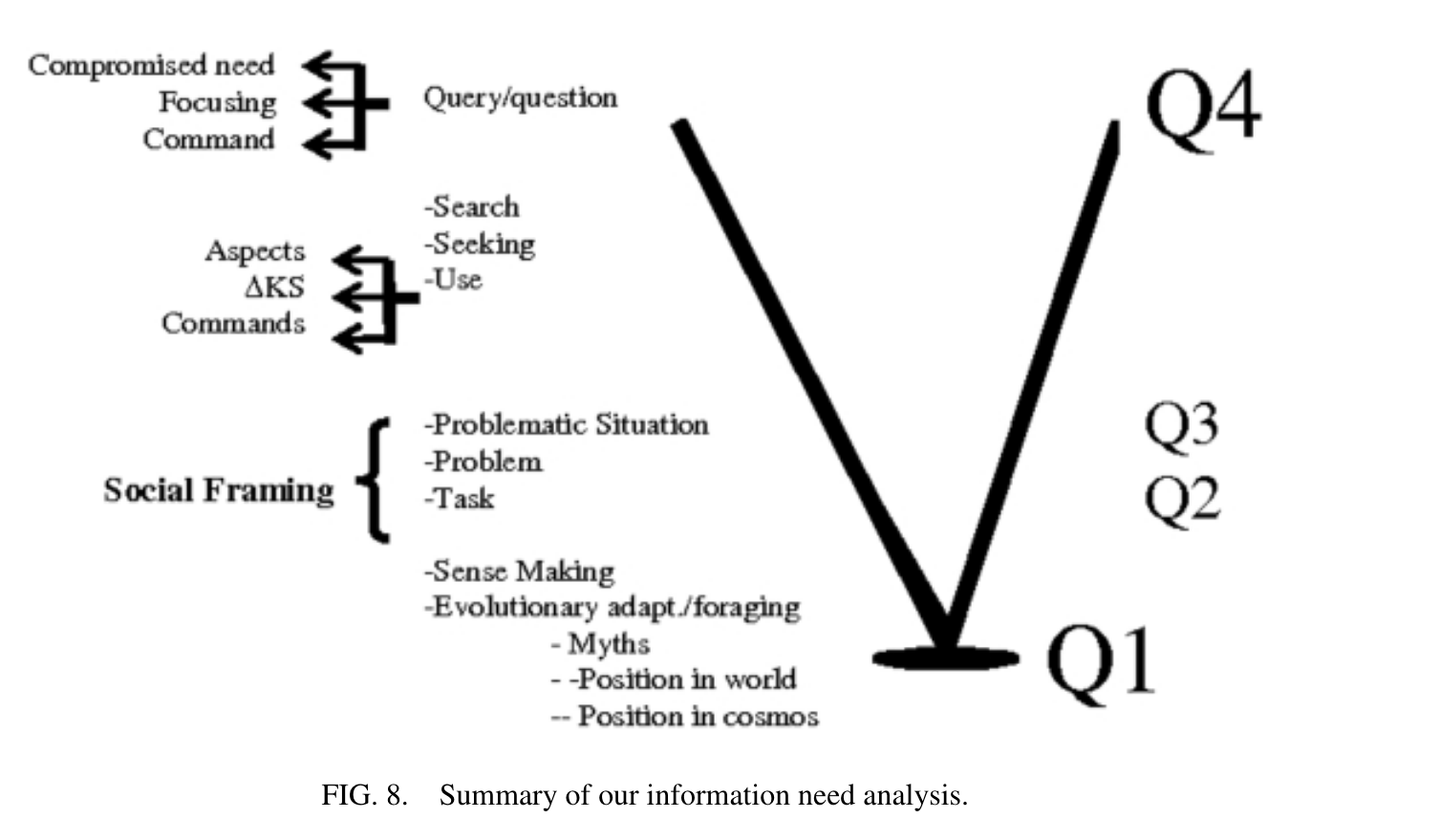
(Cole, 2011, p. 1228)
“The user begins search based on an area of doubt or a gap in understanding, which is a compromised form Q4 level of information need. The user with subsequent searching builds up an information need frame, borrowing generic knowledge frames from adjacent areas in memory; at a certain point, the information need actualizes in a transformational information use event, causing a focusing in information search. This transformation information use causes the user’s Q4 compromised need level to hook into the deeper Q1–3 level of their information need. Part of this hooking may be the user becoming aware, by being introduced to problem-goal, problem-solution, or task formulas, of the sociological aspect of an information need. We have argued in previous sections that, just as Minsky’s perception frames enable people to navigate through their environment based on knowledge structures encoding past experience with an event or object (e.g., about a “room”), so too do problem and task-based frames serve as containers that facilitate the information system user becoming aware of and adapting to tried and true society-approved formulas for managing and communicating information. The user’s behavior in managing the problem or” (Cole, 2011, p. 1228)
用户开始搜索时是基于一个疑惑领域或理解上的空白,这是一种折衷形式的 Q4 级信息需求。用户在随后的搜索中建立起信息需求框架,借用记忆中相邻领域的通用知识框架;在某一时刻,信息需求在转化信息使用事件中实现,导致信息搜索的聚焦。这种转换性信息使用会使用户的 Q4 妥协性需求层次与更深层次的 Q1-3 信息需求层次挂钩。这种挂钩的部分原因可能是用户通过了解问题-目标、问题-解决方案或任务公式,开始意识到信息需求的社会学方面。我们在前面的章节中已经论证过,正如明斯基的感知框架使人们能够根据编码过去对某一事件或对象(如关于 "房间")的经验的知识结构在其环境中进行导航一样,基于问题和任务的框架也可以作为容器,促进信息系统用户意识到并适应社会认可的、久经考验的管理和交流信息的公式。用户管理问题或任务的行为完成任务在很大程度上也要受到外部世界的组织和机构的评价,这就增加了我们信息需求理论中这一适应层面的分量。然而,我们认为,信息需求的社会学层面并不能完全进入最深层次的 Q1 层面。
“We believe this is the wrong way to conceptualize the new perspective on information need which sets out as its fundamental objective knowledge formation with the activity of information access during a user’s information search session with an information system.” (Cole, 2011, p. 1229)
信息需求新视角的基本目标是,在用户使用信息系统进行信息搜索的过程中,通过信息获取活动形成知识。正确的说法是,用户的信息需求以不同的方式表现出来。
“But the central thesis of this book is that the underlying information need in fact does not instantiate fully to Taylor’s deepest Q1 level until the user achieves focus. Only the levels perspective on information need will achieve the linkage of knowledge formation and information access in information system design that we believe necessary to overcoming the information overload issues we all face in a pre-focus stage of performing an information-based task, and the information literacy issues the informationally disadvantaged in our society face because they see information, information use, critical thinking, and the information age as part of a strange, foreign culture that only others can use.” (Cole, 2011, p. 1229)
但本书的中心论点是,在用户实现聚焦之前,潜在的信息需求实际上并没有完全体现在泰勒最深的 Q1 层次上。只有从层次的角度来看待信息需求,才能在信息系统设计中实现知识形成与信息获取之间的联系,而我们认为这种联系对于克服我们在执行一项基于信息的任务的前聚焦阶段所面临的信息超载问题,以及我们社会中的信息弱势群体所面临的信息素养问题是必不可少的,因为他们将信息、信息使用、批判性思维和信息时代视为一种陌生的、只有其他人才能使用的外来文化的一部分。

 浙公网安备 33010602011771号