
Redis(四)SpringBoot整合Redis
前言
在SpringBoot2.x后,原来的jedis被替换为lettuce
jedis:采用的直连,多个线程操作不安全,可以用jedis pool连接池,更像bio
lettuce:采用的是netty,实例可以在多个线程中共享,不存在线程不安全的情况,可以减少线程数据,更像nio
SpringBoot默认有Redis自动配置类RedisAutoConfiguration和配置属性RedisProperties
源码分析:
    @Bean
   // 表示在Spring容器中如果有一个Bean的name是redisTemplate那将不需要再执行被此注解修饰的方法,
    // 也就是说当redisTemplate这个Bean不存在的时候,才生效,如果自己写了一个配置类,可以把这个类替换掉。
    @ConditionalOnMissingBean(
        name = {"redisTemplate"}
    )
    @ConditionalOnSingleCandidate(RedisConnectionFactory.class)
    public RedisTemplate<Object, Object> redisTemplate(RedisConnectionFactory redisConnectionFactory) {
        RedisTemplate<Object, Object> template = new RedisTemplate();
        template.setConnectionFactory(redisConnectionFactory);
        return template;
    }

    @Bean
    @ConditionalOnMissingBean
    @ConditionalOnSingleCandidate(RedisConnectionFactory.class)
    public StringRedisTemplate stringRedisTemplate(RedisConnectionFactory redisConnectionFactory) {
        StringRedisTemplate template = new StringRedisTemplate();
        template.setConnectionFactory(redisConnectionFactory);
        return template;
    }
导入依赖
<?xml version="1.0" encoding="UTF-8"?>
<project xmlns="http://maven.apache.org/POM/4.0.0" xmlns:xsi="http://www.w3.org/2001/XMLSchema-instance"
         xsi:schemaLocation="http://maven.apache.org/POM/4.0.0 https://maven.apache.org/xsd/maven-4.0.0.xsd">
    <modelVersion>4.0.0</modelVersion>
    <parent>
        <groupId>org.springframework.boot</groupId>
        <artifactId>spring-boot-starter-parent</artifactId>
        <version>2.5.5</version>
        <relativePath/> <!-- lookup parent from repository -->
    </parent>
    <groupId>com.jedis</groupId>
    <artifactId>jedisDemo</artifactId>
    <version>0.0.1-SNAPSHOT</version>
    <name>jedisDemo</name>
    <description>jedisDemo</description>
    <properties>
        <java.version>1.8</java.version>
    </properties>
    <dependencies>
        <dependency>
            <groupId>org.springframework.boot</groupId>
            <artifactId>spring-boot-starter-data-redis</artifactId>
        </dependency>
        <dependency>
            <groupId>org.springframework.boot</groupId>
            <artifactId>spring-boot-starter-web</artifactId>
        </dependency>

        <dependency>
            <groupId>org.springframework.boot</groupId>
            <artifactId>spring-boot-starter-test</artifactId>
            <scope>test</scope>
        </dependency>
    </dependencies>

    <build>
        <plugins>
            <plugin>
                <groupId>org.springframework.boot</groupId>
                <artifactId>spring-boot-maven-plugin</artifactId>
            </plugin>
        </plugins>
    </build>

</project>
配置连接
spring.redis.host=127.0.0.1
spring.redis.port=6379
测试
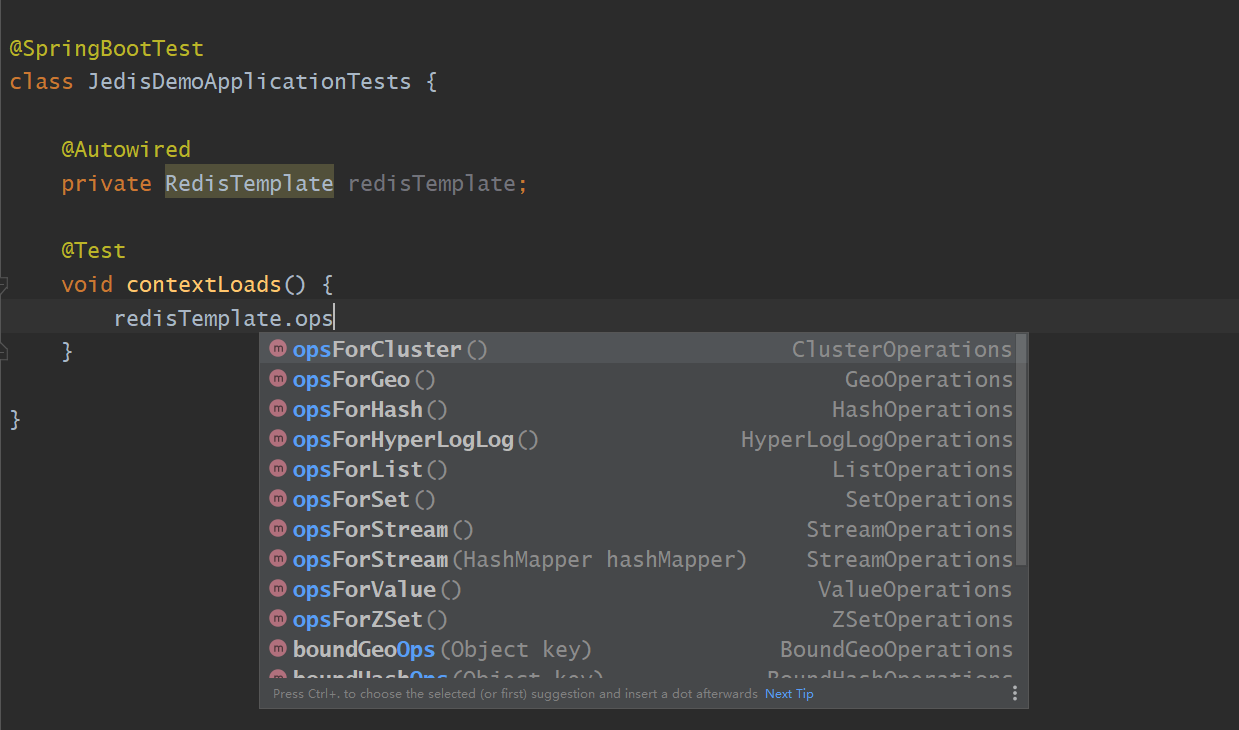
我们可以观察到,这里的几个方法,对应我们之前所说的数据类型:
- opsForValue()=》String
- opsForList()=》List
- opsForSet()=》Set
- opsForHash()=》Hash
- opsForZSet()=》ZSet
这里会输出“XiaoMu”
@SpringBootTest
class JedisDemoApplicationTests {

    @Autowired
    private RedisTemplate redisTemplate;

    @Test
    void contextLoads() {
        redisTemplate.opsForValue().set("myKey","XiaoMu");
        System.out.println(redisTemplate.opsForValue().get("myKey"));
    }
}
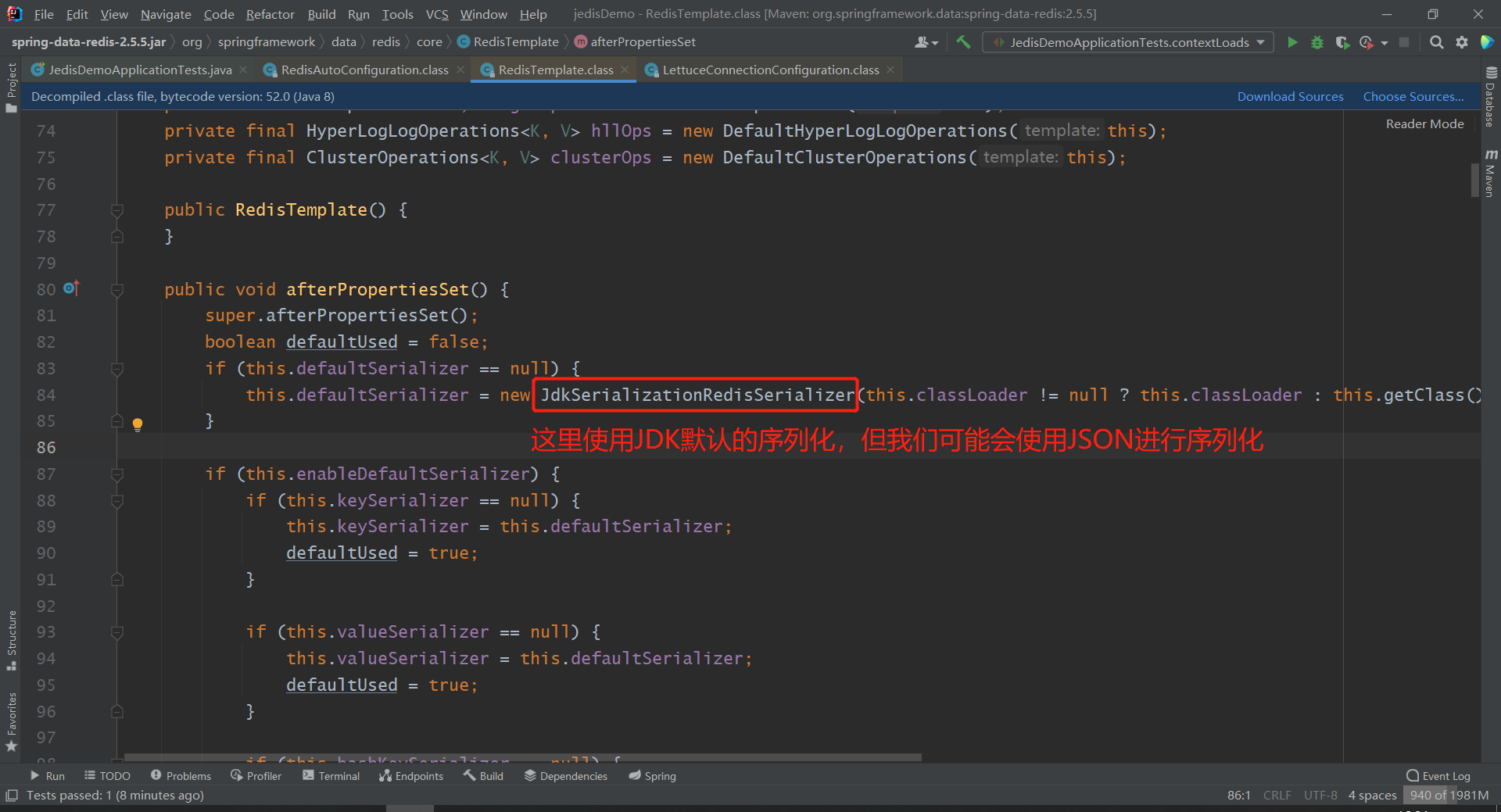
分析
Redis配置
package com.config;

import com.fasterxml.jackson.annotation.JsonAutoDetect;
import com.fasterxml.jackson.annotation.JsonTypeInfo;
import com.fasterxml.jackson.annotation.PropertyAccessor;
import com.fasterxml.jackson.databind.ObjectMapper;
import com.fasterxml.jackson.databind.jsontype.impl.LaissezFaireSubTypeValidator;
import org.springframework.context.annotation.Bean;
import org.springframework.context.annotation.Configuration;
import org.springframework.data.redis.connection.RedisConnectionFactory;
import org.springframework.data.redis.core.RedisTemplate;
import org.springframework.data.redis.serializer.Jackson2JsonRedisSerializer;
import org.springframework.data.redis.serializer.StringRedisSerializer;

/**
 * @Author HandSomeHeLin
 * @Date 2021/9/26 16:15
 * @Description Redis配置
 */
@Configuration
public class RedisConfig {
    @Bean
    public RedisTemplate<String, Object> redisTemplate(RedisConnectionFactory redisConnectionFactory) {
        // 为了开发方便,一般会使用<String, Object>
        RedisTemplate<String, Object> template = new RedisTemplate<>();
        // 配置Redis连接工厂:必须在afterPropertiesSet之前配置
        template.setConnectionFactory(redisConnectionFactory);
        // 方式一:JSON序列化配置
        // 配置使用JSON去解析任意对象,使其用JSON序列化
        Jackson2JsonRedisSerializer<Object> jackson2JsonRedisSerializer = new Jackson2JsonRedisSerializer<>(Object.class);
        // 配置使用ObjectMapper进行转义
        ObjectMapper om = new ObjectMapper();
        om.setVisibility(PropertyAccessor.ALL, JsonAutoDetect.Visibility.ANY);
        // enableDefaultTyping方法已经过时
        // om.enableDefaultTyping(ObjectMapper.DefaultTyping.NON_FINAL);
        om.activateDefaultTyping(LaissezFaireSubTypeValidator.instance,
                ObjectMapper.DefaultTyping.NON_FINAL,
                JsonTypeInfo.As.WRAPPER_ARRAY
        );
        // 方式二:String序列化配置
        StringRedisSerializer stringRedisSerializer = new StringRedisSerializer();
        // Key序列化
        template.setKeySerializer(stringRedisSerializer);
        // Value序列化
        template.setValueSerializer(jackson2JsonRedisSerializer);
        // HashKey序列化
        template.setHashKeySerializer(stringRedisSerializer);
        // HashValue序列化
        template.setHashValueSerializer(jackson2JsonRedisSerializer);
        // 在属性初始化之后设置
        template.afterPropertiesSet();
        jackson2JsonRedisSerializer.setObjectMapper(om);
        return template;
    }
}
在om.activateDefaultTyping(LaissezFaireSubTypeValidator.instance,ObjectMapper.DefaultTyping.NON_FINAL,JsonTypeInfo.As.WRAPPER_ARRAY);这一行中,DefaultTyping可以取以下值:
    public enum DefaultTyping {
        /**
         * This value means that only properties that have
         * {@link java.lang.Object} as declared type (including
         * generic types without explicit type) will use default
         * typing.
         */
        JAVA_LANG_OBJECT,

        /**
         * Value that means that default typing will be used for
         * properties with declared type of {@link java.lang.Object}
         * or an abstract type (abstract class or interface).
         * Note that this does <b>not</b> include array types.
         *<p>
         * Since 2.4, this does NOT apply to {@link TreeNode} and its subtypes.
         */
        OBJECT_AND_NON_CONCRETE,

        /**
         * Value that means that default typing will be used for
         * all types covered by {@link #OBJECT_AND_NON_CONCRETE}
         * plus all array types for them.
         *<p>
         * Since 2.4, this does NOT apply to {@link TreeNode} and its subtypes.
         */
        NON_CONCRETE_AND_ARRAYS,

        /**
         * Value that means that default typing will be used for
         * all non-final types, with exception of small number of
         * "natural" types (String, Boolean, Integer, Double), which
         * can be correctly inferred from JSON; as well as for
         * all arrays of non-final types.
         *<p>
         * Since 2.4, this does NOT apply to {@link TreeNode} and its subtypes.
         */
        NON_FINAL,

        /**
         * Value that means that default typing will be used for
         * all types, with exception of small number of
         * "natural" types (String, Boolean, Integer, Double) that
         * can be correctly inferred from JSON, and primitives (which
         * can not be polymorphic either).
         * Typing is also enabled for all array types.
         *<p>
         * WARNING: most of the time this is <b>NOT</b> the setting you want
         * as it tends to add Type Ids everywhere, even in cases
         * where type can not be anything other than declared (for example
         * if declared value type of a property is {@code final} -- for example,
         * properties of type {@code long} (or wrapper {@code Long}).
         *<p>
         * Note that this is rarely the option you should use as it results
         * in adding type information in many places where it should not be needed:
         * make sure you understand its behavior.
         * The only known use case for this setting is for serialization
         * when passing instances of final class, and base type is not
         * separately specified.
         *
         * @since 2.10
         */
        EVERYTHING
    }
JAVA_LANG_OBJECT: 当对象属性类型为Object时生效;
OBJECT_AND_NON_CONCRETE: 当对象属性类型为Object或者非具体类型(抽象类和接口)时生效;
NON_CONCRETE_AND+_ARRAYS: 同上, 另外所有的数组元素的类型都是非具体类型或者对象类型;
NON_FINAL: 对所有非final类型或者非final类型元素的数组。
Redis工具类
package com.utils;

import org.springframework.beans.factory.annotation.Autowired;
import org.springframework.data.redis.core.RedisTemplate;
import org.springframework.stereotype.Component;
import org.springframework.util.CollectionUtils;
import java.util.Collection;
import java.util.List;
import java.util.Map;
import java.util.Set;
import java.util.concurrent.TimeUnit;

@Component
public final class RedisUtil {
    @Autowired
    private RedisTemplate<String, Object> redisTemplate;
    // =============================common============================

    /**
     * 指定缓存失效时间
     * @param key 键
     * @param time 时间(秒)
     * @return boolean
     */
    public boolean expire(String key, long time) {
        try {
            if (time > 0) {
                redisTemplate.expire(key, time, TimeUnit.SECONDS);
            }
            return true;
        } catch (Exception e) {
            e.printStackTrace();
            return false;
        }
    }
    /**
     * 根据key 获取过期时间
     * @param key 键 不能为null
     * @return 时间(秒) 返回0代表为永久有效
     */
    public long getExpire(String key) {
        return redisTemplate.getExpire(key, TimeUnit.SECONDS);
    }
    /**
     * 判断key是否存在
     * @param key 键
     * @return true 存在 false不存在
     */
    public boolean hasKey(String key) {
        try {
            return redisTemplate.hasKey(key);
        } catch (Exception e) {
            e.printStackTrace();
            return false;
        }
    }
    /**
     * 删除缓存
     * @param key 可以传一个值 或多个
     */
    public void del(String... key) {
        if (key != null && key.length > 0) {
            if (key.length == 1) {
                redisTemplate.delete(key[0]);
            } else {
                redisTemplate.delete((Collection<String>) CollectionUtils.arrayToList(key));
            }
        }
    }
    // ============================String=============================
    /**
     * 普通缓存获取
     * @param key 键
     * @return 值
     */
    public Object get(String key) {
        return key == null ? null : redisTemplate.opsForValue().get(key);
    }
    /**
     * 普通缓存放入
     * @param key 键
     * @param value 值
     * @return true成功 false失败
     */
    public boolean set(String key, Object value) {
        try {
            redisTemplate.opsForValue().set(key, value);
            return true;
        } catch (Exception e) {
            e.printStackTrace();
            return false;
        }
    }
    /**
     * 普通缓存放入并设置时间
     * @param key 键
     * @param value 值
     * @param time 时间(秒) time要大于0 如果time小于等于0 将设置无限期
     * @return true成功 false 失败
     */
    public boolean set(String key, Object value, long time) {
        try {
            if (time > 0) {
                redisTemplate.opsForValue().set(key, value, time, TimeUnit.SECONDS);
            } else {
                set(key, value);
            }
            return true;
        } catch (Exception e) {
            e.printStackTrace();
            return false;
        }
    }
    /**
     * 递增
     * @param key 键
     * @param delta 要增加几(大于0)
     * @return
     */
    public long incr(String key, long delta) {
        if (delta < 0) {
            throw new RuntimeException("递增因子必须大于0");
        }
        return redisTemplate.opsForValue().increment(key, delta);
    }
    /**
     * 递减
     * @param key 键
     * @param delta 要减少几(小于0)
     * @return
     */
    public long decr(String key, long delta) {
        if (delta < 0) {
            throw new RuntimeException("递减因子必须大于0");
        }
        return redisTemplate.opsForValue().increment(key, -delta);
    }
    // ================================Map=================================
    /**
     * HashGet
     * @param key 键 不能为null
     * @param item 项 不能为null
     * @return 值
     */
    public Object hget(String key, String item) {
        return redisTemplate.opsForHash().get(key, item);
    }
    /**
     * 获取hashKey对应的所有键值
     * @param key 键
     * @return 对应的多个键值
     */
    public Map<Object, Object> hmget(String key) {
        return redisTemplate.opsForHash().entries(key);
    }
    /**
     * HashSet
     * @param key 键
     * @param map 对应多个键值
     * @return true 成功 false 失败
     */
    public boolean hmset(String key, Map<String, Object> map) {
        try {
            redisTemplate.opsForHash().putAll(key, map);
            return true;
        } catch (Exception e) {
            e.printStackTrace();
            return false;
        }
    }
    /**
     * HashSet 并设置时间
     * @param key 键
     * @param map 对应多个键值
     * @param time 时间(秒)
     * @return true成功 false失败
     */
    public boolean hmset(String key, Map<String, Object> map, long time) {
        try {
            redisTemplate.opsForHash().putAll(key, map);
            if (time > 0) {
                expire(key, time);
            }
            return true;
        } catch (Exception e) {
            e.printStackTrace();
            return false;
        }
    }
    /**
     * 向一张hash表中放入数据,如果不存在将创建
     * @param key 键
     * @param item 项
     * @param value 值
     * @return true 成功 false失败
     */
    public boolean hset(String key, String item, Object value) {
        try {
            redisTemplate.opsForHash().put(key, item, value);
            return true;
        } catch (Exception e) {
            e.printStackTrace();
            return false;
        }
    }
    /**
     * 向一张hash表中放入数据,如果不存在将创建
     * @param key 键
     * @param item 项
     * @param value 值
     * @param time 时间(秒) 注意:如果已存在的hash表有时间,这里将会替换原有的时间
     * @return true 成功 false失败
     */
    public boolean hset(String key, String item, Object value, long time) {
        try {
            redisTemplate.opsForHash().put(key, item, value);
            if (time > 0) {
                expire(key, time);
            }
            return true;
        } catch (Exception e) {
            e.printStackTrace();
            return false;
        }
    }
    /**
     * 删除hash表中的值
     * @param key 键 不能为null
     * @param item 项 可以使多个 不能为null
     */
    public void hdel(String key, Object... item) {
        redisTemplate.opsForHash().delete(key, item);
    }
    /**
     * 判断hash表中是否有该项的值
     * @param key 键 不能为null
     * @param item 项 不能为null
     * @return true 存在 false不存在
     */
    public boolean hHasKey(String key, String item) {
        return redisTemplate.opsForHash().hasKey(key, item);
    }
    /**
     * hash递增 如果不存在,就会创建一个 并把新增后的值返回
     * @param key 键
     * @param item 项
     * @param by 要增加几(大于0)
     * @return
     */
    public double hincr(String key, String item, double by) {
        return redisTemplate.opsForHash().increment(key, item, by);
    }
    /**
     * hash递减
     * @param key 键
     * @param item 项
     * @param by 要减少记(小于0)
     * @return
     */
    public double hdecr(String key, String item, double by) {
        return redisTemplate.opsForHash().increment(key, item, -by);
    }
    // ============================set=============================
    /**
     * 根据key获取Set中的所有值
     * @param key 键
     * @return
     */
    public Set<Object> sGet(String key) {
        try {
            return redisTemplate.opsForSet().members(key);
        } catch (Exception e) {
            e.printStackTrace();
            return null;
        }
    }
    /**
     * 根据value从一个set中查询,是否存在
     * @param key 键
     * @param value 值
     * @return true 存在 false不存在
     */
    public boolean sHasKey(String key, Object value) {
        try {
            return redisTemplate.opsForSet().isMember(key, value);
        } catch (Exception e) {
            e.printStackTrace();
            return false;
        }
    }
    /**
     * 将数据放入set缓存
     * @param key 键
     * @param values 值 可以是多个
     * @return 成功个数
     */
    public long sSet(String key, Object... values) {
        try {
            return redisTemplate.opsForSet().add(key, values);
        } catch (Exception e) {
            e.printStackTrace();
            return 0;
        }
    }
    /**
     * 将set数据放入缓存
     * @param key 键
     * @param time 时间(秒)
     * @param values 值 可以是多个
     * @return 成功个数
     */
    public long sSetAndTime(String key, long time, Object... values) {
        try {
            Long count = redisTemplate.opsForSet().add(key, values);
            if (time > 0)
                expire(key, time);
            return count;
        } catch (Exception e) {
            e.printStackTrace();
            return 0;
        }
    }
    /**
     * 获取set缓存的长度
     * @param key 键
     * @return
     */
    public long sGetSetSize(String key) {
        try {
            return redisTemplate.opsForSet().size(key);
        } catch (Exception e) {
            e.printStackTrace();
            return 0;
        }
    }
    /**
     * 移除值为value的
     * @param key 键
     * @param values 值 可以是多个
     * @return 移除的个数
     */
    public long setRemove(String key, Object... values) {
        try {
            Long count = redisTemplate.opsForSet().remove(key, values);
            return count;
        } catch (Exception e) {
            e.printStackTrace();
            return 0;
        }
    }
    // ===============================list=================================
    /**
     * 获取list缓存的内容
     * @param key 键
     * @param start 开始
     * @param end 结束 0 到 -1代表所有值
     * @return
     */
    public List<Object> lGet(String key, long start, long end) {
        try {
            return redisTemplate.opsForList().range(key, start, end);
        } catch (Exception e) {
            e.printStackTrace();
            return null;
        }
    }
    /**
     * 获取list缓存的长度
     * @param key 键
     * @return
     */
    public long lGetListSize(String key) {
        try {
            return redisTemplate.opsForList().size(key);
        } catch (Exception e) {
            e.printStackTrace();
            return 0;
        }
    }
    /**
     * 通过索引 获取list中的值
     * @param key 键
     * @param index 索引 index>=0时, 0 表头,1 第二个元素,依次类推;index<0时,-1,表尾,-2倒数第二个元素,依次类推
     * @return
     */
    public Object lGetIndex(String key, long index) {
        try {
            return redisTemplate.opsForList().index(key, index);
        } catch (Exception e) {
            e.printStackTrace();
            return null;
        }
    }
    /**
     * 将list放入缓存
     * @param key 键
     * @param value 值
     * @return
     */
    public boolean lSet(String key, Object value) {
        try {
            redisTemplate.opsForList().rightPush(key, value);
            return true;
        } catch (Exception e) {
            e.printStackTrace();
            return false;
        }
    }
    /**
     * 将list放入缓存
     * @param key 键
     * @param value 值
     * @param time 时间(秒)
     * @return
     */
    public boolean lSet(String key, Object value, long time) {
        try {
            redisTemplate.opsForList().rightPush(key, value);
            if (time > 0)
                expire(key, time);
            return true;
        } catch (Exception e) {
            e.printStackTrace();
            return false;
        }
    }
    /**
     * 将list放入缓存
     * @param key 键
     * @param value 值
     * @return
     */
    public boolean lSet(String key, List<Object> value) {
        try {
            redisTemplate.opsForList().rightPushAll(key, value);
            return true;
        } catch (Exception e) {
            e.printStackTrace();
            return false;
        }
    }
    /**
     * 将list放入缓存
     * @param key 键
     * @param value 值
     * @param time 时间(秒)
     * @return
     */
    public boolean lSet(String key, List<Object> value, long time) {
        try {
            redisTemplate.opsForList().rightPushAll(key, value);
            if (time > 0)
                expire(key, time);
            return true;
        } catch (Exception e) {
            e.printStackTrace();
            return false;
        }
    }
    /**
     * 根据索引修改list中的某条数据
     * @param key 键
     * @param index 索引
     * @param value 值
     * @return
     */
    public boolean lUpdateIndex(String key, long index, Object value) {
        try {
            redisTemplate.opsForList().set(key, index, value);
            return true;
        } catch (Exception e) {
            e.printStackTrace();
            return false;
        }
    }
    /**
     * 移除N个值为value
     * @param key 键
     * @param count 移除多少个
     * @param value 值
     * @return 移除的个数
     */
    public long lRemove(String key, long count, Object value) {
        try {
            Long remove = redisTemplate.opsForList().remove(key, count, value);
            return remove;
        } catch (Exception e) {
            e.printStackTrace();
            return 0;
        }
    }
}
完!

 浙公网安备 33010602011771号