
机器学习作业(六)支持向量机——Matlab实现
题目下载【传送门】
第1题
简述:支持向量机的实现
(1)线性的情况:
第1步:读取数据文件,可视化数据:
% Load from ex6data1:
% You will have X, y in your environment
load('ex6data1.mat');

% Plot training data
plotData(X, y);
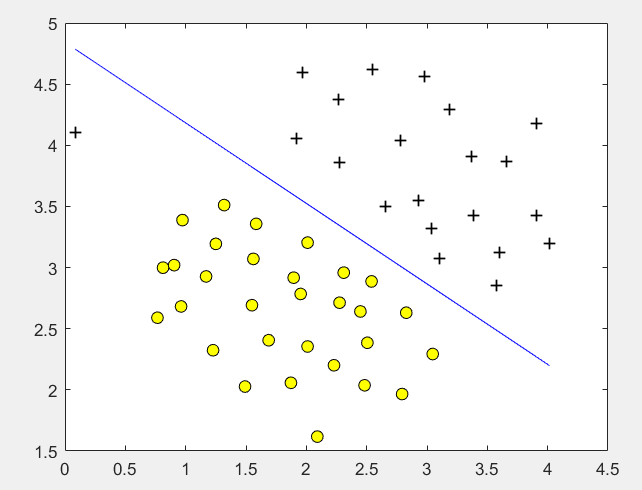
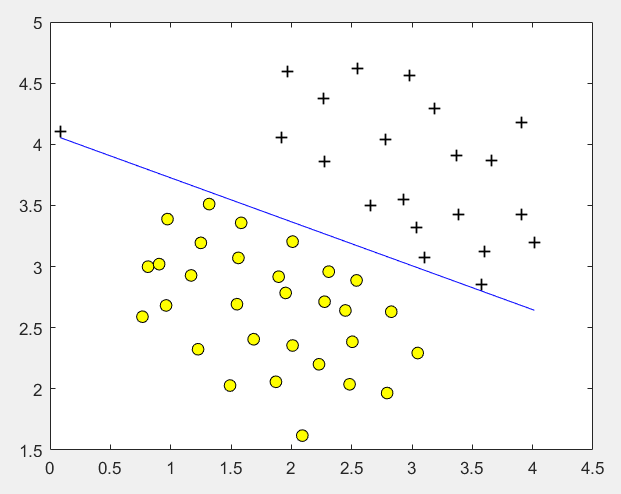
第2步:设定不同的C,使用线性核函数训练SVM,并画出决策边界:
C = 1;
model = svmTrain(X, y, C, @linearKernel, 1e-3, 20);
visualizeBoundaryLinear(X, y, model);
运行结果:
C = 1时:
C = 1000时:
其中线性核函数linearKernel:
function sim = linearKernel(x1, x2)

% Ensure that x1 and x2 are column vectors
x1 = x1(:); x2 = x2(:);

% Compute the kernel
sim = x1' * x2;  % dot product

end
高斯核函数gaussianKernel实现:
function sim = gaussianKernel(x1, x2, sigma)

% Ensure that x1 and x2 are column vectors
x1 = x1(:); x2 = x2(:);

% You need to return the following variables correctly.
sim = 0;

sim = exp(-norm(x1 - x2) ^ 2 / (2 * (sigma ^ 2)));

end
训练模型svmTrain函数(实现较为复杂,直接调用):
function [model] = svmTrain(X, Y, C, kernelFunction, ...
                            tol, max_passes)
%SVMTRAIN Trains an SVM classifier using a simplified version of the SMO
%algorithm.
%   [model] = SVMTRAIN(X, Y, C, kernelFunction, tol, max_passes) trains an
%   SVM classifier and returns trained model. X is the matrix of training
%   examples.  Each row is a training example, and the jth column holds the
%   jth feature.  Y is a column matrix containing 1 for positive examples
%   and 0 for negative examples.  C is the standard SVM regularization
%   parameter.  tol is a tolerance value used for determining equality of
%   floating point numbers. max_passes controls the number of iterations
%   over the dataset (without changes to alpha) before the algorithm quits.
%
% Note: This is a simplified version of the SMO algorithm for training
%       SVMs. In practice, if you want to train an SVM classifier, we
%       recommend using an optimized package such as:
%
%           LIBSVM   (http://www.csie.ntu.edu.tw/~cjlin/libsvm/)
%           SVMLight (http://svmlight.joachims.org/)
%
%

if ~exist('tol', 'var') || isempty(tol)
    tol = 1e-3;
end

if ~exist('max_passes', 'var') || isempty(max_passes)
    max_passes = 5;
end

% Data parameters
m = size(X, 1);
n = size(X, 2);

% Map 0 to -1
Y(Y==0) = -1;

% Variables
alphas = zeros(m, 1);
b = 0;
E = zeros(m, 1);
passes = 0;
eta = 0;
L = 0;
H = 0;

% Pre-compute the Kernel Matrix since our dataset is small
% (in practice, optimized SVM packages that handle large datasets
%  gracefully will _not_ do this)
%
% We have implemented optimized vectorized version of the Kernels here so
% that the svm training will run faster.
if strcmp(func2str(kernelFunction), 'linearKernel')
    % Vectorized computation for the Linear Kernel
    % This is equivalent to computing the kernel on every pair of examples
    K = X*X';
elseif strfind(func2str(kernelFunction), 'gaussianKernel')
    % Vectorized RBF Kernel
    % This is equivalent to computing the kernel on every pair of examples
    X2 = sum(X.^2, 2);
    K = bsxfun(@plus, X2, bsxfun(@plus, X2', - 2 * (X * X')));
    K = kernelFunction(1, 0) .^ K;
else
    % Pre-compute the Kernel Matrix
    % The following can be slow due to the lack of vectorization
    K = zeros(m);
    for i = 1:m
        for j = i:m
             K(i,j) = kernelFunction(X(i,:)', X(j,:)');
             K(j,i) = K(i,j); %the matrix is symmetric
        end
    end
end

% Train
fprintf('\nTraining ...');
dots = 12;
while passes < max_passes,

    num_changed_alphas = 0;
    for i = 1:m,

        % Calculate Ei = f(x(i)) - y(i) using (2).
        % E(i) = b + sum (X(i, :) * (repmat(alphas.*Y,1,n).*X)') - Y(i);
        E(i) = b + sum (alphas.*Y.*K(:,i)) - Y(i);

        if ((Y(i)*E(i) < -tol && alphas(i) < C) || (Y(i)*E(i) > tol && alphas(i) > 0)),

            % In practice, there are many heuristics one can use to select
            % the i and j. In this simplified code, we select them randomly.
            j = ceil(m * rand());
            while j == i,  % Make sure i \neq j
                j = ceil(m * rand());
            end

            % Calculate Ej = f(x(j)) - y(j) using (2).
            E(j) = b + sum (alphas.*Y.*K(:,j)) - Y(j);

            % Save old alphas
            alpha_i_old = alphas(i);
            alpha_j_old = alphas(j);

            % Compute L and H by (10) or (11).
            if (Y(i) == Y(j)),
                L = max(0, alphas(j) + alphas(i) - C);
                H = min(C, alphas(j) + alphas(i));
            else
                L = max(0, alphas(j) - alphas(i));
                H = min(C, C + alphas(j) - alphas(i));
            end

            if (L == H),
                % continue to next i.
                continue;
            end

            % Compute eta by (14).
            eta = 2 * K(i,j) - K(i,i) - K(j,j);
            if (eta >= 0),
                % continue to next i.
                continue;
            end

            % Compute and clip new value for alpha j using (12) and (15).
            alphas(j) = alphas(j) - (Y(j) * (E(i) - E(j))) / eta;

            % Clip
            alphas(j) = min (H, alphas(j));
            alphas(j) = max (L, alphas(j));

            % Check if change in alpha is significant
            if (abs(alphas(j) - alpha_j_old) < tol),
                % continue to next i.
                % replace anyway
                alphas(j) = alpha_j_old;
                continue;
            end

            % Determine value for alpha i using (16).
            alphas(i) = alphas(i) + Y(i)*Y(j)*(alpha_j_old - alphas(j));

            % Compute b1 and b2 using (17) and (18) respectively.
            b1 = b - E(i) ...
                 - Y(i) * (alphas(i) - alpha_i_old) *  K(i,j)' ...
                 - Y(j) * (alphas(j) - alpha_j_old) *  K(i,j)';
            b2 = b - E(j) ...
                 - Y(i) * (alphas(i) - alpha_i_old) *  K(i,j)' ...
                 - Y(j) * (alphas(j) - alpha_j_old) *  K(j,j)';

            % Compute b by (19).
            if (0 < alphas(i) && alphas(i) < C),
                b = b1;
            elseif (0 < alphas(j) && alphas(j) < C),
                b = b2;
            else
                b = (b1+b2)/2;
            end

            num_changed_alphas = num_changed_alphas + 1;

        end

    end

    if (num_changed_alphas == 0),
        passes = passes + 1;
    else
        passes = 0;
    end

    fprintf('.');
    dots = dots + 1;
    if dots > 78
        dots = 0;
        fprintf('\n');
    end
    if exist('OCTAVE_VERSION')
        fflush(stdout);
    end
end
fprintf(' Done! \n\n');

% Save the model
idx = alphas > 0;
model.X= X(idx,:);
model.y= Y(idx);
model.kernelFunction = kernelFunction;
model.b= b;
model.alphas= alphas(idx);
model.w = ((alphas.*Y)'*X)';

end
(2)非线性的情况:
第1步:读取数据文件,并可视化数据:
% Load from ex6data2:
% You will have X, y in your environment
load('ex6data2.mat');

% Plot training data
plotData(X, y);
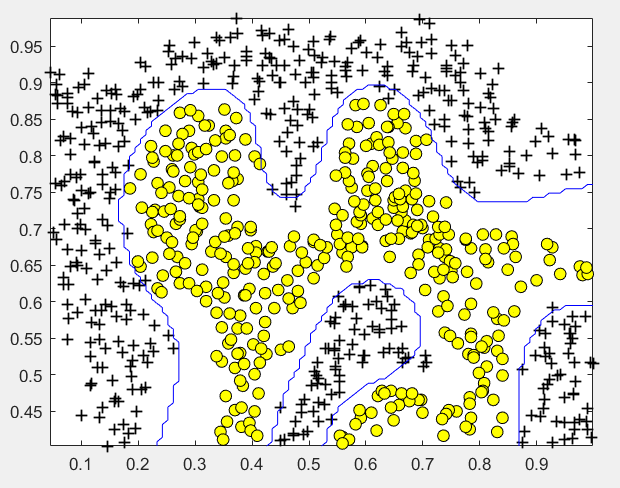
第2步:使用高斯核函数进行训练:
% SVM Parameters
C = 1; sigma = 0.1;

% We set the tolerance and max_passes lower here so that the code will run
% faster. However, in practice, you will want to run the training to
% convergence.
model= svmTrain(X, y, C, @(x1, x2) gaussianKernel(x1, x2, sigma));
visualizeBoundary(X, y, model);
运行结果:
(3)非线性情况2:
第1步:读取数据文件,并可视化数据:
% Load from ex6data3:
% You will have X, y in your environment
load('ex6data3.mat');

% Plot training data
plotData(X, y);
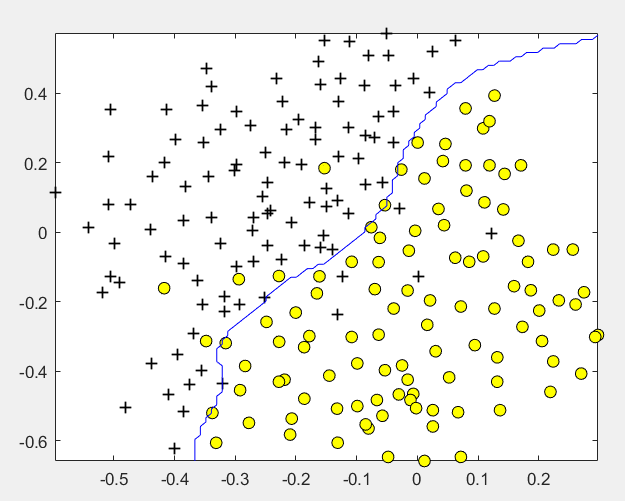
第2步:尝试不同的参数,选取准确率最高的:
% Try different SVM Parameters here
[C, sigma] = dataset3Params(X, y, Xval, yval);

% Train the SVM
model= svmTrain(X, y, C, @(x1, x2) gaussianKernel(x1, x2, sigma));
visualizeBoundary(X, y, model);
其中datasetParams函数:
function [C, sigma] = dataset3Params(X, y, Xval, yval)

% You need to return the following variables correctly.
C = 1;
sigma = 0.3;

C_vec = [0.01, 0.03, 0.1, 0.3, 1, 3, 10, 30];
sigma_vec = [0.01, 0.03, 0.1, 0.3, 1, 3, 10, 30];
m = size(C_vec, 2);
error_val = 1;
for i = 1:m
    for j = 1:m
        model= svmTrain(X, y, C_vec(i), @(x1, x2) gaussianKernel(x1, x2, sigma_vec(j)));
        pred = svmPredict(model, Xval);
        error_temp = mean(double(pred ~= yval));
        if error_temp < error_val
            C = C_vec(i);
            sigma = sigma_vec(j);
            error_val = error_temp;
        end
    end
end


end
其中svmPredict函数:
function pred = svmPredict(model, X)

% Check if we are getting a column vector, if so, then assume that we only
% need to do prediction for a single example
if (size(X, 2) == 1)
    % Examples should be in rows
    X = X';
end

% Dataset
m = size(X, 1);
p = zeros(m, 1);
pred = zeros(m, 1);

if strcmp(func2str(model.kernelFunction), 'linearKernel')
    % We can use the weights and bias directly if working with the
    % linear kernel
    p = X * model.w + model.b;
elseif strfind(func2str(model.kernelFunction), 'gaussianKernel')
    % Vectorized RBF Kernel
    % This is equivalent to computing the kernel on every pair of examples
    X1 = sum(X.^2, 2);
    X2 = sum(model.X.^2, 2)';
    K = bsxfun(@plus, X1, bsxfun(@plus, X2, - 2 * X * model.X'));
    K = model.kernelFunction(1, 0) .^ K;
    K = bsxfun(@times, model.y', K);
    K = bsxfun(@times, model.alphas', K);
    p = sum(K, 2);
else
    % Other Non-linear kernel
    for i = 1:m
        prediction = 0;
        for j = 1:size(model.X, 1)
            prediction = prediction + ...
                model.alphas(j) * model.y(j) * ...
                model.kernelFunction(X(i,:)', model.X(j,:)');
        end
        p(i) = prediction + model.b;
    end
end

% Convert predictions into 0 / 1
pred(p >= 0) =  1;
pred(p <  0) =  0;

end
运行结果:
第2题
概述:实现垃圾邮件的识别
第1步:读取数据文件,对单词进行处理:
% Extract Features
file_contents = readFile('emailSample1.txt');
word_indices  = processEmail(file_contents);

% Print Stats
fprintf('Word Indices: \n');
fprintf(' %d', word_indices);
fprintf('\n\n');
单词处理过程:
去除符号、空格、换行等;
识别出邮箱、价格、超链接、数字,替换为特定单词;
在关键词列表中找出出现的关键词,并标记为出单词编号.
function word_indices = processEmail(email_contents)

% Load Vocabulary
vocabList = getVocabList();

% Init return value
word_indices = [];

% ========================== Preprocess Email ===========================

% Find the Headers ( \n\n and remove )
% Uncomment the following lines if you are working with raw emails with the
% full headers

% hdrstart = strfind(email_contents, ([char(10) char(10)]));
% email_contents = email_contents(hdrstart(1):end);

% Lower case
email_contents = lower(email_contents);

% Strip all HTML
% Looks for any expression that starts with < and ends with > and replace
% and does not have any < or > in the tag it with a space
email_contents = regexprep(email_contents, '<[^<>]+>', ' ');

% Handle Numbers
% Look for one or more characters between 0-9
email_contents = regexprep(email_contents, '[0-9]+', 'number');

% Handle URLS
% Look for strings starting with http:// or https://
email_contents = regexprep(email_contents, ...
                           '(http|https)://[^\s]*', 'httpaddr');

% Handle Email Addresses
% Look for strings with @ in the middle
email_contents = regexprep(email_contents, '[^\s]+@[^\s]+', 'emailaddr');

% Handle $ sign
email_contents = regexprep(email_contents, '[$]+', 'dollar');


% ========================== Tokenize Email ===========================

% Output the email to screen as well
fprintf('\n==== Processed Email ====\n\n');

% Process file
l = 0;

while ~isempty(email_contents)

    % Tokenize and also get rid of any punctuation
    [str, email_contents] = ...
       strtok(email_contents, ...
              [' @$/#.-:&*+=[]?!(){},''">_<;%' char(10) char(13)]);

    % Remove any non alphanumeric characters
    str = regexprep(str, '[^a-zA-Z0-9]', '');

    % Stem the word
    % (the porterStemmer sometimes has issues, so we use a try catch block)
    try str = porterStemmer(strtrim(str));
    catch str = ''; continue;
    end;

    % Skip the word if it is too short
    if length(str) < 1
       continue;
    end

    for i = 1:size(vocabList),
        if strcmp(str, vocabList(i)),
            word_indices = [word_indices i];
        end
    end

    % Print to screen, ensuring that the output lines are not too long
    if (l + length(str) + 1) > 78
        fprintf('\n');
        l = 0;
    end
    fprintf('%s ', str);
    l = l + length(str) + 1;

end

% Print footer
fprintf('\n\n=========================\n');

end
其中读取关键字列表函数:
function vocabList = getVocabList()

%% Read the fixed vocabulary list
fid = fopen('vocab.txt');

% Store all dictionary words in cell array vocab{}
n = 1899;  % Total number of words in the dictionary

% For ease of implementation, we use a struct to map the strings => integers
% In practice, you'll want to use some form of hashmap
vocabList = cell(n, 1);
for i = 1:n
    % Word Index (can ignore since it will be = i)
    fscanf(fid, '%d', 1);
    % Actual Word
    vocabList{i} = fscanf(fid, '%s', 1);
end
fclose(fid);

end
第3步:对关键字进行特征值标记,出现的关键词标记为1:
% Extract Features
features  = emailFeatures(word_indices);

% Print Stats
fprintf('Length of feature vector: %d\n', length(features));
fprintf('Number of non-zero entries: %d\n', sum(features > 0));
其中emailFeatures函数为:
function x = emailFeatures(word_indices)

% Total number of words in the dictionary
n = 1899;

% You need to return the following variables correctly.
x = zeros(n, 1);

for i = 1:size(word_indices),
    x(word_indices(i)) = 1;
end

end
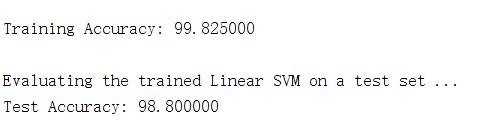
第4步:使用线性核函数进行训练,并分别计算训练集准确率和测试集准确率:
% Load the Spam Email dataset
% You will have X, y in your environment
load('spamTrain.mat');

fprintf('\nTraining Linear SVM (Spam Classification)\n')
fprintf('(this may take 1 to 2 minutes) ...\n')

C = 0.1;
model = svmTrain(X, y, C, @linearKernel);

p = svmPredict(model, X);

fprintf('Training Accuracy: %f\n', mean(double(p == y)) * 100);

% Load the test dataset
% You will have Xtest, ytest in your environment
load('spamTest.mat');

fprintf('\nEvaluating the trained Linear SVM on a test set ...\n')

p = svmPredict(model, Xtest);

fprintf('Test Accuracy: %f\n', mean(double(p == ytest)) * 100);
运行结果:
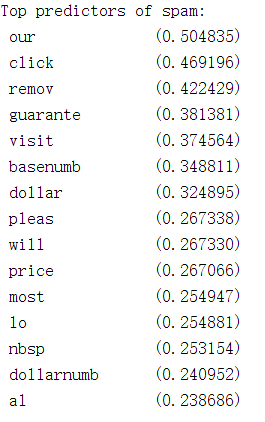
第5步:找出最高权重的关键词:
% Sort the weights and obtin the vocabulary list
[weight, idx] = sort(model.w, 'descend');
vocabList = getVocabList();

fprintf('\nTop predictors of spam: \n');
for i = 1:15
    fprintf(' %-15s (%f) \n', vocabList{idx(i)}, weight(i));
end

fprintf('\n\n');
fprintf('\nProgram paused. Press enter to continue.\n');
pause;
运行结果:

 浙公网安备 33010602011771号