浅析RT1170的功耗管理之(2) -- CPU模式、SetPoint 以及 Standby
术语解释
Clock Control Module (CCM) :时钟管理,源控制、时钟频率生成
Low Power Clock Gating (LPCG) :时钟使能管理
General Power Controller (GPC):功耗模式管理,功耗模式的切换以及SP的切换,是功耗管理的核心单元
Power Management Unit (PMU):电源管理,比如DCDC, LDO
System Reset Controller (SRC):复位管理
Resource Domain Controller(RDC):资源域管理器
Unified power management interface (UPI):统一电源管理接口
State Save and Restore Controller (SSARC):状态恢复与保存
Power Gating and Memory Controller (PGMC):电源开关及内存管理器
CPU Mode Control (CMC)
UPI CM Mapping (UPI)
Setpoint Control (SPC)
Standby Control (SBC)
Sleep = WAIT/STOP/SUSPEND
系统框图
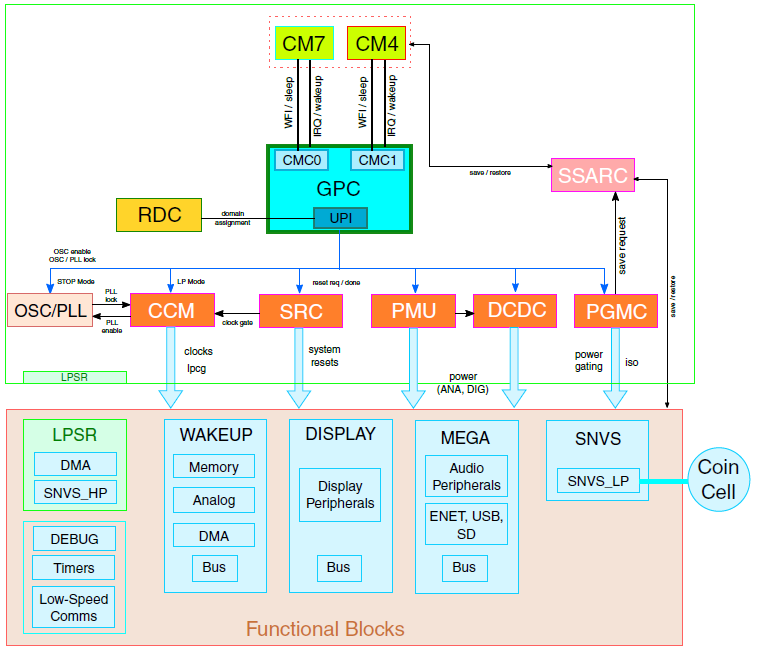
CPU的四种功耗模式
GPC负责模式的转换
|
|
Core |
Cache |
TCM |
Bus/Peripheral |
Wakeup time |
|
RUN |
active |
active |
active |
active |
- |
|
WAIT |
clock gated |
clock gated |
active |
active |
short |
|
STOP |
clock gated |
clock gated |
clock gated |
clock gated |
short |
|
SUSPEND |
power gated |
power gated |
power gated |
power gated |
long |
资源的四种属性
Private,Public,Shared,Unassigned
SetPoint(SP)
SP用于控制Public资源的功耗状态。
系统SP的管理
每个Core对应一个CMC
CMC给SPC发SP切换请求
如果不同的core请求不同的SP,需要仲裁。仲裁算法:
有点复杂,慢慢道来:
1.CPU0提供CM0_SPx_MAPPING, CPU1提供CM1_SPx_MAPPING
2.ALLOW = SP_SYS_STAT[SYS_SP_ALLOWED] = CM0_SPx_MAPPING & CM0_SPx_MAPPING.
3.进行判决
If ALLOW = 0, 非法,会触发IRQ。
If ALLOW 只有1个bit为1,则执行对应的SPx。
If ALLOW有多个bit则需要执行仲裁算法(有些复杂,而且感觉没必要)。
- 如果ALLOW仅和SP_CPU_REQ[SP_ACCEPTED_CPUn]中的一个匹配, 则执行SP_CPU_REQ[SP_ACCEPTED_CPUn].
- 如果ALLOW和SP_CPU_REQ[SP_ACCEPTED_CPUn]中的多个匹配, 则执行匹配的SP中高优先级的SP.
- 如果ALLOW和SP_CPU_REQ[SP_ACCEPTED_CPUn]不匹配, 则执行ALLOW中的高优先级的SP.
Standby
从概念上说,Standby是独立于CPU模式和SP之外的一种低功耗模式。
当每个core都进入了WAIT/STOP/SUSPEND后,并且每个core都发起了Standby请求后,系统会进入Standby的模式。
进入Standby后,可以活得更低的功耗。
小结
RT1170的功耗状态由CPU mode,SP以及Standby共同决定。

 浙公网安备 33010602011771号