
leetcode刷题第四周
栈和队列:容器适配器,不提供迭代器
232、用栈实现队列
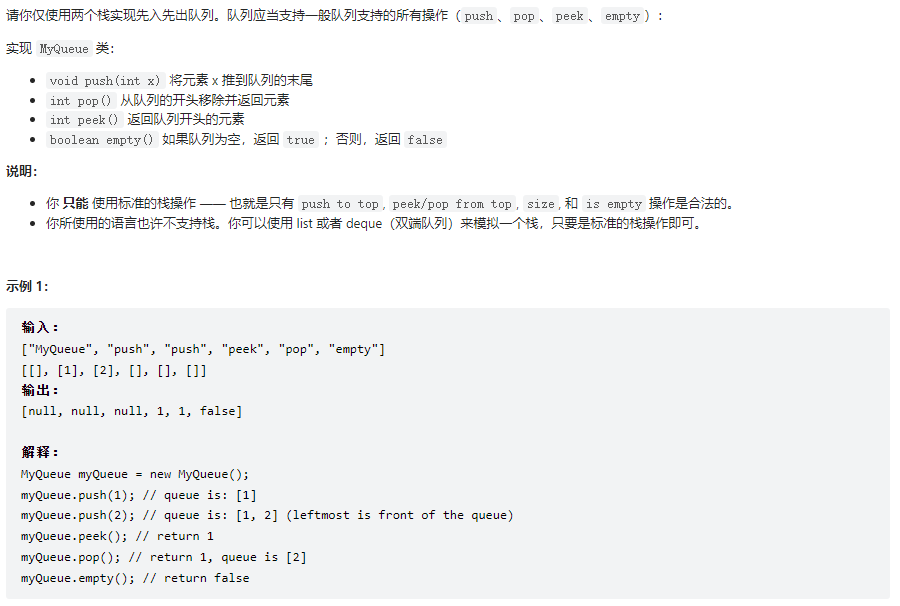
class MyQueue {
    Stack<Integer> stack1 = new Stack<>();
    Stack<Integer> stack2 = new Stack<>();
    public MyQueue() {

    }

    public void push(int x) {
        stack1.push(x);
    }

    public int pop() {
        if(stack2.isEmpty()){
            while(!stack1.isEmpty()){
                stack2.push(stack1.pop());
            }
        }
        return stack2.pop();
    }

    public int peek() {
        if(stack2.isEmpty()){
            while(!stack1.isEmpty()){
                stack2.push(stack1.pop());
            }
        }
        return stack2.peek();
    }

    public boolean empty() {
        if(stack1.isEmpty() && stack2.isEmpty()){
            return true;
        }
        return false;
    }
}

/**
 * Your MyQueue object will be instantiated and called as such:
 * MyQueue obj = new MyQueue();
 * obj.push(x);
 * int param_2 = obj.pop();
 * int param_3 = obj.peek();
 * boolean param_4 = obj.empty();
 */
225、用队列实现栈
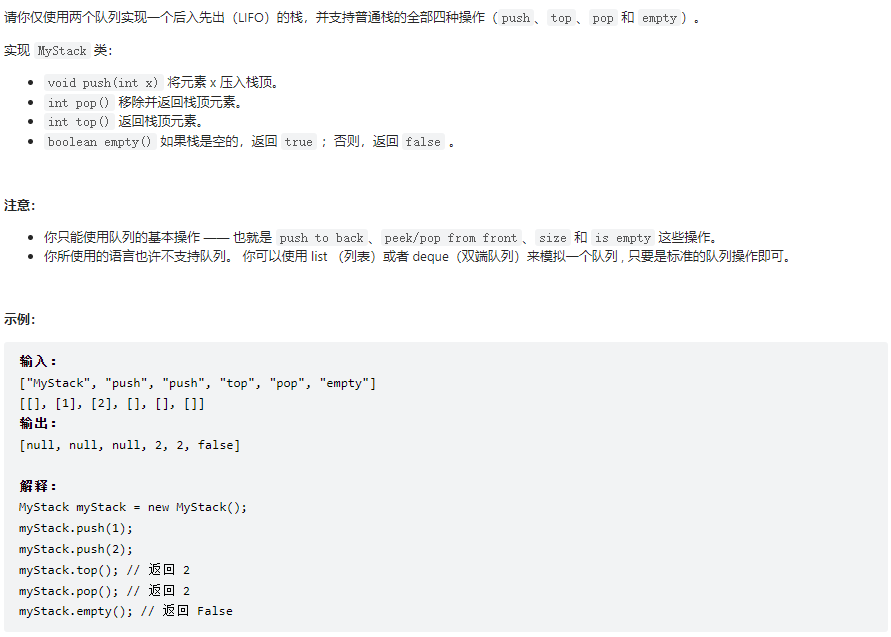
class MyStack {
    Queue<Integer> queue1;
    Queue<Integer> queue2;//用来备份栈的数据(除栈顶)
    public MyStack() {
        queue1 = new LinkedList<>();
        queue2 = new LinkedList<>();
    }
    // 方法一:较为繁琐
    // public void push(int x) {
    //     while(queue1.size() > 0){
    //         queue2.offer(queue1.poll());
    //     }
    //     while(queue2.size() > 0){
    //         queue1.offer(queue2.poll());
    //     }
    //     queue1.offer(x);
    // }

    // public int pop() {
    //     while(queue1.size() > 1){
    //         queue2.offer(queue1.poll());
    //     }
    //     int temp =  queue1.poll();
    //     while(queue2.size() > 0){
    //         queue1.offer(queue2.poll());
    //     }
    //     return temp;
    // }

    // public int top() {
    //     while(queue1.size() > 1){
    //         queue2.offer(queue1.poll());
    //     }
    //     int temp = queue1.peek();
    //     while(queue1.size() > 0){
    //         queue2.offer(queue1.poll());
    //     }
    //     while(queue2.size() > 0){
    //         queue1.offer(queue2.poll());
    //     }
    //     return temp;
    // }
    // public boolean empty() {
    //     return queue1.isEmpty() && queue2.isEmpty();
    // }
    // 方法二:参考代码随想录
    // public void push(int x) {
    //     queue2.offer(x);
    //     while(!queue1.isEmpty()){
    //         queue2.offer(queue1.poll());
    //     }
    //     Queue<Integer> temp = new LinkedList<>();
    //     queue1 = queue2;
    //     queue2 = temp;
    // }

    // public int pop() {
    //     return queue1.poll();
    // }

    // public int top() {
    //     return queue1.peek();
    // }
    // public boolean empty() {
    //     return queue1.isEmpty() && queue2.isEmpty();
    // }
    // 方法三:用单队列实现
    public void push(int x) {
        if(queue1.isEmpty()){
            queue1.offer(x);
        }else{
            int count = queue1.size();
            queue1.offer(x);
            while(count > 0){
                queue1.offer(queue1.poll());
                count--;
            }
        }
    }

    public int pop() {
        return queue1.poll();
    }

    public int top() {
        return queue1.peek();
    }
    public boolean empty() {
        return queue1.isEmpty();
    }
}

/**
 * Your MyStack object will be instantiated and called as such:
 * MyStack obj = new MyStack();
 * obj.push(x);
 * int param_2 = obj.pop();
 * int param_3 = obj.top();
 * boolean param_4 = obj.empty();
 */
20、有效的括号

class Solution {
    public boolean isValid(String s) {
        // 方法一:用字符串
        // String s1 = "";
        // if(s.length()%2 == 1){
        //     return false;
        // }
        // for(int i = 0; i < s.length(); i++){
        //     if(s.charAt(i) == '(' || s.charAt(i) == '[' || s.charAt(i) == '{'){
        //         s1 = s1 + s.charAt(i);
        //     }else if(s1.length() == 0){
        //         return false;
        //     }else if((s.charAt(i) == ']') && (s1.charAt(s1.length()-1) == '[')){
        //         s1 = s1.substring(0,s1.length() - 1);
        //     }else if((s.charAt(i) == '}') && (s1.charAt(s1.length()-1) == '{')){
        //         s1 = s1.substring(0,s1.length() - 1);
        //     }else if((s.charAt(i) == ')') && (s1.charAt(s1.length()-1) == '(')){
        //         s1 = s1.substring(0,s1.length() - 1);
        //     }else{
        //         return false;
        //     }
        // }
        // if(s1.length() == 0){
        //     return true;
        // }else{
        //     return false;
        // }
        // 方法二:用栈
        Stack<Character> stack = new Stack<>();
        char[] arr = s.toCharArray();
        for(int i = 0; i < arr.length; i++){
            if(arr[i] == '(' || arr[i] == '[' || arr[i] == '{'){
                stack.push(arr[i]);
            }else if(arr[i] == ')'){
                if(stack.isEmpty() || stack.pop() != '('){
                    return false;
                }
            }else if(arr[i] == ']'){
                if(stack.isEmpty() ||stack.pop() != '['){
                    return false;
                }
            }else if(arr[i] == '}'){
                if(stack.isEmpty() ||stack.pop() != '{'){
                    return false;
                }
            }
        }
        return stack.isEmpty();
    }
}
1047、删除字符串中的所有相邻重复项
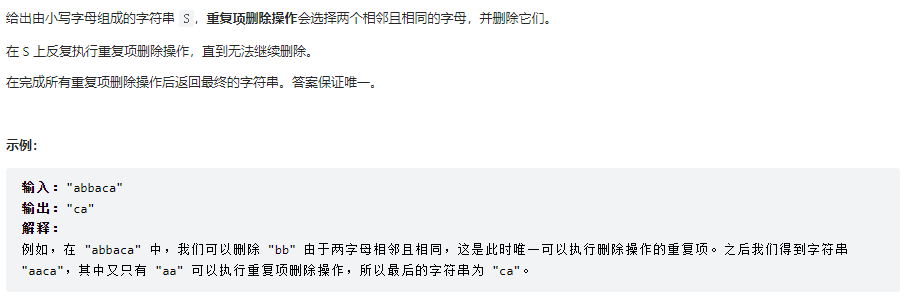
class Solution {
    public String removeDuplicates(String s) {
        // 方法一:用栈
        char[] arr = s.toCharArray();
        Stack<Character> stack = new Stack<>();
        for(int i = 0; i < arr.length; i++){
            if(stack.isEmpty()){
                stack.push(arr[i]);
            }else if(stack.peek() == arr[i]){
                stack.pop();
            }else{
                stack.push(arr[i]);
            }
        }
        String str = "";
        while(!stack.isEmpty()){
            str = stack.pop() + str;
        }
        return str;
        // // 方法二:双线队列
        // char[] arr = s.toCharArray();
        // ArrayDeque<Character> arraydeque = new ArrayDeque<>();
        // for(int i = 0; i < arr.length; i++){
        //     if(arraydeque.isEmpty()){
        //         arraydeque.push(arr[i]);
        //     }else if(arraydeque.peek() == arr[i]){
        //         arraydeque.pop();
        //     }else{
        //         arraydeque.push(arr[i]);
        //     }
        // }
        // String str = "";
        // while(!arraydeque.isEmpty()){
        //     str = arraydeque.pop() + str;
        // }
        // return str;
    }
}
150、逆波兰表达式求值
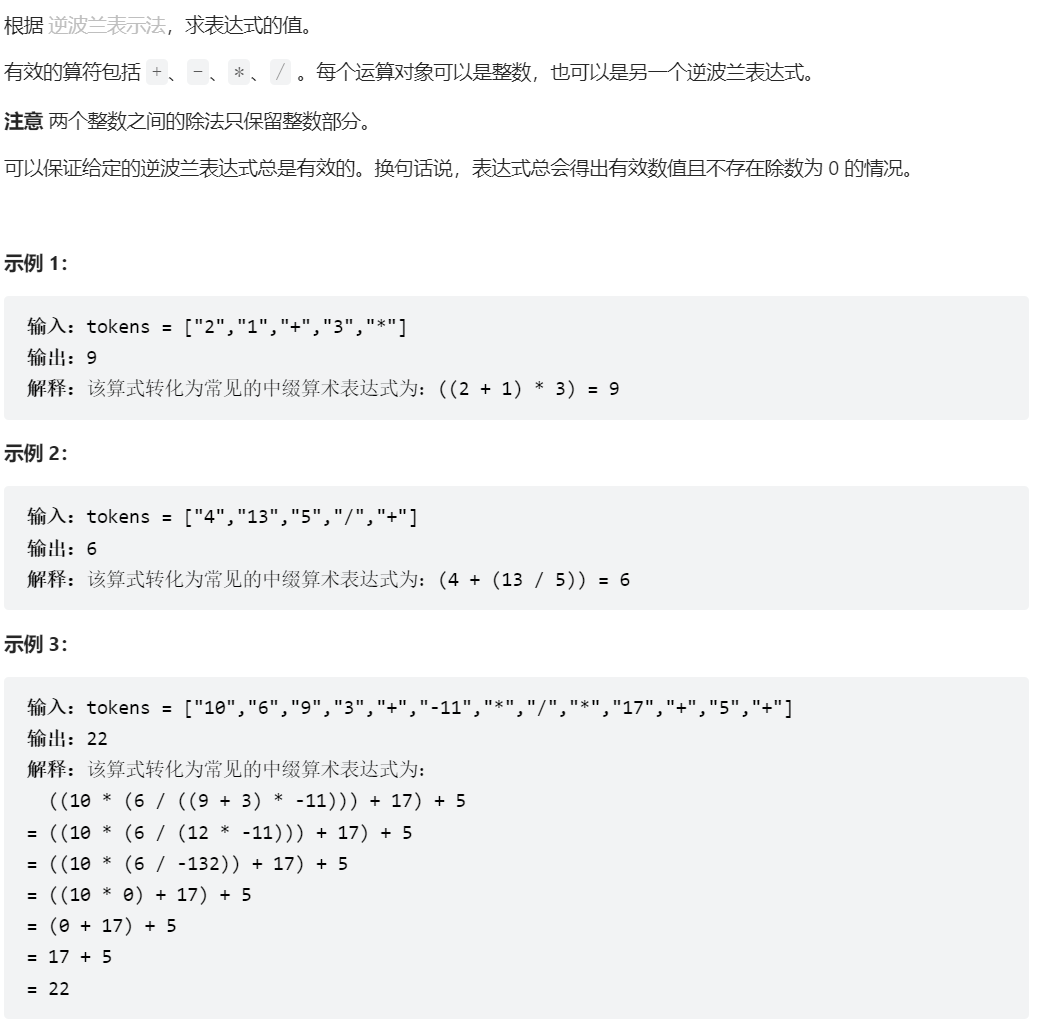
class Solution {
    public int evalRPN(String[] tokens) {
        Stack<Integer> stack = new Stack<>();
        for(int i = 0; i < tokens.length; i++){
            if(tokens[i].equals("+")){
                stack.push(stack.pop() + stack.pop());
            }else if(tokens[i].equals("-")){
                stack.push(-stack.pop() + stack.pop());
            }else if(tokens[i].equals("*")){
                stack.push(stack.pop() * stack.pop());
            }else if(tokens[i].equals("/")){
                int divisor = stack.pop();
                int dividend = stack.pop();
                int temp = dividend/divisor;
                stack.push(temp);
            }else{
                stack.push(Integer.valueOf(tokens[i]));
            }
        }
        return stack.pop();
    }
}
239、滑动窗口最大值
单调队列

class Solution {
    public int[] maxSlidingWindow(int[] nums, int k) {
        Deque<Integer> deque = new LinkedList<>();//单调双向队列
        int[] result = new int[nums.length - k + 1];
        for(int i = 0; i < nums.length; i++){
            while(deque.peekFirst() != null && deque.peekFirst() < i - k + 1){
                deque.pollFirst();
            }
            while(deque.peekLast() != null && nums[i] > nums[deque.peekLast()]){
                deque.pollLast();
            }
            deque.offerLast(i);
            if(i - k + 1 >= 0 ){
                result[i - k + 1] = nums[deque.peekFirst()];
            }
        }
        return result;
    }
}
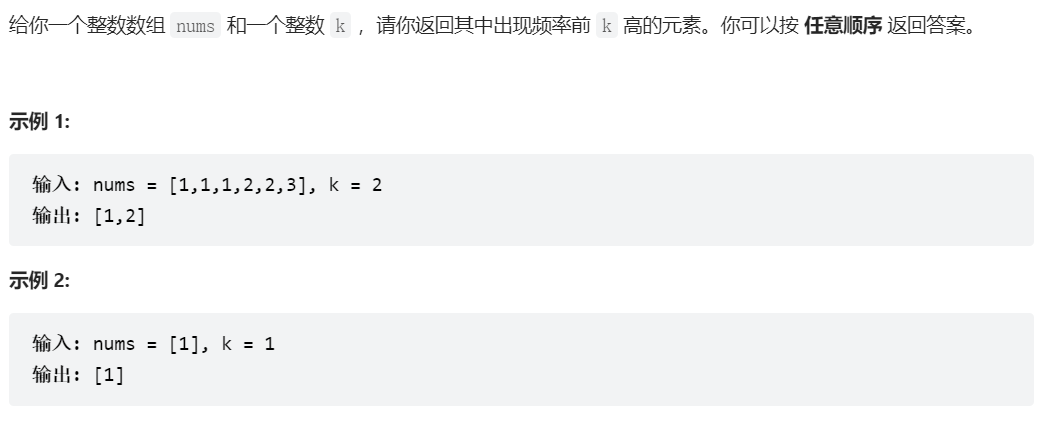
347、前 K 个高频元素
优先级队列,大顶堆,小顶堆
class Solution {
    public int[] topKFrequent(int[] nums, int k) {
        Map<Integer, Integer> map = new HashMap<>();
        for(int i: nums){
            map.put(i, map.getOrDefault(i, 0) + 1);
        }
        PriorityQueue<int[]> pq = new PriorityQueue<>(new Comparator<int[]>(){
            public int compare(int[] m, int[] n){
                return m[1] - n[1];
            }
        });
        for(Map.Entry<Integer, Integer> entry: map.entrySet()){
            if(pq.size() < k){
                pq.add(new int[]{entry.getKey(), entry.getValue()});
            }else{
                if(pq.peek()[1] < entry.getValue()){
                    pq.poll();
                    pq.add(new int[]{entry.getKey(), entry.getValue()});
                }
            }
        }
        int[] arr = new int[k];
        for(int i = 0; i < arr.length; i++){
            arr[i] = pq.poll()[0];
        }
        return arr;
    }
}

 浙公网安备 33010602011771号