
【数据结构与算法】贪心算法详解
贪心算法详解
贪心算法(Greedy Algorithm)是一种在每一步选择中都采取当前状态下最优决策的算法策略,通过局部最优解的累积来逼近全局最优解。其核心思想是“着眼当下,不顾全局”,适用于具有贪心选择性质和最优子结构的问题。
核心原理
-
贪心选择性质
每一步的局部最优选择能导致全局最优解,无需回溯。 -
最优子结构
问题的最优解包含其子问题的最优解(与动态规划类似)。
执行流程
-
问题分解
将问题分解为多个相互关联的子问题。 -
贪心策略
对每个子问题应用贪心策略,做出当前最优选择。 -
迭代求解
基于前一步的结果,继续求解下一个子问题。 -
组合解
将所有局部最优解组合成最终解。
特性
| 特性 | 说明 |
|---|---|
| 高效性 | 时间复杂度通常较低(常为 O(n log n) 或 O(n)) |
| 不可回溯 | 一旦做出选择,不可更改(与回溯、动态规划的区别) |
| 局部最优导向 | 依赖局部最优决策,不保证全局最优(需证明正确性) |
| 适用场景有限 | 仅适用于具有贪心选择性质的问题(如活动选择、霍夫曼编码) |
适用场景
- 活动选择问题
- 霍夫曼编码
- 最小生成树(Prim/Kruskal)
- 单源最短路径(Dijkstra)
- 部分背包问题(物品可拆分)
注意:贪心算法在 0-1背包问题 中不适用(物品不可拆分)。
经典问题:活动选择
问题描述
选择最多的互不重叠活动(每个活动有开始时间 s[i] 和结束时间 f[i])。
贪心策略
优先选择结束时间最早的活动,为后续活动留出更多时间。
Java 代码实现
import java.util.*;

class Activity {
    int start;
    int end;

    public Activity(int start, int end) {
        this.start = start;
        this.end = end;
    }
}

public class GreedyActivitySelection {
    public static List<Activity> selectActivities(Activity[] activities) {
        // 1. 按结束时间升序排序
        Arrays.sort(activities, (a1, a2) -> Integer.compare(a1.end, a2.end));

        List<Activity> selected = new ArrayList<>();
        // 2. 选择第一个活动(结束最早)
        selected.add(activities[0]);
        int lastEnd = activities[0].end;

        // 3. 贪心选择后续活动
        for (int i = 1; i < activities.length; i++) {
            if (activities[i].start >= lastEnd) {
                selected.add(activities[i]);
                lastEnd = activities[i].end;
            }
        }
        return selected;
    }

    public static void main(String[] args) {
        Activity[] activities = {
            new Activity(1, 4), new Activity(3, 5),
            new Activity(0, 6), new Activity(5, 7),
            new Activity(8, 9), new Activity(5, 9)
        };

        List<Activity> result = selectActivities(activities);
        System.out.println("Selected Activities:");
        for (Activity act : result) {
            System.out.println("[" + act.start + ", " + act.end + "]");
        }
    }
}
代码解析
-
排序阶段
Arrays.sort(activities, (a1, a2) -> Integer.compare(a1.end, a2.end));按活动结束时间升序排序(贪心策略核心)。
-
初始化选择
selected.add(activities[0]);
int lastEnd = activities[0].end;
选择第一个结束最早的活动。
-
贪心迭代
if (activities[i].start >= lastEnd) {
     selected.add(activities[i]);
     lastEnd = activities[i].end;
}
后续活动只需满足开始时间 ≥ 上一个活动的结束时间。
输出结果
Selected Activities:
[1, 4]
[5, 7]
[8, 9]
贪心算法 vs 动态规划
| 特性 | 贪心算法 | 动态规划 |
|---|---|---|
| 决策依据 | 当前局部最优 | 历史状态 + 当前决策 |
| 回溯性 | 不可回溯 | 需保存子问题解(可回溯) |
| 时间复杂度 | 通常更低 | 通常较高(需填表) |
| 问题类型 | 满足贪心选择性质 | 有重叠子问题和最优子结构 |
| 解的正确性 | 需数学证明 | 天然保证最优解 |
贪心算法实战应用
贪心算法核心原理再探
贪心选择性质的数学证明
贪心算法的正确性依赖于两个关键性质,需要通过严格的数学证明:
1. 贪心选择性质证明(反证法示例)
假设存在一个最优解不包含贪心选择的第一步
证明将该最优解的第一个选择替换为贪心选择后:
  1. 新解仍然可行
  2. 新解的价值不低于原最优解
从而得出贪心选择是安全的
2. 最优子结构证明(递归关系)
设问题P的最优解为S
证明S包含子问题P'的最优解S'
若存在更优解S'',则可构造出比S更优的解,矛盾
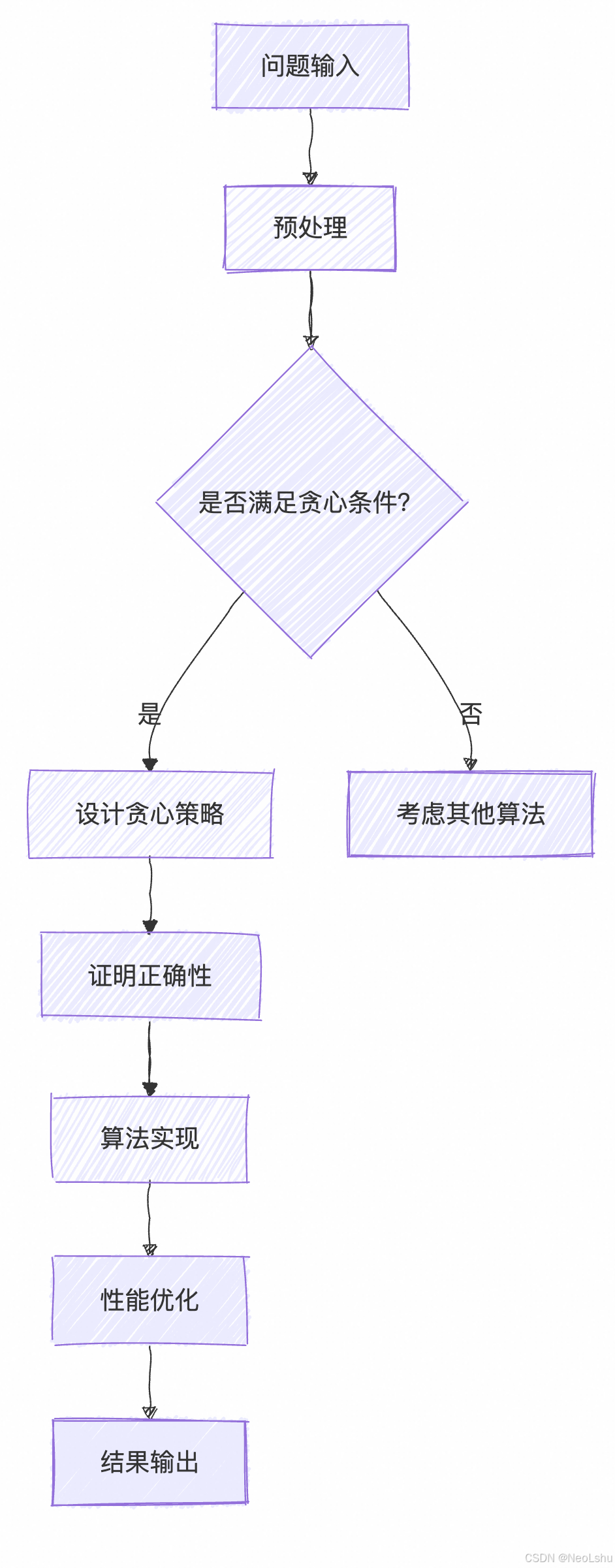
贪心算法执行流程优化
LeetCode贪心算法实战
1. 455. 分发饼干 (Assign Cookies)
问题描述:给孩子分配饼干,每个孩子有满足度g_i,饼干有大小s_j,每个孩子最多分一块饼干。求最多满足的孩子数。
贪心策略:
- 优先满足满足度小的孩子
- 使用能满足孩子的最小饼干
Java实现:
import java.util.Arrays;

public class AssignCookies {
    public int findContentChildren(int[] g, int[] s) {
        Arrays.sort(g);
        Arrays.sort(s);
        int child = 0, cookie = 0;
        while (child < g.length && cookie < s.length) {
            if (g[child] <= s[cookie]) {
                child++;
            }
            cookie++;
        }
        return child;
    }
}
复杂度分析:
- 时间复杂度:O(n log n + m log m) 排序时间复杂度
- 空间复杂度:O(1) 不使用额外空间
变种题:每个孩子可以分多块饼干(饼干可拆分),求最大满足度总和
public int maxSatisfaction(int[] g, int[] s) {
    Arrays.sort(g);
    Arrays.sort(s);
    int total = 0, j = 0;
    for (int i = 0; i < g.length && j < s.length; i++) {
        while (j < s.length && s[j] < g[i]) j++;
        if (j < s.length) {
            total += g[i];
            j++;
        }
    }
    return total;
}
2. 122. 买卖股票的最佳时机 II
问题描述:给定股票每天的价格,可进行多次交易(买前需卖出),求最大利润。
贪心策略:
- 所有上升趋势的收益都计入利润
- 忽略价格下跌的日子
Java实现:
public class BestTimeToBuyStock {
    public int maxProfit(int[] prices) {
        int profit = 0;
        for (int i = 1; i < prices.length; i++) {
            if (prices[i] > prices[i - 1]) {
                profit += prices[i] - prices[i - 1];
            }
        }
        return profit;
    }
}
复杂度分析:
- 时间复杂度:O(n) 单次遍历
- 空间复杂度:O(1) 常数空间
变种题:含交易手续费(714题)
public int maxProfit(int[] prices, int fee) {
    int buy = -prices[0]; // 持有股票状态
    int sell = 0;         // 不持有股票状态

    for (int i = 1; i < prices.length; i++) {
        int prevBuy = buy;
        buy = Math.max(buy, sell - prices[i]);
        sell = Math.max(sell, prevBuy + prices[i] - fee);
    }
    return sell;
}
3. 55. 跳跃游戏
问题描述:给定非负整数数组,每个元素表示可跳跃的最大长度,判断能否从起点到达终点。
贪心策略:
- 维护当前能到达的最远位置
- 遍历数组更新最远位置
- 当最远位置≥终点时返回true
Java实现:
public class JumpGame {
    public boolean canJump(int[] nums) {
        int maxReach = 0;
        for (int i = 0; i < nums.length; i++) {
            if (i > maxReach) return false;
            maxReach = Math.max(maxReach, i + nums[i]);
            if (maxReach >= nums.length - 1) return true;
        }
        return true;
    }
}
复杂度分析:
- 时间复杂度:O(n) 单次遍历
- 空间复杂度:O(1) 常数空间
变种题:45. 跳跃游戏 II(求最小跳跃次数)
public int jump(int[] nums) {
    int jumps = 0, curEnd = 0, curFarthest = 0;
    for (int i = 0; i < nums.length - 1; i++) {
        curFarthest = Math.max(curFarthest, i + nums[i]);
        if (i == curEnd) {
            jumps++;
            curEnd = curFarthest;
        }
    }
    return jumps;
}
4. 435. 无重叠区间
问题描述:给定区间集合,移除最小区间数使剩余区间互不重叠。
贪心策略:
- 按结束时间排序
- 优先保留结束早的区间
- 移除与已选区间重叠的区间
Java实现:
import java.util.Arrays;
import java.util.Comparator;

public class NonOverlappingIntervals {
    public int eraseOverlapIntervals(int[][] intervals) {
        if (intervals.length == 0) return 0;

        Arrays.sort(intervals, Comparator.comparingInt(a -> a[1]));
        int count = 1;
        int end = intervals[0][1];

        for (int i = 1; i < intervals.length; i++) {
            if (intervals[i][0] >= end) {
                count++;
                end = intervals[i][1];
            }
        }
        return intervals.length - count;
    }
}
复杂度分析:
- 时间复杂度:O(n log n) 排序时间复杂度
- 空间复杂度:O(1) 常数空间
变种题:452. 用最少数量的箭引爆气球
public int findMinArrowShots(int[][] points) {
    if (points.length == 0) return 0;

    Arrays.sort(points, (a, b) -> Integer.compare(a[1], b[1]));
    int arrows = 1;
    int end = points[0][1];

    for (int i = 1; i < points.length; i++) {
        if (points[i][0] > end) {
            arrows++;
            end = points[i][1];
        }
    }
    return arrows;
}
贪心算法高级应用
1. 霍夫曼编码优化(使用优先队列)
import java.util.PriorityQueue;

public class HuffmanOptimized {
    public int minCost(int[] freq) {
        PriorityQueue<Integer> pq = new PriorityQueue<>();
        for (int f : freq) pq.offer(f);

        int cost = 0;
        while (pq.size() > 1) {
            int a = pq.poll();
            int b = pq.poll();
            int sum = a + b;
            cost += sum;
            pq.offer(sum);
        }
        return cost;
    }
}
2. 任务调度问题(621. 任务调度器)
public class TaskScheduler {
    public int leastInterval(char[] tasks, int n) {
        int[] freq = new int[26];
        for (char c : tasks) freq[c - 'A']++;

        Arrays.sort(freq);
        int maxFreq = freq[25];
        int idleSlots = (maxFreq - 1) * n;

        for (int i = 24; i >= 0 && freq[i] > 0; i--) {
            idleSlots -= Math.min(maxFreq - 1, freq[i]);
        }

        return tasks.length + Math.max(0, idleSlots);
    }
}
贪心算法问题解决框架
1. 问题分析框架
graph TD
    A[问题分析] --> B{是否具有最优子结构?}
    B -->|是| C{是否具有贪心选择性质?}
    B -->|否| D[考虑动态规划或回溯]
    C -->|是| E[设计贪心策略]
    C -->|否| F[尝试动态规划]
    E --> G[证明正确性]
    G --> H[算法实现]
2. 代码实现模板
public class GreedyTemplate {
    public Solution greedySolution(Problem problem) {
        // 1. 预处理(通常需要排序)
        preprocess(problem);

        // 2. 初始化解决方案
        Solution solution = initializeSolution();

        // 3. 贪心迭代
        for (Element element : problem.getElements()) {
            if (isFeasible(solution, element)) {
                solution.add(element);
                updateState(solution, element);
            }
        }

        // 4. 返回结果
        return solution;
    }
}
总结与进阶
贪心算法适用场景特征
- 局部最优可推导全局最优:问题具有贪心选择性质
- 无后效性:当前决策不影响后续子问题
- 高效性要求:需要优于O(n²)的解决方案
- 问题可分解:问题可分解为相似子问题
贪心算法局限性
- 不保证全局最优:局部最优的累积不一定全局最优
- 证明困难:需要严格的数学证明
- 适用范围有限:仅适用于特定问题类型
- 对输入敏感:排序预处理可能增加时间复杂度
进阶学习方向
- 拟阵理论:贪心算法的数学基础
- 近似算法:贪心在NP难问题中的应用
- 在线算法:处理流式数据的贪心策略
- 分布式贪心:并行环境下的贪心算法
贪心算法作为算法设计的核心范式之一,其价值不仅在于解决特定问题,更在于培养"局部最优推导全局最优"的算法思维。掌握贪心算法的关键在于:准确识别适用场景、设计有效策略、严格证明正确性,并在实践中不断优化。
本文来自博客园,作者:NeoLshu,转载请注明原文链接:https://www.cnblogs.com/neolshu/p/19513664

 浙公网安备 33010602011771号