Linux input子系统
-
Input driver :主要实现对硬件设备的读写访问,中断设置,并把硬件产生的事件转换为核心层定义的规范提交给事件处理层。
-
Input core :承上启下。为设备驱动层提供了规范和接口;通知事件处理层对事件进行处理;
-
Event handler :提供用户编程的接口(设备节点),并处理驱动层提交的数据处理。
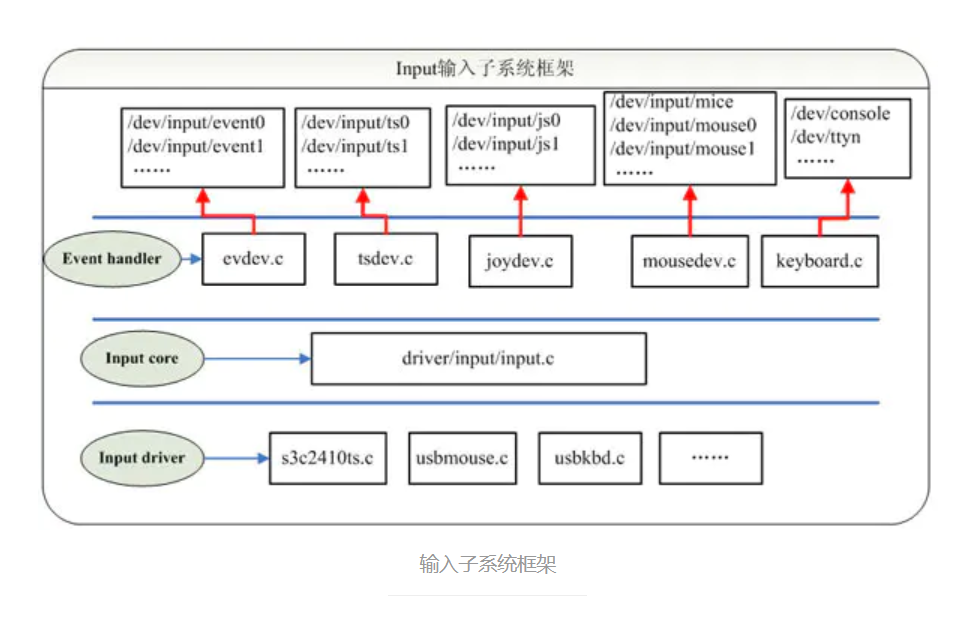
1输入子系统框架分析
1.1设备驱动层(Input driver)
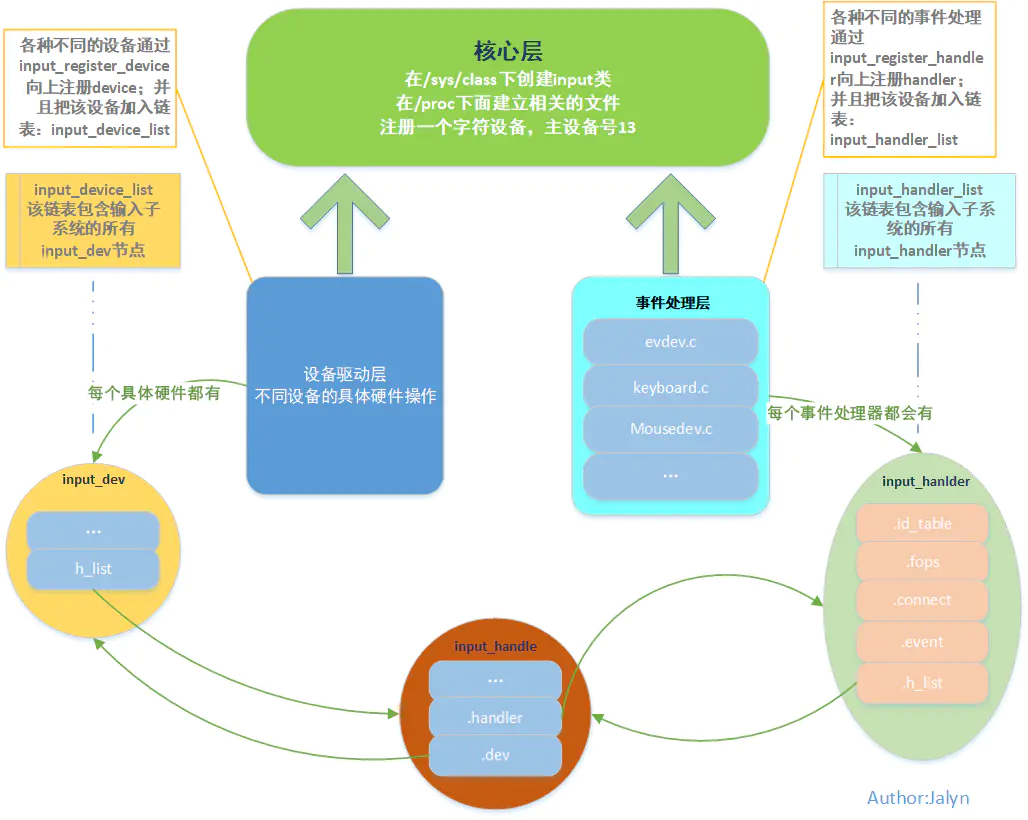
- device是纯硬件操作层,包含不同的硬件接口处理,如gpio等
- 对于每种不同的具体硬件操作,都对应着不同的input_dev结构体
- 该结构体内部也包含着一个h_list,指向handle
1.2.系统核心层(Input core)
- 申请主设备号;
- 提供input_register_device跟input_register_handler函数分别用于注册device跟handler;
- 提供input_register_handle函数用于注册一个事件处理,代表一个成功配对的input_dev和input_handler;
1.3.事件处理层(Event handler)
- 不涉及硬件方面的具体操作,handler层是纯软件层,包含不同的解决方案,如键盘,鼠标,游戏手柄等;
- 对于不同的解决方案,都包含一个名为input_handler的结构体,该结构体内含的主要成员如下:
| 成员 | 功能 |
|---|---|
| .id_table | 一个存放该handler所支持的设备id的表(其实内部存放的是EV_xxx事件,用于判断device是否支持该事件) |
| .fops | 该handler的file_operation |
| .connect | 连接该handler跟所支持device的函数 |
| .disconnect | 断开该连接 |
| .event | 事件处理函数,让device调用 |
| h_list | 是一个链表,该链表保存着该handler到所支持的所有device的中间站:handle结构体的指针 |
2.两条链表连接dev和handler
#file pwd: drivers/input/input.c
MODULE_AUTHOR("Vojtech Pavlik <vojtech@suse.cz>"); MODULE_DESCRIPTION("Input core"); MODULE_LICENSE("GPL");#define INPUT_MAX_CHAR_DEVICES 1024
#define INPUT_FIRST_DYNAMIC_DEV 256
static DEFINE_IDA(input_ida);static LIST_HEAD(input_dev_list);
static LIST_HEAD(input_handler_list);
3.输入子系统代码分析
文件路径:driver/input/input.c (核心层)
1 static int __init input_init(void) 2 { 3 int err; 4 5 err = class_register(&input_class);//在/sys/class下创建逻辑(input)类,在类下面挂载input设备6 if (err) { 7 pr_err("unable to register input_dev class\n"); 8 return err; 9 } 10 11 err = input_proc_init();//在/proc下面建立相关的虚拟文件,proc下创建的文件可以看作是虚拟文件对内核读写的一种操作12 if (err) 13 goto fail1; 14 15 err = register_chrdev_region(MKDEV(INPUT_MAJOR, 0),//在/dev下创建input设备号 16 INPUT_MAX_CHAR_DEVICES, "input"); 17 if (err) { 18 pr_err("unable to register char major %d", INPUT_MAJOR); 19 goto fail2; 20 } 21 22 return 0; 23 24 fail2: input_proc_exit(); 25 fail1: class_unregister(&input_class); 26 return err; 27 } 28 29 static void __exit input_exit(void) 30 { 31 input_proc_exit(); 32 unregister_chrdev_region(MKDEV(INPUT_MAJOR, 0), 33 INPUT_MAX_CHAR_DEVICES); 34 class_unregister(&input_class); 35 } 36 37 subsys_initcall(input_init); 38 module_exit(input_exit);
现在基本框架已经建成,如何往input系统里面注册dev和hanlder呢?
3.1注册dev
  1 /**
  2  * struct input_dev - represents an input device
  3  * @name: name of the device
  4  * @phys: physical path to the device in the system hierarchy
  5  * @uniq: unique identification code for the device (if device has it)
  6  * @id: id of the device (struct input_id)
  7  * @propbit: bitmap of device properties and quirks
  8  * @evbit: bitmap of types of events supported by the device (EV_KEY,
  9  *    EV_REL, etc.)
 10  * @keybit: bitmap of keys/buttons this device has
 11  * @relbit: bitmap of relative axes for the device
 12  * @absbit: bitmap of absolute axes for the device
 13  * @mscbit: bitmap of miscellaneous events supported by the device
 14  * @ledbit: bitmap of leds present on the device
 15  * @sndbit: bitmap of sound effects supported by the device
 16  * @ffbit: bitmap of force feedback effects supported by the device
 17  * @swbit: bitmap of switches present on the device
 18  * @hint_events_per_packet: average number of events generated by the
 19  *    device in a packet (between EV_SYN/SYN_REPORT events). Used by
 20  *    event handlers to estimate size of the buffer needed to hold
 21  *    events.
 22  * @keycodemax: size of keycode table
 23  * @keycodesize: size of elements in keycode table
 24  * @keycode: map of scancodes to keycodes for this device
 25  * @getkeycode: optional legacy method to retrieve current keymap.
 26  * @setkeycode: optional method to alter current keymap, used to implement
 27  *    sparse keymaps. If not supplied default mechanism will be used.
 28  *    The method is being called while holding event_lock and thus must
 29  *    not sleep
 30  * @ff: force feedback structure associated with the device if device
 31  *    supports force feedback effects
 32  * @repeat_key: stores key code of the last key pressed; used to implement
 33  *    software autorepeat
 34  * @timer: timer for software autorepeat
 35  * @rep: current values for autorepeat parameters (delay, rate)
 36  * @mt: pointer to multitouch state
 37  * @absinfo: array of &struct input_absinfo elements holding information
 38  *    about absolute axes (current value, min, max, flat, fuzz,
 39  *    resolution)
 40  * @key: reflects current state of device's keys/buttons
 41  * @led: reflects current state of device's LEDs
 42  * @snd: reflects current state of sound effects
 43  * @sw: reflects current state of device's switches
 44  * @open: this method is called when the very first user calls
 45  *    input_open_device(). The driver must prepare the device
 46  *    to start generating events (start polling thread,
 47  *    request an IRQ, submit URB, etc.)
 48  * @close: this method is called when the very last user calls
 49  *    input_close_device().
 50  * @flush: purges the device. Most commonly used to get rid of force
 51  *    feedback effects loaded into the device when disconnecting
 52  *    from it
 53  * @event: event handler for events sent _to_ the device, like EV_LED
 54  *    or EV_SND. The device is expected to carry out the requested
 55  *    action (turn on a LED, play sound, etc.) The call is protected
 56  *    by @event_lock and must not sleep
 57  * @grab: input handle that currently has the device grabbed (via
 58  *    EVIOCGRAB ioctl). When a handle grabs a device it becomes sole
 59  *    recipient for all input events coming from the device
 60  * @event_lock: this spinlock is is taken when input core receives
 61  *    and processes a new event for the device (in input_event()).
 62  *    Code that accesses and/or modifies parameters of a device
 63  *    (such as keymap or absmin, absmax, absfuzz, etc.) after device
 64  *    has been registered with input core must take this lock.
 65  * @mutex: serializes calls to open(), close() and flush() methods
 66  * @users: stores number of users (input handlers) that opened this
 67  *    device. It is used by input_open_device() and input_close_device()
 68  *    to make sure that dev->open() is only called when the first
 69  *    user opens device and dev->close() is called when the very
 70  *    last user closes the device
 71  * @going_away: marks devices that are in a middle of unregistering and
 72  *    causes input_open_device*() fail with -ENODEV.
 73  * @dev: driver model's view of this device
 74  * @h_list: list of input handles associated with the device. When
 75  *    accessing the list dev->mutex must be held
 76  * @node: used to place the device onto input_dev_list
 77  * @num_vals: number of values queued in the current frame
 78  * @max_vals: maximum number of values queued in a frame
 79  * @vals: array of values queued in the current frame
 80  * @devres_managed: indicates that devices is managed with devres framework
 81  *    and needs not be explicitly unregistered or freed.
 82  */
 83 struct input_dev {
 84     const char *name;
 85     const char *phys;
 86     const char *uniq;
 87     struct input_id id;
 88
 89     unsigned long propbit[BITS_TO_LONGS(INPUT_PROP_CNT)];
 90
 91     unsigned long evbit[BITS_TO_LONGS(EV_CNT)];
 92     unsigned long keybit[BITS_TO_LONGS(KEY_CNT)];
 93     unsigned long relbit[BITS_TO_LONGS(REL_CNT)];
 94     unsigned long absbit[BITS_TO_LONGS(ABS_CNT)];
 95     unsigned long mscbit[BITS_TO_LONGS(MSC_CNT)];
 96     unsigned long ledbit[BITS_TO_LONGS(LED_CNT)];
 97     unsigned long sndbit[BITS_TO_LONGS(SND_CNT)];
 98     unsigned long ffbit[BITS_TO_LONGS(FF_CNT)];
 99     unsigned long swbit[BITS_TO_LONGS(SW_CNT)];
100
101     unsigned int hint_events_per_packet;
102
103     unsigned int keycodemax;
104     unsigned int keycodesize;
105     void *keycode;
106
107     int (*setkeycode)(struct input_dev *dev,
108               const struct input_keymap_entry *ke,
109               unsigned int *old_keycode);
110     int (*getkeycode)(struct input_dev *dev,
111               struct input_keymap_entry *ke);
112
113     struct ff_device *ff;
114
115     unsigned int repeat_key;
116     struct timer_list timer;
117
118     int rep[REP_CNT];
119
120     struct input_mt *mt;
121
122     struct input_absinfo *absinfo;
123
124     unsigned long key[BITS_TO_LONGS(KEY_CNT)];
125     unsigned long led[BITS_TO_LONGS(LED_CNT)];
126     unsigned long snd[BITS_TO_LONGS(SND_CNT)];
127     unsigned long sw[BITS_TO_LONGS(SW_CNT)];
128
129     int (*open)(struct input_dev *dev);
130     void (*close)(struct input_dev *dev);
131     int (*flush)(struct input_dev *dev, struct file *file);
132     int (*event)(struct input_dev *dev, unsigned int type, unsigned int code, int value);
133
134     struct input_handle __rcu *grab;
135
136     spinlock_t event_lock;
137     struct mutex mutex;
138
139     unsigned int users;
140     bool going_away;
141
142     struct device dev;
143
144     struct list_head    h_list;
145     struct list_head    node;
146
147     unsigned int num_vals;
148     unsigned int max_vals;
149     struct input_value *vals;
150
151     bool devres_managed;
152 };
153 #define to_input_dev(d) container_of(d, struct input_dev, dev)
  1 /**
  2  * input_register_device - register device with input core
  3  * @dev: device to be registered
  4  *
  5  * This function registers device with input core. The device must be
  6  * allocated with input_allocate_device() and all it's capabilities
  7  * set up before registering.
  8  * If function fails the device must be freed with input_free_device().
  9  * Once device has been successfully registered it can be unregistered
 10  * with input_unregister_device(); input_free_device() should not be
 11  * called in this case.
 12  *
 13  * Note that this function is also used to register managed input devices
 14  * (ones allocated with devm_input_allocate_device()). Such managed input
 15  * devices need not be explicitly unregistered or freed, their tear down
 16  * is controlled by the devres infrastructure. It is also worth noting
 17  * that tear down of managed input devices is internally a 2-step process:
 18  * registered managed input device is first unregistered, but stays in
 19  * memory and can still handle input_event() calls (although events will
 20  * not be delivered anywhere). The freeing of managed input device will
 21  * happen later, when devres stack is unwound to the point where device
 22  * allocation was made.
 23  */
 24 int input_register_device(struct input_dev *dev)
 25 {
 26     struct input_devres *devres = NULL;
 27      /* 输入事件的处理接口指针,用于和设备的事件类型进行匹配 */
 28     struct input_handler *handler;
 29     unsigned int packet_size;
 30     const char *path;
 31     int error;
 32
 33     if (dev->devres_managed) {
 34         devres = devres_alloc(devm_input_device_unregister,
 35                       sizeof(struct input_devres), GFP_KERNEL);
 36         if (!devres)
 37             return -ENOMEM;
 38
 39         devres->input = dev;
 40     }
 41
 42     /* Every input device generates EV_SYN/SYN_REPORT events. */
 43     __set_bit(EV_SYN, dev->evbit);
 44
 45     /* KEY_RESERVED is not supposed to be transmitted to userspace. */
 46     __clear_bit(KEY_RESERVED, dev->keybit);
 47
 48     /* Make sure that bitmasks not mentioned in dev->evbit are clean. */
 49     input_cleanse_bitmasks(dev);
 50
 51     packet_size = input_estimate_events_per_packet(dev);
 52     if (dev->hint_events_per_packet < packet_size)
 53         dev->hint_events_per_packet = packet_size;
 54
 55     dev->max_vals = dev->hint_events_per_packet + 2;
 56     dev->vals = kcalloc(dev->max_vals, sizeof(*dev->vals), GFP_KERNEL);
 57     if (!dev->vals) {
 58         error = -ENOMEM;
 59         goto err_devres_free;
 60     }
 61
 62     /*
 63      * If delay and period are pre-set by the driver, then autorepeating
 64      * is handled by the driver itself and we don't do it in input.c.
 65      */
 66     if (!dev->rep[REP_DELAY] && !dev->rep[REP_PERIOD]) {
 67         dev->timer.data = (long) dev;
 68         dev->timer.function = input_repeat_key;
 69         dev->rep[REP_DELAY] = 250;
 70         dev->rep[REP_PERIOD] = 33;
 71     }
 72
 73     if (!dev->getkeycode)
 74         dev->getkeycode = input_default_getkeycode;
 75
 76     if (!dev->setkeycode)
 77         dev->setkeycode = input_default_setkeycode;
 78
 79     error = device_add(&dev->dev);
 80     if (error)
 81         goto err_free_vals;
 82
 83     path = kobject_get_path(&dev->dev.kobj, GFP_KERNEL);
 84     pr_info("%s as %s\n",
 85         dev->name ? dev->name : "Unspecified device",
 86         path ? path : "N/A");
 87     kfree(path);
 88
 89     error = mutex_lock_interruptible(&input_mutex);
 90     if (error)
 91         goto err_device_del;
 92
 93     /* 重要:把设备挂到全局的input子系统设备链表input_dev_list上 */
 94     list_add_tail(&dev->node, &input_dev_list);
 95
 96     /* 核心重点,input设备在增加到input_dev_list链表上之后,会查找
 97      * input_handler_list事件处理链表上的handler进行匹配,这里的匹配
 98      * 方式与设备模型的device和driver匹配过程很相似*/
 99     list_for_each_entry(handler, &input_handler_list, node)
100         input_attach_handler(dev, handler);/*遍历input_handler_list,通过input_match_device试图与每一个handler进行匹配 匹配上了就使用connect连接*/
101     /*
102     static int input_attach_handler(struct input_dev *dev, struct input_handler *handler)
103     {
104         const struct input_device_id *id;
105         int error;
106
107         id = input_match_device(handler, dev);
108         if (!id)
109             return -ENODEV;
110
111         error = handler->connect(handler, dev, id);
112         if (error && error != -ENODEV)
113             pr_err("failed to attach handler %s to device %s, error: %d\n",
114                    handler->name, kobject_name(&dev->dev.kobj), error);
115
116         return error;
117     }
118     */
119
120     input_wakeup_procfs_readers();
121
122     mutex_unlock(&input_mutex);
123
124     if (dev->devres_managed) {
125         dev_dbg(dev->dev.parent, "%s: registering %s with devres.\n",
126             __func__, dev_name(&dev->dev));
127         devres_add(dev->dev.parent, devres);
128     }
129     return 0;
130
131 err_device_del:
132     device_del(&dev->dev);
133 err_free_vals:
134     kfree(dev->vals);
135     dev->vals = NULL;
136 err_devres_free:
137     devres_free(devres);
138     return error;
139 }
140 EXPORT_SYMBOL(input_register_device);
3.2注册handler
一般handler不需要我们自己写 内核里面已经有了很多的hanlder基本够用
下面以Evdev为例,来分析事件处理层。vim drivers/input/evdev.c
 1 static const struct input_device_id evdev_ids[] = {
 2     { .driver_info = 1 },    /* Matches all devices */
 3     { },            /* Terminating zero entry */
 4 };
 5
 6 MODULE_DEVICE_TABLE(input, evdev_ids);
 7
 8 static struct input_handler evdev_handler = {
 9     .event        = evdev_event,
10     .events        = evdev_events,
11     .connect    = evdev_connect,
12     .disconnect    = evdev_disconnect,
13     .legacy_minors    = true,
14     .minor        = EVDEV_MINOR_BASE,
15     .name        = "evdev",
16     .id_table    = evdev_ids,
17 };
18
19 static int __init evdev_init(void)
20 {
21     return input_register_handler(&evdev_handler);
22 }
23
24 static void __exit evdev_exit(void)
25 {
26     input_unregister_handler(&evdev_handler);
27 }
28
29 module_init(evdev_init);
30 module_exit(evdev_exit);
31
32 MODULE_AUTHOR("Vojtech Pavlik <vojtech@ucw.cz>");
33 MODULE_DESCRIPTION("Input driver event char devices");
34 MODULE_LICENSE("GPL");
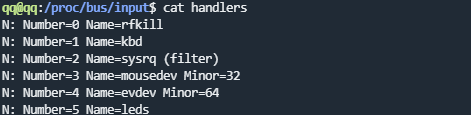
注册的handler可以在proc/bus/input/danlder中查看到
1 /** 2 * input_register_handler - register a new input handler 3 * @handler: handler to be registered 4 * 5 * This function registers a new input handler (interface) for input 6 * devices in the system and attaches it to all input devices that 7 * are compatible with the handler. 8 */ 9 int input_register_handler(struct input_handler *handler) 10 { 11 struct input_dev *dev; 12 int error; 13 14 error = mutex_lock_interruptible(&input_mutex); 15 if (error) 16 return error; 17 18 INIT_LIST_HEAD(&handler->h_list); 19/* `重要`:把设备处理器挂到全局的input子系统设备链表input_handler_list上 */20 list_add_tail(&handler->node, &input_handler_list); 21/*遍历input_dev_list,试图与每一个input_dev进行匹配*/22 list_for_each_entry(dev, &input_dev_list, node) 23 input_attach_handler(dev, handler);
/*static int input_attach_handler(struct input_dev *dev, struct input_handler *handler) { const struct input_device_id *id; int error;/* 利用handler->id_table和dev进行匹配/
id = input_match_device(handler, dev);
if (!id)
return -ENODEV;
/匹配成功,则调用handler->connect函数进行连接*/
error = handler->connect(handler, dev, id);
if (error && error != -ENODEV)
pr_err("failed to attach handler %s to device %s, error: %d\n",
handler->name, kobject_name(&dev->dev.kobj), error);
return error;
}
*/
24
25 input_wakeup_procfs_readers();
26
27 mutex_unlock(&input_mutex);
28 return 0;
29 }
30 EXPORT_SYMBOL(input_register_handler);
这个过程和注册dev及其相似
3.3 handler的connect函数
 1 static int evdev_connect(struct input_handler *handler, struct input_dev *dev,
 2              const struct input_device_id *id)
 3 {
 4     struct evdev *evdev;
 5     int minor;
 6     int dev_no;
 7     int error;
 8
 9     /*申请一个新的次设备号*/
10     minor = input_get_new_minor(EVDEV_MINOR_BASE, EVDEV_MINORS, true);
11
12     /* 这说明内核已经没办法再分配这种类型的设备了 */
13     if (minor < 0) {
14         error = minor;
15         pr_err("failed to reserve new minor: %d\n", error);
16         return error;
17     }
18
19     /* 开始给evdev事件层驱动分配空间了 */
20     evdev = kzalloc(sizeof(struct evdev), GFP_KERNEL);
21     if (!evdev) {
22         error = -ENOMEM;
23         goto err_free_minor;
24     }
25
26         /* 初始化client_list列表和evdev_wait队列 */
27     INIT_LIST_HEAD(&evdev->client_list);
28     spin_lock_init(&evdev->client_lock);
29     mutex_init(&evdev->mutex);
30     init_waitqueue_head(&evdev->wait);
31     evdev->exist = true;
32
33     dev_no = minor;
34     /* Normalize device number if it falls into legacy range */
35     if (dev_no < EVDEV_MINOR_BASE + EVDEV_MINORS)
36         dev_no -= EVDEV_MINOR_BASE;
37
38     /*设置设备节点名称,/dev/eventX 就是在此时设置*/
39     dev_set_name(&evdev->dev, "event%d", dev_no);
40
41     /* 初始化evdev结构体,其中handle为输入设备和事件处理的关联接口 */
42     evdev->handle.dev = input_get_device(dev);
43     evdev->handle.name = dev_name(&evdev->dev);
44     evdev->handle.handler = handler;
45     evdev->handle.private = evdev;
46
47       /*设置设备号,应用层就是通过设备号,找到该设备的*/
48     evdev->dev.devt = MKDEV(INPUT_MAJOR, minor);
49     evdev->dev.class = &input_class;
50     evdev->dev.parent = &dev->dev;
51     evdev->dev.release = evdev_free;
52     device_initialize(&evdev->dev);
53
54      /* input_dev设备驱动和handler事件处理层的关联,就在这时由handle完成 */
55     error = input_register_handle(&evdev->handle);
56     if (error)
57         goto err_free_evdev;
58
59     cdev_init(&evdev->cdev, &evdev_fops);
60     evdev->cdev.kobj.parent = &evdev->dev.kobj;
61     error = cdev_add(&evdev->cdev, evdev->dev.devt, 1);
62     if (error)
63         goto err_unregister_handle;
64
65     /*将设备加入到Linux设备模型,它的内部将找到它的bus,然后让它的bus
66     给它找到它的driver,在驱动或者总线的probe函数中,一般会在/dev/目录
67     先创建相应的设备节点,这样应用程序就可以通过该设备节点来使用设备了
68     ,/dev/eventX 设备节点就是在此时生成
69     */
70     error = device_add(&evdev->dev);
71     if (error)
72         goto err_cleanup_evdev;
73
74     return 0;
75
76  err_cleanup_evdev:
77     evdev_cleanup(evdev);
78  err_unregister_handle:
79     input_unregister_handle(&evdev->handle);
80  err_free_evdev:
81     put_device(&evdev->dev);
82  err_free_minor:
83     input_free_minor(minor);
84     return error;
85 }
over
4.应用层的角度分析到底层
evdev_read()---------------------------》wait_event_interruptible(evdev->wait,client->packet_head != client->tail || !evdev->exist || client->revoked);等待evdev->wait唤醒
evdev_pass_values-----------------------》wake_up_interruptible(&evdev->wait);
evdev_events---------------------------》evdev_pass_values(client, vals, count, ev_time);
evdev_event----------------------------》evdev_events(handle, vals, 1);
static struct input_handler evdev_handler = {
.event = evdev_event,
.events = evdev_events,
.connect = evdev_connect,
.disconnect = evdev_disconnect,
.legacy_minors = true,
.minor = EVDEV_MINOR_BASE,
.name = "evdev",
.id_table = evdev_ids,
};
input_to_handler-----------------------------》 if (handler->events)
handler->events(handle, vals, count);
else if (handler->event)
for (v = vals; v != vals + count; v++)
handler->event(handle, v->type, v->code, v->value);
input_pass_values--------------------------------》count = input_to_handler(handle, vals, count);
input_handle_event----------------------------》input_pass_values(dev, dev->vals, dev->num_vals);
input_event----------------------------------------》input_handle_event(dev, type, code, value);
显然,就是input_dev通过输入核心为驱动层提供统一的接口,input_event,来向事件处理层上报数据并唤醒。


 浙公网安备 33010602011771号