


使用libtorch训练一个异或逻辑门
本文以一个例子介绍如何使用libtorch创建一个包含多层神经元的感知机,训练识别异或逻辑。即${ z = x \text{^} y }$。本例的测试环境是VS2017和libtorch1.13.1。从本例可以学到如何复用网络结构,如下方的LinearSigImpl类的写法。该测试网络结构如下图。一个线性层2输入3输出,一个Sigmoid激活函数3输入3输出,一个线性输出层:
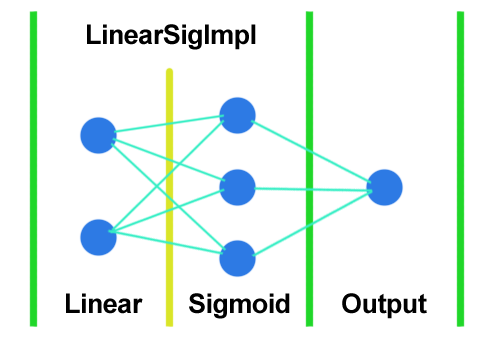
头文件代码如下:
class LinearSigImpl : public torch::nn::Module
{
public:
    LinearSigImpl(int intput_features, int output_features);
    torch::Tensor forward(torch::Tensor x);

private:
    torch::nn::Linear ln;
    torch::nn::Sigmoid bn;
};

TORCH_MODULE(LinearSig);

class Mlp : public torch::nn::Module
{
public:
    Mlp(int in_features, int out_features);
    torch::Tensor forward(torch::Tensor x);

private:
    LinearSig ln1;
    torch::nn::Linear output;
};
CPP文件:
LinearSigImpl::LinearSigImpl(int in_features, int out_features) :
    ln(nullptr), bn(nullptr)
{
    ln = register_module("ln", torch::nn::Linear(in_features, out_features));
    bn = register_module("bn", torch::nn::Sigmoid());
}

torch::Tensor LinearSigImpl::forward(torch::Tensor x)
{
    x = ln->forward(x);
    x = bn->forward(x);
    return x;
}

Mlp::Mlp(int in_features, int out_features) :
    ln1(nullptr), output(nullptr)
{
    ln1 = register_module("ln1", LinearSig(in_features, 3));
    output = register_module("output", torch::nn::Linear(3, out_features));
}

torch::Tensor Mlp::forward(torch::Tensor x)
{
    x = ln1->forward(x);
    x = output->forward(x);
    return x;
}

int main()
{
    Mlp linear(2, 1);

    /* 30个样本。在这里是一行一个样本 */
    at::Tensor b = torch::rand({ 30, 2 });
    at::Tensor c = torch::zeros({ 30, 1 });
    for (int i = 0; i < 30; i++)
    {
        b[i][0] = (b[i][0] >= 0.5f);
        b[i][1] = (b[i][1] >= 0.5f);
        c[i] = b[i][0].item().toBool() ^ b[i][1].item().toBool();
    }

    //cout << b << endl;
    //cout << c << endl;

    /* 训练过程 */
    torch::optim::SGD optim(linear.parameters(), torch::optim::SGDOptions(0.01));
    torch::nn::MSELoss lossFunc;
    linear.train();
    for (int i = 0; i < 50000; i++)
    {
        torch::Tensor predict = linear.forward(b);
        torch::Tensor loss = lossFunc(predict, c);
        optim.zero_grad();
        loss.backward();
        optim.step();
        if (i % 2000 == 0)
        {
            /* 每2000次循环输出一次损失函数值 */
            cout << "LOOP:" << i << ",LOSS=" << loss.item() << endl;
        }
    }
    /* 非线性的网络就不输出网络参数了 */
    /* 太过玄学,输出也看不懂 */

    /* 做个测试 */
    at::Tensor x = torch::tensor({ { 1.0f, 0.0f }, { 0.0f, 1.0f }, { 1.0f, 1.0f }, { 0.0f, 0.0f} });
    at::Tensor y = linear.forward(x);
    cout << "输出为[1100]=" << y;

    /* 看看能不能泛化 */
    x = torch::tensor({ { 0.9f, 0.1f }, { 0.01f, 0.2f } });
    y = linear.forward(x);
    cout << "输出为[10]=" << y;

    return 0;
}
控制台输出如下。如果把0.5作为01分界线,从输出上看网络是有一定的泛化能力的。当然每次运行输出数字都不同,绝大多数泛化结果都正确:
LOOP:0,LOSS=1.56625
LOOP:2000,LOSS=0.222816
LOOP:4000,LOSS=0.220547
LOOP:6000,LOSS=0.218447
LOOP:8000,LOSS=0.215877
LOOP:10000,LOSS=0.212481
LOOP:12000,LOSS=0.207645
LOOP:14000,LOSS=0.199905
LOOP:16000,LOSS=0.187244
LOOP:18000,LOSS=0.168875
LOOP:20000,LOSS=0.145476
LOOP:22000,LOSS=0.118073
LOOP:24000,LOSS=0.087523
LOOP:26000,LOSS=0.0554768
LOOP:28000,LOSS=0.0280211
LOOP:30000,LOSS=0.0109953
LOOP:32000,LOSS=0.00348786
LOOP:34000,LOSS=0.000959343
LOOP:36000,LOSS=0.000243072
LOOP:38000,LOSS=5.89887e-05
LOOP:40000,LOSS=1.40228e-05
LOOP:42000,LOSS=3.3041e-06
LOOP:44000,LOSS=7.82167e-07
LOOP:46000,LOSS=1.85229e-07
LOOP:48000,LOSS=4.43763e-08
输出为[1100]= 0.9999
 1.0000
 0.0002
 0.0001
[ CPUFloatType{4,1} ]输出为[10]= 0.9999
 0.4588
[ CPUFloatType{2,1} ]

 浙公网安备 33010602011771号